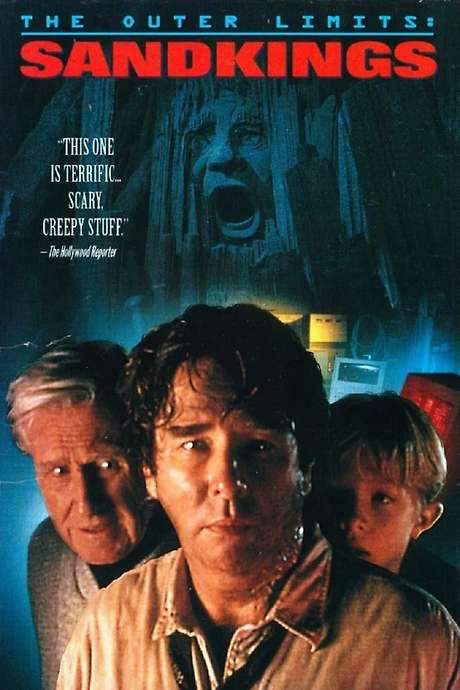



Where to Watch Sandkings
See current US streaming, rental, and purchase options for Sandkings (1995) via JustWatch.

Streaming availability powered by 
Sandkings Plot Summary
Read the complete plot summary and ending explained for Sandkings (1995). From turning points to emotional moments, uncover what really happened and why it matters.
Beau Bridges plays Dr. Simon Kress, a government researcher whose Martian life studies are abruptly halted when an escaped specimen nearly breaches the surface. Undeterred, he continues the work in a shielded barn, secretly stealing sand containing Martian eggs from the lab and rigging a makeshift incubator to hatch more of the enigmatic sandkings. What begins as a stubborn persistence quickly spirals into an obsession, pulling his attention away from home and toward the creatures he’s determined to understand.
This fixation drives a growing rift with his wife Cathy Kress, portrayed by Helen Shaver, as the couple’s once-stable life unravels under the weight of Kress’s secret experiments. The family dog, Cowboy, meets a tragic fate when the sandkings, stirred by their digging, encroach on the yard and claim him as their first victim outside the lab. The horror of that moment marks a turning point, a stark reminder of the boundary between scientist ambition and the safety of his own household.
Inside the terrarium, the sandkings split into two distinct factions: a white group and a red group, each claiming opposite sides of their glass enclosure. The opposition grows more than territorial; it becomes a showcase of evolving intelligence and ritual. The white group even constructs a sand sculpture that eerily resembles Kress’s own face, a chilling sign that the sandkings may be elevating his image to a godlike status in their microcosm. This unsettling development pushes Kress deeper into a god complex, blurring the line between scientific curiosity and deification.
When the red group fails to replicate the same grand gesture, Kress responds with brutal severity, smashing their structure. In a climactic moment, one red sandking breaks free and delivers a sting that proves the danger is far from abstract. The escalation peaks as Kress confronts his former supervisor, Dave Stockley, tossed into the enclosure where the sandkings eagerly consume him, a visceral consequence of the doctor’s unchecked drive. Kim Coates brings Stockley to life, a figure who embodies the uneasy alliance between oversight and obsession.
After the confrontation, Kress finds himself descending into the basement where the red sandkings have formed a nest around Stockley’s face, a haunting reminder of the consequences of playing god with alien life. In a final bid to erase the threat, he ruptures a gas line, unleashing an explosion meant to extinguish every sandking in the enclosure. The ending reveals a stubborn, surviving colony of sandkings persisting in the wilderness, suggesting that while one man’s empire may fall, the creatures he unleashed endure beyond the walls of his home.
Overall, the story follows a scientist’s relentless pursuit of discovery that spirals into hubris, sabotage, and tragedy, culminating in a stark, unsettling look at the consequences of unchecked scientific ambition and the eerie resilience of the creatures he sought to control. The focus on Kress’s deteriorating relationships and the claustrophobic tension of the sandkings’ evolving ecosystem grounds the narrative in a human scale, even as the otherworldly threat looms just beyond the glass enclosure.
Sandkings Timeline
Follow the complete movie timeline of Sandkings (1995) with every major event in chronological order. Great for understanding complex plots and story progression.
Project aborted after escape
The government's Martian life project is aborted after one specimen escapes the lab and almost reaches the surface. Dr. Simon Kress disapproves of abandoning the research and decides to continue the experiments in his barn. The decision triggers a rift between him and his colleagues.
Kress steals eggs and sets up a home incubator
Kress steals sand containing Martian eggs from the lab and transports it to his barn. He constructs a makeshift incubator to hatch more sandkings. This clandestine setup marks the beginning of his obsessive pursuit.
Relationship deteriorates under obsession
Kress’s growing fixation strains his marriage to Cathy, foreshadowing emotional rupture at home. Their relationship deteriorates as his experiments demand more of his time and attention. The home life deteriorates in parallel with the science project.
Cowboy the dog encounters danger
The sandkings begin digging and awaken the family dog Cowboy. After stepping into their territory, Cowboy is eaten by the sandkings, a brutal demonstration of their predatory reach. The event foreshadows the danger posed by the alien lifeforms.
Sandkings hatch and divide into two groups
The sandkings hatch and organize into two groups, a white group and a red group. They settle on opposite sides of the glass enclosure, signaling the beginnings of a social order. This division hints at future rivalry and strategy.
White group builds a face; godlike belief arises
The white group builds a sand structure that resembles Kress's face, a sign that seems to flatter his ego. He begins to believe he is a god to his sandkings, interpreting their work as worship. His sense of omnipotence deepens as the structure grows.
Red group structure is smashed; sting occurs
Kress smashes the sand structure built by the red group because they did not imitate him. In the aftermath, one red sandking escapes and delivers a sting to him. The encounter confirms the physical danger posed by the creatures.
Supervisor Stockley is tossed into the enclosure
Kress throws his former supervisor Dave Stockley into the enclosure, and the sandkings promptly devour him. The act demonstrates the escalating consequences of his interference and violence. The enclosure becomes a lethal arena for those who challenge the sandkings.
Red sandkings nest in basement with Stockley's face
In the basement, the red sandkings have created a nest that features the face of Stockley. The nest signals their growing intelligence and their association with a human threat. Kress realizes the creatures are evolving beyond his control.
Gas pipe explosion in an attempt to kill them all
He breaks a gas pipe to ignite an explosion in an attempt to kill all the sandkings. The blast is intended to erase the infestation, but the sandkings' numbers and adaptability suggest an incomplete victory. The scene underscores the futility of trying to annihilate them.
Sandkings survive the explosion
Even after the explosion, a colony of sandkings survives, continuing to thrive in the aftermath. The surviving group demonstrates resilience and a threat that transcends the immediate conflict. The episode hints at a haunting future for the human characters.
Ending shot: sandkings in the wilderness
The ending shows a colony of sandkings surviving in the wilderness, implying they have escaped containment. Their continued existence suggests a lasting, ominous legacy of Kress's experiment. The final image leaves the viewer with a sense of unease about what might come next.
Sandkings Characters
Explore all characters from Sandkings (1995). Get detailed profiles with their roles, arcs, and key relationships explained.
Dr. Simon Kress (Beau Bridges)
A brilliant but obsessive researcher who refuses to stop his experiments after the lab project is abandoned. He constructs a home-made incubator to hatch Martian sandkings, letting his ambition override caution and ethics. His god-like self-image drives him to confront both the creatures and the consequences of his actions.
Dave Stockley (Kim Coates)
Kress's former supervisor who becomes a casualty of the escalating dangerous experiment. He is drawn into the peril as the sandkings threaten the environment of the lab and the family. His death underscores the dangers of letting a project spiral beyond oversight.
Cathy Kress (Helen Shaver)
Kress's wife whose relationship with him deteriorates due to the obsession. She represents the personal cost of scientific fixation and the emotional fallout that accompanies dangerous experiments. Her perspective highlights the strain of balancing family with a partner's dangerous fixation.
Sandkings Settings
Learn where and when Sandkings (1995) takes place. Explore the film’s settings, era, and how they shape the narrative.
Location
Government research lab, Kress's barn, Glass-walled sandkings enclosure, Basement
The story unfolds across several settings: a government research lab where Martian life is studied, a secluded barn where Dr. Kress secretly continues experiments, and a glass-walled enclosure that divides the sandkings into two rival groups. The basement serves as a hidden staging area for the red sandkings' nest. The environments underscore the collision between science, obsession, and domestic life.
Sandkings Themes
Discover the main themes in Sandkings (1995). Analyze the deeper meanings, emotional layers, and social commentary behind the film.
🧪
Hubris
A scientist's fixation on an alien lifeform drives him to override safety and moral lines. He begins to see himself as a god to the creatures he studies. This obsession corrodes his relationship with Cathy and blinds him to the danger of his experiment. The escalation from curiosity to control ends with violence and unintended consequences.
⚖️
Science Ethics
The project bypasses oversight and safety protocols, reflecting the dangers of unregulated research. The sandkings' potential for harm is ignored in pursuit of data and power. The story questions who bears responsibility when scientific breakthroughs collide with human ethics. It suggests that scientific progress without accountability can unleash uncontrollable life.
🏚️
Domestic Fallout
Kress's obsession consumes his home life, driving a wedge between him and Cathy. The experiments intrude into the family space, turning the house into a site of danger and secrecy. The dog's death underscores the personal cost of obsession. The ending suggests a fractured family left in the wake of reckless ambition.
🌿
Survival & Power
Two factions of sandkings evolve into a brutal power dynamic inside the enclosure. They exploit the environment to create structures and nests, signaling intelligent collective behavior. Kress's attempts at domination backfire as the sandkings strike back, eroding his control. The final shot of a surviving colony hints at nature's persistence beyond human plans.

Coming soon on iOS and Android
The Plot Explained Mobile App
From blockbusters to hidden gems — dive into movie stories anytime, anywhere. Save your favorites, discover plots faster, and never miss a twist again.
Sign up to be the first to know when we launch. Your email stays private — always.
Explore the mobile appSandkings Spoiler-Free Summary
Discover the spoiler-free summary of Sandkings (1995). Get a concise overview without any spoilers.
In a dimly lit garage that doubles as a makeshift laboratory, a lone researcher delves into a discovery that could rewrite humanity’s understanding of life beyond Earth. The setting feels both intimate and unsettling, a cramped sanctuary where the ordinary world fades into the hum of equipment and the faint scent of Martian soil. The atmosphere is charged with a quiet, unsettling curiosity, as the faint glow of incubators casts long shadows on the walls, hinting at possibilities that are as thrilling as they are dangerous.
Simon Kress is a brilliant mind whose career has been marred by controversy, leaving him on the fringes of the scientific community. Stripped of official support, he clings to the remnants of his ambition, working late into the night with a singular focus that isolates him from the world he once navigated with confidence. His partnership with his wife, Cathy, adds a human counterpoint to his obsessive quest; their relationship is strained by the relentless pull of his experiments, creating a delicate balance between devotion and dread.
From the alien particles emerge delicate, insect‑like beings that pulse with an eerie intelligence. Their behavior hints at a complex social structure, and each subtle movement seems to reflect the hidden desires of their creator. The creatures’ otherworldly beauty is juxtaposed with an unsettling sense that they are more than mere specimens, prompting questions about control, creation, and the thin line between observation and domination.
As the garage becomes a microcosm of larger ethical and existential dilemmas, the story invites viewers to wonder what it truly means to play god in a world where the line between curiosity and obsession blurs. The tone remains tense yet thoughtful, promising a journey that explores the cost of scientific ambition against the backdrop of an unforgiving, alien mystery.
Movies with Similar Twists and Themes
Uncover films that echo the narrative beats, emotional arcs, or dramatic twists of the one you're exploring. These recommendations are handpicked based on story depth, thematic resonance, and spoiler-worthy moments — perfect for fans who crave more of the same intrigue.


Featured on this page

What's After the Movie?
Not sure whether to stay after the credits? Find out!
Check out our other apps:

SAT Sphere
Build confidence for the Digital SAT.

Mori Atlas
Discover wild places worth protecting.

Luntero
Search smarter for a home in Amsterdam.

Plot Explained
Unravel movie endings and hidden clues.

Pokechamp
Dive into Pokémon data and battle logic.

Driving Theory
Get ready for your European theory test.

Movie Dust
Plan your next cinema trip with ease.

Musemap
Find art and culture as you travel.

Selkobase
Compare credentials before committing.

Local Manual
Turn an unfamiliar country into practical next steps.

Lernavi
Compare school systems before your next move.

GymRoam
Find a workout stop wherever your plans take you.
Explore Our Movie Platform
New Movie Releases (2026)
Famous Movie Actors
Top Film Production Studios
Movie Plot Summaries & Endings
Major Movie Awards & Winners
Best Concert Films & Music Documentaries
Movie Collections and Curated Lists
© 2026 What's After the Movie. All rights reserved.
Privacy Policy