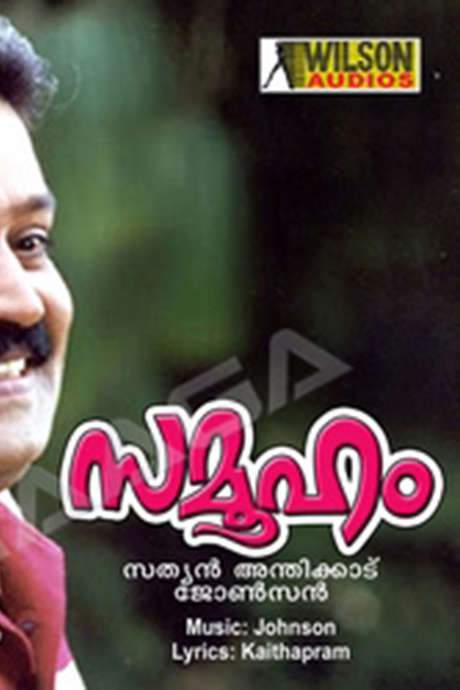
Samooham 1993

Directed by

Sathyan Anthikad
Made by

Century Films
Where to Watch Samooham
See current US streaming, rental, and purchase options for Samooham (1993) via JustWatch.

Streaming availability powered by 
Samooham Plot Summary
Read the complete plot summary and ending explained for Samooham (1993). From turning points to emotional moments, uncover what really happened and why it matters.
Sudhakaran runs his paddy field with steady efficiency, keeping the cultivation organized even when some workers seem reluctant or unskilled. He cares deeply about his land and the people who depend on it, and his practical leadership underpins much of the film’s social texture.
Rajalakshmi is the daughter of a Sakavu who is known for being a tireless party activist. A senior party member, portrayed by Balan Poduval, consistently nudges Rajalakshmi toward political ambition, shaping her path even as she wrestles with self-doubt. Their long-standing bond with Sudhakaran is rooted in a childhood friendship that turns into a complex romance as the political arena encroaches on private loyalties.
Rajalakshmi’s public speaking moments reveal a fragile, emotional side: when asked to address a crowd, she often cries, and at one turning point she bluntly tells the people not to vote for her. Yet this vulnerability paradoxically helps her win support and, against expectations, she becomes an MLA. The film uses this arc to explore the tension between personal authenticity and public perception in politics.
When a wave of violence strikes the vulnerable—goons burn down huts belonging to poor families—the community seeks help from Rajalakshmi. She travels to the burnt area and then to the police station, urging the authorities to arrest those responsible. The police resist, and a confrontation spills into the streets as Rajalakshmi leads a protest in front of the minister’s car. The clash with the police underscores the fraught relationship between activism and state power.
Johnny, the son whose father died in the earlier fire attack, has already filed a case against the criminals. The political pressure cooker intensifies when Krishnamurti, defeated in an election, orders the attack that results in Johnny’s murder. The next day’s rumor—Johnny’s suicide due to financial burdens—sparks further outrage, but Rajalakshmi refuses to accept the easy explanation and demands accountability.
Udayan, who witnesses the crime, steps forward to corroborate Rajalakshmi’s version of events. His testimony strengthens the call for a formal investigation, and the case begins to migrate toward a higher level of scrutiny with the involvement of the CBI. The atmosphere grows tense as the political stakes climb and the line between political adversaries and criminal conspirators becomes increasingly blurred.
The investigation exposes the reach of the criminals, and the nation’s top investigators close in. The case also reveals a brutal crime—the gang’s assault on Rajalakshmi’s sister, Radhika—a brutal act that galvanizes public opinion against Krishnamurti, the man blamed for the electoral defeat and the violence that followed. The arrest of the chief goon who killed Johnny and his confession further solidify the prosecution’s case.
In court, the evidence pieces together with the help of a newspaper article written by Pavithran, which presents compelling facts that corroborate the charges. The courtroom drama builds toward a decisive moment: Krishnamurti is finally ordered to face punishment, and he is taken away in handcuffs.
As Krishnamurti exits the courthouse, he forcibly dispatches his rage by firing at Pavithran in front of the crowd, a violent act that underscores the film’s theme of cycles of vengeance and accountability. A confrontational clash ensues between Krishnamurti’s goons and Sudhakaran’s group, including Majeed, ultimately ending in a hard-won victory for Sudhakaran and his allies.
In the aftermath, Sudhakaran confronts his own earlier judgments about Rajalakshmi. He apologizes for having mistaken her political drive as mere power hunger and, recognizing the genuine intent to serve the people, pledges his full support for her political career. The conclusion reaffirms a shared commitment to helping their community, balancing personal affection with public responsibility.
The film’s world is populated by a strong, grounded ensemble, including Balan Poduval in a pivotal guiding role, and Pavithran as a catalyst for crucial revelations. The story navigates themes of loyalty, integrity, and the complicated dance between ambition and service, all set against the texture of rural life and political upheaval. The ending leaves viewers with a nuanced portrait of partnership in the public sphere, where personal bonds are tested, redefined, and ultimately reinforced in the name of the greater good.
Samooham Timeline
Follow the complete movie timeline of Samooham (1993) with every major event in chronological order. Great for understanding complex plots and story progression.
Sudhakaran leaves the paddy field for Rajalakshmi's arrival
Sudhakaran manages the paddy field efficiently, keeping workers in line. He leaves the field to go home when he learns that Rajalakshmi has come, signaling a personal turning point. This moment blends domestic life with the larger political drama to come.
Childhood love between Sudhakaran and Rajalakshmi
Sudhakaran and Rajalakshmi have shared love since childhood, a relationship that grounds the story. Their bond persists despite the political pressures surrounding them. It sets the stage for Rajalakshmi's role in politics.
Rajalakshmi's lineage and political push
Rajalakshmi is the daughter of a Sakavu known for his party workaholism. Nedumudi, a party member, continually urges her to become a contestant for the party. The family background frames her political path.
Rajalakshmi's public-speech moment
When asked to speak in front of the public, Rajalakshmi cries and tells people never to vote for her. This vulnerable moment paradoxically wins sympathy from voters. It foreshadows her unusual rise in politics.
Rajalakshmi becomes MLA
Public sentiment shifts and Rajalakshmi is elected as MLA. Her victory marks a turning point for her career and for the party's image. The outcome surprises many traditionalists in the political setup.
Hut burnings and Rajalakshmi's field visit
Goons burn down huts belonging to the poor, triggering a plea for help from the community. Rajalakshmi visits the burnt area to assess the damage and show support. The incident intensifies the pressure on law enforcement.
Police refusal and ministerial protest
Rajalakshmi goes to the police station to demand arrests and action against the criminals. The police refuse to act, prompting her to protest in front of the minister's car. The protest is met with police intervention, highlighting corruption and inertia.
Johnny files a case
Johnny, whose father died in the fire attack, files a case against the criminals. The action raises the stakes for the entire political establishment. It sets the legal battle in motion.
Krishnamurti kills Johnny
Krishnamurti, behind the attack due to his election defeat, murders Johnny. The killing escalates the case and shocks the community. It marks a turning point toward a full-blown criminal investigation.
Misreport of Johnny's death; Udhayan's confession
News later suggests Johnny's death was due to a financial burden, casting doubt on the true cause. Rajalakshmi protests this mischaracterization as an injustice. Udhayan, who witnessed the murder, confesses to Rajalakshmi, strengthening the case against Krishnamurti.
CBI investigation is ordered
With growing evidence, the case attracts a higher level of scrutiny and a CBI investigation is ordered. The investigation gains momentum as more witnesses come forward. The political stakes rise as Krishnamurti's network tightens its grip.
Radhika's assault and confession of goon
Krishnamurti's goons rape Radhika, Rajalakshmi's sister, escalating the personal stakes in the case. The public outrage intensifies as the assault compounds the demand for justice. Meanwhile, the chief goon behind Johnny's murder is arrested and confesses, strengthening the case.
Court verdict strengthens the case
In court, the judge orders punishment for Krishnamurti; he is arrested and handcuffed. Evidence is reinforced by a newspaper article written by Pavithran, which provides full documentation. The verdict marks a clear turn toward accountability.
Pavithran shot; final confrontation begins
As Krishnamurti leaves the court, he grabs a gun and shoots Pavithran, who dies. This triggers a climactic confrontation between Krishnamurti's goons and Sudhakaran and Majeed. The fight ends with Krishnamurti's defeat.
Sudhakaran reconciles with Rajalakshmi's political path
Sudhakaran apologizes for misunderstanding Rajalakshmi's ambition as mere power hunger. He pledges full support for Rajalakshmi's political career to help the people. The couple commits to a future focused on public service.
Samooham Characters
Explore all characters from Samooham (1993). Get detailed profiles with their roles, arcs, and key relationships explained.
Sudhakaran (Suresh Gopi)
A diligent paddy-field farmer whose efficient work ethic masks a hopeful, protective nature for his community and Rajalakshmi. He admires Rajalakshmi from childhood but later learns to support her political path, realizing the stakes are about people as much as power. His practical mindset complements Rajalakshmi's idealism, and he ultimately stands with her in the fight for justice.
Rajalakshmi (Suhasini Maniratnam)
An ambitious, work-focused politician whose public speaking is fragile, yet she demonstrates courage by protesting for victims and demanding accountability. She wins the MLA seat despite emotional moments on stage, signaling a complex blend of compassion and political resolve. Her relationship with Sudhakaran evolves into mutual support for the people she serves.
Krishnamurti (Rajan P Dev)
A calculated antagonist behind the attacks and a symbol of corrupt, power-driven politics. His campaign defeats trigger ruthless tactics and violence carried out by his goons. He faces legal consequences as the truth emerges, but his willingness to commit brutality creates a lasting threat to the protagonists.
Pavithran / Ramachandran (Sreenivasan)
A journalist whose investigative reporting and newspaper articles provide crucial evidence in the case. He embodies the role of truth-teller within a system prone to suppression, and his work fuels the pursuit of justice, even as the story ends with renewed danger to him.
Radhika (Sunitha)
Rajalakshmi's sister who becomes a victim of violence, illustrating the personal cost of political strife. Her plight highlights the human consequences of public confrontation and the urgency of protecting families during upheaval.
Udayan (Vineeth Radhakrishnan)
A witness to critical violence who ultimately helps strengthen the pursuit of justice. His decision to come forward marks a turning point in the investigation, underscoring the importance of truth-telling in the face of intimidation.
Johnny (Sudheesh)
A young man whose father died in the attack and who files a case against the criminals. His decisions and fate propel the legal drama forward, illustrating the personal stakes behind political violence.
Majeed (Manoj K Jayan)
A steadfast ally to Sudhakaran who participates in the final showdown against Krishnamurti. His loyalty and willingness to stand up for justice reflect the film’s emphasis on solidarity in the fight for right.
Balan Poduval (Nedumudi Venu)
A guiding elder who inspires Rajalakshmi to enter politics, emphasizing the role of family support and mentorship in public service. His influence helps shape Rajalakshmi's political journey and her commitment to helping others.
Minister Narayanan Nair (C I Paul)
A government official whose presence in the political ecosystem underscores the nexus of power and law enforcement. He symbolizes the institutional context within which Rajalakshmi must navigate protests, investigations, and accountability.
Samooham Settings
Learn where and when Samooham (1993) takes place. Explore the film’s settings, era, and how they shape the narrative.
Location
Paddy fields in a rural village, Rajalakshmi's house, Burnt huts area, Police station, Courtroom
The story unfolds across a rural landscape centered on Sudhakaran's paddy fields and Rajalakshmi's home. It contrasts peaceful village life with scenes of destruction in the burnt huts, highlighting social injustice. Key locations like the police station and courtroom frame the political and legal battle that drives the plot.
Samooham Themes
Discover the main themes in Samooham (1993). Analyze the deeper meanings, emotional layers, and social commentary behind the film.
⚖️
Justice
The film centers on the pursuit of justice in the face of police inaction and political pressure. Rajalakshmi pushes for accountability, even when it means public protests. Evidence, including a decisive newspaper exposé, propels the CBI-tinged investigation forward. The court scene brings Krishnamurti to account, though the violence surrounding the case lingers.
🗳️
Politics
Political ambition and party dynamics drive much of the conflict, including Krishnamurti's retaliation after electoral defeat. The narrative reveals how power plays and intimidation can threaten democratic processes. It contrasts populist rhetoric with genuine public service and ends with a renewed commitment to political integrity.
🌾
Rural life
The rural setting of paddy fields anchors the characters' livelihoods and social bonds. Attacks on the poor huts reveal how violence intersects with political maneuvering. The relationships, especially between Sudhakaran and Rajalakshmi, are rooted in family and labor, underscoring how leadership impacts ordinary people.

Coming soon on iOS and Android
The Plot Explained Mobile App
From blockbusters to hidden gems — dive into movie stories anytime, anywhere. Save your favorites, discover plots faster, and never miss a twist again.
Sign up to be the first to know when we launch. Your email stays private — always.
Explore the mobile appSamooham Spoiler-Free Summary
Discover the spoiler-free summary of Samooham (1993). Get a concise overview without any spoilers.
In the verdant fields of a Kerala village, Sudhakaran tends his paddy with a quiet diligence that mirrors the steady rhythm of rural life. His world is rooted in the earth, his sense of responsibility extending beyond the furrows to the modest community that depends on the harvest. Across the same landscape, Rajalakshmi grows up under the banner of a tireless party activist, her upbringing steeped in political discourse and the promise of change. Their childhood friendship blossoms into a tender romance, set against the backdrop of modest homes, bustling marketplaces, and the slow hum of everyday labor.
As Rajalakshmi’s voice finds its way into public gatherings, the village awakens to a new kind of energy—one that blends earnest idealism with the fierce realities of local politics. Guided, at times reluctantly, by seasoned party mentors, she begins to navigate a sphere where personal conviction meets collective expectation. The atmosphere crackles with the tension between authenticity and performance, as villagers watch a familiar face step onto a stage that demands both sincerity and strategy. Meanwhile, Sudhakaran watches this transformation with a mixture of pride and unease, his own steady world subtly shifting under the weight of her rising influence.
The film rests on the delicate balance between love and duty, exploring how ambition can both illuminate and strain the bonds that have long defined a couple’s life. Through intimate dialogue and sweeping vistas of rice paddies and council meetings, the story invites viewers to wonder how far personal devotion can stretch when the public eye turns toward a once‑private partnership. It is a narrative that feels both grounded in the textures of everyday Kerala life and charged with the restless promise of political awakening, leaving the audience poised on the cusp of change without revealing the paths it will ultimately take.
Movies with Similar Twists and Themes
Uncover films that echo the narrative beats, emotional arcs, or dramatic twists of the one you're exploring. These recommendations are handpicked based on story depth, thematic resonance, and spoiler-worthy moments — perfect for fans who crave more of the same intrigue.




Featured on this page

What's After the Movie?
Not sure whether to stay after the credits? Find out!
Check out our other apps:

SAT Sphere
Build confidence for the Digital SAT.

Mori Atlas
Discover wild places worth protecting.

Luntero
Search smarter for a home in Amsterdam.

Plot Explained
Unravel movie endings and hidden clues.

Pokechamp
Dive into Pokémon data and battle logic.

Driving Theory
Get ready for your European theory test.

Movie Dust
Plan your next cinema trip with ease.

Musemap
Find art and culture as you travel.

Selkobase
Compare credentials before committing.

Local Manual
Turn an unfamiliar country into practical next steps.

Lernavi
Compare school systems before your next move.

GymRoam
Find a workout stop wherever your plans take you.
Explore Our Movie Platform
New Movie Releases (2026)
Famous Movie Actors
Top Film Production Studios
Movie Plot Summaries & Endings
Major Movie Awards & Winners
Best Concert Films & Music Documentaries
Movie Collections and Curated Lists
© 2026 What's After the Movie. All rights reserved.
Privacy Policy