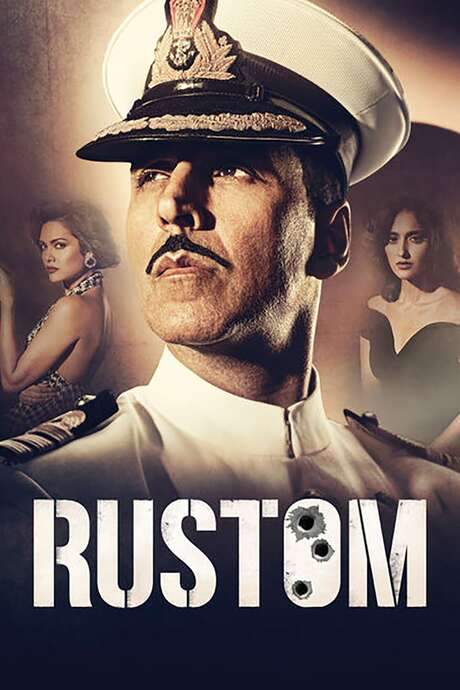
Rustom 2016

Directed by

Tinu Suresh Desai
Made by

KriArj Entertainment
Rustom Plot Summary
Read the complete plot summary and ending explained for Rustom (2016). From turning points to emotional moments, uncover what really happened and why it matters.
In 1959 Bombay, Rustom Pavri, a respected Indian Navy commander, enjoys a stable, close-knit life with Cynthia Pavri. It’s a relationship built on years of mutual trust, still feeling fresh twelve years after India’s hard-won independence from British rule. But that quiet happiness begins to fracture when a troubling truth surfaces: Cynthia has been entangled with Vikram Makhija, a man who tests the limits of their bond and trust. The moment of crisis arrives when [Rustom] discovers Vikram’s intimate letters hidden in Cynthia’s cupboard, and he witnesses the two of them together, an image that unsettles the foundation of his world.
Shaken, [Rustom Pavri] reaches for a pistol kept on the naval ship’s armory rack and makes a trunk call to K. M. Bakshi at the Defence Secretariat in New Delhi. He then sets off to locate Vikram, first to Vikram’s workplace at Imperial Motors and then to Vikram’s home, intent on understanding what has gone wrong. The sequence culminates in Vikram’s bedroom, where a servant hears three gunshots and enters to find Vikram dead and [Rustom] departing with the firearm in hand. In a decisive turn, [Rustom] surrenders to the Bombay police, and Senior Inspector Vincent Lobo begins the formal investigation.
The tragedy ripples through Vikram’s circle, and Vikram’s sister, Priti Makhija, seeks the toughest possible outcome for Rustom from the public prosecutor, Lakshman Khangani. Unwilling to be steered or aided by others, Rustom chooses to stand his ground and fights the case on his own, even requesting custody rather than accepting a passive defense. In the background, Rear Admiral Prashant Kamath—Rustom’s senior naval officer—tries to shield sensitive information, sending two men to the Pavri residence to recover crucial documents, though they fail to unearth anything.
Meanwhile, Cynthia confides in Rustom’s side of the story in jail, explaining the loneliness she felt while he was away in London for months. She reveals that Vikram exploited her vulnerability, and although she had attempted to end the affair, the pain lingered. With mounting agitation and the weight of the truth, Cynthia begins to coerce Kamath for money, attempting to extract ₹5 crore in exchange for the vital documents that could bolster Rustom’s case, an action that throws more shadows over everyone involved.
As the trial progresses, Rustom unexpectedly pleads not guilty in front of Judge Patel, and a 9-member jury is charged with delivering the verdict. The courtroom atmosphere is tense, and the proceedings hinge on the unseen threads of the trunk call and the political pressures surrounding the Navy’s integrity. In Bombay, the case deepens when Lobo is in New Delhi and meets Bakshi to obtain the recording of that trunk call, a piece of the puzzle that had not been disclosed during the hearing. The moral weight of the story grows heavier as the truth behind these recordings comes to light, challenging everyone to re-evaluate what they believe about loyalty, justice, and honor.
On the eve of judgment, [Rustom Pavri] reveals a deeper, long-buried truth: during a London posting in 1958, he inspected an aircraft carrier the Navy hoped to purchase. Vikram, who was lobbying for the carrier’s acquisition, and Kamath allegedly tried to bribe him to declare the carrier seaworthy. When [Rustom] attempted to warn Bakshi from abroad, Bakshi likewise attempted to influence him, and Vikram’s extortionate schemes unfolded through Cynthia. In a moment of righteous anger, Vikram’s manipulation backfired; Rustom made the only choice he could in defense of the Navy’s integrity. He then asserts that he never possessed documents proving the carrier’s damage, a confession that reframes the entire investigation.
The verdict finally comes: the jury declares Rustom not guilty, a moment that fills the courtroom with tears and relief as he and Cynthia step out into the light. Yet the case does not end there. In the background, Bakshi’s corruption surfaces in half-truths and half-recordings, and the pressure around Kamath intensifies, driving Bakshi to suicide to avoid further exposure. With the legal battle resolved but the moral questions lingering, Rustom and Cynthia embark on a quiet vacation, their spirits buoyed by vindication and a sense of restored dignity. The Navy receives a glimmer of hope as INS Vikrant begins to take shape anew, and Rustom learns of the future carrier’s robust condition—news that reinforces his long-awaited sense of justice, even as he reflects on the personal price paid along the way.
Rustom Timeline
Follow the complete movie timeline of Rustom (2016) with every major event in chronological order. Great for understanding complex plots and story progression.
Marriage in Bombay
Commander Rustom Pavri and Cynthia are a happily married couple in 1959, living in Bombay. Their life seems peaceful despite years after independence, but underlying tensions begin to surface as Rustom suspects trouble in their relationship.
Rustom discovers Cynthia's affair
Rustom returns from deployment and finds love letters from Vikram; he glimpses Vikram and Cynthia together. He confronts Cynthia, waiting for her to explain but walks away before she can respond.
Pistol and trunk call
Rustom retrieves a pistol from the naval armory and places a trunk call to Bakshi at the Defence Secretariat in New Delhi. The call sets the stage for pursuing Vikram and the accompanying cover-ups.
Search for Vikram
Rustom searches for Vikram at Imperial Motors and then at Vikram's home, following a trail that ends with Vikram's murder. The pursuit tightens as the motive behind Vikram's influence becomes clearer.
Vikram's murder and discovery
Vikram is found dead in his bedroom with three bullets; a servant rushes to the room after hearing gunshots and finds Vikram dead as Rustom walks away with the pistol. The incident triggers a formal investigation.
Surrender and investigation
Rustom surrenders to Bombay police; Senior Inspector Vincent Lobo starts the investigation into Vikram's murder. The case quickly attracts public attention and media scrutiny.
Prosecutor's pursuit and Rustom's stance
Vikram's sister Preeti seeks the toughest punishment; Rustom refuses any outside help and decides to fight the case on his own, preferring to remain in police custody. The defense lines are shaped around his sense of honor.
Goon search for documents
Rear Admiral Kamath sends two goons to Rustom's house to retrieve critical documents, but they fail to find anything. The missing documents become a recurring thread in the defense strategy.
Cynthia's jail visit and testimony
Cynthia visits Rustom in jail and explains how loneliness and Vikram's manipulation led to the affair; she had broken up with Vikram before the murder and was injured during a confrontation with him. Her testimony adds emotional complexity to the case.
Cynthia's blackmail for documents
On Rustom's instruction, Cynthia blackmails Kamath for ₹5 crore in exchange for vital documents needed for the case. This maneuver reveals the extent of corruption entwined with the naval inquiry.
Not guilty plea and jury trial
In court, Rustom pleads not guilty, triggering a 9-member jury trial to determine his fate. The courtroom becomes the central stage where personal honor, politics, and justice collide.
Trunk call recording and Delhi connection
Lobo travels to New Delhi to obtain the trunk call recording that could prove police corruption; Bakshi holds half a recording that hints at a wider cover-up. The missing pieces threaten to sway the jury's perception.
London posting and bribery confession
On the eve of judgement, Rustom reveals his London posting in 1958, where Vikram and Kamath tried to bribe him to testify about the carrier's seaworthiness. Vikram's seduction of Cynthia is tied to his motive for revenge.
Verdict and public turning point
The jury returns not guilty, and the judge's teary-eyed declaration marks a turning point in public perception of the case. The outcome reinforces the idea of personal integrity against corruption.
Aftermath and consequences
Bakshi commits suicide to avoid trial for corruption; Kamath's wrongdoing is exposed as the INS Vikrant carrier is procured by India. Rustom and Cynthia later celebrate a new calm on vacation, having faced a turbulent ordeal.
Rustom Characters
Explore all characters from Rustom (2016). Get detailed profiles with their roles, arcs, and key relationships explained.
Rustom Pavri (Akshay Kumar)
A decorated Indian Navy Commander wrestling with jealousy, honor, and a sense of duty. He is driven by a belief in just action, yet his choices place him in moral ambiguity as he seeks to protect his reputation and the Navy. His decision to shoot Vikram is presented as self-defense but subjects him to a grueling legal battle.
Cynthia Rustom Pavri (Ileana D'Cruz)
Rustom's wife, whose loneliness and affair with Vikram become the central emotional pressure point. She is portrayed as torn between loyalty to her husband and her own longing, ultimately seeking stability in marriage after the scandal.
Vikram Makhija (Arjan Bajwa)
Cynthia's lover whose charm and influence mask a deeper insecurity and desire for control. He manipulates relationships and uses money and status to influence others, ultimately meeting a violent end.
Priti Makhija (Esha Gupta)
Vikram's sister who seeks harsh punishment for Rustom, representing the legal and moral stakes of the case and how familial loyalties intersect with the pursuit of justice.
Rear Admiral Prashant Kamath (Parmeet Sethi)
Rustom's senior officer who seeks to protect his own interests through influence, highlighting the friction between military hierarchy and legal processes.
Defense Secretary K. M. Bakshi (Kanwaljit Singh)
A powerful political figure whose involvement reveals how politics can sway the pursuit of justice and the allure of corruption.
Public Prosecutor Lakshman Khangani (Sachin Khedekar)
The public prosecutor who wields legal strategy in the trial, balancing duty with public sentiment and personal risk.
Head Constable Tukaram (Brijendra Kala)
A police officer involved in the investigation, whose actions reflect the investigative process and its limitations.
Judge Patel (Anang Desai)
The judge presiding over the jury trial, whose demeanor and rulings shape the trial's flow and outcome.
Rustom Settings
Learn where and when Rustom (2016) takes place. Explore the film’s settings, era, and how they shape the narrative.
Time period
1959
The story unfolds in the late 1950s, in the wake of India’s independence. It portrays a naval officer’s personal crisis against a backdrop of post-colonial modernization and Cold War-era politics. Events span brief stints in 1958 London and 1959 Bombay as the case plays out.
Location
Bombay (Mumbai), London, New Delhi
Bombay serves as the primary setting in 1959, a bustling port city where naval life and post-independence society intersect. The tale also traverses London, where Rustom’s overseas assignment and the bribery plot unfold. Key scenes occur in New Delhi within the Defence Secretariat, highlighting political and bureaucratic maneuvering.
Rustom Themes
Discover the main themes in Rustom (2016). Analyze the deeper meanings, emotional layers, and social commentary behind the film.
⚖️
Justice
A courtroom drama drives the plot as Rustom insists on his innocence and fights a jury trial. The film explores whether justice is objective truth or a product of perception shaped by evidence and power. The tension between self-defense, duty, and public opinion questions the fairness of legal outcomes.
💔
Betrayal
Infidelity and broken trust fuel the conflict between spouses, revealing how personal vulnerabilities collide with social expectations. Cynthia's affair and Vikram's manipulation catalyze a cascade of events that test loyalty. The narrative foregrounds how reputations are affected by private choices.
🛡️
Duty
Rustom’s sense of naval duty clashes with personal emotions, pushing him to make extreme choices to protect the Navy's integrity. The film juxtaposes professional obligation with marital strain, showing how service can strain, but also justify, personal actions. The resolution emphasizes honor within the military code.
💰
Corruption
Powerful figures attempt to manipulate outcomes through bribery and cover-ups linked to naval procurement. The plot reveals how money and influence threaten institutional integrity. The revelation of tape recordings and corrupt schemes serves as a critique of high-level corruption.

Coming soon on iOS and Android
The Plot Explained Mobile App
From blockbusters to hidden gems — dive into movie stories anytime, anywhere. Save your favorites, discover plots faster, and never miss a twist again.
Sign up to be the first to know when we launch. Your email stays private — always.
Explore the mobile appRustom Spoiler-Free Summary
Discover the spoiler-free summary of Rustom (2016). Get a concise overview without any spoilers.
In the bustling streets of 1959 Bombay, a city still feeling the echoes of a newly won independence, the world of the Indian Navy stands as a symbol of discipline and pride. Against this backdrop, the film paints a richly textured portrait of post‑colonial India—its formal institutions, lingering colonial shadows, and the intimate homes where personal and national honor often collide. The tone balances restrained elegance with an undercurrent of tension, inviting the audience to feel both the grandeur of the era and the quiet pressures that shape its characters.
Rustom Pavri is a decorated naval commander whose reputation is built on duty, integrity, and an unshakable sense of responsibility. At home, he shares a seemingly steady life with his wife Cynthia, a woman whose warmth and devotion appear to complement his disciplined world. Their marriage, twelve years after independence, reflects the optimism of a generation striving to forge a future rooted in mutual trust and shared purpose.
The equilibrium is quietly disturbed when Rustom uncovers that Cynthia has grown close to Vikram Makhija, a charismatic and affluent businessman whose presence introduces a discordant note into their lives. This revelation unsettles the foundations of Rustom’s personal world, compelling him to confront questions of loyalty, honor, and the lengths one might go to protect both family and reputation. As the tension escalates, the narrative hints at a legal confrontation that will test Rustom’s steadfast principles against the complexities of love and betrayal.
The film weaves together the polished formality of naval life, the intimate dynamics of a marriage on the brink, and the looming presence of a courtroom where truth and duty intersect. Its style is both period‑driven and emotionally resonant, offering a compelling study of a man caught between the rigid expectations of his profession and the fragile realities of his personal sphere, all set against the vibrant, hopeful, yet uncertain backdrop of a newly independent nation.
Featured on this page

What's After the Movie?
Not sure whether to stay after the credits? Find out!
Check out our other apps:

SAT Sphere
Build confidence for the Digital SAT.

Mori Atlas
Discover wild places worth protecting.

Luntero
Search smarter for a home in Amsterdam.

Plot Explained
Unravel movie endings and hidden clues.

Pokechamp
Dive into Pokémon data and battle logic.

Driving Theory
Get ready for your European theory test.

Movie Dust
Plan your next cinema trip with ease.

Musemap
Find art and culture as you travel.

Selkobase
Compare credentials before committing.

Local Manual
Turn an unfamiliar country into practical next steps.

Lernavi
Compare school systems before your next move.

GymRoam
Find a workout stop wherever your plans take you.
Explore Our Movie Platform
New Movie Releases (2026)
Famous Movie Actors
Top Film Production Studios
Movie Plot Summaries & Endings
Major Movie Awards & Winners
Best Concert Films & Music Documentaries
Movie Collections and Curated Lists
© 2026 What's After the Movie. All rights reserved.
Privacy Policy