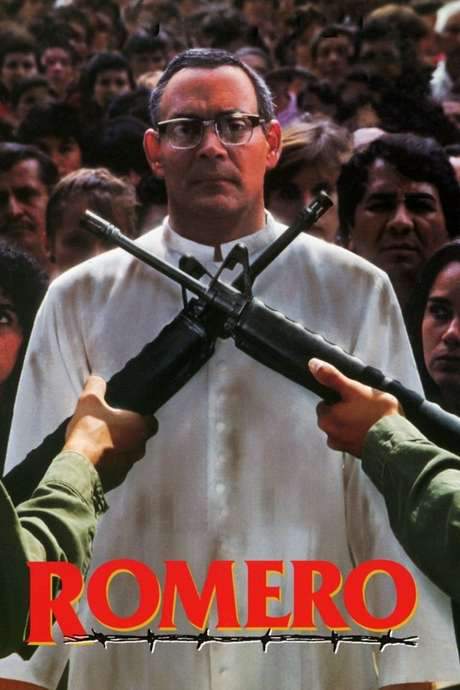
Romero 1989

Directed by

John Duigan
Made by

Paulist Productions
Where to Watch Romero
See current US streaming, rental, and purchase options for Romero (1989) via JustWatch.



Streaming availability powered by 
Romero Plot Summary
Read the complete plot summary and ending explained for Romero (1989). From turning points to emotional moments, uncover what really happened and why it matters.
Against the backdrop of El Salvador’s 1977 presidential election, the country is shown as a tinderbox of public unrest and fear of a fraudulent outcome. A brutal Marxist-Leninist guerrilla movement, led by the Farabundo Martí National Liberation Front, presses a insurgent campaign while an anti-communist military dictatorship answers with deadly force. Death squads abduct, torture, and disappear anyone who speaks out or dares to challenge the regime. Voters are blocked from reaching polling places; buses are halted, and when people decide to walk, soldiers open fire on the vans, leaving the return journey perilously cut off and the atmosphere saturated with dread.
In this volatile climate, the Vatican elevates Archbishop Oscar Romero to lead the archdiocese of San Salvador, hoping his spiritual guidance will steer the church away from political entanglements. Initially, Romero aims to steer a careful, pastoral course and keeps a relatively apolitical profile, even as the government’s hostility edges closer to the surface. The weight of oppression becomes something he can no longer ignore as he witnesses growing deceit and systemic murder that touch everyday life.
The turning point arrives with the shocking assassination of Father Rutilio Grande, a Jesuit priest who openly advocates for the poor and stands beside the vulnerable. This loss jolts Romero into a more public awareness and a moral awakening; it becomes clear to him that the violence is not abstract but personal, and it compels him to speak out against the regime’s abuses. The response from the state is swift and brutal, with death squads intensifying their focus on priests and other religious leaders who serve as voices for the oppressed.
Romero’s path becomes a test of courage as he navigates the pressures from both sides of the conflict. After a botched attempt to rescue a pro-government hostage held by guerrillas, he discovers that Father Osuna has been captured and tortured. Though he secures Osuna’s release, the ordeal hardens Romero’s resolve to stand with those who suffer most. He begins to mobilize broad opposition, including a boycott of the president-elect’s inauguration, and defies the regime by delivering Mass in a church that the military has occupied as a barracks, turning a place of worship into a bold symbol of resistance.
Even as Romero rejects the violent methods employed by the guerrillas, his stance remains a thorn in the side of the authorities. His efforts to broker dialogue and protect lives continue, yet his nonviolent approach cannot shield him from retaliation. He is eventually arrested in the process of pursuing possible negotiations for a prisoner’s fate, and tragically, Father Osuna is tortured to death in custody, despite Romero’s protests and appeals.
The arc of Romero’s life culminates in a brutal, almost sacramental moment: he is assassinated while saying Mass, specifically as he consecrates the Eucharist. The film closes with a stark epilogue that places Romero’s death within a longer history, noting that by 1992, when the Salvadoran Civil War concluded, the toll had risen to over 75,000 lives lost.
Throughout the film, the conflict is rendered with a calm, human focus, centering on the moral choices of clergy, the fear threaded through daily life, and the ways in which religious faith and peaceful advocacy confront the hard edges of political power. The story remains anchored in the personal losses, the moments of quiet defiance, and the enduring impact of Romero’s transformation from a cautious pastor to a figure who spoke truth to power, even at the ultimate cost.
Romero Timeline
Follow the complete movie timeline of Romero (1989) with every major event in chronological order. Great for understanding complex plots and story progression.
Elevation to Archbishop of San Salvador
The Vatican elevates Oscar Arnulfo Romero to Archbishop of San Salvador, hoping he remains apolitical. At first, Romero is cautious and wary of the government's hostility. He steps into his new role amid rising tensions and an atmosphere of fear.
Election-day unrest and state coercion
During the 1977 presidential election, public unrest peaks as fears of fraud spread. The military blocks a bus carrying voters to town, and when people walk to vote, soldiers attack the vans to prevent a return journey. The atmosphere is dangerous for ordinary citizens trying to participate in the vote.
Assassination of Father Rutilio Grande
The assassination of Father Rutilio Grande, a close ally of Romero and advocate for the poor, shocks the church and the country. The murder exposes the depths of state violence and deception. Romero's resolve strengthens as he begins to speak out against the regime's abuses.
Romero takes a public stand against the regime
Romero shifts from cautious leadership to outspoken advocacy, using sermons and public statements to denounce human rights abuses. He confronts the government's lies and the violence faced by ordinary people. The church becomes a platform for protest and moral witness.
Death squads target priests
In response to Romero's criticisms, the military regime orders death squads to target priests and church leaders. The archdiocese becomes a focal point of repression as attacks on clergy intensify. The church stands at the frontline of the conflict.
Botched ransom and Osuna's capture
A botched ransom attempt to rescue a pro-government hostage from guerrillas ends in failure. Following the failure, Romero learns that Father Osuna has been captured and subjected to torture. The personal cost of the conflict deepens Romero's resolve and fear for his friends.
Release of Osuna; boycott of inauguration
After securing Osuna's release, Romero leads a boycott of the president-elect's inauguration. He defies the regime by saying Mass in a church the military has occupied as a barracks, turning a sacred space into a political statement. The act heightens tensions between the church and the state.
Arrest during hostage negotiation
Romero attempts to secure the release of a soldier hostage together with Fr. Osuna, but is arrested in the process. The arrest marks a period of intensified repression and demonstrates the regime's intolerance for negotiation. The struggle between the church and the authorities escalates.
Fr. Osuna tortured to death
Despite Romero's protests, Fr. Osuna is tortured to death by security forces. Romero's pleas go unheard, underscoring the regime's brutal response to dissent. The death deepens Romero's moral resolve but also personal tragedy.
Romero is assassinated during Mass
Romero, who rejects the violent methods of the guerrillas, is assassinated while saying Mass and consecrating the Eucharist. The murder shocks the nation and the wider world, highlighting the brutal toll of El Salvador's civil conflict.
Closing text notes the war's toll by 1992
The film closes with a text update: by 1992, when the Salvadorian Civil War ended, the total number of Salvadorans killed had risen to over 75,000. The statistic frames Romero's legacy within the broader national tragedy. The narrative links his martyrdom to the decades-long conflict.
State oppression through disappearances
The regime uses abductions, torture and disappearances to silence anyone who speaks about human rights abuses. The church becomes a refuge for dissidents, and Romero's witness amplifies those voices. The climate of fear saturates daily life in El Salvador.
Romero Characters
Explore all characters from Romero (1989). Get detailed profiles with their roles, arcs, and key relationships explained.
Archbishop Oscar Romero (Raúl Juliá)
As San Salvador’s archbishop, he begins as a cautious, apolitical cleric but gradually embraces a prophetic role. His evolving stance against oppression places him in direct conflict with the regime, culminating in his assassination while celebrating Mass. The character embodies moral integrity and a willingness to risk personal safety for the vulnerable.
Father Rutilio Grande (Richard Jordan)
A close ally of Romero and a vocal advocate for the poor, Grande’s martyrdom acts as a catalyst for Romero’s shift toward public dissent. His commitment to social justice and fearless critique of inequality is depicted as a driving force behind the archbishop’s eventual stand.
Father Alfonzo Osuna (Alejandro Bracho)
Osuna is a militant critic of the regime who is captured and tortured. Romero’s effort to secure his release fails, and Osuna’s death underscores the brutality of the conflict. The character embodies the cost of dissent and the risks faced by outspoken clergy.
Romero Settings
Learn where and when Romero (1989) takes place. Explore the film’s settings, era, and how they shape the narrative.
Time period
Late 1970s
The events unfold around the 1977 presidential election and the ensuing civil strife. The regime deploys death squads and blocks voters, while guerrillas wage a harsh insurgency. The film also foreshadows the prolonged conflict that culminates in the Salvadoran Civil War, which lasts into the early 1990s.
Location
San Salvador, El Salvador
Set in San Salvador, the capital of El Salvador, the film depicts a country under a repressive, anti-communist dictatorship during the late 1970s. The city and surrounding regions are scenes of protests, militarized routes, and disappearances as the regime fights a growing guerrilla insurgency. The setting highlights a society under siege where faith institutions and civilians are increasingly targeted.
Romero Themes
Discover the main themes in Romero (1989). Analyze the deeper meanings, emotional layers, and social commentary behind the film.
🕊️
Moral Courage
Archbishop Romero begins to act on his conscience, moving from cautious silence to outspoken critique of the regime. His sermons and public statements reveal a rising willingness to place justice above political convenience. The theme centers on how personal faith can translate into public moral action amid danger.
⚔️
State Violence
The government’s death squads, disappearances, and political intimidation form the film’s grim backdrop. The narrative shows how state violence is used to suppress dissent and maintain power, often hitting innocent civilians and religious figures alike. It also frames violence as a mirror of the regime’s fear and fragility.
🪧
Nonviolent Resistance
Despite escalating danger, Romero advocates peaceful resistance such as Mass, boycotts, and moral suasion instead of retaliation. The film portrays the power and limits of nonviolent protest when the regime refuses to concede. This theme emphasizes dignity, solidarity, and civil courage in the face of oppression.
⛪
Religious Authority Under Pressure
The Vatican’s cautious stance contrasts with Romero’s exposed conscience and public advocacy. The church becomes a battleground for moral authority as faith leaders navigate political pressures, fear, and killers. The narrative examines how religious institutions can act as catalysts for justice or targets of the regime.

Coming soon on iOS and Android
The Plot Explained Mobile App
From blockbusters to hidden gems — dive into movie stories anytime, anywhere. Save your favorites, discover plots faster, and never miss a twist again.
Sign up to be the first to know when we launch. Your email stays private — always.
Explore the mobile appRomero Spoiler-Free Summary
Discover the spoiler-free summary of Romero (1989). Get a concise overview without any spoilers.
In the waning days of a fraught 1970s election, El Salvador teeters on the edge of chaos. Streets pulse with whispers of a looming conflict, and the air is heavy with the tension of a society caught between whispered hopes and an ever‑present threat of repression. The film paints the country with a hushed, almost reverent palette, allowing the oppressive atmosphere to settle like fog over bustling markets and solemn churches alike, inviting the audience to feel the weight of every uncertain footstep.
Against this backdrop rises Oscar Romero, a newly appointed archbishop whose early days are marked by a cautious devotion to pastoral care. Ordained in a tradition that usually keeps faith separate from politics, he initially seeks to shepherd his flock without stirring the volatile waters around him. Yet the everyday realities of poverty, fear, and the quiet pleas of the marginalized begin to echo louder than any liturgy, hinting at a deepening inner conflict between his sacred duties and the moral urgency of the moment.
The tone of the story is both intimate and expansive, blending the personal rituals of a clergyman with the broader, simmering unrest of a nation on the brink. As Romero navigates the delicate balance between spiritual leadership and the call to bear witness, the film cultivates a sense of quiet resistance, suggesting that truth itself may become his most potent weapon. The audience is left to wonder how a man of faith will reconcile his commitment to peace with the growing need to speak against injustice—all within a world where silence feels as dangerous as any outright confrontation.
Movies with Similar Twists and Themes
Uncover films that echo the narrative beats, emotional arcs, or dramatic twists of the one you're exploring. These recommendations are handpicked based on story depth, thematic resonance, and spoiler-worthy moments — perfect for fans who crave more of the same intrigue.


Featured on this page

What's After the Movie?
Not sure whether to stay after the credits? Find out!
Check out our other apps:

SAT Sphere
Build confidence for the Digital SAT.

Mori Atlas
Discover wild places worth protecting.

Luntero
Search smarter for a home in Amsterdam.

Plot Explained
Unravel movie endings and hidden clues.

Pokechamp
Dive into Pokémon data and battle logic.

Driving Theory
Get ready for your European theory test.

Movie Dust
Plan your next cinema trip with ease.

Musemap
Find art and culture as you travel.

Selkobase
Compare credentials before committing.

Local Manual
Turn an unfamiliar country into practical next steps.

Lernavi
Compare school systems before your next move.

GymRoam
Find a workout stop wherever your plans take you.
Explore Our Movie Platform
New Movie Releases (2026)
Famous Movie Actors
Top Film Production Studios
Movie Plot Summaries & Endings
Major Movie Awards & Winners
Best Concert Films & Music Documentaries
Movie Collections and Curated Lists
© 2026 What's After the Movie. All rights reserved.
Privacy Policy