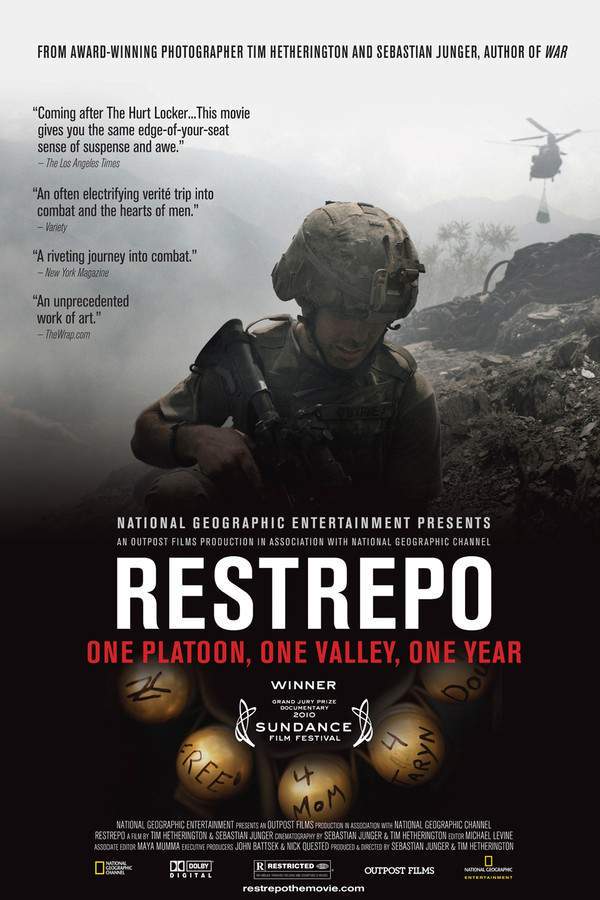
Restrepo 2010

Directed by

Sebastian Junger

Where to Watch Restrepo
See current US streaming, rental, and purchase options for Restrepo (2010) via JustWatch.

Streaming availability powered by 
Restrepo Plot Summary
Read the complete plot summary and ending explained for Restrepo (2010). From turning points to emotional moments, uncover what really happened and why it matters.
Restrepo chronicles the men of Second Platoon, Battle Company, as they spend a grueling 15-month deployment in the Korengal Valley of eastern Afghanistan. The film opens with raw footage of four soldiers filmed by PFC Juan Sebastián Restrepo, and a written note places their mission in May 2007, highlighting the Korengal as one of the U.S. military’s most dangerous postings. The landscape is rugged and unforgiving, with the Korengal flowing into the Pech and then toward the Kunar River Valley along Afghanistan’s porous border with Pakistan. American troops and supplies move into the remote Combat Outpost (COP) Korengal via Chinook helicopters, underscoring the logistical challenges of operating in such harsh terrain. The opening sequence also introduces an early firefight on a narrow mountain road when a military Hummer is disabled by an IED, foreshadowing the constant danger that will define the soldiers’ days.
The film then tracks the platoon from several months after their arrival to their eventual return home, focusing on the real-life experiences and routines that shape life in a high-stakes war zone. Early in the deployment, Pfc. Timothy R. Vimoto, only 19, is killed in action, and soon after the unit suffers the loss of PFC Restrepo, their medic, whose memory motivates the naming of an advanced outpost as OP Restrepo. At this outpost, the soldiers come under fire nearly every day, sometimes multiple times daily, as enemy positions shift across the surrounding terrain. The narrative emphasizes their daily commitment to security operations, including interrupting Taliban movement and safeguarding the construction of a road, all while attempting to win the trust of local leaders and civilians. The interactions with residents vary in tone, ranging from cordial exchanges to obvious antagonism, painting a nuanced picture of the complex relationships in the valley.
A substantial portion of the second half centers on Operation Rock Avalanche, conducted in October 2007, a dangerous mission aimed at rooting out Taliban fighters. During this operation, Staff Sergeant Larry Rougle is killed in an ambush that tests the unit’s resolve and leadership. Rougle, a Purple Heart recipient who served multiple tours in both Iraq and Afghanistan, is memorialized as his unit secures a position in the aftermath of the assault, with his sacrifice underscoring the high cost of the fight. The film does not merely present the action; it memorializes the personal cost of war and the way a unit depends on one another for survival.
Throughout Restrepo, the director frames the story around a central idea of brotherhood: the deep bond that forms among soldiers who share danger, responsibility, and trust. Intercut with on-the-ground footage are interviews conducted after Second Platoon returned to the 173rd Airborne Brigade Combat Team’s base near Vicenza, Italy, where the men candidly reflect on their experiences, acknowledge the wounds—both physical and emotional—and consider the lasting impact of what they endured, including memories of those who were wounded or killed. The film thus offers not only a record of specific battles and missions but also a meditation on friendship, duty, and the psychological weight of combat.
Before the credits, the film situates the broader historical context by noting that in April 2010 the United States withdrew from the Korengal Valley, and that nearly 50 American soldiers died fighting there. Restrepo is presented as a documentary that transcends a simple chronicle of events; it is a close, unflinching portrait of a unit under pressure, the strategies they pursue to achieve their objectives, the personal costs of their mission, and the enduring ties that bind them together long after they leave the valley.
Restrepo Timeline
Follow the complete movie timeline of Restrepo (2010) with every major event in chronological order. Great for understanding complex plots and story progression.
Deployment begins after opening footage
The film opens with footage of four inebriated soldiers shot by PFC Juan Restrepo, setting the tone of risk and camaraderie. In May 2007, Second Platoon, Battle Company begins a 15-month deployment to the Korengal Valley, one of the most dangerous postings in the U.S. military.
Infiltration into COP Korengal
American troops and supplies are ferried into COP Korengal by Chinook helicopters, marking their arrival at a hard-to-access outpost. The transport underscores the isolation and difficulty of the mission in the valley.
First firefight on a mountain road
The film's opening Afghanistan scenes depict a firefight after a Hummer is disabled by an IED on a narrow mountain road. The soldiers endure heavy enemy fire and navigate perilous terrain to press their defense.
Early casualty: Timothy Vimoto killed
Pfc. Timothy R. Vimoto, 19, is killed in action within months of arriving, illustrating the constant danger shaping the unit's experience. His loss compounds the emotional and operational strain on Second Platoon.
Death of Restrepo
PFC Restrepo, the unit's medic, is killed shortly after Vimoto, underscoring the human cost and the close bonds formed with him. His absence is felt throughout the rest of the deployment.
Decision to build OP Restrepo
Captain Dan Kearney initiates construction of an advanced outpost, which the troops name OP Restrepo in honor of Juan Restrepo. The outpost becomes the focal point of much of the battles and daily life.
Daily firefights at OP Restrepo
At OP Restrepo, the men endure near-daily firefights from shifting enemy positions across the surrounding terrain. The relentless exposure to combat defines their routine.
Goal: secure road and win locals' trust
A major objective becomes interrupting Taliban supply flow while securing a road project and earning the trust of the local populace. The soldiers interact with local leaders and civilians.
Negotiations with locals
The film portrays negotiations with local leaders—some cordial, others hostile—underscoring the complexity of connecting with a population in a war zone.
Operation Rock Avalanche begins
In October 2007, Operation Rock Avalanche targets Taliban fighters in the Korengal, marking a major offensive effort during the deployment.
Ambush and Rougle's death
Staff Sergeant Larry Rougle, at the point of the ambush, is killed, sacrificing himself to allow his soldiers to secure a position and continue the fight.
Rougle's burial
SSG Rougle, a Purple Heart recipient with prior deployments, is buried in Arlington National Cemetery as a mark of his service and sacrifice.
Interviews after redeployment
Interviews with some soldiers after returning to the 173rd Airborne Brigade base near Vicenza, Italy reveal candid reflections on combat, wounds, and the emotional distress they carry.
Return home and continuation of life
The film follows the men from months after their return to their homes, illustrating how the experience continues to shape their lives and friendships long after leaving Afghanistan.
Withdrawal and toll
Text at the end states that the United States withdrew from the Korengal Valley in April 2010, marking the end of the posting. It also notes that nearly 50 American soldiers died fighting there, highlighting the cost of the conflict.
Restrepo Characters
Explore all characters from Restrepo (2010). Get detailed profiles with their roles, arcs, and key relationships explained.
PFC Juan Sebastián Restrepo
Medically trained medic whose death inspires the naming of OP Restrepo and serves as a poignant symbol of the unit's bond and sacrifice. His presence looms over the outpost as a catalyst for camaraderie and memory.
PFC Timothy R. Vimoto
A 19-year-old soldier whose early death during the deployment underscores the scale of danger and the fragility of life in the Korengal. His loss marks a turning point for the unit and their resolve to persevere.
Captain Dan Kearney
Leader who decides to construct the advanced outpost OP Restrepo, guiding his men through harsh conditions and mounting threats. His decisions shape the daily rhythm of life at the outpost.
Staff Sergeant Larry Rougle
Senior non-commissioned officer who dies during Operation Rock Avalanche, a casualty that highlights the dangers of point-man roles and the high cost of bold actions. He is respected for his service and bravery.
Restrepo Settings
Learn where and when Restrepo (2010) takes place. Explore the film’s settings, era, and how they shape the narrative.
Time period
May 2007 – April 2010
The deployment spans about 15 months starting in May 2007 in one of the U.S. military's most dangerous postings. The narrative follows near-constant combat, including the decision to build OP Restrepo and daily engagements with Taliban forces. It covers the October 2007 Operation Rock Avalanche and the subsequent losses, including SSG Larry Rougle. The film ends with the unit returning to Vicenza, Italy, and the U.S. withdrawal from the Korengal Valley in April 2010.
Location
Korengal Valley, COP Korengal, Kunar River Valley, eastern Afghanistan
Set in the Korengal Valley of eastern Afghanistan, the film centers on a remote Combat Outpost (COP Korengal). The valley's rugged terrain and its proximity to the Pakistan border make it a focal point of combat operations and logistical challenges. Soldiers describe daily firefights and IED threats, which shape life at the outpost and the unit's relationship with the local population.
Restrepo Themes
Discover the main themes in Restrepo (2010). Analyze the deeper meanings, emotional layers, and social commentary behind the film.
🤝
Brotherhood
The film centers on the bonds among Second Platoon, Battle Company, and the soldiers who rely on each other for survival. It highlights how shared danger deepens trust, loyalty, and a sense of family that persists beyond the battlefield. The naming of OP Restrepo anchors this brotherhood in memory and respect for a fallen comrade. Interwoven interviews emphasize the emotional cost of living and fighting together.
⚔️
War and Duty
The narrative presents the dual pulls of mission and humanity: securing roads, protecting civilians, and resisting constant Taliban pressure. The soldiers face daily threats—from IEDs to ambushes—that test discipline and resolve. Decisions about risk, strategy, and keeping teammates safe illustrate the complexity of modern combat. The film portrays how duty evolves into a shared, relentless routine.
🕯️
Sacrifice
Casualties such as PFC Timothy R. Vimoto, PFC Juan Sebastián Restrepo, and SSG Larry Rougle underscore the human cost of prolonged deployments. Operation Rock Avalanche becomes a focal point for loss, heroism, and the harsh realities of battlefield medic duties. The soldiers confront grief, honor fallen comrades, and reflect on what their sacrifices mean back home. The narrative also honors the memory of those buried and the impact on survivors.

Coming soon on iOS and Android
The Plot Explained Mobile App
From blockbusters to hidden gems — dive into movie stories anytime, anywhere. Save your favorites, discover plots faster, and never miss a twist again.
Sign up to be the first to know when we launch. Your email stays private — always.
Explore the mobile appRestrepo Spoiler-Free Summary
Discover the spoiler-free summary of Restrepo (2010). Get a concise overview without any spoilers.
In the crag‑filled Korengal Valley of eastern Afghanistan, a tiny U.S. combat outpost clings to a mountainside that seems as unforgiving as the conflict around it. The outpost carries the name of PFC Juan Sebastián Restrepo, a medic whose early footage captured the stark reality of life there, and it stands as a solitary foothold in a landscape where every ridge and river whispers danger. The environment is relentless—steep cliffs, narrow roads, and the ever‑present possibility of sudden violence—setting a backdrop that feels both isolated and deeply alive.
Within this isolated world, a close‑knit platoon of young soldiers forms the film’s emotional core. Their days blur between routine patrols, the maintenance of a fragile foothold, and the quiet moments that reveal the bonds forged under pressure. The camaraderie among them feels instinctive, a brotherhood that grows not from shared stories but from the unspoken trust required to survive each passing hour. Their interactions, whether with one another or the few locals they encounter, hint at a complex tapestry of duty, uncertainty, and an unspoken hope for connection amid the chaos.
The documentary’s style is unmistakably immersive, using handheld cameras that put the viewer directly into the mud‑splattered boots and echoing gunfire. Intercut interviews recorded after the platoon’s return to a peaceful base in Italy add a reflective layer, allowing the soldiers to speak candidly about what the valley demanded of them—physically, mentally, and emotionally. This juxtaposition of raw on‑the‑ground footage with sober, post‑deployment testimony creates a visceral portrait that feels less like a conventional war narrative and more like an unfiltered window into an extraordinary reality.
Through its unvarnished visual language and the quiet testimony of its subjects, the film invites the audience to sense the relentless tension of the valley while feeling the lingering, invisible threads that bind these men together long after the dust settles.
Movies with Similar Twists and Themes
Uncover films that echo the narrative beats, emotional arcs, or dramatic twists of the one you're exploring. These recommendations are handpicked based on story depth, thematic resonance, and spoiler-worthy moments — perfect for fans who crave more of the same intrigue.
Featured on this page

What's After the Movie?
Not sure whether to stay after the credits? Find out!
Check out our other apps:

SAT Sphere
Build confidence for the Digital SAT.

Mori Atlas
Discover wild places worth protecting.

Luntero
Search smarter for a home in Amsterdam.

Plot Explained
Unravel movie endings and hidden clues.

Pokechamp
Dive into Pokémon data and battle logic.

Driving Theory
Get ready for your European theory test.

Movie Dust
Plan your next cinema trip with ease.

Musemap
Find art and culture as you travel.

Selkobase
Compare credentials before committing.

Local Manual
Turn an unfamiliar country into practical next steps.

Lernavi
Compare school systems before your next move.

GymRoam
Find a workout stop wherever your plans take you.
Explore Our Movie Platform
New Movie Releases (2026)
Famous Movie Actors
Top Film Production Studios
Movie Plot Summaries & Endings
Major Movie Awards & Winners
Best Concert Films & Music Documentaries
Movie Collections and Curated Lists
© 2026 What's After the Movie. All rights reserved.
Privacy Policy