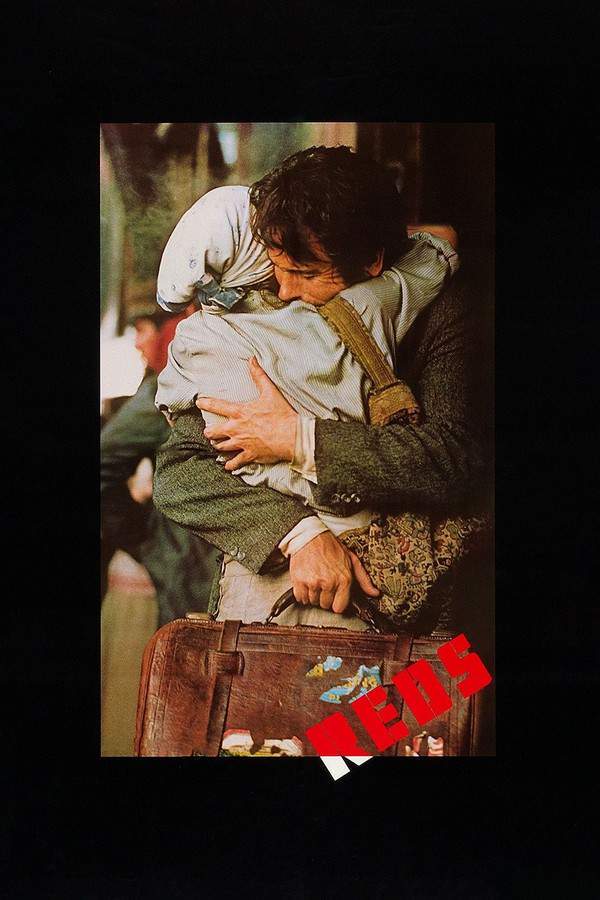
Reds 1981


Made by

Paramount Pictures
Where to Watch Reds
See current US streaming, rental, and purchase options for Reds (1981) via JustWatch.

fuboTV
HD
MGM Plus
HD
MGM Plus Roku Premium Channel
HD
MGM+ Amazon Channel
4K
Philo
HD
Amazon Video
4K
Apple TV Store
4K
Fandango At Home
4K
Google Play Movies
SD
Spectrum On Demand
HD
YouTube
SD Streaming availability powered by 
Reds Plot Summary
Read the complete plot summary and ending explained for Reds (1981). From turning points to emotional moments, uncover what really happened and why it matters.
In 1915, Louise Bryant, a married journalist and suffragist, meets the radical journalist John Reed at a lecture in Portland, Oregon, and is drawn to his ardent idealism. What begins as a chance encounter becomes a deep dive into international politics, as a night-long interview helps Bryant see that writing has been her true escape from a life she finds frustratING.
Driven by a new sense of purpose, she is inspired to leave her husband and joins Reed in Greenwich Village. There she is drawn into a vivid circle of activists and artists, where bold voices echo through crowded rooms and smoky theaters, and she begins to define herself as a feminist and radical in her own right. As Reed throws himself into labor struggles with the Reds of the Industrial Workers of the World, his hunger to change the world grows ever more intense, pulling him toward larger stages and farther horizons.
The couple moves to Provincetown, Massachusetts, to focus on their writing and to immerse themselves in the local theater scene. Bryant’s work and perspective begin to reshape her identity, while Reed’s restless energy fuels a shared ambition to chronicle and influence the social upheavals around them. Their collaboration is charged with intellectual camaraderie and personal risk, and the bond between them deepens even as their ambitions pull in different directions.
Reed’s radical fervor leads him into high-stakes international engagement, and Bryant finds herself navigating a life that is increasingly divided between shared purpose and personal longing. During Reed’s absence in the Midwest covering a pivotal convention, Bryant enters a complicated affair with the playwright Eugene O’Neill. When Reed returns, he learns of the liaison but still loves Bryant, and the pair marry in secret, establishing a home in Croton-on-Hudson while their visions for life and politics continue to diverge.
As Reed confronts his own infidelities, Bryant decides to work abroad, traveling to Europe as a war correspondent. A kidney disorder complicates Reed’s health, leading to the removal of one kidney, yet he is warned to limit travel and stress—caution he ultimately sets aside to pursue the next front in their shared journey. Together again, they reconnect through their work as they travel to Russia, where they become swept up in the collapse of the czarist regime and the upheavals of the 1917 Revolution.
Back in the United States, Reed writes the influential Ten Days That Shook the World while Bryant is summoned to testify before the Overman Committee, a moment that crystallizes the political stakes surrounding their lives. Reed’s political trajectory accelerates as he aligns with the Left Wing of the Socialist Party, and the couple watches as the party’s leadership is reshaped by factional clashes. The Left Wing’s presence is strong, but the old guard refuses to concede control, expelling the entire left faction and pushing Reed toward new and divergent paths, ultimately leading him to form the Communist Labor Party of America.
With a fierce conviction to help steer America toward a Communist future, Reed plans a return to Russia to seek formal recognition from the Soviet Comintern. Bryant, anxious to preserve their relationship, cautions him about the costs of such a path, but Reed proceeds, promising to return by Christmas. When travel to Russia becomes illegal, Reed makes his way by sneaking into Finland, where his disillusionment with Bolshevik authoritarianism deepens. His attempts to leave are thwarted when he is imprisoned after crossing the border, and Bryant, seeking any possible aid, asks the U.S. government for help—only to be met with rejection because Reed has been indicted for sedition in his absence.
Left with few options, Bryant travels illegally to Finland herself, hoping to secure his release, only to discover that Reed has already been moved back to Russia as part of a prisoner exchange. They continue their lives apart until Reed is stationed in Petrograd as a propagandist for the Comintern, sharing a rented apartment with Emma Goldman, who had been deported from the United States. Reed repeatedly attempts to reach Bryant through telegrams sent to New York, but he finds himself increasingly frustrated by the silence.
Louise, determined to reunite with him, eventually makes her way to Petrograd. Emma Goldman meets her there and explains that Reed has been sent to deliver a speech in Baku, leaving Bryant to wonder when they will finally reconnect. A dramatic turn comes when a White Army raid interrupts Reed’s train en route back to Petrograd. He survives the attack and is finally reunited with Bryant at the train station, a moment tempered by the harsh realities of their world.
Soon afterward, Reed falls ill with typhus and is hospitalized. Bryant stays by his side, and in the quiet of his last days they share intimate, loving words. When Bryant leaves to fetch water, she returns to find him dead, his hand resting in hers as she sits with him at his bedside, the closing image of a life spent chasing a revolutionary dream and a personal longing that could not be fully reconciled.
Reds Timeline
Follow the complete movie timeline of Reds (1981) with every major event in chronological order. Great for understanding complex plots and story progression.
Portland introduction: Bryant meets Reed
In Portland, Oregon, Louise Bryant, a married journalist and suffragist, attends a lecture by radical journalist John Reed and is captivated by his idealism. They strike up an intense connection when he agrees to an interview that lasts all night. The encounter plants the seed for Bryant's future as a political writer and activist.
All-night interview reveals her calling
The all-night interview deepens Bryant's sense that writing is her escape and purpose. She comes away convinced that Reed's world of radical ideas is worth pursuing. This moment begins her transformation from domestic life toward political journalism.
Move to Greenwich Village; meeting Goldman and O'Neill
Bryant moves to Greenwich Village to join Reed and becomes acquainted with a vibrant community of activists and artists. She meets Emma Goldman and Eugene O'Neill, expanding her feminist and radical circles. The cultural energy of the Village reshapes her ambitions.
Provincetown years: writing and theater
The couple relocates to Provincetown to focus on writing and immerse themselves in the local theater scene. Bryant gains recognition as a feminist and radical writer, while Reed dives into labor activism with the IWW Reds. The seaside town becomes a creative and political hub for them.
Reed heads to St. Louis for the 1916 Democratic National Convention
Reed travels to St. Louis to cover the 1916 Democratic National Convention, expanding his footprint as a radical journalist. Bryant remains in Provincetown, where she continues to write and grow as a political voice. The trip widens their professional and ideological horizons.
Affair and secret marriage: O'Neill and Croton-on-Hudson
During Reed's absence, Bryant begins an affair with Eugene O'Neill. When Reed returns and learns of it, he confronts his lingering feelings for her. They marry in secret and set up a home in Croton-on-Hudson, trying to balance passion with political commitment.
Bryant sails to Europe; Reed travels there too
Reed confesses his infidelities, and Bryant sails for Europe to work as a war correspondent. Reed travels there as well, and the two are soon reunited in a shared pursuit of reporting. Their renewed collaboration deepens their personal and political bond.
Reunited in Europe; travel to Russia amid 1917 revolution
Together they travel to Russia, swept up in the fall of the czar and the events of the 1917 Revolution. The experience imprints a radical inflection on both their careers and their relationship. The couple's work becomes inseparable from the upheaval around them.
Return to the United States; Ten Days That Shook the World
Returning to the United States, Reed writes Ten Days That Shook the World. Louise is called to testify before the Overman Committee, signaling a new era of political scrutiny in America. Their lives become a blend of literary achievement and public controversy.
Left Wing rise and party realignments
Reed joins the Socialist Party of America's Left Wing and is elected to a majority of its National Executive Committee seats. The Left Wing is soon blocked and expelled, and the party fractures into rival groups. Reed forms the Communist Labor Party of America, declaring a more militant path.
Plans to return to Russia; Christmas promise
Wanting official recognition from the Soviet Comintern, Reed plans a return to Russia despite Bryant's warning that it could end their relationship. He departs with a Christmas deadline looming, signaling both ambition and personal risk. The couple's fates become increasingly intertwined with international politics.
Illicit border crossing into Finland; imprisonment
Travel to Russia becomes illegal, forcing Reed to enter Finland and sneak across the border. He becomes disillusioned with Bolshevik rule and attempts to leave, but is imprisoned in Finland after trying to cross back. Louise seeks help from the U.S. government, but the government refuses due to his sedition charges.
Louise goes to Finland; prisoner exchange brings Reed back to Russia
Louise travels illegally to Finland to be with Reed, but by the time she arrives, he has been moved back to Russia as part of a prisoner exchange. She continues to pursue his welfare as their fates spiral through the geopolitics of the era.
Petrograd years: Comintern and reunion attempts
In Petrograd, Reed works as a propagandist for the Comintern and shares an apartment with Emma Goldman, who was deported to the Soviet Union. Unaware of Louise's journey, Reed repeatedly sends telegrams to New York, growing frustrated by the silence. Louise eventually travels to Petrograd to reunite with him.
Tragic death: final days with Reed
Emma Goldman explains where Reed has gone to deliver a speech in Baku. On the way back, White Army forces attack Reed's train; he survives but falls ill with typhus. Louise stays by his side as he dies in his hospital bed, a poignant end to their turbulent partnership.
Reds Characters
Explore all characters from Reds (1981). Get detailed profiles with their roles, arcs, and key relationships explained.
Louise Bryant (Diane Keaton)
A journalist and suffragist who grows from a dissatisfied wife into a formidable feminist writer. Her tenacity and evolving independence shape the narrative as she supports and challenges Reed, travels to war zones, and becomes a public voice for radical ideas.
John Reed (Warren Beatty)
A radical journalist driven by a relentless belief in changing the world. His political ambitions pull him toward labor activism and revolutionary movements, while his personal relationships test his loyalty and idealism.
Emma Goldman
An anarchist thinker and writer living among the radicals; her deportation and exile intersect with Bryant and Reed’s life, placing them in a global web of dissent.
Eugene O'Neill
Playwright entangled with Bryant during Reed’s absence, adding a personal layer to the era's artistic and political ferment.
Reds Settings
Learn where and when Reds (1981) takes place. Explore the film’s settings, era, and how they shape the narrative.
Time period
1915-1918
The narrative unfolds during World War I and the years surrounding the Russian Revolution. It follows Bryant and Reed from 1915 Portland to 1918 Petrograd and beyond, touching on political rallies, strikes, and the birth of radical movements.
Location
Portland, Oregon, Greenwich Village, New York City, Provincetown, Massachusetts, Croton-on-Hudson, New York, Petrograd, Russia, Finland
Portland hosts the initial lecture that sparks Bryant's awakening. Greenwich Village is depicted as a hotbed of activists, writers, and radical circles. Provincetown serves as a writing and theatre retreat, while Croton-on-Hudson becomes the couple's quiet home. The journey traverses Europe and Russia amid the era's upheavals.
Reds Themes
Discover the main themes in Reds (1981). Analyze the deeper meanings, emotional layers, and social commentary behind the film.
❤️
Love
The romance between Bryant and Reed drives much of the plot but is tested by the pull of competing political commitments. Bryant's emergence as a feminist writer grows alongside her relationship with Reed. The film examines how personal happiness clashes with public conviction.
🗺️
Revolution
Reed's immersion in the Reds, the Left Wing, and eventual forays into the Comintern expose the costs of ideological pursuit. The story follows his disillusionment with authoritarian turns in revolutionary ideals. It highlights the tension between revolutionary zeal and individual conscience.
📰
Journalism
Louise's development as a journalist and outspoken feminist frames the narrative beyond romance. Her reporting fuels the couple's public personas and invites scrutiny from political bodies. The film ties words on the page to real-world political change.
🎭
Theatre
Theatrical circles in Greenwich Village and Provincetown provide a stage for ideas and personal entanglements. The art world serves as a training ground for radical discourse and creative collaboration. The interplay between stagecraft and politics underscores the film's cultural context.

Coming soon on iOS and Android
The Plot Explained Mobile App
From blockbusters to hidden gems — dive into movie stories anytime, anywhere. Save your favorites, discover plots faster, and never miss a twist again.
Sign up to be the first to know when we launch. Your email stays private — always.
Explore the mobile appReds Spoiler-Free Summary
Discover the spoiler-free summary of Reds (1981). Get a concise overview without any spoilers.
In the fever‑driven months of 1917, an eager American journalist named John Reed finds himself drawn to the tumult of a nation on the brink of radical change. His restless ambition leads him across the Atlantic to a Russia where the old order is crumbling and the promise of a new society hangs in the air. The film unfolds within a world of crowded rallies, smoky cafés, and stark winter streets, each scene pulsing with the urgency of ideas that could reshape history. Its tone blends the sweeping grandeur of a historic epic with the intimate immediacy of a personal diary, inviting the audience to feel both the collective roar of revolution and the quiet heartbeat of those who bear witness.
Amid the chaos, Reed meets Louise Bryant, a sharp‑tongued suffragist and fellow reporter whose own longing for purpose propels her beyond the constraints of her previous life. Their connection is forged in shared ideals and fierce curiosity, as they navigate the vibrant circles of activists, artists, and labor organizers who populate the revolutionary landscape. Together they embark on a partnership that is at once intellectual and emotional, each spurring the other toward deeper commitment while wrestling with the personal sacrifices such a path demands.
The story is less about battles and more about the collision of conviction and romance, set against a backdrop of political upheaval that tests the limits of hope. As Reed and Bryant immerse themselves in the unfolding events, the film captures the intoxicating blend of idealism, danger, and yearning that defines a generation striving to rewrite the world. Their journey offers a window into a pivotal moment in history, explored through the eyes of two passionate observers whose love for each other and for a cause larger than themselves fuels the narrative’s relentless, yet tender, momentum.
Movies with Similar Twists and Themes
Uncover films that echo the narrative beats, emotional arcs, or dramatic twists of the one you're exploring. These recommendations are handpicked based on story depth, thematic resonance, and spoiler-worthy moments — perfect for fans who crave more of the same intrigue.


-GXe6qXgIQpk7Pg.jpg)

Featured on this page

What's After the Movie?
Not sure whether to stay after the credits? Find out!
Check out our other apps:

SAT Sphere
Build confidence for the Digital SAT.

Mori Atlas
Discover wild places worth protecting.

Luntero
Search smarter for a home in Amsterdam.

Plot Explained
Unravel movie endings and hidden clues.

Pokechamp
Dive into Pokémon data and battle logic.

Driving Theory
Get ready for your European theory test.

Movie Dust
Plan your next cinema trip with ease.

Musemap
Find art and culture as you travel.

Selkobase
Compare credentials before committing.

Local Manual
Turn an unfamiliar country into practical next steps.

Lernavi
Compare school systems before your next move.

GymRoam
Find a workout stop wherever your plans take you.
Explore Our Movie Platform
New Movie Releases (2026)
Famous Movie Actors
Top Film Production Studios
Movie Plot Summaries & Endings
Major Movie Awards & Winners
Best Concert Films & Music Documentaries
Movie Collections and Curated Lists
© 2026 What's After the Movie. All rights reserved.
Privacy Policy