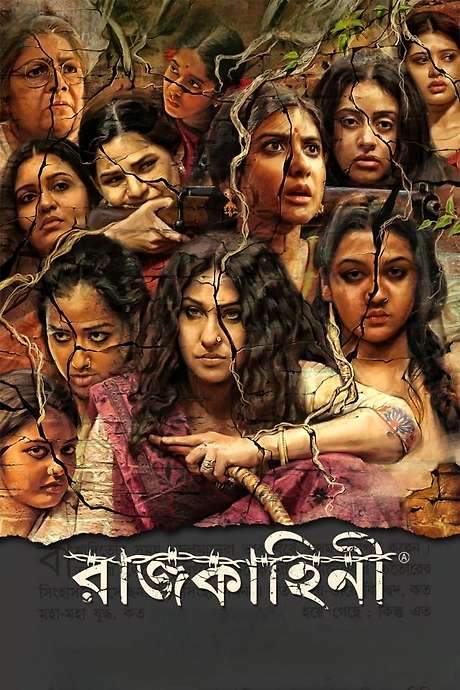

Rajkahini Plot Summary
Read the complete plot summary and ending explained for Rajkahini (2015). From turning points to emotional moments, uncover what really happened and why it matters.
In June 1947, as the British loom over the end of imperial rule and a turbulent partition reshapes a divided Bengal, the film Rajkahini narrows its lens to a stark, lived-in border that cuts through a single brothel. The place houses eleven women and two men, a world unto itself where survival, loyalty, and a fierce sense of belonging collide with politics, violence, and shifting borders. The backdrop is the Radcliffe Line, drawn to separate India and East Pakistan, a line that snakes between Debiganj and Haldibari and touches the lives of everyone who calls this corner of Bengal home.
At the center stands Begum Jaan, Begum Jaan, the brothel’s fearless boss who keeps her house together with grit and a stubborn code of care for her women. By her side is Saleem Mirza, Saleem Mirza, a loyal Pathan bodyguard, and Sujan, Sujan, their capable man-servant and entertainer. The trio’s routine is upended as the political mood darkens and the boundary slices straight through their world, turning a sanctuary into a crossroads of danger and demand.
Across the political spectrum, two men from rival camps step into Begum Jaan’s life. A Congress man and a former friend from childhood, Prophullo Mohan Sen, Prophullo Mohan Sen, and a Muslim League representative, Ilias, travel to Debiganj with a hard proposal: evacuate the brothel and relocate its residents before the line is finalized. Begum Jaan refuses to abandon her whores or cede the space they’ve carved out for themselves, turning the meeting into a stubborn stand for autonomy.
The political chessboard grows more complex when news arrives from Delhi about the Princely States, the Nawab of Rangpur, Nawaab, and his retinue. He is moving westward to what will soon be Indian soil, his status and titles slipping away as the new order takes shape. His visit underscores the broader reality: not only is a border being drawn, but the old hierarchy is undergoing a radical, irreversible transformation. Begum Jaan taps into this mood, deciding to fight on her own terms rather than fold under pressure.
Frustration drives desperate choices. When the pair of men turn to Kabir, Kabir, the head of a criminal gang, Begum Jaan’s world is further destabilized. Kabir and his crew unleash cruelty in the name of upheaval, chasing Sujan and others through the streets and markets until Sujan sacrifices himself to shield the others. The violence reverberates through the brothel and beyond, tightening Begum Jaan’s resolve.
Inside the brothel, Master, Master, schemes to settle a personal score with Begum Jaan by ensnaring a girl. He joins forces with Kabir and the others, complicating the already perilous landscape and forcing Begum Jaan to confront the brutal prices of resistance.
The plan culminates in a furious blaze. Kabir and his gang set fire to Begum Jaan’s house, and the women—trained to shoot—fight back with discipline and courage. Losses mount quickly; Saleem Mirza falls in a brutal, memorable moment that scars Begum Jaan and hardens the rest of the women. The burning building becomes a crucible in which the women test the limits of loyalty, memory, and the will to live in a land that is being redrawn around them.
As the flames rage, those who survive—begun to see themselves as refugees in their own land—make a grim, defiant choice. They enter the inferno together, facing death in their self-styled country, while the story of the legendary Rajput queen Rani Padmini is invoked as a haunting parallel to their stand. The dawn reveals a ruin, a smoldering shell of the brothel, and the characters’ futures left open in the ashes.
In the final tableau, the broken remains of Begum Jaan’s world lie beneath a somber dawn, and the horizon holds the weight of history. A gathering crowd arrives to witness the aftermath of this stubborn stand, as the strains of a national lullaby echo softly in the background, underscoring the film’s meditation on identity, belonging, and the human cost of political realignments.
Rajkahini Timeline
Follow the complete movie timeline of Rajkahini (2015) with every major event in chronological order. Great for understanding complex plots and story progression.
Partition dawn and the border cuts through Bengal
In June 1947 the Radcliffe Line is drawn, slicing Bengal and snaking between Debiganj and Haldibari. The brothel sits at the border, suddenly a sanctuary under threat as the new line marks who can stay. The film frames this moment as a political shift that intrudes directly into intimate space.
Begum Jaan's world holds firm
Begum Jaan, the brothel's fearless boss, keeps her house together with grit and a stubborn code of care for her women. Eleven women and two men depend on her leadership as survival hinges on loyalty. The looming border makes every decision feel like a vote for staying or breaking apart.
Evacuation proposal and refusal
Prophullo Mohan Sen and Ilias travel to Debiganj with the hard proposal to evacuate the residents before the line is finalized. Begum Jaan refuses to abandon her house or the people who depend on it. She stakes the community's future on resistance rather than retreat.
Nawab of Rangpur's visit signals upheaval
News arrives that the Nawab of Rangpur is moving westward, his status slipping as the old order gives way. His entourage underscores that change is sweeping beyond the border into social hierarchies. The moment amplifies the sense that nothing will stay the same.
Kabir's arrival and the threat of violence
Kabir, a feared gangster, and his crew arrive in Debiganj with a plan to destabilize Begum Jaan's world. They begin chasing Sujan and others through the streets and markets, turning everyday life into a game of danger. The invasion signals that the border conflict is reaching the micro-society inside the brothel.
Sujan's sacrifice
As the pursuit heats up, Sujan sacrifices himself to shield the others from Kabir and his gang. The act leaves Begum Jaan and the residents stunned, but it hardens their resolve to resist. The price of survival becomes brutally clear.
Master betrays Begum Jaan
Master, the brothel's schemer, plots to ensnare a girl to settle a personal score with Begum Jaan. He aligns with Kabir, adding a layer of danger from within. Begum Jaan must confront a betrayal that hits close to home.
The fire erupts
Kabir and his gang set fire to Begum Jaan's house, turning the sanctuary into a blazing trap. The women respond with discipline and courage, trained to shoot, as flames rage around them. The fire marks a turning point in the struggle for autonomy.
Losses during the blaze
Saleem Mirza is killed in the chaos, a brutal moment that scars Begum Jaan and steels the others to resist. Losses mount as the fire consumes the building and the lives inside. The crisis crystallizes the cost of standing up to political forces.
Refugees in their own land
As smoke clears, the survivors see themselves as refugees in a newly redrawn country. They choose to stay together and face an uncertain future rather than surrender. The moment reframes their identity around resilience and collective belonging.
Rani Padmini echoes their stand
The women invoke the legend of Rani Padmini, drawing a parallel between their defiant stand and a heroic chapter from history. The reference deepens their sense of belonging and resolve. The moment links personal survival to a larger heritage of resistance.
Dawn and the ruined horizon
A somber dawn reveals the smoldering remains of Begum Jaan's world. The crowd gathers to witness the aftermath as a national lullaby plays in the background. The film closes on a note of history, memory, and the human cost of partition.
Rajkahini Characters
Explore all characters from Rajkahini (2015). Get detailed profiles with their roles, arcs, and key relationships explained.
Begum Jaan (Rituparna Sengupta)
The brothel’s fearless owner who holds her house together with grit and a stubborn code of care for her women. Her leadership anchors the group as external pressures mount, and she navigates loyalty, danger, and personal sacrifice to keep everyone safe.
Saleem Mirza (Nigel Akkara)
A loyal Pathan bodyguard whose dedication to Begum Jaan and the residents runs deep. He serves as a steady shield and moral compass, ultimately paying a heavy personal price as the conflict erupts.
Sujan (Rudranil Ghosh)
The house’s capable man-servant and entertainer, who keeps the daily rhythm while supporting Begum Jaan’s leadership. He embodies practicality and quiet resilience under pressure.
Kabir (Jisshu Sengupta)
Head of a criminal gang whose cruelty catalyzes the plot’s upheaval. His actions destabilize Begum Jaan’s world and propel the confrontation between the brothel and the outside forces.
Master (Abir Chatterjee)
A schemer within Begum Jaan’s circle who seeks to settle a personal score by exploiting one of the girls. His plans complicate the resistance and heighten the costs of defiance.
Prophullo Mohan Sen (Saswata Chatterjee)
A Congress man and an old ally from Begum Jaan’s past who visits with a proposal to evacuate the residents. His stance reflects political pragmatism, pressure, and a test of loyalty.
Ilias (Kaushik Sen)
A Muslim League representative who travels with a hard proposal to relocate the brothel’s residents. He embodies the competitive factionalism shaping the partition era.
Nawaab (Rajatabha Dutta)
Nawab of Rangpur, arriving as the old hierarchy buckles under a new political order. His presence underscores how traditional titles contend with emerging nation-state realities.
Rajkahini Settings
Learn where and when Rajkahini (2015) takes place. Explore the film’s settings, era, and how they shape the narrative.
Time period
June 1947
The film unfolds during the final days of British rule and the tumultuous partition of Bengal. This historical moment brings a sudden reordering of borders, power, and identities. As Delhi broadcasts news of princely states and new authorities, the residents of Debiganj confront a future fractured by geography and politics.
Location
Debiganj, Haldibari
The story is anchored on a narrow border corridor cutting through Debiganj and Haldibari, turning a single brothel into a microcosm of a divided Bengal. The location functions as a sanctuary that is suddenly threatened by political redraws and shifting loyalties. Its setting—the Radcliffe Line's intrusion into everyday life—highlights how geography reshapes belonging and survival.
Rajkahini Themes
Discover the main themes in Rajkahini (2015). Analyze the deeper meanings, emotional layers, and social commentary behind the film.
🗺️
Autonomy
Begum Jaan refuses to abandon her house or its residents, turning autonomy into a lived struggle rather than a abstract ideal. The women fight to claim a space where they can govern themselves, insulated from external mandates. This resistance is framed as a moral stand for self-determination amid looming borders.
🤝
Solidarity
In a world being redrawn, the women of the brothel rely on mutual loyalty and collective action to endure. They pool resources, shield one another, and coordinate responses to threats from both political factions and criminal elements. Their unity becomes the backbone of their survival.
🔥
Conflict
Political manipulation, rival factions, and gang violence escalate into a brutal confrontation that ends with fire and loss. The violence exposes exploitation and power dynamics, forcing painful choices and testing the characters’ resolve to stay together.

Coming soon on iOS and Android
The Plot Explained Mobile App
From blockbusters to hidden gems — dive into movie stories anytime, anywhere. Save your favorites, discover plots faster, and never miss a twist again.
Sign up to be the first to know when we launch. Your email stays private — always.
Explore the mobile appRajkahini Spoiler-Free Summary
Discover the spoiler-free summary of Rajkahini (2015). Get a concise overview without any spoilers.
In the heat of August 1947, as the British draw the final line that will split Bengal into two new nations, a lone building straddles the emerging border. Inside, the world is confined to a courtyard where the sounds of daily life—laughter, bargaining, whispered prayers—are constantly tinged by the distant roar of political debate and communal unrest. The film paints this liminal space with a stark, almost tactile realism, letting the audience feel the weight of a history being rewritten while the walls of the brothel hold together a fragile micro‑society.
At the heart of the story is Begum Jaan, the formidable matriarch who runs the house with a blend of pragmatism and fierce protectiveness. Beside her stands Saleem Mirza, a loyal Pathan bodyguard whose quiet strength offers a steadier counterpoint to the chaos beyond the gate, and Sujan, the ever‑resourceful servant‑entertainer whose humor masks deeper anxieties. The looming political reality is embodied by Mr. Profullo Sen, a Congress representative, and Mr. Ilias, his Muslim‑League counterpart, both drawn into the brothel’s orbit as they negotiate the fate of the very land on which it stands. A fleeting presence of the Nawab of Rangpur hints at the waning influence of princely authority in the new order.
The tone oscillates between intimate character studies and the broader, unsettling atmosphere of a nation on the brink of division. Through careful framing and muted colors, the film invites viewers to contemplate how ordinary lives become entangled with grand historical forces, while the women of the brothel grapple with questions of identity, belonging, and agency. The tension builds not from overt action but from the quiet, relentless pressure of an invisible line that threatens to redraw every personal boundary, leaving the audience eager to discover how these intertwined destinies will navigate the uncertain dawn of two emerging countries.
Featured on this page

What's After the Movie?
Not sure whether to stay after the credits? Find out!
Check out our other apps:

SAT Sphere
Build confidence for the Digital SAT.

Mori Atlas
Discover wild places worth protecting.

Luntero
Search smarter for a home in Amsterdam.

Plot Explained
Unravel movie endings and hidden clues.

Pokechamp
Dive into Pokémon data and battle logic.

Driving Theory
Get ready for your European theory test.

Movie Dust
Plan your next cinema trip with ease.

Musemap
Find art and culture as you travel.

Selkobase
Compare credentials before committing.

Local Manual
Turn an unfamiliar country into practical next steps.

Lernavi
Compare school systems before your next move.

GymRoam
Find a workout stop wherever your plans take you.
Explore Our Movie Platform
New Movie Releases (2026)
Famous Movie Actors
Top Film Production Studios
Movie Plot Summaries & Endings
Major Movie Awards & Winners
Best Concert Films & Music Documentaries
Movie Collections and Curated Lists
© 2026 What's After the Movie. All rights reserved.
Privacy Policy