What Happens in Planet of the Humans?
The complete story of Planet of the Humans, from the first scene to the last, in 957 words (about 4 minutes). Spoilers throughout.
Spoilers ahead
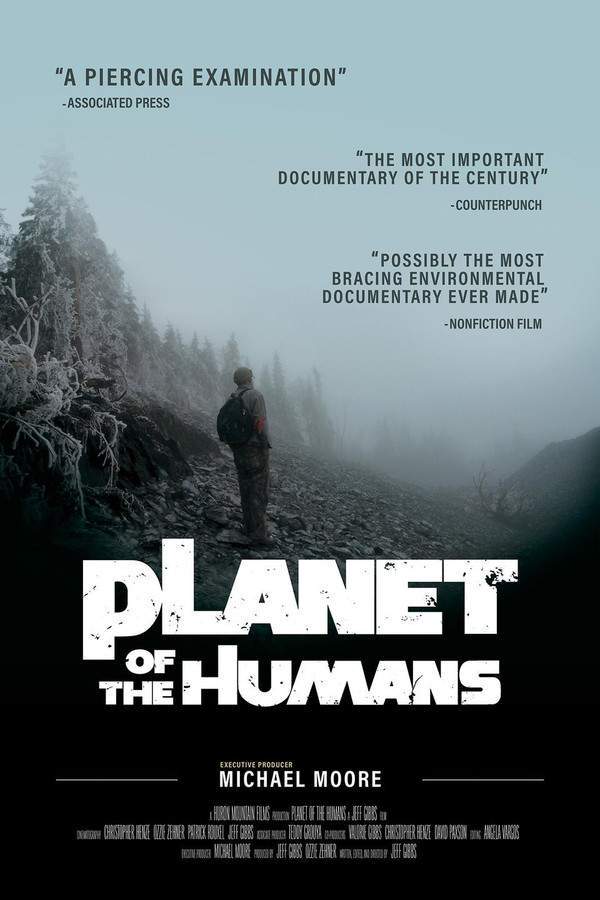
Planet of the Humans takes a critical look at the mainstream environmental movement, questioning its leaders’ decision to partner with billionaires, corporations, and wealthy family foundations, and to promote renewable energy technology as the solution to climate change. Writer and narrator Jeff Gibbs admits to being a long-time fan of renewable energy and examines some of its implications.
After Barack Obama had directed billions of dollars into renewable energy, Gibbs follows the green energy movement more closely but is disappointed, finding that it wasn’t what it seemed. Attending General Motors’ Chevy Volt press conference in 2010, he learns that charging is done by a fossil fuel grid. He finds that his local solar array could only power 10 homes over a year. On a hike to a wind turbine construction site in Vermont he finds part of the mountainside being removed. This leads Gibbs to ask if machines made by our industrial civilization can save us from industrialization.
Gibbs interviews environmental sociologist Richard York, whose study in Nature, found that renewables were not displacing fossil fuels. Gibbs also speaks with author Richard Heinberg and anthropologist Nina Jablonski on why people seek technological fixes. Gibbs then interviews Ozzie Zehner, author of Green Illusions (2012), who states that solar, wind, and electric vehicle technologies require mined minerals, including rare earths, and heavy industrial processes to produce, with new mines opening as demand for green technology rises.
Gibbs speaks to a series of solar industry insiders, an electrical engineer, and a Federal Energy Regulatory Commissioner about solar energy’s intermittency limitation and reliance on baseload plants. Zehner describes how while the Sierra Club’s “Beyond Coal” campaign has closed coal plants, natural gas plants were opening in their wake, resulting in the overall expansion of fossil fuel use in the US. Green tech investor Robert F. Kennedy Jr. speaks to an oil and gas industry group, stating: “The plants that we’re building, the wind plants and the solar plants, are gas plants.”
Zehner discusses how companies including Apple and Tesla claim to run on 100% renewable energy despite remaining hooked up to the grid, and describes the Koch Brothers’ involvement in green technology production. A three-minute montage shows the scale of industrial mining required for renewable technologies, and Gibbs describes how solar and wind arrays must be replaced after only a few decades.
Gibbs then visits Steven Running, an ecologist from the University of Montana, who discusses planetary limits to global fish production, agricultural land, water irrigation, and ground water. Gibbs ends the section by speaking to social-psychologist Sheldon Solomon positing whether faith in renewables could be a reflection of a fear of death.
The next section investigates biomass. Gibbs sneaks onto a biomass plant property in Vermont and finds that instead of burning forest residue as advertised, the plant is surrounded by whole trees. A citizen activist in Michigan describes how her local biomass plant burns pentachlorophenol and creosote-treated railroad ties shipped in from Canada as well as rubber tires, which cause black snow to appear at the adjacent elementary school. Gibbs explores the practice of universities committing to “go green” by opening biomass plants on campus, tracing the practice back to a college in Middlebury, VT, endorsed by Bill McKibben. Gibbs states that biomass energy remains the largest percentage of renewable energy in the world. He then explores what he calls the “language loopholes” that allow for the continuation of biomass around the U.S. The section ends with Gibbs, as part of a media event at the Climate March in New York City, asking environmental leaders for their stance on biomass including Van Jones, Robert F. Kennedy Jr., Bill McKibben, and Vandana Shiva. Only Shiva denounces biomass & biofuels.
In the last third of the film, Gibbs explores the partnerships between mainstream environmental groups and Wall Street investors, billionaires, and wealthy family foundations. Gibbs displays a tax return showing that the Sierra Club accepted $3 million from timber investor Jeremy Grantham. Bill McKibben of 350.org is shown on stage with former Goldman Sachs executive David Blood, supporting his call to raise $40–50 trillion in green energy investments. Gibbs displays U.S. Securities and Exchange Commission filings of green funds promoted in divestment campaigns by McKibben and the Sierra Club, which show holdings in mining companies, oil and gas infrastructure, various banks including BlackRock, as well as Halliburton, McDonalds, Coca-Cola, Exxon, Chevron, Gazprom, and Enviva among others. Gibbs shows corporate formation documents indicating that Al Gore partnered with David Blood to start Generation Investment Management, a sustainability investment fund, before releasing An Inconvenient Truth. Gibbs then shows Gore lobbying Congress on behalf of the sugarcane ethanol industry in Brazil, juxtaposing footage of indigenous cultures in Brazil being evicted from their land to create more sugarcane fields.
Gibbs asserts that the environmental movement has been completely taken over by capitalism. The film shows McKibben stating that 350.org receives funding from The Rockefeller Brothers Fund, and the V. Kann Rasmussen Foundation. He also shows Gore in multiple interviews defending his decision to sell his American television channel, Current TV, earning him an estimated $100 million pre-tax for the deal, to Al Jazeera, which is owned by the State of Qatar, an oil and gas producer. Gibbs attends an Earth Day concert celebration in Washington, DC sponsored by Toyota, Citibank, and Caterpillar, where Dennis Hayes claims the entire event is run on solar energy. Backstage, Gibbs discovers the concert is actually being run by biodiesel generators.
The film ends with Gibbs reflecting that “Infinite growth on a finite planet is suicide”, imploring the audience to take back the environmental movement from billionaires and capitalists. The final scene shows a mother and baby orangutan struggling to survive as the forest is logged and burned around them.