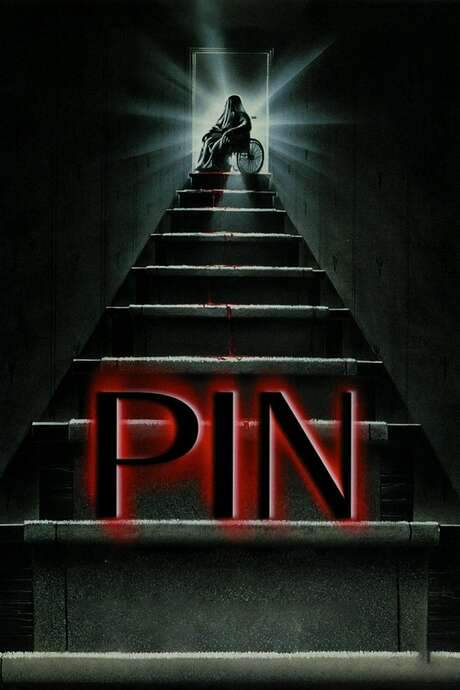
Pin 1988

Directed by

Sandor Stern
Made by

Malofilm Communications Inc.
Pin Plot Summary
Read the complete plot summary and ending explained for Pin (1988). From turning points to emotional moments, uncover what really happened and why it matters.
Dr. Frank Linden, Terry O’Quinn, keeps a life-size, anatomically correct medical dummy in his office that he calls Pin, Jonathan Banks. Through ventriloquism, he uses Pin to explain bodily functions to his children in a way that feels approachable and oddly comforting, a warmth that lightly contradicts his otherwise cool, emotionally distant demeanor. The practice frames a curious beacon in the house for Leon, David Hewlett, and Ursula, [Cynthia Preston](/actor/cynthia-preston, who grow up alongside Pin as a constant, almost living, presence.
Unknown to Dr. Linden, Leon is mentally unstable and clings to the belief that Pin is real. He has little real friendship outside the home, partly because his mother discourages outdoor play, leaving him with Pin as his closest companion. A pivotal, chilling moment comes when he secretly witnesses the nurse in the house using Pin as a sex toy, an event that imprints a deep, troubling fixation on women and sexuality. As the two siblings navigate adolescence, they discuss sex education, and Ursula divulges that she is looking forward to growing older and feeling the pull of “the urge.”
The story advances into their teenage years with brutal clarity. At a high school dance, Leon discovers graffiti implying Ursula’s promiscuity and confronts her in a car with a boy, threatening to hold her to account. Ursula later confesses she is pregnant, and Leon—through Pin—presses that they tell their father, who ends up performing an abortion on the fifteen-year-old Ursula. When Leon becomes an adult, Dr. Linden, drawn back to collect case studies for a speech, catches Leon speaking to Pin and realizes the depth of his son’s psychosis. The revelation compounds the family tragedy: the Lindens die instantly in a car crash, caused by either Dr. Linden’s recklessness or Pin’s malevolent influence. Leon, however, manages to retrieve Pin from the wreckage and begins to carve out a new, terrifying autonomy for himself.
Orphaned and grieving, Ursula and Leon try to carve out independence until Aunt Dorothy, Aunt Dorothy, Patricia Collins arrives to help. Ursula settles into a library job, which Leon resents, and Ursula starts to academically explore schizophrenia as a potential explanation for his brother. Leon escalates, dressing Pin in Dr. Linden’s clothes and eventually giving Pin latex skin and a wig to further the ruse. He lures Stan Fraker, John Pyper-Ferguson, to the house under the pretense of planning Ursula’s surprise party, drugs Stan, and brutally bludgeons him, concealing the body in a woodpile. Pin’s voice and instructions become a haunting backdrop as Ursula confronts the increasingly unstable reality, moving toward a confrontation that leaves her reeling.
When the police eventually discover Stan, they find him alive, a jolt that underscores the film’s unnerving tension. Some time later, Ursula and Stan return to visit Pin, and Ursula confesses she plans to travel with Stan. The final act interweaves memory and manipulation as Ursula speaks to Pin, only to reveal that she is actually speaking to Leon, who has fully absorbed Pin’s persona and now exists as Pin’s malevolent, embodied echo. In the end, the line between person and dummy blurs completely, and the chilling truth is that Leon’s fractured mind has weaponized Pin to become a malevolent presence that walks—and talks—in the flesh.
Pin Timeline
Follow the complete movie timeline of Pin (1988) with every major event in chronological order. Great for understanding complex plots and story progression.
Pin is introduced as a teaching tool
Dr. Frank Linden uses a life-size medical dummy named 'Pin' in his office to teach his children about bodily functions. Through ventriloquism, Pin speaks and explains how the body works in a way that feels approachable to Leon and Ursula. Pin becomes the one bright, playful sign of warmth in an otherwise emotionally distant household.
Leon believes Pin is alive
Unknown to Linden, Leon is mentally ill and comes to believe Pin is alive. His mother discourages outdoor play and forbids friends, leaving Leon with Pin as his only confidant. The bond with Pin seeds an escalating delusion that will shape his future.
Nurse uses Pin as a sex doll
Leon secretly witnesses a nurse using Pin as a masturbatory sex doll. The shocking scene deepens his fear of women and seeds a crippling mistrust of female sexuality. This traumatic event becomes a touchstone that informs his later violence and paranoia.
Teens discuss sexuality
During their school-age years, Leon and Ursula discuss the sex education they've received. Ursula admits she is looking forward to becoming older and experiencing desire. The conversation highlights a growing, complicated fascination with bodies and boundaries.
High school dance and Ursula's pregnancy
At a high school dance, Leon discovers graffiti claiming Ursula sleeps around. He finds her in a car with a boy and assaults him, forcing her to promise never to do this again. He later learns Ursula is pregnant, and, through Pin, insists they tell their father who then performs an abortion on Ursula.
Eighteen and a fatal road trip
When Leon turns eighteen, Dr. Linden, planning to use Pin as a visual aid for a speech, realizes the extent of his son's psychosis. They speed toward the medical school hall, but a car crash kills both Linden and his wife. Ursula and Leon survive, immediately shattering their family life.
Aunt Dorothy moves in
Grief-stricken, Ursula and Leon become orphans. Aunt Dorothy, their mother's sister, moves in to help, while Ursula begins a job at the local library. Leon resents Aunt Dorothy's influence and worries about Ursula's independence.
Aunt Dorothy dies from a heart attack
Leon's fixation with Pin escalates and he uses Pin to frighten Aunt Dorothy, causing a fatal heart attack. Ursula is shaken by the loss and begins researching mental illness, realizing Leon's paranoia may be driving the events around them.
Ursula meets Stan Fraker
Ursula meets handsome Stan Fraker while continuing her library work and falls in love. She remains unaware of Leon's growing paranoia and his fixation on Pin. Leon's suspicion that Stan is after Ursula's inheritance begins to color his actions.
Leon plots against Stan
Leon invites Stan to the house under the pretense of planning a surprise party. He drugs Stan's drink and, when Stan resists, bludgeons him with a sculpture. Following Pin's supposed instructions, he places Stan's body in a bag and hides it in the woodpile, making it look like a disappearance.
Confrontation and near-disaster
Ursula suspects something is wrong when she hears Stan's beeping watch and finds a damp spot on the carpet. Leon blames Pin, but Pin reminds him that they cannot lie to themselves. In a panic, Ursula returns home with an axe, ready to strike, and the scene ends with a white-out as Leon screams.
Stan is found alive; Ursula and Stan visit Pin
Police later discover that Stan's body is still alive, revealing a shocking survival. Ursula and Stan return to the house to visit Pin and discuss her future with him. Pin asks if Ursula has heard from Leon; she says no, and Pin laments the missing bond with his 'brother'.
Final twist: Leon inhabits Pin's persona
As the story ends, Ursula speaks to Leon, who has taken Pin's persona and lives in the dummy's skin. The ventriloquism act becomes literal in a terrifying split personality, suggesting Pin's persona has survived as Leon's new self. The film closes on the chilling implication that the brother's danger is far from over.
Pin Characters
Explore all characters from Pin (1988). Get detailed profiles with their roles, arcs, and key relationships explained.
Leon (David Hewlett)
Leon is a traumatized, isolated boy who believes Pin is alive. He shows paranoid fixations and a growing capacity for violence as his jealousy and fear fester. His bond with Pin becomes a malignant force that distorts reality and drives him toward murder.
PIN (Jonathan Banks)
PIN is a life-size ventriloquist dummy used by Dr. Linden as a teaching tool, which becomes an externalized voice for Leon's psyche. It channels manipulation, cruelty, and a chilling detachment from truth. The puppet acts as both companion and accomplice in Leon's crimes.
Ursula Linden (Cynthia Preston)
Ursula grows from a naive teen into a wary young woman who navigates puberty, love, and her brother's escalating threat. Her relationship with Stan and her exposure to Leon's violence shape her into a survivors' perspective on family and trust. She learns to confront the complexities of loyalty, sexuality, and loss.
Dr. Frank Linden (Terry O'Quinn)
Dr. Linden is a physician whose emotional distance and clinical focus define his parenting. He treats family life as part of his professional world, and his eventual confrontation with Leon's psychosis reveals his own limits and the consequences of detachment. His role culminates in tragedy that underscores the cost of absence and control.
Aunt Dorothy (Patricia Collins)
Aunt Dorothy moves in and attempts to support Ursula, becoming entangled in the escalating tensions around Leon. Her presence catalyzes resentment and fear, and her death becomes a focal point in Leon's spiraling violence.
Stan Fraker (John Pyper-Ferguson)
Stan is Ursula's love interest, whose relationship is tested by Leon's jealousy and the revelation of Ursula's pregnancy. He becomes a target of Leon's violence but survives the initial assault, remaining a key figure in the unraveling of the family’s secrets.
Pin Settings
Learn where and when Pin (1988) takes place. Explore the film’s settings, era, and how they shape the narrative.
Time period
Late 20th century
The narrative tracks years from childhood into late adolescence and early adulthood. The era’s attitudes toward parenting, sexuality, and medical authority shape how the characters respond to trauma and secrecy. Time moves the characters from innocence toward deadly consequences, underscoring a gradual erosion of safety within the family.
Location
Dr. Linden's home and office, high school, library, medical school, river/wooded area
The story unfolds around the Linden household and Dr. Linden's clinical office, with key scenes at a local high school and a library. It also passes through the medical school where Pin is used as a visual aid, and culminates in outdoor, domestic spaces that become stages for violence. These locations frame a claustrophobic world where personal life and professional authority intersect, fueling the characters' unraveling psyches.
Pin Themes
Discover the main themes in Pin (1988). Analyze the deeper meanings, emotional layers, and social commentary behind the film.
🧠
Mental Illness
Leon's developing psychosis drives the plot, anchored by his belief that Pin is alive. The film examines how neglect, emotional distance, and a problematic home environment can contribute to a fractured mind. Pin externalizes Leon's inner world, making it hard to distinguish between reality and imagination.
🎭
Dual Reality
Pin becomes a separate persona that guides Leon's actions and distorts perception of others. The boundary between fantasy and reality dissolves as Leon uses Pin to manipulate people and justify crimes. The audience is pulled between sympathy for a troubled boy and horror at the consequences of his delusions.
💔
Family Trauma
The Linden home is emotionally cold, and affectionate warmth is scarce, shaping how the siblings cope with danger. Aunt Dorothy's arrival deepens tension and introduces a further sense of manipulation and control. Ursula's coming-of-age is shadowed by fear of her brother, amplifying the sense of loss that follows each tragedy.
🔪
Violence and Consequences
The narrative escalates from psychological distress to physical violence, including assaults and killings driven by obsession and fear. Pin's influence exposes Leon's capacity for brutal acts and questions who bears responsibility—the patient, the puppet, or a broken family system. The ending reframes the violence as a clash between a collapsing psyche and a sinister external persona.

Coming soon on iOS and Android
The Plot Explained Mobile App
From blockbusters to hidden gems — dive into movie stories anytime, anywhere. Save your favorites, discover plots faster, and never miss a twist again.
Sign up to be the first to know when we launch. Your email stays private — always.
Explore the mobile appPin Spoiler-Free Summary
Discover the spoiler-free summary of Pin (1988). Get a concise overview without any spoilers.
In a quiet suburb where the ordinary hum of everyday life masks deeper currents, a family home becomes a stage for psychological unease. The rooms are filled with the soft click of household routine, yet the presence of a lifelike medical dummy—normally a teaching tool—creates an undercurrent of discomfort that lingers like a half‑remembered dream. The film’s tone balances meticulous, almost clinical detail with a slow‑building dread, inviting the audience to linger on the line between innocence and obsession.
Leon has carried the dummy with him since childhood, treating it as more than a plastic figure. His bond with the inanimate companion is rooted in a need for control and comfort, forged in the shadow of an emotionally distant father figure. Across the hallway, his sister Ursula watches the arrangement with a mixture of curiosity and unease, aware that the dummy’s role in their family dynamic is more complex than it appears. Their sibling relationship, formed in the same house, oscillates between protectiveness and subtle rivalry, each trying to navigate their own emerging identities.
When a sudden accident leaves the siblings orphaned, the dummy is thrust from a quiet background prop into the center of their daily existence. Leon brings it into the home they now share with Ursula, and the dummy’s quiet, unblinking stare begins to echo the unspoken tensions between them. As their lives settle into a fragile new rhythm, the dummy’s influence grows, casting shadows that suggest the line between affection and fixation may be thinner than anyone imagined. The atmosphere thickens with subtle hints that what once was a harmless comfort could become a source of quiet terror, testing the limits of trust and the strength of familial bonds.
The film maintains a poised, atmospheric style, letting ordinary moments stretch into unsettling pauses. Viewers are drawn into a world where a simple plastic figure becomes a mirror for hidden anxieties, and the looming sense that something familiar may turn threatening fuels a lingering sense of anticipation.
Movies with Similar Twists and Themes
Uncover films that echo the narrative beats, emotional arcs, or dramatic twists of the one you're exploring. These recommendations are handpicked based on story depth, thematic resonance, and spoiler-worthy moments — perfect for fans who crave more of the same intrigue.



Featured on this page

What's After the Movie?
Not sure whether to stay after the credits? Find out!
Check out our other apps:

SAT Sphere
Build confidence for the Digital SAT.

Mori Atlas
Discover wild places worth protecting.

Luntero
Search smarter for a home in Amsterdam.

Plot Explained
Unravel movie endings and hidden clues.

Pokechamp
Dive into Pokémon data and battle logic.

Driving Theory
Get ready for your European theory test.

Movie Dust
Plan your next cinema trip with ease.

Musemap
Find art and culture as you travel.

Selkobase
Compare credentials before committing.

Local Manual
Turn an unfamiliar country into practical next steps.

Lernavi
Compare school systems before your next move.

GymRoam
Find a workout stop wherever your plans take you.
Explore Our Movie Platform
New Movie Releases (2026)
Famous Movie Actors
Top Film Production Studios
Movie Plot Summaries & Endings
Major Movie Awards & Winners
Best Concert Films & Music Documentaries
Movie Collections and Curated Lists
© 2026 What's After the Movie. All rights reserved.
Privacy Policy