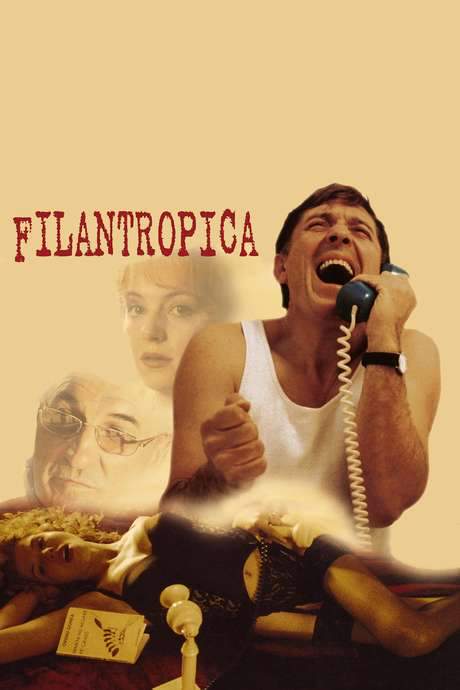
Philanthropy 2002

Directed by

Nae Caranfil
Made by

Domino Film
Philanthropy Plot Summary
Read the complete plot summary and ending explained for Philanthropy (2002). From turning points to emotional moments, uncover what really happened and why it matters.
Ovidiu Gorea Mircea Diaconu is a jaded high-school teacher and aspiring writer in his mid-40s who still lives with his parents, his mother Monica Ghiuță and his father Constantin Drăgănescu in a quiet Bucharest orbit. He has just published a collection of short stories titled Nobody Dies for Free, but bookstores reject it and buyers stay away, leaving him with a sense that his literary dreams are slipping through his fingers. The film opens with this tension: a capable, intelligent man who feels unseen and underappreciated, stuck in a routine that pays little and promises less.
The high school principal entrusts Ovidiu with a fragile task: to handle a trouble-making student named Robert. Ovidiu tries a straightforward approach—having Robert call one of his parents for a conversation—but the teen instead sends his sister, Diana Viorica Vodă, a striking, perceptive girl who immediately unsettles him. What begins as a flirtation quickly spirals into something more dangerous for Ovidiu as he is drawn into a misguided plan to win Diana’s interest through a night of bar-hopping, coffee turning into a cascade of reckless decisions that nearly drains his pockets and his dignity.
One night, a shabby, intoxicated beggar appears and offers to recite poems in exchange for vodka. The exchange opens a door to a much larger, darker opportunity. The beggar introduces Ovidiu to the Filantropica Foundation, a desolate basement operation run by the enigmatic Pavel Puiuț [Gheorghe Dinică], a former convict who has built an empire out of emotional manipulation. He has learned that begging earns more when each beggar has a carefully crafted, tear-jerking backstory. The “foundation” becomes a pimply, intricate machine that preys on generosity, turning pity into profit. Puiuț sees potential in Ovidiu and invites him into a new “project” that will test his wits, his charm, and his ethics.
Ovidiu is paired with Miruna [Mara Nicolescu], the Foundation’s sharp secretary, and they are set to perform at high-end restaurants under the pretense of being a couple of poor teachers celebrating an anniversary. In each scene, they act out the ruse: a first dinner where they pretend to struggle to pay the bill, a hungry guest is asked to step in and settle the tab, and the two of them split the payoff once back in the alley. The scheme begins to yield real money, and Ovidiu’s previously dull life starts to sparkle with material improvements. He rents a roadster, takes Diana to lakeside clubs, and flaunts the purchases and experiences that his new “success” allows, all while his sole objective is still gaining Diana’s affection.
Puiuț grants Ovidiu access to the Foundation’s show-house—a place meant to wow others with a visible sign of success. However, a mis-timed phone call betrays his cover, and Diana distances herself in irritation, leaving him to face the consequences of his choices. Meanwhile, Miruna’s feelings grow complicated: she falls for her partner in crime and resents Ovidiu’s constant complaints about the “bimbo” who’s not a real woman. Her resentment deepens into desire, and she quietly engineers a shift, coaxing Ovidiu to play the scam not just as a performance but as a genuine experience.
The operation expands beyond the dining rooms. Miruna persuades Ovidiu to an evening that should have been a shared victory, but the karaoke bar’s loud music thwarts their calculated scene. A waiter not in on the ruse pulls Ovidiu aside and beats him in the back, exposing the fragility of their deception. Puiuț reveals the full purpose of the project: Ovidiu must appear, with Miruna, on Chestiunea Zilei, a popular late-night program, to recount the karaoke incident and to announce that the Filantropica Foundation has opened a customer account for people who wish to donate to the “poor teachers.” The plan turns public and personal at the same time, turning their private scheme into a public spectacle.
Back in the school, two thugs arrive demanding repayment for Robert, who owes $3,000 to someone and has only two days to settle. Ovidiu withdraws the money from the Foundation’s account and transfers it to Diana, who pretends to be impressed and urges him to visit her again that night. Yet she misleads him again by leaving the city in the afternoon, and Ovidiu discovers that Robert’s supposed sister was nothing of the sort, a lying “chick” who used him to push the debt further from sight.
The story’s momentum twists as Ovidiu returns home to find the media and Puiuț claiming he has just won a lottery prize, a sly payoff that confirms to Ovidiu that he has become a tool in Puiuț’s larger business. The con’s price is steep: Ovidiu accepts his fate and Miruna as his wife in the foundation’s game, trapped by a web of manipulation that he helped to weave.
The film closes on a chilling, unnerving note, as Pavel Puiuț confronts Robert in the street and uses him to illustrate the cold calculus of their operation. Then, in a final meta-moment that underscores the movie’s critique of spectacle and complicity, Puiuț breaks the fourth wall: “Do you feel pity for this piece of trash? Hah! Got your money!” The line lingers, reframing the audience’s gaze—pity, profit, and the price of a lie are all bound together in a city that rewards cleverness over conscience.
In this story of ambition, need, and moral compromise, the characters navigate a precarious economy of emotions. Ovidiu’s longing for recognition and affection collides with a societal system that monetizes hardship, while Miruna’s evolving feelings pull her toward a different, perhaps more dangerous, version of success. The Filantropica Foundation operates as a mirror, reflecting not only the hunger of its beggars but the hunger within the people who seek to fill their emptiness with power, status, and money. The film ends with an unsettling blend of triumph and loss, leaving viewers to ask where the line lies between art, manipulation, and genuine human connection.
Philanthropy Timeline
Follow the complete movie timeline of Philanthropy (2002) with every major event in chronological order. Great for understanding complex plots and story progression.
Nobody Dies for Free published and dismissed by bookstores
Ovidiu Gorea, a jaded high-school teacher and aspiring writer, has just published a collection titled Nobody Dies for Free. The bookstores reject it and it fails to sell, leaving him frustrated and financially strained. He remains living with his parents, chasing a dream that seems out of reach.
Principal assigns problem-student; Diana is substituted for a parent call
The high school principal tasks him with handling a problem-student, Robert. Ovidiu tries to arrange a talk by having Robert call one of his parents, but the boy instead sends his sister, Diana, who is strikingly beautiful. Ovidiu is instantly smitten, foreshadowing trouble to come.
A quiet coffee date spirals into a bar-hopping extravaganza
On a date that was supposed to be a quiet coffee, Ovidiu follows Diana into a night of bar-hopping and showy spending. He hopes to impress her with a glamorous image, but the evening blows through his finances and patience. By the end, he is nearly broke and morally conflicted.
Beggar with poems directs him to the Filantropica Foundation
One night he meets a shabby-looking drunk beggar who offers to recite poems in exchange for vodka. The beggar explains that he can earn two or three times what Ovidiu makes by selling tear-jerking stories, directing him to the Filantropica Foundation. Intrigued and desperate, Ovidiu visits the foundation.
Filantropica Foundation reveals the project and Miruna is introduced
Inside the foundation's desolate basement, Pavel Puiuț pitches a lucrative scheme to exploit pity. He pairs Ovidiu with Miruna, and sends them to high-end restaurants posing as poor teachers celebrating a wedding anniversary. Their assignment is to trigger a charitable payout from wealthy diners and split the money with a waiter.
First restaurant scams and moral compromise
At the restaurants, Ovidiu and Miruna perform the ruse and stage scenes of financial desperation. Ovidiu must escalate the moment to provoke a generous gesture from a rich patron, and the trio splits the money after the 'pity' buy-in. The scheme marks a slippery ascent into fraud and moral compromise.
Money buys attention: roadster, lakeside clubs, and Diana
With the money flowing, Ovidiu buys a flashy roadster and takes Diana to lakeside clubs to show off. He treats her as a conquest rather than a person, hoping the expensive lifestyle will win her affection. But all the while his conscience gnaws at him.
Access to the show-house exposes the fraud
Puiuț grants Ovidiu access to the foundation's 'show-house,' a day-rental property meant to impress the social circle. A mis-timed client call reveals the hoax, blowing his cover and causing Diana to walk out on him. The illusion of respectability begins to crumble.
Miruna seduces and reveals a shocking past
The next day Miruna becomes romantically involved with Ovidiu and they share a bed, much to his surprise when he learns she was a former prostitute. She manipulates him emotionally, pulling him deeper into the operation. Ovidiu's ego and vulnerability become increasingly entwined with her.
The scam backfires and the TV angle looms
Emboldened, Miruna pushes Ovidiu to perform the scam for their own benefit and they dine out again. The karaoke bar plan fails when the noise drowns out their scene, and a hostile waiter drags Ovidiu to the back. Puiuț then reveals the grand scheme on a TV show, announcing the foundation's account to collect money for the 'poor teachers'.
Debt pressure mounts: Robert's fate and the 3,000
Back at school, two thugs confront Ovidiu about Robert and the debt he owes. Ovidiu withdraws 3,000 from the foundation's account and gives it to Diana, who pretends to be impressed and invites him to visit that night. She instead leaves the city, deepening his sense of betrayal and vulnerability.
Robert becomes a beggar; the Diana deception unravels
Ovidiu finds Robert in a park, now turned into a beggar, who reveals that 'Diana' was not his sister. The true scope of the scam begins to dawn as the lines between victim and perpetrator blur. Ovidiu realizes his own life has become part of Puiuț's manipulation.
Lottery cover-up and final entanglement
With the 3,000 missing and the pressure mounting, the media and Puiuț stage a big lottery prize to keep the debt hidden. Ovidiu grudgingly accepts his fate and Miruna becomes his wife as part of the ongoing deceit. The foundation tightens its grip, pulling him further into its scheme.
Ending: recruitment and a fourth-wall punchline
Puiuț finds Robert on the street and convinces him to join the operation. He breaks the fourth wall, asking the audience if they feel pity for this piece of trash and declaring, Got your money. The finale leaves a cynical sting about exploitation hidden behind acts of apparent charity.
Philanthropy Characters
Explore all characters from Philanthropy (2002). Get detailed profiles with their roles, arcs, and key relationships explained.
Ovidiu Gorea (Mircea Diaconu)
A jaded high-school teacher and aspiring writer in his mid-40s who lives with his parents. His recent book Nobody Dies for Free is rejected, fueling his resentment and desire for status. He becomes involved with the Filantropica Foundation's scam to impress the glamorous Diana.
Miruna (Mara Nicolescu)
The Foundation’s secretary and a former prostitute who partners with Ovidiu in the scams. She is drawn to him emotionally, yet remains pragmatic about money and power. Her shifting loyalties reveal a complex mix of affection and calculation as the plan unfolds.
Pavel Puiuț (Gheorghe Dinică)
Leader of Bucharest's beggars’ network and mastermind behind the project. A former convict, he turns begging into a calculated enterprise by crafting tear-jerker stories. He orchestrates Ovidiu’s late-game scheme and controls the operation with a cold, strategic mindset.
Diana Dobrovicescu (Viorica Vodă)
A beautiful, socially ambitious teenager who becomes the focus of Ovidiu’s romantic pursuits. She uses romance and status as tools, leaving Ovidiu after a fling and keeping him emotionally unsettled as she climbs social ladders.
Robert Dobrovicescu (Cristian Gheorghe)
A problem student who owes money and triggers the foundation’s manipulation of Ovidiu. He is pushed toward a life on the streets as the scam tightens its grip, highlighting vulnerability and the consequences of predatory schemes.
Philanthropy Settings
Learn where and when Philanthropy (2002) takes place. Explore the film’s settings, era, and how they shape the narrative.
Time period
Early 2000s
Set in post-communist Romania around the turn of the millennium, the film captures Bucharest during a period of rapid economic change. A growing consumer culture and a saturated television landscape frame the characters' schemes. These conditions fuel moral compromises and the urge to 'upgrade' one's social standing.
Location
Bucharest, Romania, Filantropica Foundation (basement), upscale restaurants and clubs
The story unfolds across Bucharest, moving from the desolate Filantropica Foundation basement to glitzy dining rooms and lakeside clubs. The city’s spaces become stages for social climbing, where pity can be monetized and appearances purchased. The foundation’s basement serves as a stark counterpoint to the flashy nightlife and aspirational façades of its characters.
Philanthropy Themes
Discover the main themes in Philanthropy (2002). Analyze the deeper meanings, emotional layers, and social commentary behind the film.
💸
Greed
Greed drives the central deception: a beggar network crafts tearful backstories to extract money from well-meaning strangers. Ovidiu’s push for status and romance makes him susceptible to the scam, while the foundation monetizes pity as a product. The film critiques a society where wealth and appearances are mistaken for virtue.
🎭
Deception
Elaborate lies—invented histories, staged dinners, and a fake show-house—fabricate an aura of authenticity while profiting from others’ vulnerability. Ovidiu and Miruna perform roles to manipulate the wealthy audience and the media, culminating in a televised revelation. The story’s meta moment breaks the audience’s illusion and highlights the performative nature of moral redemption.
🗣️
Narrative Power
Stories become currency for the beggars’ network, with each tale tailored to maximize sympathy and donations. Ovidiu learns that narratives carry more weight than facts and uses them to lure Diana and public sympathy. The media-driven arc demonstrates how controlling a narrative can reshape money, status, and relationships, inviting viewers to question where pity ends and exploitation begins.

Coming soon on iOS and Android
The Plot Explained Mobile App
From blockbusters to hidden gems — dive into movie stories anytime, anywhere. Save your favorites, discover plots faster, and never miss a twist again.
Sign up to be the first to know when we launch. Your email stays private — always.
Explore the mobile appPhilanthropy Spoiler-Free Summary
Discover the spoiler-free summary of Philanthropy (2002). Get a concise overview without any spoilers.
In contemporary Bucharest, the city’s glossy nightlife clashes with the quiet desperation of its back‑streets. The film follows Ovidiu Gorea, a modest high‑school teacher and aspiring writer whose life circles around a cramped family home and a modest salary that never quite matches his ambitions. Though his short‑story collection has barely made a ripple, he longs for recognition, a splash of excitement, and the chance to impress an alluring woman who briefly enters his world through his school.
When a routine school task leads Ovidiu into a chance encounter with a charismatic, poetry‑reciting beggar, he is introduced to a shadowy network that treats poverty as performance. This hidden economy, run out of a basement “Filantropica Foundation,” turns personal hardship into a staged spectacle, where every appeal for charity is backed by a crafted backstory. The tone is simultaneously sardonic and melancholic, painting Bucharest’s neon‑lit avenues as both a playground for daring schemes and a stage for quiet desperation.
Diana, the striking student who becomes the object of Ovidiu’s fascination, represents the fleeting allure of the city’s glamorous promises, while Miruna, the foundation’s sharp‑tongued secretary, hints at a more complex moral calculus within the operation. Their interactions suggest a world where wit and charm can be traded for cash, yet every transaction leaves an intangible cost. The film’s atmosphere is steeped in dark humor and social critique, using intimate moments and bustling restaurant scenes to explore how far one might go to escape anonymity.
Through tightly woven dialogue and a muted color palette that shifts from the grey of everyday life to the garish hues of night‑time ventures, the story asks what it means to sell one’s own story for survival. The audience is drawn into a city where empathy can be monetized, and where the line between genuine need and theatrical performance blurs, setting the stage for a compelling examination of ambition, dignity, and the price of a night out.
Movies with Similar Twists and Themes
Uncover films that echo the narrative beats, emotional arcs, or dramatic twists of the one you're exploring. These recommendations are handpicked based on story depth, thematic resonance, and spoiler-worthy moments — perfect for fans who crave more of the same intrigue.







Featured on this page

What's After the Movie?
Not sure whether to stay after the credits? Find out!
Check out our other apps:

SAT Sphere
Build confidence for the Digital SAT.

Mori Atlas
Discover wild places worth protecting.

Luntero
Search smarter for a home in Amsterdam.

Plot Explained
Unravel movie endings and hidden clues.

Pokechamp
Dive into Pokémon data and battle logic.

Driving Theory
Get ready for your European theory test.

Movie Dust
Plan your next cinema trip with ease.

Musemap
Find art and culture as you travel.

Selkobase
Compare credentials before committing.

Local Manual
Turn an unfamiliar country into practical next steps.

Lernavi
Compare school systems before your next move.

GymRoam
Find a workout stop wherever your plans take you.
Explore Our Movie Platform
New Movie Releases (2026)
Famous Movie Actors
Top Film Production Studios
Movie Plot Summaries & Endings
Major Movie Awards & Winners
Best Concert Films & Music Documentaries
Movie Collections and Curated Lists
© 2026 What's After the Movie. All rights reserved.
Privacy Policy