Philanthropy 2002

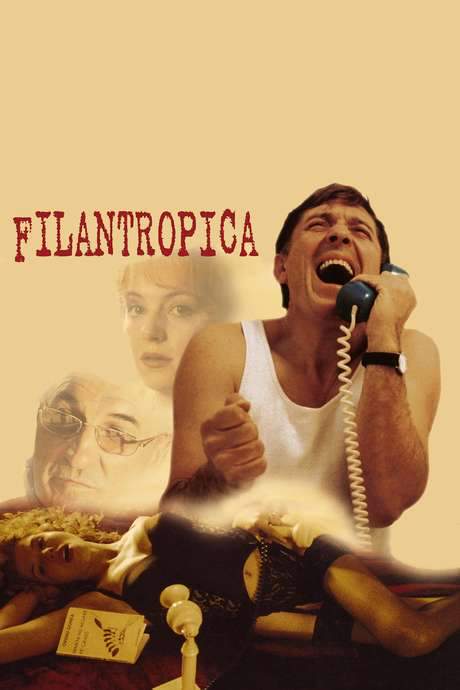
In modern Bucharest, a Saturday night outing with an attractive woman is a costly gamble. Ovidiu, a modest high‑school teacher, cannot afford such luxuries. Determined to earn more than his modest salary, he is drawn into the shadowy world of organized beggars, where a hand without a story receives no alms.


Does Philanthropy have end credit scenes?
No!
Philanthropy does not have end credit scenes. You can leave when the credits roll.
Meet the Full Cast and Actors of Philanthropy
Explore the complete cast of Philanthropy, including both lead and supporting actors. Learn who plays each character, discover their past roles and achievements, and find out what makes this ensemble cast stand out in the world of film and television.

Anamaria Marinca
Reporter

Ovidiu Niculescu
Ospatarul
Valentin Popescu
Recuperator #1
Mircea Diaconu
Ovidiu Gorea
Marius Capotă
Băiat de Băiat
Florin Călinescu
El însuși
Florin Zamfirescu
Poetul Gării de Nord
Mara Nicolescu
Miruna
Constantin Drăgănescu
Tatăl
Gheorghe Dinică
Pavel Puiuț
Viorica Vodă
Diana Dobrovicescu
Marius Florea Vizante
Simpaticul
Cristian Gheorghe
Robert Dobrovicescu
Monica Ghiuță
Mama
George Lungoci
Reporter
Gabriela Bobes
Marius Rizea
External Links and Streaming Options
Discover where to watch Philanthropy online, including streaming platforms, rental options, and official sources. Compare reviews, ratings, and in-depth movie information across sites like IMDb, TMDb, Wikipedia or Rotten Tomatoes.






Take the Ultimate Philanthropy Movie Quiz
Challenge your knowledge of Philanthropy with this fun and interactive movie quiz. Test yourself on key plot points, iconic characters, hidden details, and memorable moments to see how well you really know the film.
Philanthropy (2002) Quiz: Test your knowledge of the Romanian film Philanthropy (Filantropica) with these 10 mixed‑difficulty questions.
What is Ovidiu Gorea's primary occupation?
Full Plot Summary and Ending Explained for Philanthropy
Read the complete plot summary of Philanthropy, including all major events, twists, and the full ending explained in detail. Explore key characters, themes, hidden meanings, and everything you need to understand the story from beginning to end.
Ovidiu Gorea Mircea Diaconu is a jaded high-school teacher and aspiring writer in his mid-40s who still lives with his parents, his mother Monica Ghiuță and his father Constantin Drăgănescu in a quiet Bucharest orbit. He has just published a collection of short stories titled Nobody Dies for Free, but bookstores reject it and buyers stay away, leaving him with a sense that his literary dreams are slipping through his fingers. The film opens with this tension: a capable, intelligent man who feels unseen and underappreciated, stuck in a routine that pays little and promises less.
The high school principal entrusts Ovidiu with a fragile task: to handle a trouble-making student named Robert. Ovidiu tries a straightforward approach—having Robert call one of his parents for a conversation—but the teen instead sends his sister, Diana Viorica Vodă, a striking, perceptive girl who immediately unsettles him. What begins as a flirtation quickly spirals into something more dangerous for Ovidiu as he is drawn into a misguided plan to win Diana’s interest through a night of bar-hopping, coffee turning into a cascade of reckless decisions that nearly drains his pockets and his dignity.
One night, a shabby, intoxicated beggar appears and offers to recite poems in exchange for vodka. The exchange opens a door to a much larger, darker opportunity. The beggar introduces Ovidiu to the Filantropica Foundation, a desolate basement operation run by the enigmatic Pavel Puiuț [Gheorghe Dinică], a former convict who has built an empire out of emotional manipulation. He has learned that begging earns more when each beggar has a carefully crafted, tear-jerking backstory. The “foundation” becomes a pimply, intricate machine that preys on generosity, turning pity into profit. Puiuț sees potential in Ovidiu and invites him into a new “project” that will test his wits, his charm, and his ethics.
Ovidiu is paired with Miruna [Mara Nicolescu], the Foundation’s sharp secretary, and they are set to perform at high-end restaurants under the pretense of being a couple of poor teachers celebrating an anniversary. In each scene, they act out the ruse: a first dinner where they pretend to struggle to pay the bill, a hungry guest is asked to step in and settle the tab, and the two of them split the payoff once back in the alley. The scheme begins to yield real money, and Ovidiu’s previously dull life starts to sparkle with material improvements. He rents a roadster, takes Diana to lakeside clubs, and flaunts the purchases and experiences that his new “success” allows, all while his sole objective is still gaining Diana’s affection.
Puiuț grants Ovidiu access to the Foundation’s show-house—a place meant to wow others with a visible sign of success. However, a mis-timed phone call betrays his cover, and Diana distances herself in irritation, leaving him to face the consequences of his choices. Meanwhile, Miruna’s feelings grow complicated: she falls for her partner in crime and resents Ovidiu’s constant complaints about the “bimbo” who’s not a real woman. Her resentment deepens into desire, and she quietly engineers a shift, coaxing Ovidiu to play the scam not just as a performance but as a genuine experience.
The operation expands beyond the dining rooms. Miruna persuades Ovidiu to an evening that should have been a shared victory, but the karaoke bar’s loud music thwarts their calculated scene. A waiter not in on the ruse pulls Ovidiu aside and beats him in the back, exposing the fragility of their deception. Puiuț reveals the full purpose of the project: Ovidiu must appear, with Miruna, on Chestiunea Zilei, a popular late-night program, to recount the karaoke incident and to announce that the Filantropica Foundation has opened a customer account for people who wish to donate to the “poor teachers.” The plan turns public and personal at the same time, turning their private scheme into a public spectacle.
Back in the school, two thugs arrive demanding repayment for Robert, who owes $3,000 to someone and has only two days to settle. Ovidiu withdraws the money from the Foundation’s account and transfers it to Diana, who pretends to be impressed and urges him to visit her again that night. Yet she misleads him again by leaving the city in the afternoon, and Ovidiu discovers that Robert’s supposed sister was nothing of the sort, a lying “chick” who used him to push the debt further from sight.
The story’s momentum twists as Ovidiu returns home to find the media and Puiuț claiming he has just won a lottery prize, a sly payoff that confirms to Ovidiu that he has become a tool in Puiuț’s larger business. The con’s price is steep: Ovidiu accepts his fate and Miruna as his wife in the foundation’s game, trapped by a web of manipulation that he helped to weave.
The film closes on a chilling, unnerving note, as Pavel Puiuț confronts Robert in the street and uses him to illustrate the cold calculus of their operation. Then, in a final meta-moment that underscores the movie’s critique of spectacle and complicity, Puiuț breaks the fourth wall: “Do you feel pity for this piece of trash? Hah! Got your money!” The line lingers, reframing the audience’s gaze—pity, profit, and the price of a lie are all bound together in a city that rewards cleverness over conscience.
In this story of ambition, need, and moral compromise, the characters navigate a precarious economy of emotions. Ovidiu’s longing for recognition and affection collides with a societal system that monetizes hardship, while Miruna’s evolving feelings pull her toward a different, perhaps more dangerous, version of success. The Filantropica Foundation operates as a mirror, reflecting not only the hunger of its beggars but the hunger within the people who seek to fill their emptiness with power, status, and money. The film ends with an unsettling blend of triumph and loss, leaving viewers to ask where the line lies between art, manipulation, and genuine human connection.

Coming soon on iOS and Android
The Plot Explained Mobile App
From blockbusters to hidden gems — dive into movie stories anytime, anywhere. Save your favorites, discover plots faster, and never miss a twist again.
Sign up to be the first to know when we launch. Your email stays private — always.
Explore the mobile appWatch Trailers, Clips & Behind-the-Scenes for Philanthropy
Watch official trailers, exclusive clips, cast interviews, and behind-the-scenes footage from Philanthropy. Dive deeper into the making of the film, its standout moments, and key production insights.
Philanthropy Themes and Keywords
Discover the central themes, ideas, and keywords that define the movie’s story, tone, and message. Analyze the film’s deeper meanings, genre influences, and recurring concepts.
Philanthropy Other Names and Titles
Explore the various alternative titles, translations, and other names used for Philanthropy across different regions and languages. Understand how the film is marketed and recognized worldwide.
Similar Movies To Philanthropy You Should Know About
Browse a curated list of movies similar in genre, tone, characters, or story structure. Discover new titles like the one you're watching, perfect for fans of related plots, vibes, or cinematic styles.












Quick Links: Summary, Cast, Ratings, More

What's After the Movie?
Not sure whether to stay after the credits? Find out!
Check out our other apps:

SAT Sphere
Build confidence for the Digital SAT.

Mori Atlas
Discover wild places worth protecting.

Luntero
Search smarter for a home in Amsterdam.

Plot Explained
Unravel movie endings and hidden clues.

Pokechamp
Dive into Pokémon data and battle logic.

Driving Theory
Get ready for your European theory test.

Movie Dust
Plan your next cinema trip with ease.

Musemap
Find art and culture as you travel.

Selkobase
Compare credentials before committing.

Local Manual
Turn an unfamiliar country into practical next steps.

Lernavi
Compare school systems before your next move.

GymRoam
Find a workout stop wherever your plans take you.
Explore Our Movie Platform
New Movie Releases (2026)
Famous Movie Actors
Top Film Production Studios
Movie Plot Summaries & Endings
Major Movie Awards & Winners
Best Concert Films & Music Documentaries
Movie Collections and Curated Lists
© 2026 What's After the Movie. All rights reserved.
Privacy Policy