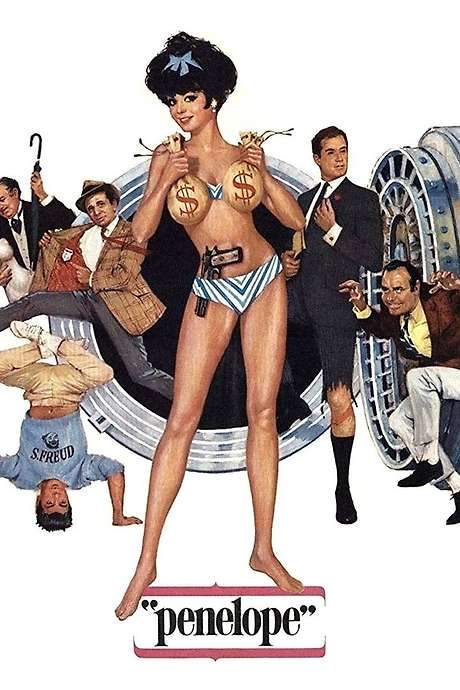
Penelope 1966


Directed by

Arthur Hiller
Made by

Metro-Goldwyn-Mayer
Where to Watch Penelope
See current US streaming, rental, and purchase options for Penelope (1966) via JustWatch.

Streaming availability powered by 
Penelope Plot Summary
Read the complete plot summary and ending explained for Penelope (1966). From turning points to emotional moments, uncover what really happened and why it matters.
Penelope Elcott [Natalie Wood] is married to James Elcott [Ian Bannen], a wealthy banker, and she feels a restlessness behind her comfortable life. One impulsive morning, she quietly decides to disguise herself as an old woman and rob her husband’s bank, kicking off a bold sequence of events. As alarms blare and police close in, including Lt. Horatio Bixbee [Peter Falk], Penelope makes a swift escape in a striking red wig and a bright yellow suit. In the aftermath, she donates some of the stolen money to a Salvation Army worker and hands the suit over to a thrift shop. The ensemble doesn’t stay hidden for long: con artists Sabada [Lila Kedrova] and Ducky [Lou Jacobi] recognize the outfit as a Parisian designer original and purchase it for a mere $7, instantly tying fashion to mischief.
To make sense of her actions, Penelope sees her psychiatrist, Dr. Gregory Mannix [Dick Shawn], and recounts the life of her “crimes.” She explains that the pattern began in college, when a professor [Jonathan Winters] in his laboratory attempted to assault her, a terrifying moment that she escaped from, leaving her dress torn in the process. During the chase that followed, she swiped the professor’s watch fob. The next breach came on her wedding day, followed by a theft from her maid of honor Mildred Halliday [Norma Crane]—her earrings and necklace disappearing in a flash. Gregory suggests that the thrill of stealing is a response to wanting more attention from a husband who seems distant.
A fresh accusation arises when Honeysuckle Rose [Arlene Golonka], a young woman, is pegged as the thief. Gregory contemplates returning the stolen money to the bank, but panic erupts as police vehicles arrive. Penelope confesses in a bid to clear Honeysuckle, yet Lt. Bixbee and James refuse to believe her innocence, casting doubt on her tale. The danger escalates when Sabada and Ducky press their blackmail, only to see Penelope outwit them and keep control of the situation.
Penelope then stages a dinner party, a gathering at which she finds herself having stolen from every invited guest. She attempts to return the pilfered items, but the guests insist they have never seen them before, leaving her increasingly unsettled. In another turn of risk, she robs James’s bank once more, this time with tears in her eyes. James pleads with Horatio to locate her, torn between concern and loyalty.
The psychiatrist later reveals the cruel logic behind the guests’ denial: they have been colluding to swell fraudulent insurance claims. Gregory—even in his own admission—breaks down, begging Penelope to run away with him. Yet she refuses, insisting that she has been “cured.” James, meanwhile, comes to realize how deeply he has neglected Penelope; he starts seeing her face everywhere he turns. He visits the psychiatrist’s office, where a quiet moment of recognition unfolds. In the end, James and Penelope share a reunion, choosing to face their renewed bond together.
Penelope Timeline
Follow the complete movie timeline of Penelope (1966) with every major event in chronological order. Great for understanding complex plots and story progression.
Penelope's bank robbery disguised as old woman
Penelope disguises herself as an elderly woman and robs her banker husband’s bank, triggering a police chase. She escapes in a distinctive red wig and yellow suit, leaving chaos in her wake. She donates part of the loot to a Salvation Army worker and later the suit ends up at a thrift shop, where con artists Sabada and Ducky buy it for a mere $7.
Donations and a designer suit go cheap
Penelope donates some of the stolen money to a Salvation Army worker and donates the designer suit to a thrift shop. Sabada and Ducky quickly recognize the outfit as a Paris original and purchase it for a pittance. The sequence shows how her thefts ripple through ordinary lives and fashion lore.
Therapy and the backstory
Penelope visits her psychiatrist Gregory and recounts a life of theft that began in college, when a professor allegedly tried to rape her. She describes escaping the assault, losing her dress, and stealing the professor's watch fob during the chase. Gregory notes that her compulsions may be a bid for attention from her distant husband.
Wedding-day thefts revealed
Penelope explains that she first began stealing on her wedding day after catching her maid of honor, Mildred, kissing James. She specifically swipes Mildred's earrings and necklace as part of her early pattern. The confession underscores the personal hurt fueling her crimes.
Therapist's take on motive
Gregory theorizes that Penelope's stealing is driven by a need to attract attention from her distant husband rather than mere greed. He frames her actions as a coping mechanism in the context of their strained marriage. The session deepens the viewers' understanding of her behavior.
Honeysuckle Rose is accused
A young woman named Honeysuckle Rose is accused of being the thief, stirring tension around the case. Gregory wants to return the money to the bank but panics when police cars arrive. Penelope confesses in an effort to clear Honeysuckle, yet Horatio and James do not believe her.
Ducky and Sabada's blackmail attempt
Ducky and Sabada visit Penelope, attempting to blackmail her with the stolen items. She outsmarts them and foils the extortion plan, demonstrating her quick reflexes and resolve. The encounter leaves her more unsettled yet determined to protect herself.
Dinner party thefts
Penelope hosts a dinner party and has stolen from every invited guest. She tries to return the items, but each guest insists they never saw them before. The social deception spirals into a tense, comic standoff as her ruse unravels.
A frightened flight
Confused and frightened by the growing fallout, Penelope runs away from the scene. She disappears into the city streets, trying to escape the net closing around her. The flight marks a turning point in her already fragile psyche.
Second bank robbery in tears
Penelope returns to the bank to rob it again, but this time her crying betrays her vulnerability. The heist feels less triumphant and more tragic as emotion overrides strategy. The act intensifies the pursuit by James and Horatio.
James asks Horatio to find her
James begs Lieutenant Horatio Bixbee to locate Penelope, turning the case into a personal summons for help. Horatio's involvement heightens the stakes, blurring professional and marital loyalties. The pursuit intensifies as the couple's diverging paths collide.
Penelope returns the money to Horatio
Penelope brings the stolen money to Horatio's office, hoping for resolution. Horatio remarks that James would not press charges against his own wife, revealing a fraught dynamic that complicates the legal and emotional landscape. The confrontation forces hard choices from all involved.
Insurance fraud revealed
Gregory explains why the dinner guests denied recognizing the stolen items—because they would lose fraudulent inflated insurance claims they had collected. The revelation reframes the thefts within a broader web of deception. Penelope's actions are thus seen as symptomatic of systemic greed as well as personal history.
Gregory's plea and Penelope's stance
Gregory begs Penelope to run away with him, but she refuses, insisting that she is cured. The moment tests whether her break with crime is lasting or merely temporary. The two characters confront the possibility of a new path apart from crime or obsession.
James's realization and the reunion
James realizes he has neglected Penelope and sees her image everywhere he turns. He goes to the psychiatrist's office, where James and Penelope finally reunite. The ending ties together personal reconciliation with therapeutic insight.
Penelope Characters
Explore all characters from Penelope (1966). Get detailed profiles with their roles, arcs, and key relationships explained.
Penelope Elcott (Natalie Wood)
Wealthy, bored wife who plans a bank robbery to snag her husband’s attention. She is quick-witted and fearless, yet emotionally unsettled, using disguises and calculated schemes to navigate a world of luxury and expectation. Her arc moves from thrill-seeking to a renewed commitment with James.
James Elcott (Ian Bannen)
Penelope's distant husband, a successful banker whose preoccupation with work and status strains their marriage. He is initially slow to respond to Penelope's needs but grows to recognize her humanity and joins in the reconciliation by the end.
Lt. Horatio Bixbee (Peter Falk)
A determined police lieutenant who pursues Penelope’s trail and embodies the investigation and suspicion surrounding the bank incidents. His skepticism of Penelope's guilt eventually yields to a broader understanding of the couple's relationship dynamics.
Dr. Gregory Mannix (Dick Shawn)
Penelope's psychiatrist who listens to her story and offers psychological context for her behavior. He confronts the tension between professional care and personal entanglement as the plot unfolds.
Princess Sadaba Sabada (Lila Kedrova)
Con artist who recognizes Penelope's Paris designer dress and schemes with Ducky to exploit social circles. She represents the opportunistic world of glamour and crime.
Ducky (Lou Jacobi)
A witty con artist who teams with Sabada to manipulate others and chase profit, contributing to the film's comic caper energy.
Mildred Halliday (Norma Crane)
Maid of honor and a symbol of Penelope's social circle; she becomes intertwined in the deception and is drawn into the web of stolen goods during the party event.
Professor (Jonathan Winters)
A former professor from Penelope's backstory who lured her into a laboratory and attempted to assault her, providing the traumatic hook that informs her later actions.
Penelope Settings
Learn where and when Penelope (1966) takes place. Explore the film’s settings, era, and how they shape the narrative.
Time period
1960s
The events occur in a contemporary 1960s setting, with fashion-forward outfits, a mix of high society events and ordinary retail spaces. The pursuit and social satire reflect mid-60s attitudes toward marriage, gender roles, and consumer culture. The narrative uses modern urban life, cars, and banks as backdrops for a caper that blends romance with crime.
Location
Bank, Salvation Army, thrift shop, psychiatrist's office, Penelope and James's home, dinner party
The story unfolds across contemporary urban spaces centered on a wealthy couple in a city bank and social circles. Key locations include a Salvation Army worker's area, a thrift shop where a designer dress changes hands, a psychiatrist's office, and the couple's home where domestic life masks tension. These spaces frame the satire of wealth, social status, and the public scrutiny that follows Penelope's caper.
Penelope Themes
Discover the main themes in Penelope (1966). Analyze the deeper meanings, emotional layers, and social commentary behind the film.
🎭
Disguise
Penelope repeatedly uses disguises, from an old woman to a fashion-forward identity, to manipulate situations and conceal her thefts. The costume changes drive the plot and highlight how appearances shape trust and suspicion. Disguise becomes a tool for exploring identity and deception within marriage and society.
💰
Wealth and Status
The film treats wealth and social standing as both motive and mask for Penelope's actions. The designer Paris dress, the bank, and the thrift shop juxtapose luxury with satire of consumer culture. Theft is framed as a dramatic, performative act to attract attention and escape loneliness. The narrative critiques how wealth distorts relationships and moral judgment.
❤️
Marriage and Reconciliation
Penelope's marriage to James is tested by deception and longing for emotional connection. The pursuit, accusations, and eventual reunion underscore forgiveness and the possibility of renewed intimacy. The ending suggests that true understanding arises from facing vulnerabilities rather than denying them. Love ultimately reconciles through acknowledgment of neglect and care.
🧠
Mental Health and Motives
Penelope's actions are interpreted through therapy and psychology, with her psychiatrist analyzing her need for attention and escape. The backstory with the professor adds a layer of trauma that shapes her behavior. The film uses medical language to explore why someone would repeatedly steal as a cry for connection or power. Therapy scenes contrast with the caper-driven chaos, revealing underlying hurt.

Coming soon on iOS and Android
The Plot Explained Mobile App
From blockbusters to hidden gems — dive into movie stories anytime, anywhere. Save your favorites, discover plots faster, and never miss a twist again.
Sign up to be the first to know when we launch. Your email stays private — always.
Explore the mobile appPenelope Spoiler-Free Summary
Discover the spoiler-free summary of Penelope (1966). Get a concise overview without any spoilers.
In a world where polished façades mask restless inner lives, the film glides through the sleek corridors of wealth with a tone that balances elegant drama and a faint, off‑kilter humor. Sun‑lit mansions and polished offices hint at a comfortable surface, yet an undercurrent of unease buzzes just beneath the polished veneer, inviting the audience to wonder what lies hidden behind perfectly trimmed hedges and immaculate marble.
Penelope is a strikingly beautiful woman whose marriage to the affluent James feels more like a gilded cage than a partnership. He is a disciplined banker, absorbed in numbers and propriety, and his emotional distance leaves her yearning for acknowledgment. The tension between her vibrant inner world and his detached routine fuels a restless energy that drives her to contemplate a radical departure from the life she’s been handed.
On a quiet morning, spurred by a sudden impulse, she adopts a disguise and steps beyond the boundaries of her prescribed role, setting off a chain of events that will pull her into a realm of secrecy and self‑examination. Seeking to understand the motivations behind her daring act, she turns to a compassionate psychiatrist, Dr. Gregory Mannix, whose own quiet affections complicate the therapeutic space. As she strives to own the consequences of her choice, the people around her—husband, authorities, even the very professionals meant to help—remain skeptical, casting doubt on her version of reality.
The film lingers on the delicate dance between appearance and authenticity, using its stylish setting and nuanced performances to explore themes of longing, control, and the desperate search for recognition. It invites viewers to sit with the quiet tension of a marriage strained by silence, and to watch as a woman grapples with the paradox of wanting both freedom and acceptance in a world where every smile may conceal an unspoken plea.
Movies with Similar Twists and Themes
Uncover films that echo the narrative beats, emotional arcs, or dramatic twists of the one you're exploring. These recommendations are handpicked based on story depth, thematic resonance, and spoiler-worthy moments — perfect for fans who crave more of the same intrigue.




Featured on this page

What's After the Movie?
Not sure whether to stay after the credits? Find out!
Check out our other apps:

SAT Sphere
Build confidence for the Digital SAT.

Mori Atlas
Discover wild places worth protecting.

Luntero
Search smarter for a home in Amsterdam.

Plot Explained
Unravel movie endings and hidden clues.

Pokechamp
Dive into Pokémon data and battle logic.

Driving Theory
Get ready for your European theory test.

Movie Dust
Plan your next cinema trip with ease.

Musemap
Find art and culture as you travel.

Selkobase
Compare credentials before committing.

Local Manual
Turn an unfamiliar country into practical next steps.

Lernavi
Compare school systems before your next move.

GymRoam
Find a workout stop wherever your plans take you.
Explore Our Movie Platform
New Movie Releases (2026)
Famous Movie Actors
Top Film Production Studios
Movie Plot Summaries & Endings
Major Movie Awards & Winners
Best Concert Films & Music Documentaries
Movie Collections and Curated Lists
© 2026 What's After the Movie. All rights reserved.
Privacy Policy