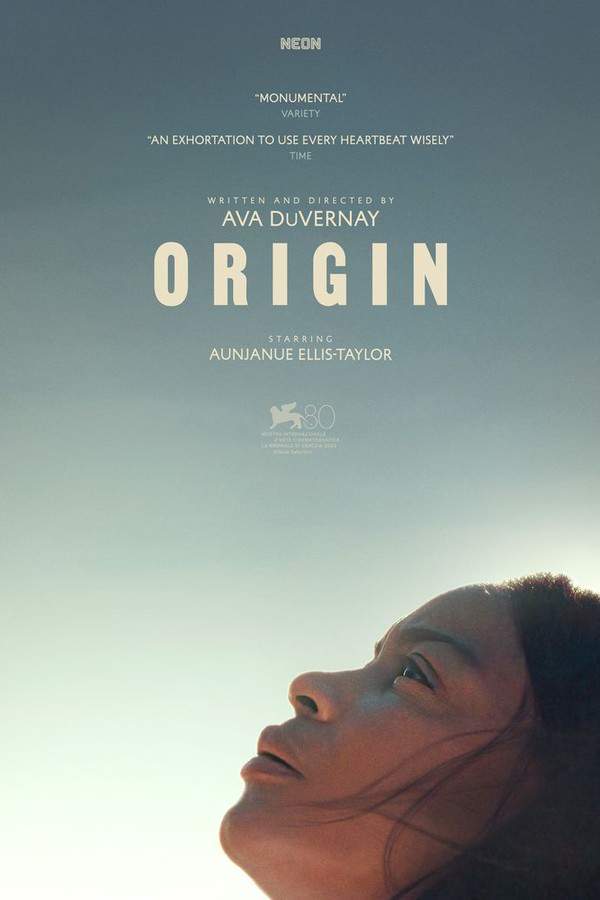
Origin 2023

Directed by

Ava DuVernay
Made by

ARRAY Filmworks
Where to Watch Origin
See current US streaming, rental, and purchase options for Origin (2023) via JustWatch.

Streaming availability powered by 
Origin Plot Summary
Read the complete plot summary and ending explained for Origin (2023). From turning points to emotional moments, uncover what really happened and why it matters.
Grappling with tremendous personal tragedy, writer Isabel Wilkerson Aunjanue Ellis-Taylor sets herself on a path of global investigation and discovery as she writes Caste: The Origins of Our Discontents. The film uses Wilkerson’s scholarly drive to thread together big questions about how people are sorted into hierarchies, insisting that prejudice is not limited to race alone but is deeply shaped by the idea of caste that orders society from birth to death.
Her journey begins in the wake of a contemporary tragedy: the killing of Trayvon Martin. That event prompts a broader inquiry into how social hierarchies operate across borders and eras. Wilkerson argues that caste can dictate who is afforded humanity, safety, and dignity even when skin tone is not the sole marker of discrimination. In this light, she examines how different societies have built systems of subordination that persist beyond explicit racial lines, such as the stratifications present in India’s caste structure, where people are assigned status regardless of nationality or ethnicity. The exploration extends to historical injuries that shaped modern hatred, including the way Jewish people were targeted in Nazi Germany, where the categories of “subjugation” and “extermination” reveal the brutal endpoints of prejudice when it is codified into law and policy.
At social gatherings and intimate conversations, Wilkerson tests her ideas against the perspectives of friends who seem cordial but do not fully grasp how intertwined forms of bigotry can be. The dialogue in these moments underscores how easy it is for people to misread the depths of caste as merely about individual prejudice rather than as a pervasive social order. Throughout the book’s development, she also navigates the toll of that intellectual pursuit on her personal life, including the loss of her husband Brett Hamilton, a white man who stood by her as she wrestled with weighty questions; the death of her elderly mother Ruby Wilkerson; and the passing of her cousin Marion Wilkerson. These bereavements haunt her, offering poignant anchors to the human costs of living under a rigid caste system, and she sometimes imagines speaking to those who have died, such as a Black boy named Al Bright who was part of a winning Little League team but denied entry to a public pool because of prejudice.
In parallel to Wilkerson’s personal biography, the documentary traces a powerful archival thread. Her research leads to Germany, where she uncovers evidence that the Nazis drew inspiration from certain American racial laws as they crafted their own system of racial hierarchy. The narrative also juxtaposes the intimate with the historical: a love story set against the German regime shows how individuals on opposite sides of the barrier of caste attempted to find common humanity, even as oppression tore them apart. The history of these relationships offers a stark mirror to the modern insistence that caste, not just race, remains a living force in how people are treated.
A crucial portion of the film revisits the story of two married Black researchers, Allison Davis and [Elizabeth Davis](/actor/j Jasmine-cephas-jones) Stubbs Davis, who collaborated with white researchers and other allies on an undercover project to better understand segregation in America. This collaboration culminated in the 1941 work Deep South: A Social Anthropological Study of Caste and Class in a Southern City, a landmark that helped illuminate how law, culture, and social norms reinforced discriminatory structures. The lynching of a Black man—met with a white audience that often treated the act as spectacle—appears in vivid, painful detail, reminding viewers that the violence woven into these systems has long preceded and outlived the narratives that try to domesticate them.
As the project deepens, Wilkerson traces how the concept of caste can illuminate questions that race alone cannot answer. Her journey carries her to India, where she visits the home and legacy of Dr. Ambedkar, a leader who championed the rights of the Dalit people at the bottom of the Indian caste hierarchy. The film culminates in Wilkerson taking the stage to speak about her developing manuscript, framing caste as a framework that more comprehensively explains social hierarchy and anti‑bigotry than race alone can—one that can mobilize people to challenge entrenched prejudice.
The closing moments of the documentary emphasize the transformative power of the idea. An onscreen monologue sums up the project’s impact, noting that Caste became a number-one New York Times nonfiction bestseller around the time of the U.S. presidential election in November 2020 and spent substantial time on the lists, signaling not just scholarly achievement but a broad public engagement with questions of hierarchy, dignity, and justice. The film leaves viewers with a detailed, nuanced portrait of how caste operates across cultures and eras, and how an ambitious work of social history can contribute to a more inclusive understanding of humanity.
Note: Names linked above connect to their respective actors on this site for first-time mentions of each character.
Origin Timeline
Follow the complete movie timeline of Origin (2023) with every major event in chronological order. Great for understanding complex plots and story progression.
Personal tragedy redirects her career
Grappling with tremendous personal loss, Isabel Wilkerson channels her grief into a global investigation as she begins drafting Caste: The Origins of Our Discontents. The process marks a shift from traditional journalism to a broader inquiry into systems of oppression. Her personal life and professional pursuit become intertwined as she seeks meaning through research.
Consulted after Trayvon Martin killing
Wilkerson is consulted for her opinion after the killing of Trayvon Martin, grounding her work in contemporary racial justice debates. She argues that bigotry can operate beyond race alone, inviting readers to consider caste as a broader framework. The moment anchors her project in real-world conversations about injustice.
Expands the concept of caste beyond race
She argues that caste structures can shape discrimination even where populations share the same ethnicity or 'race.' The discussion uses cross-cultural examples to show how social hierarchy persists across borders. This sets the foundation for her global examination of prejudice.
Germany visit and discussions about slavery vs Holocaust
Wilkerson travels to Germany and discusses with friends how the histories of slavery and the Holocaust intersect and diverge. She debates subjugation versus extermination, probing the moral weight of systems of power. The conversations reveal parallels as well as the limits of comparing atrocities.
Nazi-Gentile romance in historical arc
The narrative includes a couple in Nazi Germany: a Gentile Nazi party member falls in love with a Jewish woman. They attempt to escape together, but she is captured and sent to a camp. The arc illustrates how intimate relationships are crushed by state-sponsored anti-Semitism.
Undercover study of segregation in America
The book recounts the work of Allison Davis and Elizabeth Stubbs Davis, Black researchers who collaborate with Burleigh and Mary Gardner on an undercover project about segregation. Their fieldwork contributes to the 1941 book Deep South: A Social Anthropological Study of Caste and Class in a Southern City. Their story highlights cross-racial collaboration under oppressive conditions.
Lynching scene
The lynching of a Black man unfolds before a white audience, who treat it as a show. The crowd's reactions show the entertainment value and normalization of racial terror in American society. Wilkerson uses the memory to illustrate how caste-like hierarchies endure.
Choosing to write about caste
Wilkerson resolves to write a book centered on caste as a framework that can illuminate more than race alone. She outlines how systems of hierarchy cross cultures and borders. This decision marks the shift from analysis to producing a full manuscript.
Visit to India and Ambedkar's home
She travels to India and visits the home of Dr. Ambedkar, who championed the rights of the Dalit ('untouchable') peoples. The trip deepens her understanding of caste as a lived social order and informs the book's global scope. The Indian leg anchors the argument in historical and moral lineage.
Stage talk about Caste
Wilkerson speaks about her forthcoming work on stage, explaining how the caste framework helps illuminate bigotry in ways that race alone cannot. The talk positions caste as a universal lens for analyzing social hierarchy, and it signals the transition from private study to public discourse. The moment marks a tipping point toward widespread engagement with the idea.
Caste as bestseller and public reception
An onscreen monologue notes that Caste becomes a number-one New York Times nonfiction bestseller around the time of the November 2020 U.S. presidential election. The book spends ample time on the best-sellers list, reinforcing its impact on public conversation. The success elevates the framework of caste into mainstream discourse.
Closing reflection on fighting bigotry
The film closes with a synthesis of Wilkerson's insights, showing how caste explains many forms of oppression and offers a practical path to action. The monologue ties personal loss, historical memory, and global study into a call for understanding and reform. The work is presented as a living framework for combating bigotry.
Origin Characters
Explore all characters from Origin (2023). Get detailed profiles with their roles, arcs, and key relationships explained.
Isabel Wilkerson
A renowned writer and researcher who undertakes a global investigation into caste and bigotry, using archives, interviews, and personal reflection. Her journey is marked by profound personal loss, fueling both professional ambition and ethical resolve. She confronts difficult questions about how systems of hierarchy shape lives across nations.
Brett Hamilton
Isabel's husband, a white man whose presence anchors her personal life amid loss. His death or absence leaves a lasting void that informs her emotional and intellectual quest. He appears in memories and as a counterpoint to the social theories she pursues.
Ruby Wilkerson
Isabel's elderly mother, a figure whose life and passing evoke themes of family lineage and intergenerational memory. Her presence grounds the narrative in personal history even as the public work seeks universal explanations. Her story is a touchstone for resilience and gratitude.
Marion Wilkerson
Isabel's cousin, part of a close-knit family whose experiences illuminate how communities hold both pain and humor. Marion's presence underscores kinship amid broader social analysis. She appears in moments that connect personal and historical narratives.
Allison Davis
A Black researcher who collaborates on undercover work with Elizabeth Davis to study segregation, producing the 1941 Deep South project. Her partnership and expertise demonstrate how collaboration across race and class can uncover systemic patterns. Her work anchors the film's empirical backbone.
Elizabeth Davis
Allison's partner in the study; a white researcher whose collaboration helps expose segregation and contributes to the Deep South project. Their joint work illustrates how shared inquiry can reveal structural inequalities. Her role highlights the importance of scholarly partnerships in social analysis.
August Landmesser
A German man who bravely defies the Nazi regime by standing with a Jewish woman, a symbol of resistance in a time of oppression. His story underscores acts of individual courage within a brutal system. The sequence links personal defiance to broader questions of morality during the era.
Trayvon Martin
Memory of a Black boy whose life embodies innocence challenged by racial prejudice. Recalled within personal recollections and social commentary, his story serves as a focal point for discussions of race and justice. The portrayal anchors the narrative's contemporary relevance.
Irma Eckler
A participant at social gatherings whose interactions with Wilkerson reveal the complexities of expressing ideas about caste and prejudice. Irma embodies the everyday friction between individual belief and structural inequality. Her scenes highlight how conversations shape public understanding.
Sabine
A character who participates in intellectual discussions and social settings where Wilkerson's ideas are explored and questioned. Sabine's presence helps illustrate the misinterpretations and challenges in discussing caste across cultures. She acts as a catalyst for dialogue within the narrative.
Origin Settings
Learn where and when Origin (2023) takes place. Explore the film’s settings, era, and how they shape the narrative.
Time period
1930s–2020s
Spanning the 1930s–1940s Nazi Germany, mid-20th-century America, and contemporary present-day sequences, the film traces how caste and bigotry persist across eras. It also follows the rise of Isabel Wilkerson's book and the social discourse around its publication around the 2020 elections. The time frame thus encompasses both historical events and their modern resonance.
Location
Germany, United States, India
The film traverses three primary settings: Germany, the United States, and India. In Germany, it probes Nazi-era racial laws and archival records; in the United States, it navigates Jim Crow, segregated spaces, and civil rights histories; in India, it visits the home of Dr. Ambedkar and the Dalit rights movement. Together, these places illustrate how discrimination operates across borders and through history.
Origin Themes
Discover the main themes in Origin (2023). Analyze the deeper meanings, emotional layers, and social commentary behind the film.
🧭
Caste & Race
Isabel Wilkerson's exploration shows how caste operates beyond race alone, shaping who is treated as inferior and who advances. The film contrasts Jim Crow in America, Nazi racial policy, and Indian caste to reveal a shared logic of hierarchy. Through archival footage, interviews, and intimate memories, caste is presented as a structural system that governs access to dignity, safety, and opportunity.
🕯️
Memory & Loss
Personal grief anchors the narrative, with Wilkerson mourning her husband, mother, and cousin as she pursues a broader historical project. Memory acts as both fuel for scholarship and a haunting presence in the present. The film uses memory to connect intimate experiences with collective histories, showing how the past informs present understanding.
🔎
History & Truth
Archival inquiry drives the storytelling, revealing how sources shape our understanding of discrimination. The film juxtaposes German archives, American records, and diaspora narratives to expose biases and omissions. It suggests that truth emerges when personal narratives intersect with documentary evidence.
📚
Story & Change
Wilkerson's choice to write and publish Caste is portrayed as a deliberate act to shape public discourse. The film argues that a well-crafted narrative can illuminate hidden patterns and mobilize action across communities. The power of storytelling becomes a tool for social transformation.
🌐
Global Solidarity
By linking experiences across Germany, India, and the United States, the film emphasizes shared humanity beyond borders. It underscores how oppression operates in diverse contexts and why cross-cultural understanding is essential. The narratives reinforce a call for empathy and collective responsibility.

Coming soon on iOS and Android
The Plot Explained Mobile App
From blockbusters to hidden gems — dive into movie stories anytime, anywhere. Save your favorites, discover plots faster, and never miss a twist again.
Sign up to be the first to know when we launch. Your email stays private — always.
Explore the mobile appOrigin Ending Explained
Unravel the ending of Origin (2023) with our detailed explanation. Understand the final scenes, character fates, and unresolved questions.
In the climax of the film, Isabel travels to India seeking to understand the caste system more deeply, especially the plight of Dalits. She visits historical sites and learns about how deeply rooted caste discrimination is, even comparing it to other forms of systemic oppression like Nazi barbarity and racial segregation in America. The film emphasizes that these are different expressions of the same underlying ideology of superiority and subjugation. After her trip, Isabel’s journey is marked by the loss of her beloved cousin Marion, which adds a layer of personal grief to her quest. Her late phone call to Marion, which remains unanswered, symbolizes her attempt to find closure, yet it remains ambiguous whether Marian received her farewell.
Despite her efforts, the film makes it clear that Isabel eventually writes her groundbreaking book, Caste: The Origin of Our Discontents. Its existence suggests that her journey was ultimately worth it, as her insights provide a profound understanding of how casteism persists across different societies and eras. The story ends on a note of quiet resolve, with Isabel having gained clarity about the universal nature of systemic oppression—an understanding that transcends borders and time, linking the suffering of Trayvon Martin, Nazi victims, Dalits, and African Americans into one continuum of human struggle. The film leaves viewers with a sense of hope, that acknowledging this shared history can be the first step toward meaningful change, even if the journey to fight casteism and inequality is long and arduous. In this way, the ending underscores the importance of awareness, empathy, and the enduring human spirit in confronting systemic oppression.
Origin Spoiler-Free Summary
Discover the spoiler-free summary of Origin (2023). Get a concise overview without any spoilers.
In a present‑day United States still wrestling with the aftershocks of a deeply felt national tragedy, the film opens on a landscape where personal grief and collective history intertwine. The tone is contemplative yet urgent, a documentary canvas that blends quiet interviews, lingering shots of archives, and the subtle hum of everyday life to suggest that the questions it raises are both intimate and universal. From bustling city streets to distant research libraries, the world feels simultaneously familiar and expansive, inviting viewers to sense the hidden structures that shape daily existence.
Isabel Wilkerson stands at the heart of this exploration. Still reeling from an unexpected loss, she channels her sorrow into a scholarly quest, determined to trace the invisible lines that order societies. Her voice is steady, grounded in both academic rigor and palpable emotion, and the film follows her as she gathers clues, confronts uncomfortable truths, and sketches a new framework for understanding hierarchy. Early conversations with friends and colleagues reveal a tension between common perceptions of prejudice and the deeper, more pervasive system she proposes.
The documentary’s scope widens as Isabel travels beyond American borders, moving through archives in Europe, listening to stories from South Asia, and encountering the legacies of movements that have long grappled with similar stratifications. The visual style shifts with each locale, moving from candle‑lit study rooms to sun‑bathed cityscapes, underscoring how the concept she investigates reverberates across cultures and eras. Brief, poetic interludes hint at the personal cost of such inquiry, while the steady rhythm of her research conveys a quiet resilience.
Through its measured pacing and richly layered storytelling, the film cultivates a mood of thoughtful curiosity. It invites the audience to sit beside Isabel as she pieces together history, language, and lived experience, suggesting that the insights she uncovers may illuminate the pathways toward a more inclusive sense of identity—without ever revealing the precise conclusions she will reach.
Movies with Similar Twists and Themes
Uncover films that echo the narrative beats, emotional arcs, or dramatic twists of the one you're exploring. These recommendations are handpicked based on story depth, thematic resonance, and spoiler-worthy moments — perfect for fans who crave more of the same intrigue.






Featured on this page

What's After the Movie?
Not sure whether to stay after the credits? Find out!
Check out our other apps:

SAT Sphere
Build confidence for the Digital SAT.

Mori Atlas
Discover wild places worth protecting.

Luntero
Search smarter for a home in Amsterdam.

Plot Explained
Unravel movie endings and hidden clues.

Pokechamp
Dive into Pokémon data and battle logic.

Driving Theory
Get ready for your European theory test.

Movie Dust
Plan your next cinema trip with ease.

Musemap
Find art and culture as you travel.

Selkobase
Compare credentials before committing.

Local Manual
Turn an unfamiliar country into practical next steps.

Lernavi
Compare school systems before your next move.

GymRoam
Find a workout stop wherever your plans take you.
Explore Our Movie Platform
New Movie Releases (2026)
Famous Movie Actors
Top Film Production Studios
Movie Plot Summaries & Endings
Major Movie Awards & Winners
Best Concert Films & Music Documentaries
Movie Collections and Curated Lists
© 2026 What's After the Movie. All rights reserved.
Privacy Policy