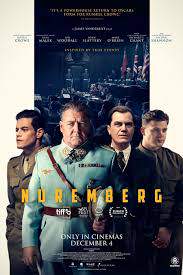
What Is Nuremberg About?
The premise of Nuremberg in 304 words, with nothing given away. The full story and the ending follow below.
Set in the shadow of the Second World War’s end, Nuremberg opens on a world staggering from the revelations of Nazi atrocities and grappling with how to hold power accountable. The film centers on three men whose fates become intertwined in this unprecedented moment of historical reckoning. Robert H. Jackson, a determined American prosecutor portrayed by Michael Shannon, takes up the mantle of chief Allied counsel with the ambitious vision of establishing an international tribunal — a legal first that could shape the future of justice itself. His resolve sets the stage for a courtroom drama where the rule of law must confront the machinery of a regime built on unspeakable cruelty.
Opposite Jackson stands Hermann Göring, played by Russell Crowe, Hitler’s former second-in-command, whose surrender marks one of the war’s final capitulations. Confined alongside other surviving Nazi leaders, Göring remains defiantly composed, a man of considerable intelligence and charisma who understands the power of spectacle as much as statecraft. Into this volatile mix steps Douglas Kelley, a young U.S. Army psychiatrist portrayed by Rami Malek, tasked with evaluating the mental state of the imprisoned leaders. His professional curiosity soon becomes a deeply personal confrontation as he sits across from Göring in a psychological duel that blurs the boundaries between doctor and patient, interrogator and witness.
The film captures the tension between the clinical precision of the courtroom and the raw, human weight of confronting evil. Kelley finds himself drawn into Göring’s orbit, while Jackson prepares to argue a case that demands the world finally reckon with what was done in its name. Nuremberg explores how justice is constructed not only through evidence and testimony, but through the quieter, more uncertain battles waged in private conversations and unspoken exchanges — a portrait of conscience under pressure, where every word carries the weight of history.
What Happens in Nuremberg?
The complete story of Nuremberg, from the first scene to the last, in 789 words (about 3 minutes). Spoilers throughout. Names in the text link to 10 cast member pages.
Spoilers ahead
On May 7, 1945, just one day before the surrender of Nazi Germany to the Allies, Reichsmarshall Hermann Göring, portrayed by Russell Crowe, along with his family, voluntarily surrenders to U.S. forces stationed in Austria. This significant event reaches Associate Justice Robert H. Jackson, played by Michael Shannon, who is informed of Göring’s capture during a crucial discussion with his secretary, Elsie, expertly depicted by Wrenn Schmidt. They engage in a debate regarding the establishment of an international tribunal aimed at charging the surviving leaders of the Nazi regime with their multitude of war crimes. While Elsie expresses her concerns about the lack of legal precedents for such actions, Jackson remains optimistic, seeing this tribunal as a rare chance to inaugurate a new legal framework.
Initially, the U.S. government shows hesitance towards Jackson’s proposal, favoring rapid executions instead. Nevertheless, Jackson’s determination shines through as he secures the backing of Pope Pius XII by subtly hinting at his understanding of the Pope’s controversial associations with the Nazis. Meanwhile, U.S. Army psychiatrist Lt. Col. Douglas Kelley, portrayed by Rami Malek, is called upon to assess the mental health of 22 prominent Nazi leaders, including Göring, who are in Allied custody and facing prosecution.
Kelley begins his evaluation at Bad Mondorf, Luxembourg, assisted by interpreter Sgt. Howie Triest (Leo Woodall). His early interactions with Göring appear cordial, although other prisoners like Robert Ley and Julius Streicher express contempt towards him. Kelley finds Göring to be intelligent yet deeply narcissistic, sparking his ambition to pen a tell-all book based on his observations.
As plans progress, Jackson and British lawyer Sir David Maxwell Fyfe (Richard E. Grant) are appointed as prosecuting counsels for the newly formed International Military Tribunal in Nuremberg, Germany. This tribunal seeks to address a range of serious charges including crimes against peace, war crimes, and crimes against humanity. As the trial approaches, Kelley and Göring’s relationship evolves, with Göring helping Kelley communicate with his wife Emmy (Lotte Verbeek) and daughter Edda. Kelley’s rapport with the Göring family intensifies, as he serves as a conduit for their messages, while also receiving requests from Jackson to keep him informed about the prisoners’ legal defenses.
Tragedy strikes when Ley commits suicide in his cell, prompting Col. Burton Andrus (John Slattery) to call upon psychologist Dr. Gustav Gilbert (Colin Hanks) for a second opinion. The trial begins with Jackson delivering a powerful opening statement that emphasizes the urgent need for accountability. Göring, alongside his fellow detainees, pleads not guilty, despite the mounting evidence being presented against them. As the proceedings unfold, Kelley discovers that Göring’s family has been arrested due to his involvement in art thefts, leading him to request intervention from Andrus.
During the trial, harrowing footage of the atrocities committed by the Nazi regime is shown, deeply unsettling Kelley as he confronts Göring, who continues to claim ignorance about these horrific events. Göring displays a defensiveness concerning the regime’s actions, leading Kelley to despair and subsequently drown his sorrows in alcohol. In a drunken stupor, he inadvertently discloses sensitive discussions with Göring to a journalist from The Boston Globe, Lila (Lydia Peckham), resulting in dire consequences as Andrus relieves Kelley of his duties, despite having successfully negotiated the release of Emmy and Edda.
The narrative further unfolds as Triest confides in Kelley about his Jewish heritage and the tragic fate of his family during the Holocaust, warning of the complacency that allowed such atrocities to persist. As Kelley decides to surrender his notes to Jackson and Fyfe, he anticipates Göring’s attempts to utilize the trial as a platform for a defense of the regime’s actions.
Göring’s evasiveness in response to Jackson’s cross-examination eventually leads to his brazen admission of loyalty to Hitler, a miscalculation that allows Fyfe to corner him effectively. Consequently, Göring is sentenced to death by hanging. In their final meeting, Kelley comes to terms with the darkness embodied by Göring.
As the gripping events unfold, on the night before his scheduled execution, Göring takes his own life by ingesting cyanide, eliciting anger from Andrus. Meanwhile, the remaining executions occur, marked by a distressing incident involving Streicher, who struggles at the gallows. Triest, aiming to confront Streicher with his identity, instead chooses to provide comfort.
Returning to the U.S., Kelley, haunted by his experiences in Nuremberg, publishes a work titled 22 Cells in Nuremberg, but finds it challenging to find an audience. The narrative encapsulates the aftermath of this impactful trial, illustrating Kelley’s descent into alcoholism and his attempts to warn against the potential resurgence of such regimes. In a tragic turn, Kelley ultimately takes his life in 1958. The film concludes with a poignant acknowledgment of Jackson’s efforts, which provide a crucial legal foundation for prosecuting war crimes internationally.
Nuremberg Timeline: Every Key Event in Order
15 key events in the order they happen, from “Göring Surrenders” to “Legacy of the Trials”. 6 events name a place, across 3 locations.
- 1
Göring Surrenders
On May 7, 1945, Hermann Göring surrenders to U.S. forces in Austria, along with his family. This event occurs just one day before Nazi Germany officially surrenders to the Allies, marking a significant moment in the end of WWII.
When:May 7, 1945 Where:Austria
- 2
Jackson's Tribunal Discussion
Following Göring's arrest, Justice Robert Jackson discusses the establishment of an international tribunal for war crimes with his secretary, Elsie Douglas. Despite her conservative views, Jackson is enthusiastic about setting a legal precedent by prosecuting the surviving Nazi leadership.
- 3
U.S. Army Psychiatrist's Evaluation
U.S. Army psychiatrist Lt Col. Douglas Kelley is called to evaluate 22 Nazi leaders held by the Allies, including Göring. Initially, the interactions are civil, allowing Kelley to assess Göring as intelligent yet extremely narcissistic.
Where:Bad Mondorf, Luxembourg
- 4
Formation of the Tribunal
Jackson and British barrister Sir David Maxwell Fyfe are appointed as prosecution counsels for the newly formed International Military Tribunal in Nuremberg, Germany. They charge the detainees with severe crimes including crimes against humanity and conspiracy.
Where:Nuremberg, Germany
- 5
Göring's Rapport with Kelley
As the trial approaches, Kelley develops a warm rapport with Göring, who aids him in examining Rudolf Hess in exchange for being allowed contact with his family. This interaction reveals the complex psychological dynamics at play between the captor and the captives.
- 6
Ley's Suicide
Before the trial begins, Robert Ley commits suicide in his cell by strangling himself. This tragic event leads the warden to call in a psychologist for a second assessment, demonstrating the intense psychological pressure faced by the detainees.
- 7
Trial Opening Statement
During the trial's opening, Justice Jackson delivers a powerful statement calling for accountability for the crimes committed by the Nazi regime. Göring, however, remains defiant, pleading not guilty along with other defendants.
Where:Nuremberg, Germany
- 8
Atrocities Footage Shown
As the trial progresses, the prosecution presents harrowing footage depicting the atrocities of the Nazi regime. This revelation disturbs Kelley, leading to a confrontation with Göring, who continues to deny his knowledge of the gruesome actions.
- 9
Kelley’s Alcoholism Strikes
After facing the undeniable truths presented in court, Kelley succumbs to alcoholism, revealing private discussions with Göring to a journalist, which puts his position at risk. This marks a turning point in his moral journey during the trial.
- 10
Göring's Defense Strategy
Göring attempts to manipulate the trial, portraying his actions as misunderstood and reflecting loyalty to Hitler. This strategy ignites Jackson's outrage, resulting in a fierce exchange that leads to Göring being cornered by Fyfe.
Where:Nuremberg, Germany
Show the other 5 events of Nuremberg Hide the last 5 events
- 11
Göring's Sentencing
At the trial's conclusion, Hermann Göring is sentenced to death by hanging. This verdict signifies a crucial moment in international law and the pursuit of justice against war crimes.
Where:Nuremberg, Germany
- 12
Göring's Suicide
On the night before his execution, Göring commits suicide by ingesting cyanide. This shocking act leaves the authorities infuriated and the implications of his death resonate deeply through the ongoing trials.
When:October 15, 1946
- 13
Post-Trial Executions
Despite Göring's suicide, the executions of other Nazi leaders proceed as planned. The challenges during these executions highlight the psychological toll on those involved, with Streicher suffering a breakdown as he approaches the gallows.
- 14
Kelley's Tell-All Publication
After returning to the United States, Kelley publishes his experiences in '22 Cells in Nuremberg', which struggles to find an audience. His memoir reveals the enduring scars of his experiences during the trials and serves as a warning for future regimes.
- 15
Legacy of the Trials
The efforts of Justice Jackson at Nuremberg lay a foundational framework for the future prosecution of war crimes. As the world reflects on these events, the lessons learned resonate in today's pursuit of global justice.
Who Are the Main Characters in Nuremberg?
4 characters, among them Robert H. Jackson (Michael Shannon), Hermann Göring (Russell Crowe) and Lt Col. Douglas Kelley (Rami Malek): who each one is and the part they play in the story. Every profile links to the actor’s page.
-

Robert H. Jackson (Michael Shannon)
Played by Michael Shannon
Robert H. Jackson is portrayed as a committed and passionate Associate Justice, advocating for an international tribunal to hold Nazi leaders accountable. He is characterized by his strong moral compass and determination despite facing significant opposition. Jackson's efforts are pivotal in shaping the proceedings of the Nuremberg Trials.
- ⚖️ Justice
- 🧠 Intelligence
- 🏛️ Leadership
-

Hermann Göring (Russell Crowe)
Played by Russell Crowe
Hermann Göring is depicted as a complex and narcissistic figure, exuding charm while masking his malevolence. His interactions provide insight into the mindset of Nazi leadership, showcasing his evasiveness and denial about the regime’s atrocities. Göring’s ultimate actions reveal a profound moral cowardice beneath his bluster.
- 🦅 Leadership
- 😈 Manipulation
- 🕵️♂️ Deception
-

Lt Col. Douglas Kelley (Rami Malek)
Played by Rami Malek
Lt Col. Douglas Kelley is a U.S. Army psychiatrist tasked with evaluating Nazi leaders, portrayed as insightful yet conflicted. His initial rapport with Göring highlights the psychological complexities of their interactions, but he ultimately faces the moral weight of his role amidst the trials. Kelley’s personal trauma shapes his actions and decisions.
- 🧠 Psychology
- ⚖️ Morality
- 📖 Truth
-

Sir David Maxwell-Fyfe (Richard E. Grant)
Played by Richard E. Grant
Sir David Maxwell-Fyfe, a British barrister, is portrayed as shrewd and strategic, taking on the role of prosecuting counsel with a focus on establishing a strong case against the Nazi defendants. His interactions with Göring display a calculated approach to obtaining confessions and admissions of guilt. Fyfe's contributions are essential to the trial's direction.
- ⚖️ Strategy
- 🏛️ Leadership
- ✎ Advocacy
Where and When Is Nuremberg Set?
Nuremberg is set in Nuremberg, Luxembourg and Austria (1945-1946). Here is why the time and place matter to the story.
When
1945-1946
The movie predominantly takes place in the immediate aftermath of World War II, during a time of reckoning for Nazi war criminals following Germany's surrender. The Nuremberg Trials mark a significant shift in international law and human rights accountability, setting a precedent for future war crimes tribunals.
Where
Nuremberg, Luxembourg, Austria
Nuremberg, a city in Germany, is historically significant for hosting the Nuremberg Trials, where major Nazi war criminals were prosecuted after World War II. Luxembourg serves as the initial context for the narrative, where Lt Col. Douglas Kelley evaluates Nazi leaders. Austria is pivotal as it is where Hermann Göring surrenders to U.S. forces.
- 🌍 Location
- 🏛️ Historical Site
What Are the Themes of Nuremberg?
3 ideas the story keeps returning to, among them Justice, Psychology and Truth.
-
01
Justice
The theme of justice resonates throughout the film, exploring the moral complexities of prosecuting war crimes. Jackson’s push for a formal tribunal signifies a striving for accountability in the face of unprecedented atrocities. The film challenges the adequacy of legal systems in addressing the horrors of war.
-
02
Psychology
Psychological manipulation and understanding play vital roles, particularly in Kelley’s interactions with Göring and his evaluations of Nazi leaders. The film illustrates the complexities of human behavior under extreme circumstances, emphasizing the psychological toll of wartime traumas on both the perpetrators and the observers.
-
03
Truth
Truth emerges as a critical theme, especially concerning the testimonies and defenses presented at the trials. As characters grapple with their narratives and memories, the distinction between perception and reality becomes blurred, underscoring the challenges of confronting historical atrocities.
How Does Nuremberg End?
The last act of Nuremberg and what it means, in 368 words. The ending lands as mixed. Big spoilers: read the plot summary first if you have not seen it.
The final act, in full
In the final hours of the film the courtroom at Nuremberg becomes the stage for the very fate the prisoners tried to avoid. Hermann Go‑Rieng, who had arrived at the American prison defiantly confident in his own cleverness, finally faces the British prosecutor David Fyke. Fyke exploits Goering’s vanity, forcing him to admit his blind loyalty to Hitler and his role in the genocide. The confession seals his conviction; the tribunal sentences him to death by hanging. Yet the bragging Nazi still clings to a last‑minute trick—a hidden potassium‑cyanide capsule that he swallows just before the noose is dropped, turning his execution into a self‑inflicted escape and leaving the judges stunned.
The other twenty‑one defendants meet the same grim end, each hanged as the world watches history being written. Amid the hangings, the film returns to Douglas Kelley, the army psychiatrist who began his assignment by promising to keep the Nazis from killing themselves. His personal ambition—turning the inmates’ confessions into a bestseller—has already unraveled: he loses his job after leaking confidential details to a journalist, and the only prisoner who truly breaks under pressure, Robert Ley, hangs himself using a makeshift rope despite Kelley’s notes proclaiming a “successful” treatment.
A decisive encounter with the court translator Howard Triest forces Kelley to confront his own motives. Triest, a survivor of his family’s Holocaust, reminds Kelley that the trial matters not only as a legal precedent but as an act of moral reckoning for countless victims. Moved, Kelley abandons his self‑serving plan and hands over the full record of his sessions, allowing the prosecution to use the psychologists’ insights in building its case.
The epilogue follows Kelley back to the United States. He finally publishes his book, 22 Cells in Nuremberg, but it flops, and his subsequent career as a radio commentator is marked by cynical reflections on power and oppression—suggesting he never fully reclaimed his conscience. The lingering irony is that, years later, the once‑ambitious doctor succumbs to the same poison he once watched Goering use, taking his own life with cyanide in 1958. His death mirrors the very escape he once facilitated, underscoring how the shadows of Nuremberg continued to haunt those who had witnessed its horrors.
What Kind of Film Is Nuremberg?
Dark in tone, with steady pacing and a complex story, going by the plot summary.
- Tone
- Dark
- Pacing
- Steady
- Story
- Complex
- Intensity
- High
- Ending
- Mixed
A grave historical drama unfolding as a tense courtroom and psychological showdown, where the immense weight of Holocaust atrocities hangs over every legal argument and personal reckoning.
- somber
- grave
- tense
- weighty
- oppressive
- contemplative
- war crimes
- justice and accountability
- Holocaust
- legal precedent
Content notes: genocide and Holocaust atrocities, suicide, executions, graphic concentration camp footage, alcohol abuse, war violence.
Quiz
How well do you remember Nuremberg? Test yourself on the story.