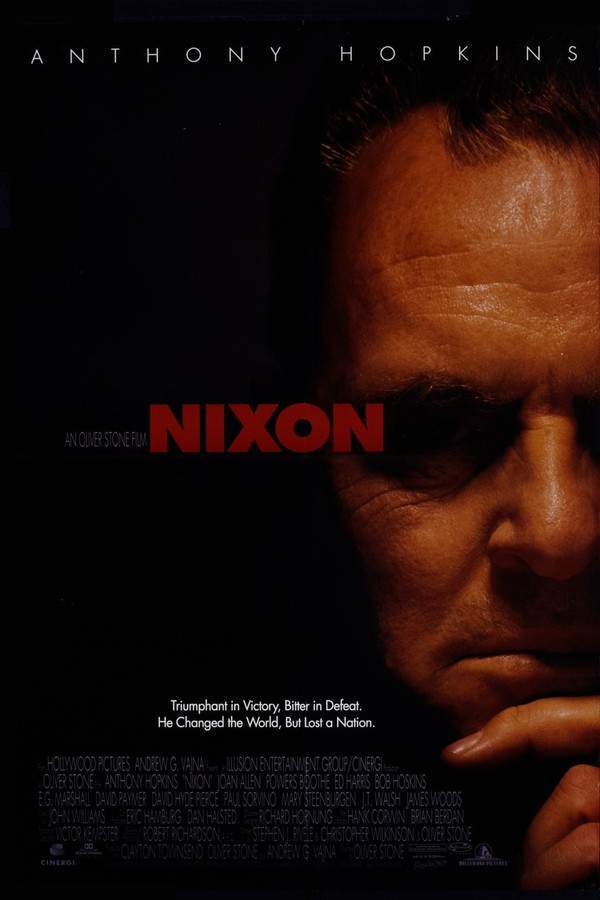
Nixon 1995

Directed by

Oliver Stone
Made by

Buena Vista Pictures
Where to Watch Nixon
See current US streaming, rental, and purchase options for Nixon (1995) via JustWatch.







Nixon Plot Summary
Read the complete plot summary and ending explained for Nixon (1995). From turning points to emotional moments, uncover what really happened and why it matters.
Nixon [Anthony Hopkins] faces a fall from grace as the Watergate break-in becomes a national scandal that unsettles the presidency and reshapes American politics. The film traces a crisis born in 1972, when the White House Plumbers break into the Democratic National Committee at the Watergate complex and are quickly arrested, setting off a domino effect of investigations, cover-ups, and public doubt. As the narrative unfolds, a sense of inevitability hangs over the characters and their choices, painting a portrait of power under pressure and the limits of loyalty.
A majority of the film is told through flashbacks drawn from Nixon’s taped conversations, a storytelling device that lets memory braid past events with present consequences. The earliest flashback centers on June 23, 1972, about a week after the break-in, in a tense meeting with H.R. Haldeman, John Ehrlichman, and Dean, where the existence and handling of the infamous “smoking gun” tape are discussed in muffled, urgent terms. The technique creates a sense of a mind continually revisiting decisions, consequences, and the escalating tension behind closed doors.
Henry Kissinger figures prominently in the drama, evolving from a respected professor to National Security Adviser and Secretary of State. Throughout the film, there is a persistent tug-of-war over who Kissinger truly is—an independent operator who values reputation in the press, or a steadfast loyalist who follows the president’s commands. Cabinet members blame him for leaks, yet Nixon cannot easily sever the complex relationship, raising questions about authority, trust, and the balance between national interest and personal allegiance.
Alongside the political chessboard, the movie also delves into Nixon’s private life and the scars of his upbringing. He reflects on a childhood shaped by loss, including the tuberculosis deaths of two brothers, an experience that deeply colors his worldview. The portrait suggests how long-standing stress, coupled with the demands of the office, intertwines with health struggles and dependence on medications. The portrayal includes Nixon’s bouts of phlebitis and pneumonia during the crisis, and it hints at a pattern of heavy use of medicines and alcohol as a way to cope with the pressures surrounding him.
The narrative also signals connections to earlier, weightier events in American history. It references the Bay of Pigs Invasion and touches on the Kennedy assassination, implying that decisions made in the Eisenhower era and during Nixon’s vice presidency set in motion a chain of outcomes that reverberate into Watergate. The film does not claim simple causation; rather, it suggests a tangled web of actions, consequences, and moral ambiguity that continues to haunt the era’s memory.
Pat Nixon [Joan Allen] is portrayed in a human light, a wife who shares in the mounting pressure and personal toll of the presidency. Her scenes underscore how the crisis touches not only the man in the spotlight but also the intimate circle around him, adding a personal dimension to a political catastrophe. The film uses intimate moments and public pressure to show how a presidency can become a relentless test of endurance for both partners in a marriage and for the family that supports them.
The climax arrives with the resignation and the departure from the White House on Army One, a stark visual that caps a career defined by crisis and controversy. As the extended end credits roll, real footage of Nixon’s state funeral in Yorba Linda appears, and a chorus of living ex-presidents—Gerald Ford, Jimmy Carter, Ronald Reagan, and George H.W. Bush—along with then-president Bill Clinton, bear witness to the enduring consequence and memory of a presidency marked by tumult, downfall, and a dramatic exit from power.
Nixon Timeline
Follow the complete movie timeline of Nixon (1995) with every major event in chronological order. Great for understanding complex plots and story progression.
Watergate break-in and arrests
In June 1972, White House Plumbers break into the Democratic National Committee headquarters at the Watergate complex. The botched operation triggers a years-long political scandal and a mounting series of investigations and arrests. The incident marks the starting point of the crisis that dominates the film.
Nixon activates the taping system
Nixon starts the audio-taping system, turning his presidency into a self-recorded chronicle. The tapes ignite a loop of recollections that frame the scandal. This device drives the film's structure and reveals the pressures behind key choices.
Smoking Gun tape session
In a key flashback, Nixon meets with Haldeman and Ehrlichman while Dean departs, and Nixon records the so-called 'smoking gun' tape. The conversation exposes covert methods used to protect the White House and undermines trust within his inner circle. The scene crystallizes a turning point as exposure becomes inevitable.
Hoover's death referenced
The tapes reference the death of J. Edgar Hoover, using it as emotional undercurrent and a symbol of an era ending. It heightens the tension inside the White House as investigators close in. The moment widens the scope from personal to national implications.
Kissinger's role and leaks debate
Henry Kissinger is depicted as a pivotal, controversial figure whose loyalty is questioned by Nixon and his staff. The film probes whether Kissinger leaks information to protect his image or remains a trusted adviser. Nixon wrestles with how to manage their fraught relationship.
Nixon's childhood and brothers' deaths
The film returns to Nixon's childhood, showing how the loss of two brothers to tuberculosis shaped his ambition and temperament. These memories provide a psychological context for his later decisions. The sequence links personal grief to a driven political persona.
Nixon's health and medication during the crisis
During the crisis, Nixon's health—phlebitis and pneumonia—is depicted along with heavy use of medications. The portrayal suggests that physical strain and chemical aids affected judgment and stamina. These details contribute to the portrait of a leader under siege.
Bay of Pigs and JFK assassination references
The film hints at Nixon's role in Cold War actions and the Bay of Pigs invasion, suggesting those actions helped set in motion forces that culminated in the Kennedy assassination and later Watergate. The implication ties past covert actions to the present turmoil. It frames Watergate as part of a longer arc of power and secrecy.
Nixon's resignation and departure on Army One
Facing overwhelming scandal, Nixon resigns as president and departs the White House lawn aboard a helicopter, signaling the end of his tenure. The moment is presented as a personal surrender and a historical hinge. The event closes the White House era with a stark visual of departure.
State funeral footage and subsequent attendance
The film intercuts real footage of Nixon's state funeral in Yorba Linda, showing prominent ex-presidents and the sitting president in attendance. The sequence connects the film to the broader arc of American history. It emphasizes the lasting legacy and the public memorial of a controversial figure.
End credits montage and national reflection
The closing montage shows living ex-presidents—Ford, Carter, Reagan, Bush—and Bill Clinton in attendance during the funeral sequence, situating Nixon's life within the continuum of the American presidency. The film invites reflection on how Watergate reshaped leadership and public trust. It frames the crisis as a turning point in modern American politics.
Personal life under strain: alcohol and prescriptions
The narrative implies that Nixon and his wife faced alcohol use and prescription medication challenges during the crisis. This personal dimension adds depth to the portrait of a leader under extraordinary pressure. It underscores how private vulnerabilities intersect with public responsibility.
Nixon Characters
Explore all characters from Nixon (1995). Get detailed profiles with their roles, arcs, and key relationships explained.
Richard Nixon (Anthony Hopkins)
Former U.S. President Nixon navigates a crisis of legitimacy as the Watergate scandal unfolds. The portrayal emphasizes his mix of determination, paranoia, and private struggles, including health issues and heavy medication. The film hints at Nixon's perceived responsibility regarding events around the JFK assassination, alluded to through references to the Bay of Pigs invasion. The tapes become a tool to confront both public duty and private despair.
H. R. Haldeman
Nixon's longtime Chief of Staff, part of the inner circle that argues over strategy and secrecy. The film depicts the tension between loyalty to the President and the consequences of actions revealed by the tapes. He participates in critical discussions around the 'smoking gun' tape and the escalating Watergate crisis.
John Ehrlichman
Nixon's top aide who grapples with leaks and the administration's handling of the Watergate crisis. The film traces his involvement in shaping responses and his struggle with loyalty versus accountability.
John Dean
White House Counsel during the crisis, central to the unfolding revelations and the discussions surrounding the 'smoking gun' tape. His role highlights the tension between legal counsel and political expediency as the scandal deepens.
Henry Kissinger
Prominent diplomat who features heavily in the film as National Security Adviser and Secretary of State. The narrative explores whether he is a loyal adviser or a leak-prone strategist, creating a rift between policy, reputation, and private information.
Nixon Settings
Learn where and when Nixon (1995) takes place. Explore the film’s settings, era, and how they shape the narrative.
Time period
1972–1974
Set during the Nixon presidency in the early 1970s, the narrative centers on the Watergate break-in, the tape recordings, and the resignation. It also uses flashbacks triggered by Nixon's tape system to reveal his past and ascent to power.
Location
White House, Washington, D.C.; Yorba Linda, California
The White House in Washington, D.C. serves as the political nerve center where pivotal decisions and confrontations unfold during the Watergate era. The film also depicts moments tied to Nixon's departure on Army One from the White House lawn and the later state funeral in Yorba Linda, California. These settings underscore how the presidency extends from the Oval Office to national ritual.
Nixon Themes
Discover the main themes in Nixon (1995). Analyze the deeper meanings, emotional layers, and social commentary behind the film.
🏛️
Power
Power and its consequences drive the narrative: Nixon's authority is challenged by advisors, leaks, and the cover-up. The film shows how leadership can become entangled with paranoia and public image. The 'smoking gun' tape crystallizes the tension between private intent and public record, leading to Nixon's resignation.
🧭
Legacy
Legacy and image dominate Nixon's choices as he weighs how history will judge him. The drama probes loyalty—whether to the president, to the truth, or to a crafted narrative. Kissinger's role adds to the strain between policy, reputation, and information.
🕰️
Memory
The plot hinges on memory and documented fact, using tapes and flashbacks to blur lines between recollection and reality. The film invites questions about what history records and what individuals remember. It emphasizes how personal memory intersects with public history during a national crisis.

Coming soon on iOS and Android
The Plot Explained Mobile App
From blockbusters to hidden gems — dive into movie stories anytime, anywhere. Save your favorites, discover plots faster, and never miss a twist again.
Sign up to be the first to know when we launch. Your email stays private — always.
Explore the mobile appNixon Spoiler-Free Summary
Discover the spoiler-free summary of Nixon (1995). Get a concise overview without any spoilers.
In a meticulously crafted portrait that oscillates between past and present, the film invites viewers into the shadowed corridors of American power where ambition, doubt, and history constantly collide. The storytelling leans on a lyrical, non‑linear structure, letting memory and consequence bleed into one another, while a muted palette of Washington’s interiors and quiet domestic spaces sets a tone of restrained intensity. The atmosphere feels both reverential and unsettling, suggesting that the weight of the nation’s expectations presses heavily on every decision.
At the heart of the narrative stands Richard Nixon, brought to life with a nuanced, almost brittle dignity. The audience glimpses a man shaped by early loss and relentless drive, whose inner world is as tumultuous as the political arena he inhabits. Echoes of his childhood hardships surface in moments of quiet reflection, hinting at the deep‑seated insecurities that propel his public resolve. A subtle undercurrent of physical frailty—persistent ailments and reliance on medication—adds a fragile humanity to his commanding presence.
Equally integral are the people who orbit his orbit. Pat Nixon emerges as a steady, empathetic companion, offering a glimpse into the personal sacrifices demanded by the highest office. Meanwhile, Henry Kissner—a figure whose intellect and ambition intertwine with the president’s own—embodies the complex dance of loyalty and rivalry that defines the administration’s inner circle. Their interactions are charged with unspoken tension, suggesting alliances that are as strategic as they are personal.
The film’s mood balances reverence for the grandeur of the presidency with an undercurrent of impending upheaval. Through careful composition and lingering close‑ups, it hints at a looming crisis that will test the limits of power, loyalty, and personal endurance, leaving the audience poised on the edge of an uncertain political horizon.
Movies with Similar Twists and Themes
Uncover films that echo the narrative beats, emotional arcs, or dramatic twists of the one you're exploring. These recommendations are handpicked based on story depth, thematic resonance, and spoiler-worthy moments — perfect for fans who crave more of the same intrigue.



Featured on this page

What's After the Movie?
Not sure whether to stay after the credits? Find out!
Check out our other apps:

SAT Sphere
Build confidence for the Digital SAT.

Mori Atlas
Discover wild places worth protecting.

Luntero
Search smarter for a home in Amsterdam.

Plot Explained
Unravel movie endings and hidden clues.

Pokechamp
Dive into Pokémon data and battle logic.

Driving Theory
Get ready for your European theory test.

Movie Dust
Plan your next cinema trip with ease.

Musemap
Find art and culture as you travel.

Selkobase
Compare credentials before committing.

Local Manual
Turn an unfamiliar country into practical next steps.

Lernavi
Compare school systems before your next move.

GymRoam
Find a workout stop wherever your plans take you.
Explore Our Movie Platform
New Movie Releases (2026)
Famous Movie Actors
Top Film Production Studios
Movie Plot Summaries & Endings
Major Movie Awards & Winners
Best Concert Films & Music Documentaries
Movie Collections and Curated Lists
© 2026 What's After the Movie. All rights reserved.
Privacy Policy