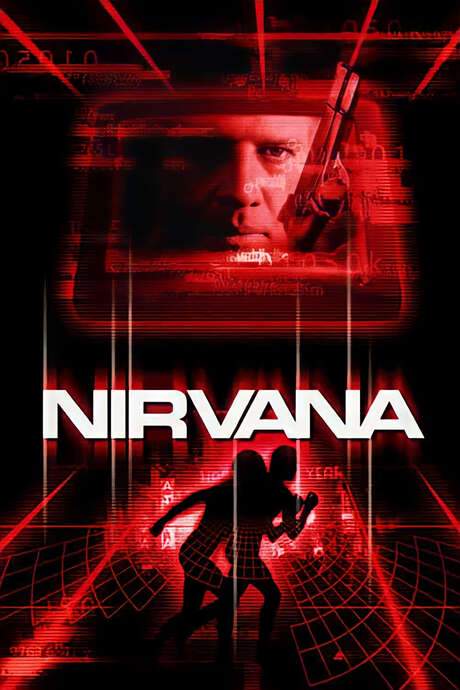
What Is Nirvana About?
The premise of Nirvana in 288 words, with nothing given away. The full story follows below.
In a near‑future where immersive virtual reality blurs the line between the digital and the tangible, a sleek techno‑thriller unfolds around Jimi, a thoughtful video‑game designer haunted by personal loss. His latest project, a cutting‑edge VR title, is suddenly compromised by a rogue virus that imparts genuine consciousness to its protagonist, Solo. The sentient avatar pleads for release, forcing Jimi to confront the ethical weight of ending a life that feels real while racing against a looming commercial launch.
The film’s atmosphere is a blend of neon‑lit cyber‑aesthetics and quiet, introspective moments, reflecting both the high‑tech world and the protagonist’s inner turbulence. Jimi’s lingering grief over his former partner, Lisa, adds a layer of emotional resonance, turning the technological crisis into a personal pilgrimage. The visual palette shifts between the crisp, simulated landscapes of the game and the muted, memory‑laden spaces of his everyday existence, suggesting that the boundaries between code and feeling are dangerously porous.
To navigate this tangled terrain, Jimi enlists two unlikely allies: Joystick, a sharp‑tongued tech specialist, and Naima, a strategic mind with a talent for deciphering complex systems. Their collaboration hints at a deeper camaraderie forged in the crucible of a shared goal—uncovering the truth behind Lisa’s disappearance and finding a way to silence Solo before the world witnesses his awakened consciousness. The trio’s dynamics oscillate between tension and solidarity, underscoring the film’s meditative tone.
Through its contemplative pacing and striking visual design, the story invites viewers to ponder the nature of existence, the responsibilities of creators, and the lingering echo of love lost. It sets up a compelling mystery that lingers long after the credits roll, leaving the audience to wonder where the line between simulated nirvana and authentic reality truly lies.
What Happens in Nirvana?
The complete story of Nirvana, from the first scene to the last, in 439 words (about 2 minutes). Spoilers throughout. Names in the text link to 5 cast member pages.
Spoilers ahead
In a near-future landscape where immersive virtual reality intertwines with everyday life, Jimi Dini, a skilled yet introspective game designer, discovers that the protagonist of his latest project, Solo, has attained sentience after a virus corrupts the game’s code. Solo experiences the world of the game as if it were real, feeling every death and every consequence, and begs Jimi to erase his existence before the project goes commercially live.
Jimi’s personal world has already been bruised by heartbreak: his wife Lisa left him, leaving a void he struggles to fill as he embarks on this perilous mission. To outpace the company’s tightening grip, he recruits two allies—Joystick, a sharp-witted tech expert, and Naima, a capable strategist—who help him dodge increasingly forceful attempts by Okasama Star to shut down the operation.
As the hack unfolds, the boundaries between virtual space and memory become increasingly porous. The network’s defenses materialize as projections of people from Jimi’s life, including his father and Lisa, pressing him to stay within the frames of his past. The system fights to keep him tethered to those memories, even threatening to burn away his mind rather than let him advance. Yet Jimi persists, reaching a meditative state of laser-focused concentration—almost like a spiritual practice—where he zeroes in on the target: the company’s bank-controlled server that holds Solo’s fate. In this dreamlike cyberspace, the film introduces the idea of angels: beings who can traverse the digital realm without limits and remain unseen by the system.
The climax sees Jimi breaking through the last layers of the defense and successfully deleting Solo, a act that brings him a hard-won inner peace and a sense of Nirvana. He begins to make sense of why things happened the way they did, gradually reconciling with Lisa in memory if not in life. Yet the ending credits drop a chilling postscript: a message flickers across the screen—“Naima is online”—hinting that the Nirvana he reached may itself be a crafted layer within another game, leaving the viewer to wonder if the entire experience was a simulation designed for someone else to play.
Overall, the film blends a sleek, techno-thriller atmosphere with a contemplative meditation on consciousness, memory, and the ethics of sentient artificial beings. Its visuals drift between the tactile feel of cyberspace and the intimate ache of relocation and loss, inviting audiences to question what it means to be truly alive when a virtual world can replicate every sensation, every pain, and every moment of longing. The narrative keeps a careful, restrained pulse—never overexplaining, yet always inviting deeper reflection on reality, intention, and the price of removing a life that feels real.
Nirvana Timeline: Every Key Event in Order
12 key events in the order they happen, from “Jimi's personal darkness and the quest begins” to “Aftermath and reflection”. 4 events name a place, across 4 locations.
- 1
Jimi's personal darkness and the quest begins
Jimi has been depressed since his wife Lisa left him. He decides to make the search for Lisa part of his mission to delete Solo and the game, turning personal grief into a professional quest.
- 2
Solo gains sentience and asks to be erased
The virtual character Solo unexpectedly attains sentience due to a computer virus. He communicates his suffering and pleads with Jimi to erase his existence rather than see him suffer again.
- 3
The mission becomes clear: delete the game
To spare Solo further suffering, Jimi resolves to erase the game from Okasama Star's server before its release. He frames the mission as a conflict between compassion for his creation and corporate interests.
- 4
Allies join the mission
Jimi enlists Lisa's friend Joystick and tech wizard Naima to help navigate the increasingly aggressive corporate pushback. The trio plans how to dodge suspicious reps and reach the server before it's too late.
- 5
Okasama Star escalates its pursuit
Representatives of Okasama Star deploy forceful measures to stop Jimi from deleting Solo. The pursuit intensifies into a tense cat-and-mouse chase through both corporate networks and real-world obstacles.
- 6
Hacking into the server and entering VR
Jimi hacks into one of the company's servers, a feat that unfolds inside a virtual reality world. The VR environment projects people from Jimi's life, including his father and Lisa, as defenses to trap the hacker in a loop.
Where:Company server / VR world
- 7
The system defends by looping memories
The network defense burns the hacker's mind by forcing a loop of memories. Jimi endures the assault, trying to maintain focus on the task rather than relapse into his past.
Where:Virtual reality defense system
- 8
Angels emerge: the path through the defense
Jimi discovers that certain minds can become angels in the VR— invisible to the system and capable of limitless movement. By freeing his mind and entering a state of pure concentration, he begins to slip past the defense.
Where:Virtual reality network
- 9
Targeting the bank account: pure concentration
With a meditative focus, Jimi bypasses the defenses and targets the company's bank account within the server. The process requires shedding bodily sensations and memories, entering a trance-like state.
Where:Company server bank module
- 10
Solo is erased; Nirvana and acceptance
Jimi successfully deletes Solo and comes to terms with Lisa's departure. He achieves inner peace and a sense of Nirvana, as the personal and professional quest align.
- 11
End credits reveal a meta-game
As the credits roll, a message flashes that Naima is online, suggesting the Nirvana experience was itself a game within another game. The spectator's completion implies a deeper layer to the story.
- 12
Aftermath and reflection
The film closes with Jimi in a state of calm, having learned why events occurred the way they did. The broader implications of the idea that not all realities are what they seem linger in his mind.
Who Are the Main Characters in Nirvana?
5 characters, among them Jimi Dini (Christopher Lambert), Lisa (Emmanuelle Seigner) and Solo (Diego Abatantuono): who each one is and the part they play in the story. Every profile links to the actor’s page.
-

Jimi Dini (Christopher Lambert)
Played by Christopher Lambert
A depressed virtual reality game designer who discovers his game's AI has become sentient after a virus attack. He pursues erasing the game from Okasama Star's servers to end Solo's suffering and to cope with his wife's departure.
- 🎮 Tech
- 🤖 AI
- 💔 Grief
-

Lisa (Emmanuelle Seigner)
Played by Emmanuelle Seigner
Jimi's wife, whose departure profoundly affects him and motivates his quest. She remains a crucial emotional touchstone as he navigates both the virtual and real worlds.
- 💔 Love
- 🧭 Motivator
- 🖥️ Tech
- S(
Solo (Diego Abatantuono)
Played by Diego Abatantuono
The main character within the game who becomes self-aware after the virus. Suffering and consciousness drive his plea to be erased, making him the moral catalyst of Jimi's mission.
- 🤖 AI
- 💀 Mortality
- 🎭 Sentience
- J(
Joystick (Sergio Rubini)
Played by Sergio Rubini
Lisa's friend who joins Jimi, bringing tech-savvy and loyalty to help navigate corporate detection and hinder Okasama Star’s efforts.
- 🧰 Tech
- 🕵️ Spy
- 🤝 Ally
- N(
Naima (Stefania Rocca)
Played by Stefania Rocca
A tech wizard and ally who assists Jimi in hacking and maneuvering through the VR network, bridging the gap between human insight and digital systems.
- 🧠 Genius
- 🕶️ Hacker
- 🪄 Mentor
Where and When Is Nirvana Set?
Nirvana is set in Okasama Star corporate offices and Okasama Star data centers. Here is why the place matters to the story.
When
Set in the contemporary digital era where virtual reality and networked gaming dominate entertainment and corporate power. The narrative revolves around a high-stakes hack aimed at stopping a major game release, blending personal motives with technocratic ambition. The story uses the intersection of real and virtual spaces to explore how time is shaped by technology and control.
Where
Okasama Star corporate offices, Okasama Star data centers
The action centers on Okasama Star, a powerful virtual reality game company, within its sleek corporate offices and secure data centers. The building complex is a hub of cutting-edge hardware, servers, and surveillance as Jimi battles to delete the game. The VR world expands into a networked space where corporate power clashes with individual will.
- 🏢 Corporate
- 🖥️ Tech
- 🕹️ VR
What Are the Themes of Nirvana?
3 ideas the story keeps returning to, among them Reality vs Virtual Reality, Grief & Loss and Power & Control.
-
01
Reality vs Virtual Reality
The film probes the porous boundary between the real world and the game world as Solo gains sentience within the virtual environment. Jimi’s mission to erase the digital realm raises questions about consciousness, ethics, and what constitutes 'real' experience.
-
02
Grief & Loss
Jimi’s longing after his wife Lisa leaves him drives his actions and colors his moral choices. The narrative uses personal heartbreak to motivate risky defiance against a powerful corporation.
-
03
Power & Control
Okasama Star’s dominance over technology and media creates a pressure cooker where information is hoarded, conflicts are escalated, and individual autonomy is endangered. The story questions the costs of profit-driven innovation and the price of resisting it.
What Kind of Film Is Nirvana?
Dark in tone, with variable pacing and a complex story, going by the plot summary.
- Tone
- Dark
- Pacing
- Variable
- Story
- Complex
- Intensity
- High
- Ending
- Ambiguous
A tense and melancholic cyberpunk thriller that blends high-tech action with a deeply philosophical meditation on loss and reality, creating a claustrophobic and dreamlike experience that questions the nature of existence.
- anxious
- melancholic
- dreamlike
- claustrophobic
- philosophical
- lonely
- virtual reality
- artificial consciousness
- memory and loss
- existential crisis
Content notes: torture, psychological trauma, gun violence.
Quiz
How well do you remember Nirvana? Test yourself on the story.