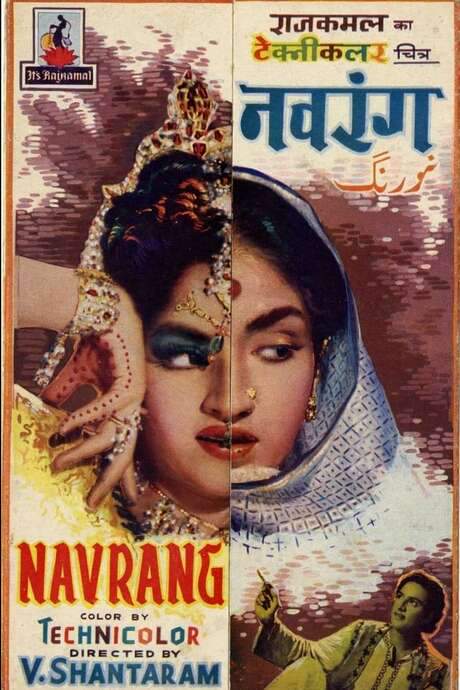
Navrang 1959

Directed by

Shantaram Rajaram Vankudre
Made by

Rajkamal Kala Mandir
Navrang Plot Summary
Read the complete plot summary and ending explained for Navrang (1959). From turning points to emotional moments, uncover what really happened and why it matters.
Diwakar Mahipal is a poet living in British-ruled India, and he deeply loves his wife Jamuna Sandhya Shantaram. Yet Jamuna views him as irresponsible, believing he retreats into a fantasy rather than facing reality, and she struggles with the way his imagination seems to pull him away from practical life. To cope with this tension, Diwakar creates a muse from his own mind who bears Jamuna’s features and calls her Mohini Sandhya Shantaram. This imagined figure becomes a powerful symbol in his art, fueling his rise as a recognized poet even as it blurs the lines between love, devotion, and obsession.
Joy comes when Jamuna gives birth to a boy, but happiness is short-lived. Diwakar’s vocal criticisms of British rule cost him his job, leaving him unable to provide for his sickly father or his child. The economic strain compounds the strain on his marriage, and his fixation on Mohini continues to pull at the fabric of family life, driving Jamuna to leave their home. In the midst of this hardship, Diwakar’s father passes away, deepening the sense of loss that surrounds him.
On the road, Manjari Vandana Sawant, a courtesan, finds Diwakar in a bleak, desolate state and asks what troubles him. She offers a way to help—she arranges a connection with Jamuna by reaching out at the Thakur Chandrakant Sharan Singh’s birthday celebration, aided by Thakur’s mother. At the celebration, the Thakur orders Diwakar to sing, a demand that forces him to confront whether the flame of his inspiration truly still burns. He initially refuses, claiming that Jamuna’s influence no longer lives in him, but the memory of his wife and the muse compels him to raise his voice in song.
Jamuna, meanwhile, sits in the court, where Thakurain (the Thakur’s mother) speaks to her of fortune and love. Thakurain’s words remind Jamuna of the depth of Diwakar’s talent and the sincerity of his devotion, even amid hardship and misunderstanding. This revelation leads Jamuna to reevaluate her own stance, and she recognizes the real heart of Diwakar’s art and the enduring love that binds them. In a quiet, hopeful turn, she patches up with her husband, and the couple’s bond settles back into place—anchored by the very music that once drew them apart and now promises to bring them together again.
Navrang Timeline
Follow the complete movie timeline of Navrang (1959) with every major event in chronological order. Great for understanding complex plots and story progression.
Diwakar, a poet in British India, loves Jamuna
Diwakar is a devoted poet living in British-ruled India who adores his wife Jamuna. He pursues poetry with passion while cherishing their life together. The bond between artist and spouse frames his early happiness.
Mohini, the muse born from imagination
He creates Mohini, a muse who looks exactly like Jamuna, from his imagination. Mohini becomes the inspiration behind his poems and songs, fueling his rising fame as a poet. This imagined figure complicates his sense of reality and creativity.
Jamuna bears Diwakar a son
As his fame grows, Jamuna bears Diwakar a son, bringing happiness to their household. The family experiences a brief period of joy despite the pressures around them. Diwakar's success seems to bless their domestic life.
Unrest and unemployment strike him down
Diwakar's songs that criticize British rule lead to him losing his job. The loss of livelihood threatens the family's stability and raises concerns about feeding his sickly father and their child. The poet's world begins to crumble as political oppression jeopardizes his means to provide.
Despair grows as family funds vanish
With no steady income, Diwakar struggles to feed his ailing father and son. The strain of poverty deepens, while his appetite for Mohini's echo persists in his writing. Jamuna's patience and support wear thin under mounting hardship.
Jamuna leaves the household
The ongoing obsession with Mohini drives Jamuna away from their home. She withdraws to seek stability and space, compelled by the emotional strain of their fractured relationship. The family unit teeters on collapse.
Diwakar's father dies
Amid the turmoil, Diwakar's father passes away, marking a painful turning point. The death compounds the poet's grief and sense of responsibility. He confronts loss while grappling with his artistic obsession.
Manjari encounters the broken poet
Manjari, a courtesan, sees Diwakar in a despondent state on the road and learns of his troubles. She offers a path to resolution by helping reconnect him with his wife for the upcoming Thakur's Birthday celebration. Her intervention becomes a catalyst for the planned reunion.
Manjari orchestrates a reunion for Thakur's Birthday
Manjari calls Jamuna to the Thakur's Birthday celebration with the help of Thakur's mother. The plan aims to bring the estranged wife back into the poet's life and scene. The stage is set for a dramatic confrontation that could restore the couple.
Thakur commands Diwakar to sing
At the celebration, Thakur orders Diwakar to perform. He initially refuses, claiming that Jamuna's inspiration is absent and that he cannot write or sing. The crowd presses for a performance, and the threat of arrest looms as his defiance grows.
Diwakar recalls his wife and muse and sings
Remembering Jamuna and Mohini, Diwakar begins to sing despite the risk of arrest. His renewed devotion and talent resurface, moving those present and proving the power of his art. The moment marks a turning point as inspiration returns.
Jamuna reveals herself in court and understands
Jamuna is revealed to be present in the court, sitting with Thakur's mother. Thakurain tells Jamuna how lucky she is to have a husband who loves her so much. Seeing Diwakar's passion and the depth of his love, Jamuna recognizes his talent and devotion.
Reconciliation and renewed hope
Moved by the revelation, Jamuna patches up with Diwakar. They reaffirm their bond and commit to supporting each other’s creative and domestic life. The couple's future hinges on mutual trust and shared art.
Navrang Characters
Explore all characters from Navrang (1959). Get detailed profiles with their roles, arcs, and key relationships explained.
Divakar (Mahipal)
A poet living in British-ruled India, Divakar loves Jamuna deeply but often retreats into a world of fantasy, creating a muse named Mohini who resembles his wife. His talent grows, yet his anti-colonial songs cost him his job and threaten his family’s stability. He is passionate and imaginative, yet increasingly torn between love and artistic obsession.
Jamuna (Sandhya Shantaram)
Divakar’s wife, who loves him but feels alienated by his fantasy world. Her patience wears thin as Mohini’s presence grows, prompting her to leave home. Eventually she recognizes Divakar’s genius and his love for her, leading to a reconciled relationship.
Manjari Devi (Vandana Sawant)
A courtesan who crosses paths with Divakar in a moment of despair and takes action to help him. She orchestrates a connection between Jamuna and the Thakur’s circle, aiding Diwakar’s return to the stage. Her practicality and influence shape the social maneuvering around Divakar’s talent.
Daulat Rai (Baburao Pendharkar)
Divakar’s father, whose ill health and eventual death contribute to the emotional and financial pressures on the poet. His mortality underscores the stakes of the family’s reliance on Divakar’s art.
Thakur Karan Singh (Ulhas)
A Thakur and local aristocrat who hosts a birthday celebration that becomes a turning point in Divakar’s fate. He wields social authority and pushes the plot toward a dramatic confrontation.
Thakur Sharan Singh (Chandrakant)
Another noble figure in the same feudal milieu, whose presence reinforces the hierarchical backdrop against which Divakar must perform. His interactions with the poet and Jamuna contribute to the tension of the courtly scenes.
Navrang Settings
Learn where and when Navrang (1959) takes place. Explore the film’s settings, era, and how they shape the narrative.
Time period
British Raj era
The events occur during the colonial period in India, a time when cultural patronage and nationalist sentiments color daily life. Poets and musicians navigate patronage networks that blur art and politics. The era's restrictions amplify the stakes around creativity, loyalty, and personal sacrifice.
Location
British India, Thakur's estate
Set in British-ruled India, the story unfolds across a poet's modest home, a grand Thakur estate, and a public space where art and authority intersect. The locations show a feudal society under colonial rule, with private households and ceremonial courts shaping the characters' fates. The ambiance contrasts intimate romance with public performance and political tension.
Navrang Themes
Discover the main themes in Navrang (1959). Analyze the deeper meanings, emotional layers, and social commentary behind the film.
❤️
Love
Love anchors the relationship between Divakar and Jamuna, yet their bond is tested by fantasy and jealousy. Jamuna's devotion clashes with Divakar's imaginative fixation on Mohini, a muse who mirrors her. The film explores how love can fuel creativity while also challenging trust and shared life.
✨
Fantasy
Divakar’s invention of the Mohini muse shows how imagination can transform ordinary life into art. The muse doubles as a mirror of Jamuna, blurring lines between affection and illusion. This fantasy elevates his poetry but strains the real-world bond, highlighting the costs of artistic obsession.
🗳️
Politics
Divakar’s songs against British rule bring him into conflict with authorities and patrons. The narrative portrays how political expression through art invites risk, unemployment, and social consequence. Yet art persists as a form of resistance and personal identity, culminating in a public moment that leads to reconciliation.

Coming soon on iOS and Android
The Plot Explained Mobile App
From blockbusters to hidden gems — dive into movie stories anytime, anywhere. Save your favorites, discover plots faster, and never miss a twist again.
Sign up to be the first to know when we launch. Your email stays private — always.
Explore the mobile appNavrang Spoiler-Free Summary
Discover the spoiler-free summary of Navrang (1959). Get a concise overview without any spoilers.
In the vibrant yet tumultuous landscape of British-ruled India, Diwakar lives a life defined by verse and a deep, if somewhat impractical, devotion to his wife, Jamuna. He is a poet whose heart resides in the clouds, drifting between reality and a rich fantasy world that Jamuna struggles to understand. While she yearns for him to remain grounded in the necessities of daily life, Diwakar’s spirit constantly seeks an escape, creating a quiet friction in their marriage that his artistic temperament cannot easily smooth over.
To bridge the gap between his domestic duties and his creative yearning, Diwakar manifests a muse from his own imagination named Mohini. Bearing Jamuna’s features but embodying an idealized spirit, this phantom figure becomes the wellspring of his creativity, propelling him into the spotlight as a celebrated poet. As his reputation grows, however, so does his fixation on this figment, blurring the boundaries between the woman who stands beside him and the muse who lives only in his mind.
The strain of maintaining this dual existence soon collides with the harsh realities of the outside world. As political tensions rise and Diwakar’s verses draw the ire of colonial authorities, his ability to provide for his family is threatened, pushing the household toward instability. With Jamuna feeling increasingly sidelined by an obsession she cannot touch or see, the couple finds themselves at a crossroads where the call of duty and the seduction of art stand in stark, painful opposition.
The narrative weaves a delicate tapestry of music, emotion, and the struggle for survival, capturing the essence of a man torn between two worlds. As Diwakar loses himself further into the persona of the artist, the domestic sphere begins to fracture, leaving the audience to wonder if love can survive when it must compete with an imagination that refuses to be silenced. It is a story poised between the hunger of the artist and the needs of the heart, set against a backdrop of cultural pride and personal longing.
Movies with Similar Twists and Themes
Uncover films that echo the narrative beats, emotional arcs, or dramatic twists of the one you're exploring. These recommendations are handpicked based on story depth, thematic resonance, and spoiler-worthy moments — perfect for fans who crave more of the same intrigue.



Featured on this page

What's After the Movie?
Not sure whether to stay after the credits? Find out!
Check out our other apps:

SAT Sphere
Build confidence for the Digital SAT.

Mori Atlas
Discover wild places worth protecting.

Luntero
Search smarter for a home in Amsterdam.

Plot Explained
Unravel movie endings and hidden clues.

Pokechamp
Dive into Pokémon data and battle logic.

Driving Theory
Get ready for your European theory test.

Movie Dust
Plan your next cinema trip with ease.

Musemap
Find art and culture as you travel.

Selkobase
Compare credentials before committing.

Local Manual
Turn an unfamiliar country into practical next steps.

Lernavi
Compare school systems before your next move.

GymRoam
Find a workout stop wherever your plans take you.
Explore Our Movie Platform
New Movie Releases (2026)
Famous Movie Actors
Top Film Production Studios
Movie Plot Summaries & Endings
Major Movie Awards & Winners
Best Concert Films & Music Documentaries
Movie Collections and Curated Lists
© 2026 What's After the Movie. All rights reserved.
Privacy Policy