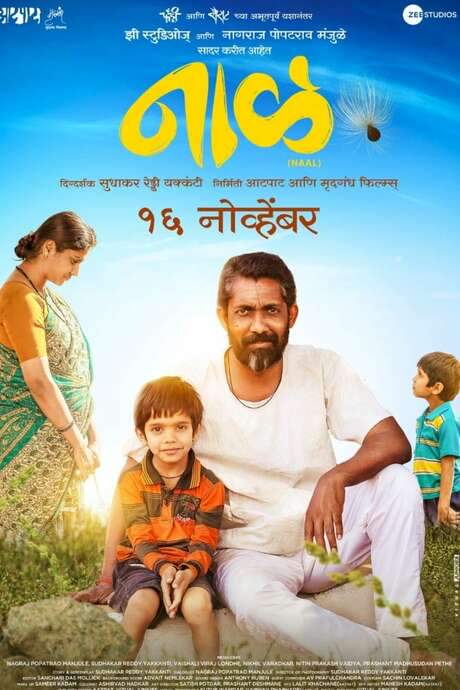
Naal 2018

Directed by

Sudhakar Reddy Yakkanti
Made by

Aatpat Production
Naal Plot Summary
Read the complete plot summary and ending explained for Naal (2018). From turning points to emotional moments, uncover what really happened and why it matters.
Chaitanya Nagraj Popatrao Manjule is an eight-year-old boy whose days unfold in a quiet, remote village in Maharashtra. He lives with his father, a small-time landlord, his loving mother, and his elderly grandmother, in a household that also includes a chicken farm and a cow with her calf. The atmosphere is intimate and rooted in routine, with the family sharing chores, meals, and small moments of affection that anchor Chaitanya’s world.
Their peaceful dynamic is shaken when an visiting uncle gently seeds a troubling thought: that Chaitanya’s real mother might be Parvati Deepti Devi, a revelation that unsettles the boy and starts to fracture the trust he feels for the people who raised him. The seed of doubt grows as Chaitanya stores the idea away, testing his own ideas about what makes a mother a parent. He turns to his oldest friend, Bachchan Sanket Itankar, who offers a simple, almost mythic piece of wisdom: real mothers cry often. This line, spoken in a casual moment, becomes a compass for Chaitanya as he begins to measure his mother’s actions against the possibility of a different, unknown mother.
From then on, Chaitanya’s questions multiply and his behavior grows distant. He probes his mother, seeking signs of love and vulnerability, and when she scolds him for pushing too hard, he interprets her warmth as a sign of absence or lack of genuine love. He withdraws from her, and the affectionate term he once used, Aai (Mom), begins to fall away as a protective shield slips into place around his heart. His adopted mother’s care feels less certain to him, and the emotional distance widens.
To reclaim a sense of stability, his family plans a crucial trip to the city for medical advice and to see his grandmother’s siblings. The plan is delicate: a chance for the mother-son bond to re-knit against the backdrop of adults’ concerns and a looming test—his exams that must not be derailed. Chaitanya longs to go, yet the journey would complicate the boy’s current commitments, and he looks for cunning ways to delay the trip. Bachchan offers a grimmer suggestion to test his grandmother’s wellbeing, a plan that is quickly abandoned when the grandmother discards the tampered food. In a later, darker moment, Chaitanya tries to orchestrate an accident, hoping to spark a change in his grandmother’s mood and the family’s future. He uses his calf as a tool to provoke a fall, but the plan backfires, and the grandmother fractures her hip, forcing a domestic relocation to recover indoors.
The camel of misfortune continues its uneasy march as the calf escapes and later dies after colliding with electrified wires. In the aftermath, Chaitanya’s father arranges to preserve the calf’s memory by stuffing it to encourage the cow to continue giving milk. The loss weighs heavily on everyone, and the family ultimately heads toward the city for medical attention and to visit relatives. Chaitanya’s longing to join them remains strong, but his mother insists he stay behind for his own protection and because he might stand in the way of the aging grandmother’s needs.
When the trio reaches the city, the trip brakes, the grandmother’s health becomes the central concern, and a sorrowful realization settles in—death has touched their lives in a way that reshapes trust and ritual. The grandmother dies in the process of their journey, a turn of fate that casts a long shadow over the family’s future. The bus departs without them, leaving Chaitanya in a state of confusion and heartbreak, unsure of how to interpret the loss and the silence that follows. The funeral ritual begins, and Parvati [Deepti Devi] appears in the midst of relatives; her presence brings a quiet ache, a reminder of the child’s uncertain connection to the woman who might be his mother. Parvati remains reserved, not fully engaging with him, perhaps out of respect or distance, and Chaitanya’s search for connection with her feels almost like a plea.
Back home, a poignant turning point arrives with the arrival of the stuffed calf at the family’s house. The cow, having learned to trust again, allows others to approach and be milked. A beaker of milk is offered to Chaitanya, who gazes at the lifelike calf and comes to a simple, profound realization: the mother who raised him—whether biologically related or not—has always been the one who provides care, warmth, and safety. In that moment, he returns to his mother, softly calling her Aai (Mom) for the first time in months, and her face lights up with relief and happiness. They share a quiet, intimate smile, the kind of smile that signals healing, forgiveness, and a renewed bond that neither time nor doubt can erase.
The film’s quiet resonance lies in its patient depiction of a family learning to navigate doubt, memory, and the meaning of true motherhood. It leans into the emotional texture of rural life, the fragility of human connections, and the enduring power of love to redefine what family means. Through Chaitanya’s journey—from curiosity and fear to reconciliation and trust—the story invites viewers to reflect on the tenderness that underpins everyday life and the way a child’s questions can lead a family back to one another.
Naal Timeline
Follow the complete movie timeline of Naal (2018) with every major event in chronological order. Great for understanding complex plots and story progression.
Uncle reveals the real mother to Chaitanya
Chaitanya's uncle visits the family home in rural Maharashtra and drops the shocking claim that his biological mother is Parvati. The revelation unsettles the eight-year-old and plants seeds of doubt about the woman he has always called mother.
Chaitanya learns real mothers cry
Chaitanya confides the news to his older friend Bachchan, who explains that real mothers cry often. This idea becomes a test of his mother's love in his young mind.
Chaitanya tests his mother by running away
Guided by Bachchan's words, Chaitanya pretends to run away to see how his mother would react. He hopes to learn whether her love is conditional or unconditional by testing her response.
Mother disciplines him; Chaitanya grows distant
Chaitanya returns home to find his mother scolding him for wandering off. He interprets the punishment as proof that his adoptive mother does not love him and withdraws, even stopping calling her Aai.
Family plans a grandmother trip; Chaitanya wants to join
Chaitanya's mother asks his father to take the grandmother to their village so she can have space, while she wants to spend time with her son. He is disappointed when his own trip to Parvati's house is blocked by his exams.
Tampering with grandmother's food
Bachchan suggests making the grandmother sick by putting something in her food, and the plan is attempted but the grandmother quickly rejects it. The moment reveals how far Chaitanya is willing to go to secure his desired outcome.
Spilling marbles to cause a fall
Chaitanya then sprinkles marbles on the floor to trip her, but she staggers and does not fall, causing the plan to fail. Frustration grows as the family realizes the trip may still be in jeopardy.
Calf charges grandmother; trip canceled
Finally he engineers the calf to charge at the grandmother, causing her to fall and break her hip, and the trip is cancelled. The incident haunts him as the consequences of his scheming unfold.
Calf runs away and dies
The calf escapes during the chaos and is later found dead in a field after colliding with electrified wires. Chaitanya blames Bachchan for the accident, though he hides his own role in encouraging harm.
Stuffing the calf to keep milk flowing
To coax the cow to continue producing milk, the father arranges for the calf to be stuffed and kept near the cow. This move buys time for the family as they cope with sorrow and distance.
City trip planned with grandmother
A few days later they decide to travel to the city with the grandmother to seek medical help and to visit Chaitanya's brothers. Chaitanya tries to maneuver his way along by convincing the grandmother to go with him, twisting the plan in his favor.
Grandmother dies en route
On the journey they reach a bus stop where the grandmother dies; the cart man and family urge a return home as the bus departs without them. The loss overwhelms Chaitanya, who is initially unaware of the full meaning of the event.
Funeral and Parvati's silent presence
A funeral is held for the grandmother, with Parvati arriving from the city, but she does not speak to Chaitanya, perhaps out of respect for his mother. The absence of direct recognition deepens the boy's loneliness.
Milk and reconciliation
The stuffed calf is brought to the house and placed by the cow, who begins to let others milk again. Chaitanya drinks a beaker of milk from his mother and realizes that the mother who raised him is the one who truly matters, finally calling her Aai.
Naal Characters
Explore all characters from Naal (2018). Get detailed profiles with their roles, arcs, and key relationships explained.
Chaitanya (Chaitya) — Shrinivas Pokale
An eight-year-old boy living in a Maharashtra village, Chaitanya is mischievous and curious, quickly testing his mother’s love after learning about biological parentage. His plotting to lure his grandmother away reveals a desire to understand belonging, sometimes through misguided schemes. Through the arc, he matures into recognizing the importance of the family that raised him.
Parvati — Deepti Devi
Parvati is Chaitya’s biological mother, a figure who represents the possibility of a different form of love. Her intermittent presence and tearful restraint at the funeral scene underscore a complex, ambiguous bond with her son. The film uses her character to challenge simple assumptions about motherhood and kinship.
Sumi — Devika Daftardar
Sumi is Chaitya’s adoptive mother, the family’s emotional center who cares for him as he grows. She disciplines and protects him, while also feeling the strain of his escalating questions. Her relationship with Chaitya evolves toward understanding and forgiveness by the story’s end.
Savkar — Nagraj Popatrao Manjule
Savkar is the village’s small-time landlord and Chaitya’s father. He provides stability and a framework for family life, supporting his wife and son while navigating the pressures of rural livelihoods. His role anchors the family’s routines and the decisions that drive the plot.
Bachchan — Sanket Itankar
Bachchan is Chaitya’s older friend whose offhand ideas spark the test that drives the boy’s infatuation with the idea of a ‘real mother.’ He acts as a catalyst for the events, illustrating how peer influence can push a child toward risky actions. His role reveals the pull of curiosity and mischief in childhood.
Mama — Om Bhutkar
Uncle to Chaitya, Mama’s visit kicks off the family discussions that reveal the mother’s role in the child’s life. He represents extended family ties and the social space in which rural families negotiate kinship. His presence is the trigger for the unfolding emotional revelations.
Gajya — Ganesh Deshmukh
Gajya is a rural helper whose duties intersect with the family’s farming life. While not central to the emotional core, his presence grounds the film in its agricultural setting and local economy. He participates in the village’s daily rhythms that shape Chaitya’s world.
Naal Settings
Learn where and when Naal (2018) takes place. Explore the film’s settings, era, and how they shape the narrative.
Time period
The action unfolds in a contemporary rural setting in Maharashtra, focused on farming life and family routines. The world is depicted through ordinary weekdays and local ceremonies, grounding Chaitya’s experiences in the here and now.
Location
Maharashtra, India
A remote village in Maharashtra forms the backdrop, where fields, a chicken coop, and a small cow-calf farm define daily life. The community is tight-knit, with traditions shaping family dynamics and routines. The landscape and rural economy shape the characters’ livelihoods and the slow, intimate tempo of the story.
Naal Themes
Discover the main themes in Naal (2018). Analyze the deeper meanings, emotional layers, and social commentary behind the film.
🧭
Identity & Belonging
A central thread tracks Chaitya’s longing to belong and to know his true mother. His questions about blood vs. the mother who raised him drive him to test loyalties and push away comfort. The film examines how love and care can define family as much as DNA, and how perception shapes identity.
💞
Motherhood
The story probes what motherhood means beyond biology, contrasting the adoptive mother’s everyday care with the idea of a ‘real’ mother. It shows tenderness, discipline, and sacrifice within a rural family. The moment of reconciliation suggests that true motherhood is proven through consistent love, not just birth.
🎭
Truth & Consequences
A cascade of small deceptions—told or implied—sparks fear, guilt, and hurt. Chaitya’s tests are fueled by a mix of curiosity and desire for belonging, leading to unintended harm. The narrative reveals how lies, even well-intentioned, can fracture trust and trigger tragic outcomes.
🌱
Loss & Forgiveness
The death of the grandmother and the later emotional shifts force the family to confront fragility and deal with grief. Forgiveness emerges as the path to healing, as Chaitya and his mother rediscover each other. The ending anchors reconciliation in simple acts of care and shared milk between mother and son.

Coming soon on iOS and Android
The Plot Explained Mobile App
From blockbusters to hidden gems — dive into movie stories anytime, anywhere. Save your favorites, discover plots faster, and never miss a twist again.
Sign up to be the first to know when we launch. Your email stays private — always.
Explore the mobile appNaal Spoiler-Free Summary
Discover the spoiler-free summary of Naal (2018). Get a concise overview without any spoilers.
In a quiet corner of rural Maharashtra, a small household hums with the rhythm of farm life. Eight‑year‑old Chaitanya, a mischievous boy with an endless curiosity, spends his days among chickens, a cow and its calf, while his father tends to their modest land holdings and his loving mother watches over the family with quiet devotion. The presence of an elderly grandmother adds a layer of generational warmth, creating a world that feels both intimate and timeless.
One ordinary afternoon, an off‑hand comment from an uncle sets off a cascade of questions that shatter Chaitanya’s comfortable sense of belonging. He learns that the woman who has cradled him since birth is not his biological mother, and that a woman named Parvati holds that role in name only. The revelation hangs in the air like an unanswered prayer, prompting the boy to stare at familiar faces with a new, unsettled perspective.
The news ripples through the family, turning everyday interactions into puzzles. Chaitanya finds himself pulling away, his once‑bright chatter softening into tentative whispers as he tests the limits of love and trust. He seeks answers in the simplest of gestures—asking whether his mother cries, watching how she reacts, and observing the subtle shifts in his father’s and grandmother’s behavior. The rural setting, with its open fields and modest homestead, mirrors his inner landscape: vast, open, yet fraught with hidden corners.
Against this backdrop of bucolic simplicity and growing emotional distance, the film cultivates a mood that is both tender and slightly uneasy. It invites the audience to walk beside a child on the cusp of understanding who family truly is, while the world around him remains steady, waiting to see whether love will bridge the gap between what is known and what is discovered.
Featured on this page

What's After the Movie?
Not sure whether to stay after the credits? Find out!
Check out our other apps:

SAT Sphere
Build confidence for the Digital SAT.

Mori Atlas
Discover wild places worth protecting.

Luntero
Search smarter for a home in Amsterdam.

Plot Explained
Unravel movie endings and hidden clues.

Pokechamp
Dive into Pokémon data and battle logic.

Driving Theory
Get ready for your European theory test.

Movie Dust
Plan your next cinema trip with ease.

Musemap
Find art and culture as you travel.

Selkobase
Compare credentials before committing.

Local Manual
Turn an unfamiliar country into practical next steps.

Lernavi
Compare school systems before your next move.

GymRoam
Find a workout stop wherever your plans take you.
Explore Our Movie Platform
New Movie Releases (2026)
Famous Movie Actors
Top Film Production Studios
Movie Plot Summaries & Endings
Major Movie Awards & Winners
Best Concert Films & Music Documentaries
Movie Collections and Curated Lists
© 2026 What's After the Movie. All rights reserved.
Privacy Policy