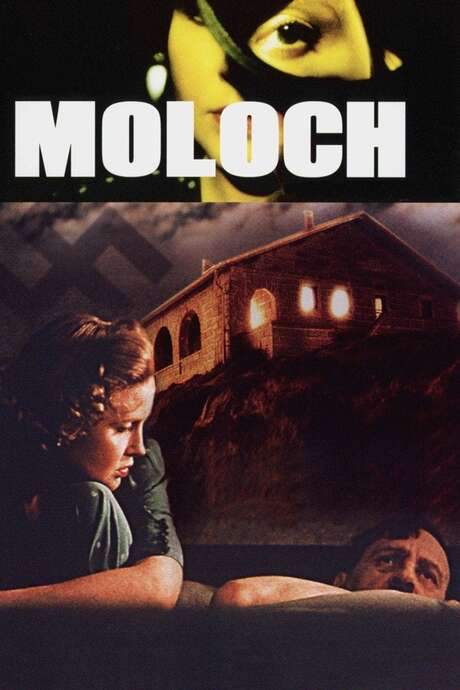
Moloch 1999

Directed by

Aleksandr Sokurov
Made by

Zero Film
Where to Watch Moloch
See current US streaming, rental, and purchase options for Moloch (1999) via JustWatch.

Streaming availability powered by 
Moloch Plot Summary
Read the complete plot summary and ending explained for Moloch (1999). From turning points to emotional moments, uncover what really happened and why it matters.
In the spring of 1942, a few months before the notorious Battle of Stalingrad, Adolf Hitler, Leonid Mozgovoy, withdraws to his secluded Berghof Retreat, perched atop a hill in the Bavarian Alps near Berchtesgaden, to unite with his longtime companion Eva Braun, Yelena Rufanova. Eva Braun spends her spare time with trivial pursuits that stand in stark contrast to the world-shaping shadow of the war: she dances in the nude, hums along to marching-band music, and noisily rummages through Hitler’s personal belongings, finding small pleasures in the quiet of the mountains.
When Hitler is joined by guests, the scene shifts into a social mix of conversation and playful banter. The visitors include Joseph Goebbels, Leonid Sokol, Magda Goebbels, Elena Kramer, Martin Bormann, Vladimir Bogdanov, and a priest, Anatoliy Shvederskiy. The gathering becomes a stage where the leaders and their circle trade jokes, share quick witticisms, and volley opinions about politics, power, and the war.
During his stop-over, Hitler rants and shares a broad spectrum of opinions on everyday matters—food, health, and climate—along with reflections on wartime politics and military victories. He moves through the Alpine setting with a sense of triumph, buoyed by the news of Germany’s early successes, and the moment takes on a satirical edge as he proclaims that he has never heard of the Auschwitz concentration camp, a line that underscores the film’s provocative engagement with history and denial. The conversation and movement through the landscape reveal a man who can be both charismatic and inflexible, capable of grand statements as the scenery around him remains unyielding.
As the visit nears its end, Eva Braun offers a quiet, sobering reminder that no one is beyond death or invincible in the face of fate. Her words hint at vulnerability beneath the public image, nudging Hitler to confront a hidden flaw as he prepares to return to the campaign. The encounter closes with Hitler mounting his motorcade, resuming Germany’s military push, while the mountains keep their silent watch over the conversations that hovered between intimacy, power, and a brutal historical reality.
Moloch Timeline
Follow the complete movie timeline of Moloch (1999) with every major event in chronological order. Great for understanding complex plots and story progression.
Hitler arrives at the Berghof for Eva Braun
In Spring 1942, Hitler retreats to the Berghof atop a Bavarian Alps hill to be with his long-time companion Eva Braun. The secluded residence becomes the stage for private routines and intimate conversation. The visit signals a rare private interlude before the next wave of campaigns.
Eva Braun's private pastime at the retreat
Braun fills her spare time with playful, frivolous activities—dancing in the nude, humming marching band tunes, and rummaging through Hitler's belongings. The carefree mood contrasts with the looming gravity of war. Her behavior reveals a personal world far from the political theater outside.
Hitler's greeting of guests
Hitler is thrilled to learn he will be joined by Joseph Goebbels, Magda Goebbels, Martin Bormann, and a visiting priest. The group settles into the residence for conversation and banter. The dynamic hints at intimate circles within the Nazi leadership.
Group conversation and playful banter
The gathering exchanges jokes and light chatter as the heavy politics loom beneath the surface. There is a sense of sociable theater masking a ruthless regime. The banter sets up the film's satirical tilt.
Hitler rants on diverse topics
Hitler launches into rants about food, health, climate change, and wartime politics, revealing a broad preoccupation beyond battlefield matters. The monologue sketches a larger persona who wields talk as a tool of authority. The range of topics underscores the film's satirical scope.
Hitler celebrates military victories
As the visit unfolds, Hitler grows triumphant upon hearing of Germany's military victories. He basks in the momentum and uses it to reinforce his worldview. The moment underscores how propaganda fuses with personal pride.
Auschwitz remark
In a provocative moment of satire, Hitler claims he has never heard of the Auschwitz concentration camp. The remark exposes a troubling disconnect between knowledge and cruelty. The line serves as a stark commentary within the dialogue.
Braun questions mortality and weakness
Towards the end of the visit, Braun reminds him that no one can escape death or be infallible. She presses to expose a hidden weakness behind his certainty. The moment blends intimate leverage with chilling political implications.
Braun's confrontation continues
The exchange escalates as Braun's warning cuts through the cordial facade. The interaction foregrounds the fragility of absolute power in a personal relationship.
Hitler departs for the next campaign
After the visit, Hitler leaves with his motorcade to continue Nazi Germany's military campaign. The departure signals the return to public duty and the machinery of war. The scene links private moment to public momentum.
Eva Braun's influence on the mood
Braun's presence shapes the atmosphere, from intimate idling to pointed moral challenges. Her role reveals the tension between personal affection and political power. The encounter exposes the human detail within a dictator's private life.
Support cast adds domestic texture
Goebbels, Magda, Bormann, and the priest contribute to a household dynamic that feels almost domestic. Their interactions add a surreal contrast to a regime built on fear and control. The scene emphasizes the theater of power.
Spring alpine setting frames the visit
The alpine spring setting frames the visit, signaling serenity that contrasts with the impending war. The landscape's beauty enhances the film's satirical critique of power. The calm surface hides turbulent history.
Power, privacy, and the cost of certainty
Across the visit, private vanity collides with public brutality, illustrating how intimate moments can coexist with monstrous regimes. The tension reveals a man who navigates geopolitics while remaining oblivious to horror.
Closing frame: motorcade disappears into history
The motorcade disappears from the frame, carrying the dictator back toward the machinery of conquest. The scene acts as a final note that personal theater ends as history presses on. The film closes on the tension between private life and public calamity.
Moloch Characters
Explore all characters from Moloch (1999). Get detailed profiles with their roles, arcs, and key relationships explained.
Adolf Hitler (Leonid Mozgovoy)
A dictatorial figure who uses conversation as a weapon, performing control through flattery, triumphalism and taunts. His discourse ranges from trivial musings on food and health to grand claims of victory, revealing a volatile and self-justifying mindset. The portrayal highlights his vanity and the dangerous belief in his infallibility.
Eva Braun (Yelena Rufanova)
Braun is a companion who spends her time on trivial pursuits, dancing and rummaging through Hitler's belongings. Her excitement at his planned visit shows a personal, intimate bond that exists alongside the regime's machinery of power. Her presence sheds light on how private life intertwines with public power.
Joseph Goebbels (Irina Sokolova)
Goebbels is the propaganda minister, present to flatter and assist in maintaining the cult of personality. He participates in the banter, wielding rhetoric as a tool to secure loyalty and influence. His role illustrates how propaganda operates within intimate circles of power.
Magda Goebbels (Elena Kramer)
Magda appears as a member of the inner circle, contributing to the conversation and social dynamic around Hitler. Her presence reflects the regime's domestic layer and the family dimension within the leadership circle. She participates in the intimate, political dialogue that unfolds at the retreat.
Martin Bormann (Vladimir Bogdanov)
Bormann stands as the quiet, ruthless bureaucrat who keeps the inner circle's machinery running. His presence emphasizes the backstage power of administration and control within the regime. He contributes to the atmosphere of calculated loyalty and hierarchical discipline.
Priest (Anatoliy Shvederskiy)
The priest offers a moral or ceremonial voice within the gathering, acting as a mediator and observer of the menacing banter. His role hints at the religious and ethical dimensions quietly present in the regime's private theater.
Moloch Settings
Learn where and when Moloch (1999) takes place. Explore the film’s settings, era, and how they shape the narrative.
Time period
Spring 1942
The events take place in spring 1942, a few months before the Battle of Stalingrad. It is a lull in the larger war, a private moment for banter and political talk among top Nazi leaders. The period underscores the gap between wartime rhetoric and the looming consequences of their decisions.
Location
Berghof Retreat, Bavarian Alps, near Berchtesgaden, Bavaria
The action unfolds at the Berghof Retreat, a secluded residence on a hilltop in the Bavarian Alps near Berchtesgaden. The alpine setting provides a private stage for Hitler, Eva Braun, and their guests to converse away from the front lines. The isolation amplifies the intimate, satirical dynamics of power and personality at play.
Moloch Themes
Discover the main themes in Moloch (1999). Analyze the deeper meanings, emotional layers, and social commentary behind the film.
🔥
Hubris
Hitler's dialogue reveals a bloated sense of power and a belief in his own infallibility. The conversations turn on grandiose statements about victories, food, health, and climate, showing how authority is used to shape reality. The film skewers his charisma and the danger of a leader who treats reality as negotiable theater. This satirical lens exposes how vanity can mask tyranny.
🪞
Seclusion
The Berghof's remote setting creates a private stage where power is performed for a select audience. Banter among Hitler, Braun, Goebbels, Bormann and the priest reveals loyalties, rivalries, and fragile alliances behind the regime's public image. The isolation magnifies how personal dynamics drive political decisions. The scene shows how a closed circle can distort accountability.
💀
Mortality
A moment where Braun reminds Hitler that no one can escape death punctures the illusion of invincibility. The film uses this reminder to hint at the fragility behind the regime's façade. It juxtaposes warmth and intimacy with the looming violence of the war. The idea that power is temporary undercuts the Führer's control.
📜
Propaganda
Hitler's rants about Auschwitz denial and wartime politics reveal how propaganda sustains a cult of personality. Goebbels's presence underscores the persuasive trick of rhetoric used to flatter power and manipulate perception. The scenes critique how speech can be charm and weapon at once. The private theater exposes the gap between displayed victory and brutal reality.

Coming soon on iOS and Android
The Plot Explained Mobile App
From blockbusters to hidden gems — dive into movie stories anytime, anywhere. Save your favorites, discover plots faster, and never miss a twist again.
Sign up to be the first to know when we launch. Your email stays private — always.
Explore the mobile appMoloch Spoiler-Free Summary
Discover the spoiler-free summary of Moloch (1999). Get a concise overview without any spoilers.
In the spring of 1942, a secluded Bavarian retreat perched on the Alpine cliffs becomes a silent stage for an unusually intimate gathering. The serene isolation of the mountains, with their crisp air and looming pine forests, contrasts sharply with the turbulence echoing across Europe, creating an atmosphere that feels both timeless and precariously perched on history’s edge. The film’s tone walks a delicate line between darkly comic satire and contemplative stillness, letting the natural beauty of the setting amplify the undercurrents of power and vulnerability that linger in every quiet corner.
The story centers on Adolf Hitler, who has withdrawn to his private sanctuary to escape the relentless demands of leadership. Here he is joined by his long‑time companion Eva Braun, whose presence infuses the retreat with a mixture of whimsical spontaneity and private tenderness. Their dynamic is one of unguarded familiarity, marked by moments of carefree dance, humming, and an almost childlike curiosity about the world beyond the warroom. The arrival of close confidants—Joseph Goebbels and his wife Magda Goebbels, as well as the steadfast Martin Bormann—adds layers of camaraderie and subtle tension, each bringing their own brand of loyalty and intellect to the secluded circle.
As the guests move through the snow‑capped landscape, their conversations drift between the mundane and the monumental. Topics such as food, health, climate, and the triumphs of a nation in conflict swirl together, revealing personalities that are both larger than life and unexpectedly ordinary. A visiting priest offers a quiet, reflective counterpoint, highlighting the blend of reverence and irreverence that permeates the gathering. Throughout, the film invites the audience to linger on the paradox of a man famed for grand, destructive ambition seeking fleeting moments of normalcy in an intimate, almost domestic setting.
The atmosphere is charged with an unspoken awareness that the world outside continues its relentless march, while within the walls of the Berghof, the characters navigate a fragile dance between public personas and private selves. This juxtaposition fuels a compelling intrigue, prompting viewers to ponder what lies beneath the polished veneer of power when it is stripped of its usual trappings.
Movies with Similar Twists and Themes
Uncover films that echo the narrative beats, emotional arcs, or dramatic twists of the one you're exploring. These recommendations are handpicked based on story depth, thematic resonance, and spoiler-worthy moments — perfect for fans who crave more of the same intrigue.


Featured on this page

What's After the Movie?
Not sure whether to stay after the credits? Find out!
Check out our other apps:

SAT Sphere
Build confidence for the Digital SAT.

Mori Atlas
Discover wild places worth protecting.

Luntero
Search smarter for a home in Amsterdam.

Plot Explained
Unravel movie endings and hidden clues.

Pokechamp
Dive into Pokémon data and battle logic.

Driving Theory
Get ready for your European theory test.

Movie Dust
Plan your next cinema trip with ease.

Musemap
Find art and culture as you travel.

Selkobase
Compare credentials before committing.

Local Manual
Turn an unfamiliar country into practical next steps.

Lernavi
Compare school systems before your next move.

GymRoam
Find a workout stop wherever your plans take you.
Explore Our Movie Platform
New Movie Releases (2026)
Famous Movie Actors
Top Film Production Studios
Movie Plot Summaries & Endings
Major Movie Awards & Winners
Best Concert Films & Music Documentaries
Movie Collections and Curated Lists
© 2026 What's After the Movie. All rights reserved.
Privacy Policy