What Is Mandala About?
The premise of Mandala in 261 words, with nothing given away. The full story follows below.
In the cool, mist‑laden foothills of South Korea, a world of silent mountains and disciplined routines frames the everyday lives of two Buddhist monks. The film moves through cramped border checkpoints, austere temples, and a secluded hermitage, each location echoing with the soft murmur of chants and the weight of centuries‑old tradition. The atmosphere is contemplative yet tense, a delicate balance between the external pressures of a modern nation and the interior quest for spiritual stillness.
The story centers on Ji‑san, an older monk whose calm presence and cryptic sayings hint at a deeper, lived understanding of the dharma. Beside him walks Beop‑woon, a younger novice who carries the eager intensity of someone still measuring the distance between practice and certainty. Their relationship is a study in contrasts: Ji‑san offers quiet guidance through ritual and measured speech, while Beop‑woon wrestles with doubt, constantly probing the limits of his devotion. Together they navigate the rhythms of monastic life, their paths intersecting and diverging as they travel through both bustling checkpoints and tranquil mountain retreats.
Beyond the shared routine, the monks encounter a tapestry of personal histories and cultural customs that subtly shift their outlook. Encounters with a shamanic rite, lingering memories of a woman from Ji‑san’s past, and the unexpected appearance of a long‑absent mother for Beop‑woon all introduce tender undercurrents that test their resolve. These hints of ordinary human ties, set against the backdrop of disciplined asceticism, create an immersive mood—one that invites the audience to wonder how the quiet pursuit of enlightenment endures when life’s unresolved threads begin to surface.
What Happens in Mandala?
The complete story of Mandala, from the first scene to the last, in 296 words (about 1 minute). Spoilers throughout. Names in the text link to 2 cast member pages.
Spoilers ahead
At a tense border checkpoint, a bus is halted and soldiers begin a careful search of every passenger. Monk Ji-san is found without proper ID, and the young monk Beop-woon quietly trails behind, watching the soldiers’ orders unfold. He is released after Ji-san chants Buddha’s name, a small ritual that the authorities accept in place of formal documentation.
Later, Beop-woon encounters Ji-san again at a temple, where Ji-san drinks and speaks with quiet gravity. He says that Buddha is not found only in Buddhist temples, a line that unsettles Beop-woon and makes him see that six years of practice may not have yielded the spiritual certainty he hoped to gain.
The two men keep moving, their paths repeatedly crossing and separating as they set off once more. Their journey leads them to a modest hermitage tucked away in the mountains, where a simple, shared life begins to form amid the surrounding silence and austere routines.
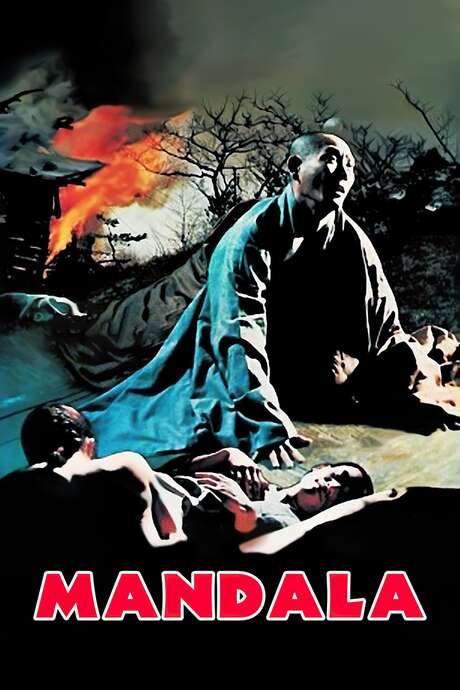
Ji-san, who also aids a shaman with the traditional ritual of “opening the eyes,” reflects on who will do the same for him. He drinks, assumes a lotus position, and, in a stark moment of surrender, freezes to death. The community around him grieves in quiet reverence, and Beop-woon undertakes the difficult duty that follows.
Beop-woon performs Ji-san’s cremation, honoring him with a ceremony. He passes along a Buddha statue that had belonged to Ji-san to Ok-sun, a woman the late monk could never forget, preserving a fragile memory within a ritual act.
In the aftermath, Beop-woon finally meets his mother, who abandoned him as a child. This reunion marks the start of a long, arduous road of suffering, testing his resolve and shaping the rest of his journey as he moves forward with a deeper, more tempered sense of faith.
Mandala Timeline: Every Key Event in Order
10 key events in the order they happen, from “Checkpoint arrest and release” to “Beop-woon's road of suffering”. 9 events name a place, across 8 locations.
- 1
Checkpoint arrest and release
A bus stops at a checkpoint and soldiers begin to inspect the passengers. Ji-san is caught without proper ID, and Beop-woon follows him quietly. The soldiers order Ji-san to chant Buddha's name, and he is released after complying. The scene sets the tension between outward appearance and inner spirituality.
When:early morning Where:checkpoint roadside
- 2
Temple reunion and lesson
Beop-woon encounters Ji-san again while the latter drinks at a temple. Ji-san declares that Buddha is not found only in Buddhist temples. Beop-woon realizes that after six years of practice, he has achieved little. This exchange shifts his view on true spiritual progress.
When:later day Where:temple
- 3
Beop-woon decides to follow Ji-san
Beop-woon decides to follow Ji-san as he sets off again. This marks a turning point from solitary study to a shared journey. The two begin a path that tests their patience and bond as they travel.
- 4
Partings and reunions on the road
They repeatedly split up and reunite along their travels. Each separation tests their commitment and resilience. They move through villages and mountain paths, slowly building a fragile companionship.
Where:various locations
- 5
Hermitage life begins
They begin living together at a small hermitage in the mountains. The quiet retreat forces them to face spiritual questions without distractions. Daily life blends study, silence, and occasional disagreements.
Where:mountain hermitage
- 6
Opening the eyes ritual
Ji-san helps a shaman with the traditional ritual of opening the eyes. The scene underscores a syncretic practice blending Buddhist and shamanic elements. It shows Ji-san's continued involvement with ritual power beyond formal temples.
Where:hermitage ceremony site
- 7
Ji-san's final moment
Ji-san asks who will do the same for him, revealing his fear of being forgotten. He drinks alcohol as a way to cope with mortality. He then sits in a lotus position and freezes to death, leaving Beop-woon to process the loss.
Where:mountain hermitage
- 8
Cremation and giving statue
Beop-woon cremates Ji-san in a ceremony at the hermitage. He gives Ji-san's Buddha statue to Ok-sun, a woman the late monk could never forget. The act memorializes Ji-san and deepens Beop-woon's sense of connection to those he leaves behind.
When:after death Where:hermitage
- 9
Reunion with his mother
Beop-woon finally meets his mother again, and the reunion is heavy with years of absence. The encounter underscores ongoing suffering and the weight of unresolved past. It marks a turning point toward an uncertain future.
Where:somewhere along the road
- 10
Beop-woon's road of suffering
Beop-woon embarks on a long road of suffering, carrying memories of Ji-san and his mother. He moves forward with resilience, seeking meaning beyond traditional temple life. The journey suggests transformation through hardship and endurance.
Where:road
Who Are the Main Characters in Mandala?
4 characters, among them Pobun (Beop-woon), Ji-san and Ok-sun: who each one is and the part they play in the story. 2 of them link to the actor’s page.
- P(
Pobun (Beop-woon)
Played by Ahn Sung-ki
A disciplined monk-in-training who travels with Ji-san. After six years of practice, he grows disenchanted with routine and seeks deeper meaning through companionship and hardship. He is patient, introspective, and carries the story forward as he confronts loss and spiritual responsibility.
- 🎯 Protagonist
- 🧭 Spiritual journey
- 🧘♂️ Discipline
- J
Ji-san
Played by Jeon Moo-song
An older monk whose wandering path challenges conventional devotion. He pairs skepticism with ritual, helping Beop-woon realize that Buddha-like insight can emerge outside temples. His eventual death marks a turning point and a meditation on legacy.
- 🧭 Mentor
- 🕯️ Ritualist
- 🕊️ Death and memory
- O
Ok-sun
A woman who embodies a memory Ji-san could not forget; Beop-woon entrusts her with Ji-san's Buddha statue. Her presence grounds the narrative in personal memory and unresolved longing, signaling the possibility of compassion beyond a monk's world.
- 🌸 Memory
- 🕊️ Compassion
- BM
Beop-woon's Mother
Beop-woon's mother abandoned him as a child; their eventual meeting underscores themes of forgiveness and reconciliation. Her absence has shaped his emotional life and his decisions on the path.
- 👩👦 Family
- 💔 Abandonment
- 🕊️ Reunion
Where and When Is Mandala Set?
Mandala is set in Checkpoint, temple and hermitage in the mountains (20th century). Here is why the time and place matter to the story.
When
20th century
The events unfold in a 20th-century Korean setting, where military checkpoints intersect with rural temples and mountain hermitages. This period mixes political tension with enduring religious practice, shaping the characters' journeys. The journey travels through both roads and secluded mountain retreats, reflecting a time when tradition and modernity coexist.
Where
Checkpoint, temple, hermitage in the mountains
A rural Korean landscape centers the film: a military checkpoint interrupts travel for passengers, a temple serves as a gathering place for monks, and a remote hermitage in the mountains becomes the setting for isolation and spiritual practice. The checkpoint represents state control intruding on spiritual travels, while the temple and hermitage embody different modes of spiritual life. The film uses these spaces to contrast discipline, ritual, and the pursuit of meaning.
- 🎯 Checkpoint
- 🏯 Temple
- 🗻 Hermitage
What Are the Themes of Mandala?
4 ideas the story keeps returning to, among them Spirituality, Abandonment and Mortality.
-
01
Spirituality
The film pushes Beop-woon and Ji-san beyond the boundaries of formal temples, suggesting that insight can arise outside established institutions. It explores doubt, endurance, and the limits of ritual when seeking true awakening. The presence of a shamanic ritual and the ritual of opening the eyes highlight a lived, experiential spirituality that transcends dogma.
-
02
Abandonment
Beop-woon's childhood abandonment by his mother drives his emotional choices and relationships. The narrative uses his connection with Ok-sun and Ji-san to examine forgiveness and reconciliation. Through memory and longing, the film shows how early wounds shape identity and spiritual longing.
-
03
Mortality
Death is treated as an inevitable, transformative moment rather than a defeat. Ji-san's death—frozen in a lotus position—forces Beop-woon to confront impermanence and the fragility of life. The cremation ceremony and the Buddha statue gift bind memory to ritual and continuity.
-
04
Nature and Solitude
Mountains and the hermitage serve as a counterbalance to social constraints, inviting introspection and humility. Isolation fosters inner clarity and a redefinition of purpose beyond social roles. The landscape acts as a mirror for the characters' evolving beliefs and emotional resilience.
What Kind of Film Is Mandala?
Melancholic in tone, with slow pacing and a moderate story, going by the plot summary.
- Tone
- Melancholic
- Pacing
- Slow
- Story
- Moderate
- Intensity
- Medium
- Ending
- Sad
A solemn and slow-paced spiritual drama that follows a monk's journey through existential doubt and poignant human connections, set against a backdrop of austere Korean mountain landscapes.
- contemplative
- somber
- spiritual
- lonely
- austere
- existential
- buddhism
- spiritual journey
- grief and loss
- existential crisis
Content notes: suicide.
Where to Watch Mandala
. US availability and prices from JustWatch.
Streaming availability in the US, powered by