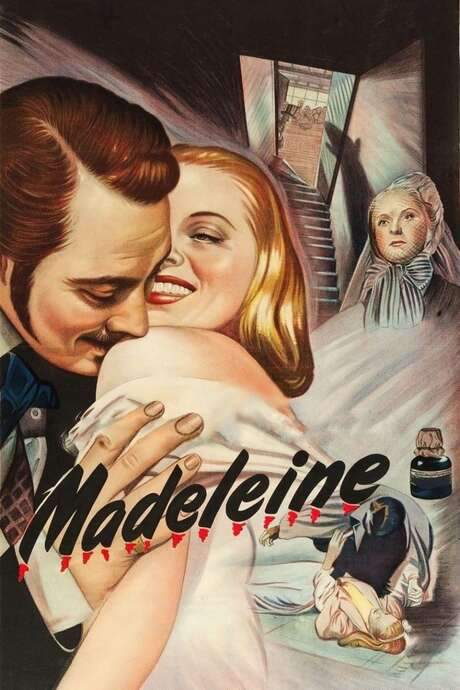
Madeleine 1950


Directed by

David Lean
Made by

Cineguild
Where to Watch Madeleine
See current US streaming, rental, and purchase options for Madeleine (1950) via JustWatch.

Criterion Channel
HD
Plex
HD
Plex Channel
HD
Tubi TV
SD
YouTube Free
HD
Amazon Video
HD Streaming availability powered by 
Madeleine Plot Summary
Read the complete plot summary and ending explained for Madeleine (1950). From turning points to emotional moments, uncover what really happened and why it matters.
The film opens in a contemporary Glasgow setting at 7 Blythswood Square, then shifts back to the early 19th century to follow Madeleine Smith, a young woman from an upper-middle-class family, and her relationship with Emile L’Angelier, a French draper’s assistant who becomes her lover. The story unravels the quiet drama of a romance that must navigate strict social expectations and hidden desires.
In the new family home, the eldest daughter makes a bold choice: she claims the basement bedroom so she can access the servants’ entrance and entertain her lover without her family’s knowledge, planting the seeds for a tension-filled secret. The romance deepens as the couple become secretly engaged, yet L’Angelier presses Madeleine to reveal the relationship to her father so they can marry openly. Madeleine, frightened by her authoritarian father, wrestles with the idea of losing him and the life she’s been groomed to lead. Eventually, she visits L’Angelier in his room and says she will elope rather than face telling her father, but he makes clear he could never marry her this way. He loves her, but he also wants to restore his own standing in society, and she realizes the relationship has become entangled with more than love alone.
During this period Madeleine’s father pushes for a different match, encouraging her to accept the attentions of a wealthy society gentleman, William Minnoch. The plan is to secure a respectable future, and Madeleine agrees to consider Minnoch’s proposal, even as she continues to see L’Angelier. L’Angelier, not content to be pushed aside, shows up threatening to expose the compromising letters in his possession unless she remains in contact with him. Madeleine agrees to continue seeing him, keeping her engagement to Minnoch under wraps.
Weeks after these tensions unfold, L’Angelier falls gravely ill, recovers, then relapses and dies of arsenic poisoning. A friend points the finger at Madeleine, and authorities discover that she had arsenic in her possession at the time of L’Angelier’s death. The remainder of the film follows the ensuing court case, culminating in the unique Scottish verdict of “not proven”, which releases Madeleine from custody as neither clearly guilty nor clearly innocent.
The drama unfolds with careful attention to character, motive, and the social pressures of Victorian Glasgow, offering a measured look at how appearances often clash with intimate truth. The film ultimately leaves viewers contemplating the stakes of reputation, desire, and the fraught path to justice in a society that guards its proprieties as fiercely as its secrets.
Madeleine Timeline
Follow the complete movie timeline of Madeleine (1950) with every major event in chronological order. Great for understanding complex plots and story progression.
Opening at 7 Blythswood Square
The film opens with a contemporary view of 7 Blythswood Square in Glasgow, where a wealthy Victorian family is established. The eldest daughter Madeleine is introduced alongside an air of intrigue about a secret life she keeps from her relatives. The scene sets a modern lens on a story that will flash back to the 19th century.
Purchase and secrets of a Glasgow house
The story flashes back to the early 19th century, when a Glasgow house is purchased by the upper middle-class family. Madeleine claims the basement bedroom so she can entertain her lover without her family noticing. The arrangement foreshadows the clandestine life that will drive the coming drama.
Secret relationship and engagement
Madeleine and Emile L'Angelier begin a romantic relationship and move toward engagement kept hidden from her father. The couple's secrecy grows as they navigate social expectations and Madeleine's fears of reprisal. The bond is framed by the pressure of Madeleine's social position.
Pressure to reveal to her father
L'Angelier presses Madeleine to reveal the relationship to her father so they can marry. Madeleine remains reluctant, weighed down by paternal authority and the risks of social scandal. The tension foreshadows the eventual end of the affair.
Elopement plan and breakup
In a heated exchange, Madeleine agrees to elope, but L'Angelier reveals he could never marry her this way. Madeleine ends the relationship and demands the return of all letters they shared. The break demonstrates how love is entangled with status and secrecy.
Father pushes toward a wealthy match
During this period, Madeleine's father and family press her toward the attentions of a wealthy suitor, William Minnoch. Despite her earlier engagement, she declares she will accept Minnoch's proposal. The family welcomes the match as a secure social ascent.
L'Angelier's return and threat
Some weeks later, L'Angelier returns, threatening to reveal the compromising letters to her father unless she continues to see him. Madeleine says nothing about her engagement and reluctantly agrees to maintain contact with him. The coercive dynamic underscores the peril surrounding her secrets.
Illness and death of L'Angelier
L'Angelier falls gravely ill, recovers, and then suffers a fatal relapse. Arsenic poisoning is confirmed as the cause of death, triggering suspicion toward Madeleine. A friend points the finger at her, and authorities later find arsenic in her possession at the time of L'Angelier's death.
Rising suspicion and investigation
Following the death, public suspicion falls on Madeleine as the central suspect in a suspected murder. Investigators weigh the evidence and social perceptions of the case intensify. The story shifts from private secrets to a public legal confrontation.
The trial unfolds in court
The remainder of the film follows the court case that pits Madeleine's fate against a skeptical prosecution. Witnesses, letters, and motives are argued in Glasgow's court, building toward a dramatic verdict. The atmosphere is tense and meticulously balanced between guilt and innocence.
The not proven verdict
The trial reaches its climax with Scotland's infamous 'not proven' verdict. The ambiguous outcome leaves Madeleine neither declared guilty nor acquitted, reflecting a peculiar legal stance of the era. The defense and public reaction highlight the unresolved questions surrounding the case.
Madeleine's release and aftermath
Madeleine is released from custody, effectively a free woman despite the unresolved questions about the death. The film closes on the cautionary note of the not proven verdict and its social implications. The era's legal tradition lingers as the true truth remains undecided.
Madeleine Characters
Explore all characters from Madeleine (1950). Get detailed profiles with their roles, arcs, and key relationships explained.
Madeleine Hamilton Smith (Ann Todd)
A respectable young woman torn between family expectations and a clandestine relationship. She navigates the pressures of marriage markets, class, and reputation, driving both the romance and the legal fallout. Her choices crystallize the central conflict between desire and duty.
Emile L'Angelier (Ivan Desny)
A French lover whose pursuit of recognition intersects with social ambition. His insistence on secrecy and his push for a public acknowledgment of the affair complicate Madeleine’s life. He embodies a blend of passion and social maneuvering that fuels the drama.
James Smith
Madeleine’s father, an authoritative figure whose insistence on propriety shapes her decisions. His control and expectations reflect the era’s emphasis on lineage and status. He embodies the household’s moral burden and its impact on Madeleine’s choices.
William Minnoch
A wealthy suitor favored by Madeleine’s family as a secure match. He represents social advancement through marriage and the external validation of status. His presence heightens the tension between true feeling and social arrangement.
Mrs. Smith
Madeleine’s mother and a participant in the family’s reputation-conscious world. Her concerns center on social standing and the optics of any potential scandal. She helps drive the family’s strategic choices in the plot.
Defense Attorney
The lawyer who challenges the prosecution and scrutinizes the evidence. His role tests Madeleine’s presumed guilt and defends the possibility of innocence within a culturally charged case. He embodies legal strategy under intense public scrutiny.
Prosecuting Attorney
The attorney who assembles the case against Madeleine and shapes the courtroom narrative. His approach reflects the era’s zeal for justice and public opinion’s influence on legal outcomes. He drives the dramatic tension of the trial.
Dr. Penny
A medical professional contributing to the investigation of the death, adding forensics to the narrative. His testimony helps frame questions about arsenic poisoning and causality in a 19th-century context. He embodies the era’s evolving medical science within a legal thriller.
Janet Smith
A member of the family circle whose presence adds to the domestic atmosphere and social dynamics surrounding Madeleine. She reflects the younger generation’s exposure to the unfolding events and the impact of family reputation on siblings.
Madeleine Settings
Learn where and when Madeleine (1950) takes place. Explore the film’s settings, era, and how they shape the narrative.
Time period
Early 19th century to 1857
The narrative moves from the early 19th century social world to the climactic 1857 murder trial. It reflects the rigid expectations of Scottish society, where class, gender, and reputation shape choices. The trial and its infamous not proven verdict sit squarely in the era’s legal and cultural context.
Location
7 Blythswood Square, Glasgow, Scotland
The story is rooted in Glasgow’s upper-middle-class milieu, anchored by the family home at 7 Blythswood Square. The city’s domestic interiors and social circuits frame the romance and the ensuing scandal. The setting contrasts respectable domestic life with the public intensity of a legal battle in Victorian Scotland.
Madeleine Themes
Discover the main themes in Madeleine (1950). Analyze the deeper meanings, emotional layers, and social commentary behind the film.
🎭
Society & Reputation
The film centers on how social status and family expectations govern personal choices. Madeleine’s actions are filtered through class norms, arranged alliances, and the fear of scandal. Private desires collide with public propriety, revealing the pressure to perform respectability.
⚖️
Law & Verdict
The 1857 trial exposes the quirks of Scottish jurisprudence, including the infamous not proven verdict. Evidence, testimony, and public sentiment intertwine to shape the courtroom drama. The legal process becomes a mirror for social judgment and accountability.
👩
Gender & Autonomy
Madeleine’s agency is constrained by patriarchal authority and expectations of female propriety. The romance tests whether a woman can determine her own fate within a rigid social framework. The story questions the balance between personal truth and societal duty.

Coming soon on iOS and Android
The Plot Explained Mobile App
From blockbusters to hidden gems — dive into movie stories anytime, anywhere. Save your favorites, discover plots faster, and never miss a twist again.
Sign up to be the first to know when we launch. Your email stays private — always.
Explore the mobile appMadeleine Spoiler-Free Summary
Discover the spoiler-free summary of Madeleine (1950). Get a concise overview without any spoilers.
In the soot‑kissed streets of early‑19th‑century Glasgow, a respectable family occupies a newly built house on Blythswood Square, its polished façade reflecting the strict codes that govern respectable society. The city’s brass‑band rhythm of industry and propriety hums in the background, offering both the promise of progress and the weight of rigid expectation. Within these walls, every doorway seems to guard a secret, and the quiet elegance of the home belies the restless undercurrents that stir beneath its surface.
Madeleine is the youngest daughter of this house, poised between the genteel future charted for her and a private world that refuses to be contained. Groomed for a respectable marriage, she feels the invisible pressure of a father whose authority shapes every decision, while an inner yearning pushes her toward a path that diverges from the one laid out before her. The film lingers on her moments of contemplation, tracing the delicate dance of obedience and desire that defines her every choice.
Across the social divide, Emile L’Angelier enters her life—a French draper’s assistant whose charm and intellect awaken a side of Madeleine that she keeps hidden from her family. At the same time, the family’s patriarch encourages a courtship with William Minnoch, a wealthy and socially advantageous gentleman whose presence represents the safety of conformity. The tension between these two suitors—one a symbol of stability, the other of forbidden passion—creates a quiet storm that threatens to upend the family’s carefully ordered world.
As whispers of Madeleine’s private choices spread, the household finds itself unwittingly entangled in a legal drama that would become one of Scotland’s most talked‑about jury verdicts. The film’s tone remains measured and atmospheric, letting the weight of reputation, the pull of longing, and the looming specter of public scrutiny hover over every interaction, inviting the audience to sense the fragile balance between appearance and truth.
Movies with Similar Twists and Themes
Uncover films that echo the narrative beats, emotional arcs, or dramatic twists of the one you're exploring. These recommendations are handpicked based on story depth, thematic resonance, and spoiler-worthy moments — perfect for fans who crave more of the same intrigue.







Featured on this page

What's After the Movie?
Not sure whether to stay after the credits? Find out!
Check out our other apps:

SAT Sphere
Build confidence for the Digital SAT.

Mori Atlas
Discover wild places worth protecting.

Luntero
Search smarter for a home in Amsterdam.

Plot Explained
Unravel movie endings and hidden clues.

Pokechamp
Dive into Pokémon data and battle logic.

Driving Theory
Get ready for your European theory test.

Movie Dust
Plan your next cinema trip with ease.

Musemap
Find art and culture as you travel.

Selkobase
Compare credentials before committing.

Local Manual
Turn an unfamiliar country into practical next steps.

Lernavi
Compare school systems before your next move.

GymRoam
Find a workout stop wherever your plans take you.
Explore Our Movie Platform
New Movie Releases (2026)
Famous Movie Actors
Top Film Production Studios
Movie Plot Summaries & Endings
Major Movie Awards & Winners
Best Concert Films & Music Documentaries
Movie Collections and Curated Lists
© 2026 What's After the Movie. All rights reserved.
Privacy Policy