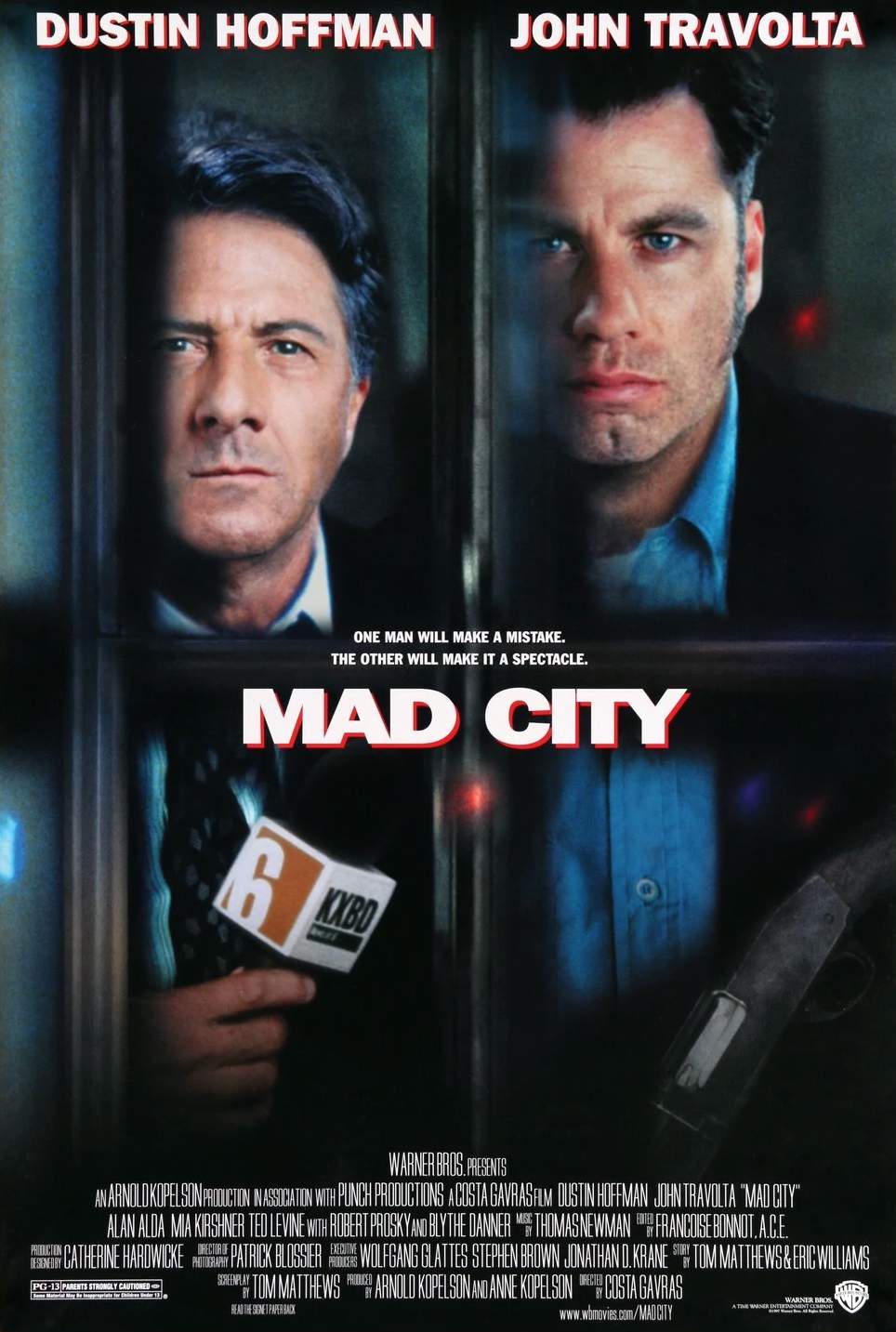
Mad City 1997

Directed by

Costa-Gavras
Made by

Warner Bros. Pictures
Where to Watch Mad City
See current US streaming, rental, and purchase options for Mad City (1997) via JustWatch.







Mad City Plot Summary
Read the complete plot summary and ending explained for Mad City (1997). From turning points to emotional moments, uncover what really happened and why it matters.
Sam Baily, a former museum security guard, is fired from his job and returns to the museum armed with a shotgun and dynamite, taking his former boss, Mrs. Banks, and a group of schoolchildren on a field trip hostage. Inside the museum, local TV journalist Max Brackett happens to be there, just after an interview about the museum’s financial troubles, and he quickly becomes drawn into the crisis. He steps in as the intermediary between the hostages inside and the outside world, trying to keep communication open with the police.
The tense situation escalates when Sam Baily accidentally shoots his friend Cliff, another security guard, sending him to the hospital. He fires again later, heightening fear among the children, and he relies on caffeine pills to stay alert. Amid the growing media attention, Brackett, along with a young intern named Laurie, starts reporting the story on television, which revives Brackett’s stalled career. Through his ability to move about the museum, Brackett negotiates with a national network and its star news anchor, Kevin Hollander, a figure with whom Brackett has an uneasy history.
Sam Baily refuses to accept jail and longs to return home to his wife and kids, while Brackett pursues the best possible story for his station. He strikes a deal to keep Hollander from getting the access he desires, which leads Hollander to publicly accuse Brackett of prolonging the crisis and endangering the children. Laurie betrays Brackett, showing that she, too, will do whatever it takes to advance her own career.
When Cliff dies, Sam Baily begins to realize how much he has lost. The hostage situation deteriorates as Brackett and Baily let the crisis worsen, until the police issue a five-minute ultimatum for the release of the hostages. Baily finally allows the children and Mrs. Banks to go. He also sends Brackett outside to persuade the police to lower their guns so he can personally usher out Baily. But instead of surrendering to prison and his wife, Baily seals the doors of the museum on Brackett, who is outside trying to persuade the authorities.
Brackett’s attempts to coax Baily out fail, and he remains inside. Unaware of Baily’s plan, Brackett watches as the explosives are set off and Baily commits suicide. The blast flings Brackett to the pavement in the parking lot, with reporters swarming to ask for a comment on the events. In the aftermath, Brackett can only reflect, “We killed him,” a stark line that underscores how the media’s handling of the crisis contributed to the tragedy.
Mad City Timeline
Follow the complete movie timeline of Mad City (1997) with every major event in chronological order. Great for understanding complex plots and story progression.
Hostage crisis erupts as Baily returns with weapons
Sam Baily, recently fired from the museum, returns with a shotgun and dynamite and takes the building’s visitors hostage. He locks the doors and coerces the staff and students to stay put while the situation unfolds. The incident instantly turns the museum into a televised crisis.
Brackett enters as intermediary
Max Brackett, a local TV journalist, is in the museum restroom after an interview about the museum's finances. He becomes Baily’s intermediary, directing information to the outside world and the police. His presence drags the event onto a national stage.
Cliff is shot; hospital dash
Baily accidentally shoots Cliff, a fellow security guard, sending him to the hospital. He fires again, increasing fear among the hostages and showing his deteriorating grip on reality. This act marks a dangerous escalation inside the hostage situation.
Caffeine-fueled tension
Baily grows more unhinged, taking caffeine pills to stay awake and maintaining control over the hostages with volatile threats. The children become increasingly frightened as the crisis stretches on. The museum atmosphere shifts from confusion to danger.
Media circus grows outside
Laurie, a young intern, and Brackett amplify the outside media coverage as Brackett reports exclusively. Their actions feed the growing media circus surrounding the event. The exposure begins reviving Brackett’s career at the expense of the hostages’ safety.
Networks and Hollander push for coverage
Brackett negotiates with a national network and its star anchor, Kevin Hollander, aiming to secure favorable coverage. He uses the crisis as leverage to gain access and airtime. The dynamic emphasizes the cost of sensational journalism.
Bailey seeks personal escape
Baily expresses a strong desire to return home to his wife and kids, refusing to accept that he might serve jail time. He clings to the notion of a personal escape rather than punishment. The tension between his personal motivation and the legal consequences deepens.
Hollander accuses Brackett; deal unfolds
Brackett makes a deal to prevent Hollander from getting the full story, prompting Hollander to publicly accuse him of prolonging the crisis and risking the children. The power struggle among media players becomes a factor in the standoff. The consequences ripple outward to the hostages.
Laurie betrays Brackett
Laurie betrays Brackett, showing she will do whatever it takes to advance her own career. Her maneuvering underscores how far some will go for headlines. The collaboration between Brackett and Laurie fractures under pressure.
Cliff dies; Baily realizes loss
With Cliff dead, Baily begins to realize he has lost everything he valued. The personal bonds he shattered are echoed in the casualties of the crisis. The event marks a turning point in his psychology toward admitting defeat.
Five-minute ultimatum
Police issue a five-minute ultimatum for the release of all hostages. Time runs short as negotiators push for a peaceful resolution. The clock creates a sense of impending violence.
Partial hostage release
Baily releases the children and Mrs. Banks, signaling a fragile concession but still refusing to surrender. The hostages’ survival becomes a focus of negotiation. The dynamic shifts with this partial release.
Brackett used to lower the guns
Brackett leaves to persuade the police to lower their guns so Baily can be ushered out, effectively being used as a tool by the authorities and the media. He returns to the exterior crowd, his role still precarious. The line between information and manipulation blurs.
Baily detonates the explosives
Rather than surrender, Baily locks the museum doors and detonates explosives, committing suicide in a final act. The blast collapses the situation and destroys the possibility of a rescue. The tragedy cements the crisis as a media-dominated catastrophe.
Brackett's grim verdict
The blast scatters debris as reporters converge on the scene. Brackett, dazed, tells the cameras, 'We killed him,' a grim statement about how the media influenced the outcome. The film closes with a somber reflection on sensational journalism’s cost.
Mad City Characters
Explore all characters from Mad City (1997). Get detailed profiles with their roles, arcs, and key relationships explained.
Sam Baily (John Travolta)
A former museum security guard who was sacked and returns with a shotgun and dynamite, taking the museum's visitors hostage. His escalating actions—shooting a coworker, using caffeine pills to stay awake—show a man unraveling under pressure. He clings to a desperate hope to return home to his wife and kids, even as his plans spiral out of control.
Max Brackett (Dustin Hoffman)
A local TV journalist who becomes the intermediary between Baily and the outside world. He leverages the crisis to resurrect his career by delivering exclusive access, navigating network politics and rival anchors. His ambition blinds him to the consequences for the hostages and others involved, at least until the situation escalates beyond control.
Kevin Hollander (Alan Alda)
A star news anchor whose pursuit of the most sensational angle drives the newsroom dynamics and the ratings race. He uses public accusations to pressure Brackett and shape the narrative, embodying a cynical broadcast culture that prioritizes spectacle over safety.
Mrs. Banks
Owner of the museum and one of the hostages, representing civilians caught in the crisis. Her presence highlights the human stakes beyond the media circus and law enforcement maneuvering.
Cliff
A friend and coworker of Sam who is shot by Sam, becoming a catalyst for the hospital visit and escalating the tension. His injury marks a turning point in Sam's realization of what is at stake.
Laurie
A young intern who becomes involved in the media circus outside and ultimately betrays Brackett to advance her own career. Her actions illustrate the cutthroat drive for advancement in a crisis-stoked media environment.
Mad City Settings
Learn where and when Mad City (1997) takes place. Explore the film’s settings, era, and how they shape the narrative.
Time period
late 1990s
The events unfold in the late 1990s, a period marked by the rise of 24-hour news cycles and sensational television coverage. Newsrooms chase exclusives, shaping how crises are reported and perceived by the public. This era’s media climate intensifies the pressure on everyone involved and drives the narrative toward spectacle.
Location
the museum
The museum serves as the setting for the hostage crisis, a cultural space that becomes a public spectacle under intense media glare. The school field trip inside the building turns into a dangerous situation as hostages are taken among frightened children, while staff and visitors are confined by the unfolding events. The public nature of the venue amplifies the stakes and invites constant media scrutiny.
Mad City Themes
Discover the main themes in Mad City (1997). Analyze the deeper meanings, emotional layers, and social commentary behind the film.
🗞️
Media Sensationalism
The hostage crisis becomes a ratings-driven spectacle as Brackett seeks a career-defining story. The film critiques how live coverage can distort events and influence decisions by authorities and networks. It shows how audiences consume crisis as drama, often at the expense of victims and truth.
🎭
Power Dynamics
Power struggles between media figures, network executives, and law enforcement push decisions in directions that prioritize viewership over safety. Baily, Brackett, and Hollander each maneuver for control of the narrative, revealing how information can be wielded as a weapon. The story probes ethical boundaries when influence eclipses responsibility.
💥
Tragic Consequences
The escalating actions and the ultimate suicide reveal how personal desperation and public pressure can culminate in ruin. The violence and its aftermath ripple through the hostages, family, and the reporters covering the crisis. The ending underscores the human cost behind a media-fueled meltdown.

Coming soon on iOS and Android
The Plot Explained Mobile App
From blockbusters to hidden gems — dive into movie stories anytime, anywhere. Save your favorites, discover plots faster, and never miss a twist again.
Sign up to be the first to know when we launch. Your email stays private — always.
Explore the mobile appMad City Spoiler-Free Summary
Discover the spoiler-free summary of Mad City (1997). Get a concise overview without any spoilers.
In the heart of a bustling metropolis, a venerable museum stands at the crossroads of art, history, and financial uncertainty. The building’s marble halls and polished exhibits serve as a backdrop for everyday struggles—budget cuts, bureaucratic pressure, and the quiet dreams of those who keep its doors open. Within this setting, Sam Baily, a former security guard whose life has been upended by a sudden dismissal, finds himself drawn back into the museum’s shadowed corridors, confronting a crisis that threatens to upend both his personal world and the institution’s fragile stability. Alongside him is Mrs. Banks, the museum’s poised director, whose dedication to the collection is matched only by her concern for the people gathered within its walls.
Across the street, a television news crew is preparing a routine segment on the museum’s monetary woes. Max Brackett, a seasoned but career‑tired journalist, steps into the unfolding drama, seeing in the tension an opportunity to revive his reputation. As he negotiates the delicate balance between reporting and intervening, he becomes the reluctant bridge between the unfolding incident inside and the frantic outside world. The atmosphere crackles with urgency, amplified by the ever‑watchful gaze of cameras and the pulsing rhythm of a city that never pauses.
Behind the scenes, an ambitious intern named Laurie eyes the spotlight, while a charismatic network anchor, Kevin Hollander, looms as both a mentor and a rival to the reporter. Their intersecting motivations create a web of ambition, responsibility, and ethical ambiguity that underscores the story’s central conflict. The tone swings between tense, almost claustrophobic moments within the museum’s stone confines and the frenetic, glossy world of live television, inviting the audience to ponder how media, personal desperation, and institutional pressure can collide in unexpected ways.
Movies with Similar Twists and Themes
Uncover films that echo the narrative beats, emotional arcs, or dramatic twists of the one you're exploring. These recommendations are handpicked based on story depth, thematic resonance, and spoiler-worthy moments — perfect for fans who crave more of the same intrigue.


Featured on this page

What's After the Movie?
Not sure whether to stay after the credits? Find out!
Check out our other apps:

SAT Sphere
Build confidence for the Digital SAT.

Mori Atlas
Discover wild places worth protecting.

Luntero
Search smarter for a home in Amsterdam.

Plot Explained
Unravel movie endings and hidden clues.

Pokechamp
Dive into Pokémon data and battle logic.

Driving Theory
Get ready for your European theory test.

Movie Dust
Plan your next cinema trip with ease.

Musemap
Find art and culture as you travel.

Selkobase
Compare credentials before committing.

Local Manual
Turn an unfamiliar country into practical next steps.

Lernavi
Compare school systems before your next move.

GymRoam
Find a workout stop wherever your plans take you.
Explore Our Movie Platform
New Movie Releases (2026)
Famous Movie Actors
Top Film Production Studios
Movie Plot Summaries & Endings
Major Movie Awards & Winners
Best Concert Films & Music Documentaries
Movie Collections and Curated Lists
© 2026 What's After the Movie. All rights reserved.
Privacy Policy