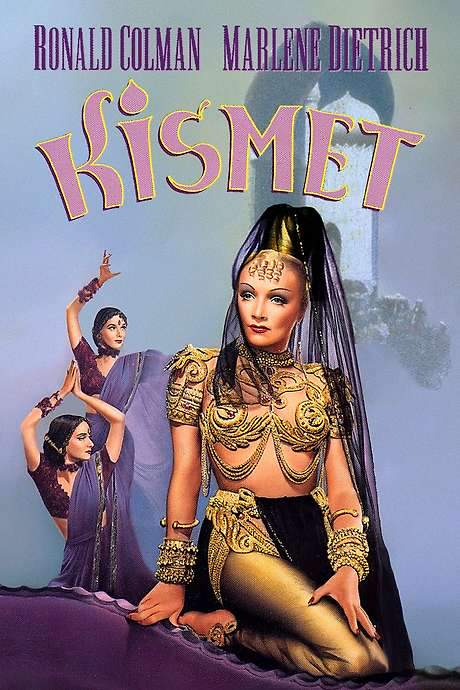
Kismet 1944

Directed by

William Dieterle
Made by

Metro-Goldwyn-Mayer
Where to Watch Kismet
See current US streaming, rental, and purchase options for Kismet (1944) via JustWatch.

HBO Max
HD
HBO Max Amazon Channel
HD
Amazon Video
SD
Apple TV Store
SD Streaming availability powered by 
Kismet Plot Summary
Read the complete plot summary and ending explained for Kismet (1944). From turning points to emotional moments, uncover what really happened and why it matters.
Set in a Baghdad that feels like a storybook come to life, where the city glitters with a newly minted shine, this tale follows Hafiz, a middle‑aged beggar and magician who drifts between two identities. By day he parades as the self-styled King of Beggars, and by night he transforms into the mysterious Prince of Hassir. In his nocturnal guise, he encounters Jamilla, the Queen of the Grand Vizier’s harem, a woman who knows he is playing a role yet remains unexpectedly drawn to him. Their dynamic becomes a delicate cat-and-mouse of attraction, bold showmanship, and shared secrets, set against the backdrop of palace politics.
Across the city, a young and curious Caliph disguises himself as the “son of the Royal Gardener,” wandering the streets to understand the people he rules. His undercover journey is rooted in a wary relationship with his trusted adviser, Agha, whose stern counsel and oversight frame the Caliph’s every decision. During these street explorations, the Caliph meets Marsinah, Hafiz’s daughter, and a tender romance begins to bloom. The Caliph’s intrigue deepens when he encounters the Prince of Hassir and is quietly amused by Hafiz’s deft magic tricks—especially the moment a knife seems to materialize from a handkerchief, a stunt that wows him but also foreshadows danger.
To shelter his daughter within a world of fairy-tale promises, Hafiz has built tall walls around his home. He believes in elevating Marsinah beyond ordinary life, and his plan—though unorthodox—aims to position her for a union with royalty. Marsinah’s nurse, Karsha, often challenges Hafiz with a blunt bite of reality, muttering a firm “Bah!” whenever his dreams threaten to outsize what is practical. Yet Marsinah confides in her nurse, revealing how she has fallen for the son of a gardener, not for aristocracy. Karsha keeps this confession close, knowing the future Hafiz imagines for his daughter might never align with her heart’s desire.
The plot thickens as Marsinah speaks openly of Hafiz’s promise of a prince who would tear down the walls that guard her world. The Caliph returns to his palace with the intention of proposing to Marsinah, setting the stage for a collision between love, status, and power. On a separate track, Hafiz witnesses an assassination attempt on the Caliph by an agent of the Grand Vizier, who is swiftly killed by the Vizier’s own men. The Caliph’s suspicions shift toward the Vizier, who seems increasingly entangled in a web of plots. Hafiz, meanwhile, perceives an opportunity: if Marsinah could wed the Vizier, the two worlds of ordinary life and royal ambition could be brought together—and perhaps even stabilized.
Predictions of a future alliance prompt Hafiz to act. He steals fine clothes from the market and enters the Vizier’s circle as the Prince of Hassir, offering Marsinah’s hand in marriage. The Vizier welcomes the prospect with wine, music, and dancing girls, while Jamilla—sensing the stakes—reluctantly agrees to perform when she realizes the guest’s true identity. In a private moment, Hafiz asks Jamilla to abandon the Vizier and marry him, but she refuses the moment it would endanger her own seat of power. Marsinah, for her part, faces a stark choice: continue under Hafiz’s dream or step into a life she has glimpsed as queenly but perilous.
Hafiz’s deception is soon exposed, and he is arrested for theft of the fancy clothing. The Vizier’s palace is placed under Caliph’s guard to secure his compliance, and Hafiz bargains for a grimly pragmatic outcome: his own hands back, his life spared, and Marsinah elevated to be the Grand Vizier’s wife. The bargain hinges on a final display of Hafiz’s knife trick, a demonstration meant to prove his cunning and win the Vizier’s cooperation.
As the plan unfolds, Hafiz—with the Vizier’s influence behind the scenes—prepares to meet the Caliph in a public setting, hoping to clinch Marsinah’s betrothal. The Caliph, aware of the ruse, is wary of the source of the petition and, at a critical moment, learns that the man he has known as Hafiz is the same young ruler who has captured his daughter’s heart. The attempted manipulation unravels quickly: the Caliph sidesteps the blade, and chaos ensues as the Vizier escapes and orders Marsinah killed. Hafiz rushes to protect his daughter, but a confrontation in the harem ends with the Vizier slain and Hafiz taken into custody by palace guards.
The punishment is stark but foreordained: the Caliph dissolves Hafiz’s twofold identity by appointing him as a Prince of the barren lands of Hassir, and he is banished from Baghdad by sunset unless the walls are demolished. Hafiz accepts, asking only that the walls be torn down when the time comes to claim Marsinah. In a climactic reversal, the Caliph’s troops tear down the walls, and he rides in on a white horse, with Marsinah and Jamilla by his side. The revelation unfolds—Marsinah’s gardener’s son is the Caliph all along—and the lovers are united. Hafiz, now a genuine Prince of Hassir in name, eyes the future with a mixed sense of loss and kinship. Exiled from Baghdad, he watches his daughter wed the Caliph, and with Jamilla beside him, they depart for Hassir, fulfilling Hafiz’s long‑standing kismet and sealing the story in a quiet, hopeful final note.
Kismet Timeline
Follow the complete movie timeline of Kismet (1944) with every major event in chronological order. Great for understanding complex plots and story progression.
Hafiz's double life: King of Beggars and Prince of Hassir
In old Baghdad, Hafiz moves through the city as the King of Beggars by day and the Prince of Hassir by night. He parades his magic and charisma while keeping his daughter Marsinah sheltered behind high walls. Lady Jamilla, the Queen of the Grand Vizier's harem, watches him with a mix of suspicion and fascination.
The Caliph's disguise and first loves
The young Caliph disguises himself as the son of the Royal Gardener and roams Baghdad to learn about his people. He falls in love with Marsinah and, meanwhile, encounters Hafiz's Prince of Hassir persona and mocks his tricks, especially the knife-from-handkerchief illusion. The streets of Baghdad become a stage for both romance and danger.
Hafiz builds walls around his house to protect Marsinah
To shield his daughter and fuel fairy-tale dreams, Hafiz has erected tall walls around his house. Marsinah's nurse Karsha senses danger and warns of the futility of the dream, while Marsinah confides in her about a future prince who will tear the walls down. The walls symbolize both protection and isolation.
Caliph plans to propose to Marsinah
The Caliph returns to his palace and sets out to propose marriage to Marsinah, unaware of the tangled web Hafiz has woven. His plan increases the stakes for both families and hints at the coming clash of loyalties. The palace corridors hum with political and romantic tension.
An assassination attempt on the Caliph
An agent of the Grand Vizier tries to kill the Caliph, but is killed by the Vizier when the plot is uncovered. The Caliph grows suspicious of the Vizier, suspecting him behind the attack and potential threat to Marsinah. The streets become a backdrop for courtly intrigue and danger.
Hafiz bargains with the Vizier
Hafiz suspects the Vizier might suit Marsinah's future and infiltrates the Vizier's circle by posing as the Prince of Hassir. Jamilla performs for the Vizier, and Hafiz privately asks her to leave the Vizier and marry him, planning Marsinah's future as the Vizier's wife. The bargain tightens the plot and alliances.
Hafiz is arrested for theft
Hafiz is arrested for stealing fancy clothes and is brought before the Vizier, who treats him with amused contempt. The sentence of cutting off his hands looms until a messenger shifts the balance of power and the Caliph's influence arrives. The danger Hafiz faces becomes more immediate and personal.
Bargain sealed with the knife trick
To secure his life and Marsinah's future, Hafiz bargains with the Vizier and plans to use magic to kill the Caliph. He demonstrates his knife-from-handkerchief trick, signaling his readiness to strike and shaping the double-deal that underpins the plot. The illusion becomes a weapon in the unfolding conspiracy.
Public audience and the revelation of fate
Hafiz is arranged to meet the Caliph in a public audience. Caliphate officials reveal that Hafiz may be the man whose hand should seal Marsinah's fate, while Hafiz remains unaware that the Caliph is the gardener's son he once impressed. The moment reframes who is manipulating whom.
The failed assassination and the chase
During the open-air audience, Hafiz tries to strike the Caliph with the staged knife. The Caliph dodges, the Vizier escapes, and Marsinah's fate looks grim as Hafiz rushes to protect her from the fallout. Chaos erupts as loyalties collide and the plans unravel.
Confrontation in the harem and Vizier's death
In the ensuing struggle, Hafiz and the Grand Vizier fight amid the palace corridors and the harem. The Vizier is killed, and palace guards swiftly arrest Hafiz, who faces the consequences of his dangerous plan. The palace atmosphere shifts from celebration to crisis.
Exile, tearing down walls, and a new kismet
The Caliph condemns Hafiz to be the Prince of Hassir and exile him from Baghdad at sunset. In a final twist, the Caliph orders the walls around Hafiz's home torn down, uniting Marsinah with the Caliph, while Jamilla sides with Hafiz as they depart Baghdad for Hassir. A new destiny awaits all, as love and power redefine the city.
Kismet Characters
Explore all characters from Kismet (1944). Get detailed profiles with their roles, arcs, and key relationships explained.
Handmaiden (Yvonne De Carlo)
A minor palace servant seen within the harem’s world; her presence highlights the opulent, tightly controlled social environment surrounding Jamilla and Hafiz.
Moolah (Hobart Cavanaugh)
A character listed in the cast whose specific role isn’t described in the provided summary; appears within the film’s broader courtly world.
Karsha (Florence Bates)
Marsinah’s nurse who knows her charge’s feelings and guards family secrets; she warns Hafiz about future plans and the princess’s heart.
Agha (Harry Davenport)
The Caliph’s trusted adviser who disapproves of the Caliph’s street-almost-revelation missions and influences political decisions.
Jamilla (Marlene Dietrich)
Queen of the Grand Vizier's harem who is drawn to Hafiz’s performative prince persona, complicating palace politics with a personal attraction.
Narrator (Frank Morgan)
Narrates the tale, guiding the audience through the magical, dreamlike events that unfold in Baghdad and Hassir.
The Grand Vizier (Edward Arnold)
A powerful court figure who plots to marry Marsinah to advance his own position, orchestrating masquerades and schemes.
Alfife (Robert Warwick)
A figure connected to the palace’s inner circle; the provided summary does not detail his actions.
Hafiz (Ronald Colman)
A middle-aged beggar and magician who leads a double life as the King of Beggars by day and the Prince of Hassir by night; his love for Marsinah drives much of the plot.
Feisal (Hugh Herbert)
A character in the Caliph’s circle; not elaborated upon in the provided summary.
Caliph (James Craig)
The young ruler who disguises himself as the gardener’s son to learn about his subjects; he falls in love with Marsinah and becomes central to the tale’s romantic and political turn.
Marsinah (Joy Page)
Hafiz’s daughter who falls for the gardener’s son who is revealed to be the Caliph; her dreams and loyalties drive the emotional center of the story.
Kismet Settings
Learn where and when Kismet (1944) takes place. Explore the film’s settings, era, and how they shape the narrative.
Time period
Arabian Nights era (fictional)
Set in a mythic past inspired by Middle Eastern folklore, the film presents a timeless Baghdad where magic and court politics mingle. The period is not anchored to a specific year, emphasizing fairy-tale atmospherics over history. Disguises, prophecies, and grand gestures drive the story.
Location
Baghdad, Hassir
Baghdad is depicted as a glittering metropolis sparkling with magic and royal power. The streets host magicians, gardeners, viziers and caliphs, all within a dreamlike Arabian Nights ambience. The setting frames Hafiz's double life and Marsinah's fate, including the exile to Hassir.
Kismet Themes
Discover the main themes in Kismet (1944). Analyze the deeper meanings, emotional layers, and social commentary behind the film.
💖
Love & Class
The romance at the heart of Kismet crosses lines of status and ambition. Marsinah, the daughter of Hafiz, falls for the Caliph’s gardener’s son, a gardener's son who is really the Caliph in disguise. Jamilla, the Queen of the Grand Vizier's harem, becomes entangled with Hafiz, showing how love can disrupt strict social hierarchies. The story uses marriage as a bargaining tool, revealing how power structures manipulate intimate relationships.
🪄
Illusion & Deception
Hafiz lives a double life as the King of Beggars by day and the Prince of Hassir by night, blurring truth and performance. He deceives the Vizier by presenting himself as Hassir's prince and later uses magical tricks to threaten the Caliph. The Caliph and Hafiz's plan to outmaneuver each other is built on misdirection and disguise. The plot hinges on lies that threaten to unravel, until truth finally alters the course of fate.
⏳
Kismet & Destiny
Much of the plot turns on fate and the idea of kismet determining outcomes. Hafiz crafts schemes to secure Marsinah's future, only to have the gardener's son reveal himself as the Caliph. The walls Hafiz builds around his daughter's dreams eventually come down in a moment of reckoning. In the end, destinies converge as lovers unite and a royal future is forged.
🏛️
Power & Politics
Court intrigue drives the narrative: the Grand Vizier seeks Marsinah's hand and manipulates court life to secure power. The Caliph's authority is tested by Hafiz's deception and the ever-present threat of assassination. The Vizier is killed in the palace conflict, and Hafiz is exiled, illustrating how personal desires collide with political scheming. The ending shows power rebalanced as the lovers' futures are resolved against the backdrop of a tearing down of walls.

Coming soon on iOS and Android
The Plot Explained Mobile App
From blockbusters to hidden gems — dive into movie stories anytime, anywhere. Save your favorites, discover plots faster, and never miss a twist again.
Sign up to be the first to know when we launch. Your email stays private — always.
Explore the mobile appKismet Spoiler-Free Summary
Discover the spoiler-free summary of Kismet (1944). Get a concise overview without any spoilers.
In a glittering vision of old Baghdad, the city swirls with lantern‑lit bazaars, echoing verses of Arabian nights, and the quiet promise of destiny that hangs over every courtyard. The streets pulse with a mixture of bustling commerce and whispered legend, where a beggar’s song can be heard beside the grandest palaces, and the line between illusion and reality feels as thin as a silk veil.
At the heart of this world is Hafiz, a roguish beggar and self‑styled magician who thrives on charm and clever tricks. By day he dons the title “King of Beggars,” dazzling passers‑by with sleight of hand, while by night he pretends to be the noble “Prince of Hassir.” His greatest ambition, however, is not his own reputation but the future he envisions for his beloved daughter, Marsinah. He wraps her childhood in stories of royalty and promises a destiny beyond the walls of their modest home, hoping to lift her from the street‑corner shadows to a place among the city’s elite.
Meanwhile, the young Caliph—the ruler of the realm—feigns the role of a humble gardener’s son to wander the alleys and understand the pulse of his subjects. In his disguised wanderings he encounters Marsinah, and an unexpected, tender connection begins to blossom. At the same time, Jamilla, a striking lady of the Grand Vizier’s harem, is drawn to the intrigue of Hafiz’s false princely persona, finding both amusement and fascination in his flamboyant performances. Their intersecting paths create a web of aspirations, secret yearnings, and gentle rivalries that pulse beneath the city’s golden veneer.
The film shimmers with a tone that blends playful wit, lingering mysticism, and the timeless allure of a dream‑chasing tale. Its richly textured setting invites viewers to imagine a world where a beggar’s vision, a disguised ruler’s curiosity, and a harem queen’s intrigue swirl together, each character poised on the brink of a destiny that may yet fulfill the very “kismet” they all yearn for.
Movies with Similar Twists and Themes
Uncover films that echo the narrative beats, emotional arcs, or dramatic twists of the one you're exploring. These recommendations are handpicked based on story depth, thematic resonance, and spoiler-worthy moments — perfect for fans who crave more of the same intrigue.


Featured on this page

What's After the Movie?
Not sure whether to stay after the credits? Find out!
Check out our other apps:

SAT Sphere
Build confidence for the Digital SAT.

Mori Atlas
Discover wild places worth protecting.

Luntero
Search smarter for a home in Amsterdam.

Plot Explained
Unravel movie endings and hidden clues.

Pokechamp
Dive into Pokémon data and battle logic.

Driving Theory
Get ready for your European theory test.

Movie Dust
Plan your next cinema trip with ease.

Musemap
Find art and culture as you travel.

Selkobase
Compare credentials before committing.

Local Manual
Turn an unfamiliar country into practical next steps.

Lernavi
Compare school systems before your next move.

GymRoam
Find a workout stop wherever your plans take you.
Explore Our Movie Platform
New Movie Releases (2026)
Famous Movie Actors
Top Film Production Studios
Movie Plot Summaries & Endings
Major Movie Awards & Winners
Best Concert Films & Music Documentaries
Movie Collections and Curated Lists
© 2026 What's After the Movie. All rights reserved.
Privacy Policy