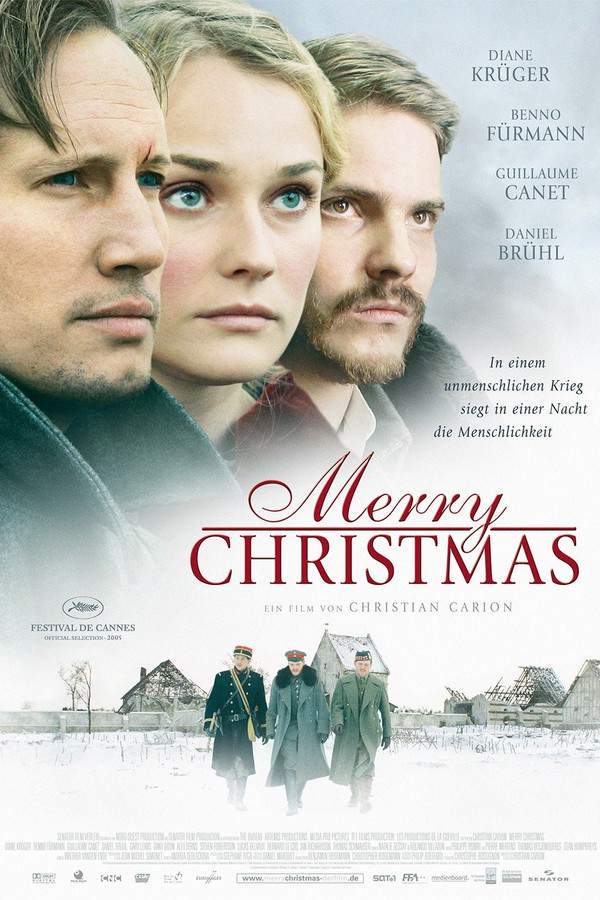
What Is Joyeux Noel About?
The premise of Joyeux Noel in 345 words, with nothing given away. The full story follows below.
Set during the bleak Christmas of 1914, this historical drama unfolds in the frozen trenches of the Western Front, where the brutal machinery of World War I grinds to a temporary, unexpected silence. The film paints a vivid portrait of ordinary men thrust into extraordinary circumstances — soldiers from warring nations separated only by a narrow, scarred strip of earth known as no-man’s-land. Against this stark and unforgiving backdrop, the story follows six souls whose lives will intersect in ways none of them could have anticipated.
At the heart of the film are three lieutenants on opposing sides: the steadfast Gordon of the Royal Scots Fusiliers, the reluctant French officer Audebert, who carries the weight of his famous general father’s legacy, and Horstmayer, a Jewish German lieutenant whose quiet humanity stands in contrast to the rigid nationalism of his superiors. Accompanying them is Father Palmer, a Scottish priest serving as both chaplain and stretcher-bearer, whose faith provides solace in a landscape where faith seems to have been abandoned. Rounding out this ensemble are two celebrated opera stars — the German tenor Nikolaus Sprink and his Danish fiancée, mezzo-soprano Anna Sørensen — whose voices become unexpectedly powerful instruments amid the chaos of war.
The film weaves together patriotic fervor, personal longing, and the haunting beauty of music, creating a tone that is at once tender and tragic. It opens with schoolboys reciting fervent national anthems, a reminder of the ideals that have sent millions marching toward destruction. Letters, photographs, and shared memories become lifelines for men cut off from the families and homes they defend. Each character carries a private grief or hope that the battlefield has not yet managed to extinguish.
Stylistically, the film embraces a wide, sweeping lens — both literal and emotional — capturing the absurdity and tragedy of a conflict where soldiers on either side of a trench share far more in common than the war would ever admit. With its multilingual dialogue and rich period detail, it sets the stage for an unprecedented convergence of cultures on one quiet winter night.
What Happens in Joyeux Noel?
The complete story of Joyeux Noel, from the first scene to the last, in 892 words (about 4 minutes). Spoilers throughout.
Spoilers ahead
The movie follows the intertwined stories of six central characters: Gordon, a Lieutenant of the Royal Scots Fusiliers; Audebert, a French Lieutenant in the 26th Infantry who is reluctantly the son of a general; Horstmayer, a Jewish German Lieutenant serving with the 93rd Infantry; Father Palmer, a Scottish priest who doubles as a chaplain and stretcher-bearer; as well as two renowned opera stars, Nikolaus Sprink (inspired by Walter Kirchhoff) and his Danish fiancée Anna Sørensen.
The narrative begins with poignant scenes of schoolboys publicly reciting patriotic speeches, aimed at instilling national pride while denouncing their adversaries. In Scotland, two brothers, Jonathan and William, enthusiastically enlist to fight, accompanied by Father Palmer, who voluntarily takes up the role of a chaplain. Meanwhile, in Germany, Sprink finds his theatrical performance abruptly disrupted by a military officer who announces a reserve call-up. On the opposite side, Audebert views a photograph of his pregnant wife—who remains behind in occupied France—and readies himself to engage in an Allied assault against the German lines. The attack ultimately proves disastrous, resulting in significant casualties for the French and British troops, including the loss of William.
In a contrasting setting, Anna receives permission to perform before Crown Prince Wilhelm in Germany, with Sprink by her side. They share a night together, performing after which Sprink expresses his disillusionment regarding the lavish comforts of the generals, igniting his determination to return to the front lines to sing for the soldiers. Initially resistant to Anna’s desire to join him, he later consents.
The film highlights an unofficial truce, initiated when the Scottish soldiers begin to sing festive songs accompanied by bagpipes. As Sprink and Sørensen arrive at the German front, Sprink serenades his comrades with heartfelt melodies. During “Silent Night,” he hears the bagpipes from Father Palmer’s side, prompting him to leave the safety of his trench and approach no-man’s-land with a small Christmas tree, singing “Adeste Fideles.” This touching moment leads Audebert, Horstmayer, and Gordon to gather in no-man’s-land, where they agree to a ceasefire for the evening.
The soldiers warmly greet each other with “Joyeux Noël,” “Frohe Weihnachten,” and “Merry Christmas.” They exchange tokens of goodwill—chocolate, champagne, and photographs of loved ones. Horstmayer returns Audebert’s wallet, which he had lost during the recent conflict, and they bond over memories from before the war. A brief Mass is celebrated by Father Palmer, which deeply resonates with the soldiers. However, amidst the camaraderie, Jonathan remains isolated, consumed by grief for his lost brother.
The following morning, the Lieutenants agree to extend the truce to allow both sides to bury their fallen comrades, followed by a day of light-hearted socializing. As the soldiers engage in a game of football, Audebert and Horstmayer connect in their shared language of French, reminiscing about Paris and their families. Horstmayer offers to take a letter back to Audebert’s wife in Lens. When the day takes a darker turn with a German shelling on the Allies, Horstmayer offers safe shelter to the French and British soldiers in his trench, an offer returned by Audebert and Gordon to protect their German counterparts from incoming fire.
As the unofficial ceasefire draws to a close, Audebert and Horstmayer lament the futility of war and their deep desire for friendship amidst the conflict. They express hope for each other’s survival and bond over personal stories—Audebert compliments Horstmayer’s French, to which Horstmayer reveals that his wife is, in fact, French.
Tensions rise as Horstmayer discovers that Anna and Sprink had performed without official permission, leading to Sprink’s impending arrest for disobedience. Both Anna and Sprink wish to remain together and request Audebert to take them as captives to prevent their separation. They hand over letters from the German soldiers, which are intercepted, prompting military authorities to learn of the truce.
Ultimately, Father Palmer faces consequences as his battalion is disbanded publicly in disgrace. Despite his testament to the humanity of the truce, his words are dismissed by the bishop, who instead delivers an anti-German sermon to new recruits, encouraging them to regard Germans as foes. After overhearing this sermon, Father Palmer is compelled to remove his cross, symbolizing his internal conflict and disillusionment.
Upon returning to the trenches, the Scots receive orders from an irate English major (enraged by the truce) to carry out an execution of a German soldier crossing into no-man’s-land. Most soldiers deliberately miss their shots, apart from the embittered Jonathan, who tragically kills the incoming German, only to discover that the soldier is a disguised Ponchel, his batman. With his final words, Ponchel reveals he received help from German soldiers during his journey home to visit his mother.
Audebert faces punishment as he’s reassigned to Verdun and confronts the reality of warfare when he shares the news of his impending grandfather status with his general father. Warmed by this new connection, the general advocates for both men to strive to survive this brutal war.
As the film wraps up, Horstmayer and his men are confined in a train, receiving orders to report to the Eastern Front without chance to visit their families. In a moment of rebellion, they softly hum a carol they learned from the Scots, symbolizing a fleeting connection to humanity even in the darkest of times. The soundtrack they leave behind resonates with hope, blending their stories of camaraderie in the face of war’s harsh realities.
Joyeux Noel Timeline: Every Key Event in Order
15 key events in the order they happen, from “Patriotic Speeches” to “Train to the Eastern Front”. 13 events name a place, across 7 locations.
- 1
Patriotic Speeches
The film opens with schoolboys reciting patriotic speeches that glorify their countries and vilify their enemies. This sets the stage for the conflicting national sentiments that will be explored throughout the story.
- 2
Enlistment of the Brothers
In Scotland, two young brothers, Jonathan and William, decide to enlist in the army to fight. Their patriotic fervor is shared by Father Palmer, who also joins the fight as a chaplain, showcasing the personal sacrifices made by individuals.
Where:Scotland
- 3
German Mobilization
In Germany, Nikolaus Sprink, a renowned tenor, is abruptly interrupted during a performance by a German officer announcing a reserve call-up. This moment highlights the sudden escalation of war and its impact on everyday lives.
Where:Germany
- 4
Audebert's Departure
French Lieutenant Audebert looks at a photograph of his pregnant wife before heading into the trenches for an Allied assault. He is filled with a mix of patriotism and sadness as he prepares to leave his loved ones behind.
Where:French Trench
- 5
Failed Assault
The Allied assault on the German lines fails catastrophically, leading to heavy casualties among the French and British forces. This heartbreaking loss signifies the brutal realities of war, marking a pivotal moment for the characters involved.
Where:Battlefield
- 6
Permission to Perform
Following the brutal realities of war, Anna Sørensen receives permission to perform for Crown Prince Wilhelm. This moment acts as a stark contrast to the ongoing conflict, where art attempts to bring solace.
Where:Germany
- 7
The Christmas Truce Begins
Amidst the horrors of war, the unofficial truce begins when the Scots start singing festive songs, creating a moment of shared humanity. The joyous music becomes a bridge across the battlefield, inviting connection amidst chaos.
Where:No Man's Land
- 8
Meeting in No Man's Land
Lieutenants Audebert, Horstmayer, and Gordon meet in no-man's-land and agree to a cease-fire for the evening. Their cautious truce marks a poignant moment of camaraderie between enemies, demonstrating the emotional bonds formed even in conflict.
Where:No Man's Land
- 9
Exchange of Gifts
Soldiers from opposing sides exchange chocolate, champagne, and photographs of their families. This unique interaction fosters friendship and hope, momentarily overshadowing the violence surrounding them.
Where:No Man's Land
- 10
Father Palmer's Mass
Father Palmer celebrates a brief Mass for the soldiers in Latin, evoking a sense of spirituality and unity among those present. This religious observance solidifies the emotional significance of the cease-fire.
Where:No Man's Land
Show the other 5 events of Joyeux Noel Hide the last 5 events
- 11
Truce Extended
The following morning, Audebert and his fellow Lieutenants decide to extend the truce to allow the burial of their dead. This act of respect further enhances their understanding of shared humanity amidst the storm of war.
Where:Battlefield
- 12
Football Match
The soldiers engage in a spirited football match, symbolizing camaraderie amidst the conflict. This moment of levity is a rare glimpse of normalcy and human connection during the war.
Where:No Man's Land
- 13
Realization of Enmity
As the truce comes to an end, Audebert and Horstmayer express their sorrow at the prospect of returning to fighting. They lament that despite the bonds formed, they are still enemies in the eyes of the war.
- 14
The Consequences of Peace
Back in the trenches, Father Palmer faces repercussions for the truce, being sent back to his parish as a mark of shame. The rebuke from his superiors highlights the harsh realities faced by those who sought to promote peace.
Where:Military Headquarters
- 15
Train to the Eastern Front
Horstmayer and his troops are informed by the German Crown Prince that they will be sent to the Eastern Front. This command underscores the ruthless nature of military decisions and the systemic disregard for individual sacrifice.
Where:Train
Who Are the Main Characters in Joyeux Noel?
6 characters, among them Gordon, Audebert and Horstmayer: who each one is and the part they play in the story. Every profile links to the actor’s page.
-

Gordon
Played by Alex Ferns
Gordon is a Lieutenant of the Royal Scots Fusiliers, characterized by his strong sense of duty and camaraderie. Throughout the film, he navigates the emotional complexities of war while striving to uphold the values that connect his fellow soldiers. His leadership and compassion are tested as he confronts the harsh realities of conflict.
- 🎖️ Military
- 🤝 Brotherhood
- 😢 Grief
-

Audebert
Played by Guillaume Canet
Audebert is a French Lieutenant who struggles with the expectations of his aristocratic background and his reality as a soldier. He is compassionate and yearns for connection, which is exemplified in his growing bond with the enemy soldiers. His internal conflict showcases the stark contrast between duty and personal morality.
- 🇫🇷 French
- ⚖️ Morality
- 🥀 Sacrifice
-

Horstmayer
Played by Daniel Brühl
Horstmayer is a Jewish German Lieutenant who becomes a symbol of the humanity that lies beneath the surface of wartime hatred. His character reveals the shared struggles of soldiers regardless of nationality and religion, fostering a sense of empathy that transcends boundaries. He yearns for peace yet is haunted by his duties as a soldier.
- 🇩🇪 German
- ✡️ Identity
- 🌍 Humanity
-

Father Palmer
Played by Christian Carion
Father Palmer is a Scottish priest who serves as both a chaplain and a stretcher-bearer, embodying the theme of sacrifice and care in the midst of chaos. His compassion and dedication to his fellow soldiers provide a poignant counterpoint to the brutality of war. He struggles between his faith and the harsh realities he witnesses.
- ⛪ Faith
- ❤️ Compassion
- 🕊️ Peace
-

Nikolaus Sprink
Played by Benno Fürmann
Nikolaus Sprink is a charismatic German tenor who uses his music to express his desires for peace and connection. His inner conflicts regarding duty and love drive his actions as he seeks to unite the soldiers through song. His character's journey highlights the power of art as a bridge across conflicting ideologies.
- 🎤 Musician
- 🎭 Passion
- 💔 Love
-

Anna Sørensen
Played by Diane Kruger
Anna Sørensen is a gifted Danish mezzo-soprano whose dual role as a performer and a symbol of longing adds depth to the narrative. Her relationship with Sprink and her involvement in the truce illustrate the intersection of love, art, and war. She represents hope and the emotional connection that transcends the battlefield.
- 🇩🇰 Danish
- 🎶 Performer
- 💖 Hope
Where and When Is Joyeux Noel Set?
Joyeux Noel is set in Scotland, Germany and France (World War I). Here is why the time and place matter to the story.
When
World War I
The story unfolds during World War I, a period marked by unprecedented global conflict and militaristic fervor. It highlights the struggles of soldiers entrenched in brutal warfare, while also showcasing moments of humanity and connection amidst chaos. The film celebrates the unusual bonds formed between enemies during a seemingly spontaneous truce.
Where
Scotland, Germany, France
The film takes place across the battlefields of Scotland, Germany, and France during World War I. These locations represent significant sites of conflict, sacrifice, and unexpected camaraderie during the harsh conditions of war. The contrasting landscapes encapsulate the emotional and physical struggles faced by the soldiers.
- 🏴☠️ War
- 🎶 Music
- 🎭 Theatrical
What Are the Themes of Joyeux Noel?
3 ideas the story keeps returning to, among them Peace, Loss and Art and Expression.
-
01
Peace
The film poignantly explores the theme of peace in a time of war. It portrays how the shared experience of soldiers from opposing sides leads to an unexpected ceasefire, allowing them to embrace their common humanity. The fleeting truce serves as a powerful reminder that understanding and goodwill can prevail even amidst deep-seated enmity.
-
02
Loss
Loss is a central theme throughout the narrative, with the characters grappling with the absence of loved ones and the harsh realities of war. The emotional weight of grief is compounded by the brutal context, as soldiers mourn their fallen comrades. This theme is encapsulated in Jonathan's struggle to cope with his brother's death, symbolizing the personal tragedies faced by many.
-
03
Art and Expression
Art and expression serve as a vital escape and means of connection among the characters. Through music and performance, especially with the characters of Nikolaus Sprink and Anna Sørensen, the film emphasizes the transformative power of art. Their singing acts as a bridge between the fighting men, momentarily lifting the heavy burden of war.
What Kind of Film Is Joyeux Noel?
Bittersweet in tone, with steady pacing and a moderate story, going by the plot summary.
- Tone
- Bittersweet
- Pacing
- Steady
- Story
- Moderate
- Intensity
- High
- Ending
- Bittersweet
A deeply moving and somber war drama that captures an extraordinary moment of humanity amid the brutal trenches of WWI, balancing haunting devastation with quiet, poignant hope.
- bittersweet
- somber
- haunting
- humanistic
- poignant
- reflective
- christmas truce
- world war one
- humanity in war
- fraternization
Content notes: war violence, combat deaths, artillery shelling, military punishment, loss of sibling, infant separation.
Quiz
How well do you remember Joyeux Noel? Test yourself on the story.