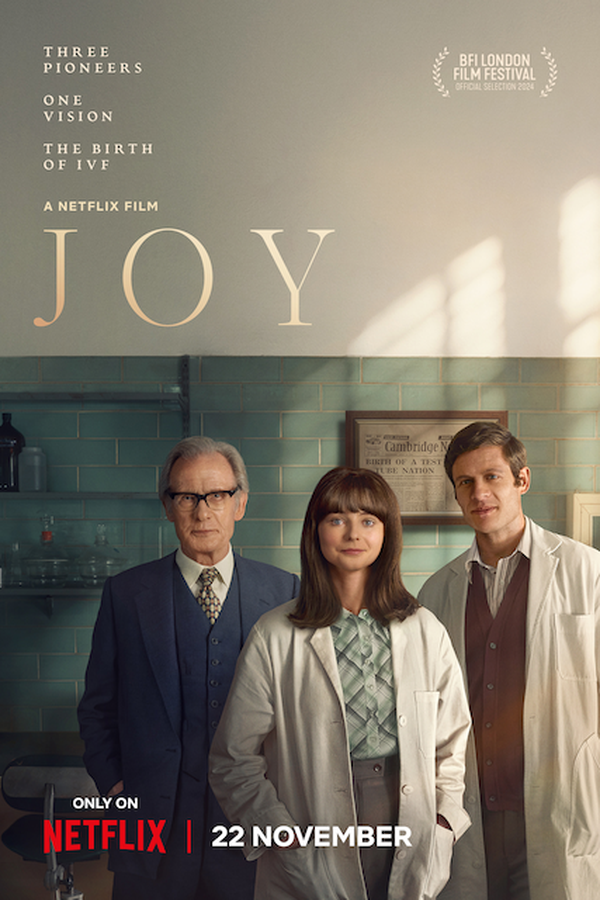


Joy Plot Summary
Read the complete plot summary and ending explained for Joy (2024). From turning points to emotional moments, uncover what really happened and why it matters.
In 1968, Nurse Jean Purdy [Thomasin McKenzie] is hired at the University of Cambridge for a lab manager post by Dr Bob Edwards [James Norton], a scientist determined to push the boundaries of reproduction research. Together, they recruit a pioneering obstetrician and surgeon, Patrick Steptoe [Bill Nighy], to join their work in infertility treatment, with the bold aim of developing a procedure that could become in vitro fertilisation. Yet from the start, Patrick cautions that their path will meet resistance from government, church, and a skeptical public, even as their shared belief in progress drives them forward.
Jean and her family live within a tightly knit community of faith. They are regular churchgoers, and their close relationship with their vicar, Reverend Paulson [Robert Wilfort], anchors their moral world even as the team pushes forward into uncharted territory. The pair’s scientific ambitions hit a rough road: funding is scarce, and Jean and Robert must commute to Oldham four hours a day to keep their research moving. Robert explains their early work with small rodents to show progress, while the team quietly nudges toward a day they hope will redefine fertility.
By the next year, the team fertilises their first human ovum, a milestone that raises excitement and scrutiny in equal measure. The pace of discovery attracts attention—especially from the media—with The Daily Mirror dubbing Robert the nickname Dr. Frankenstein as public curiosity and fear grow in tandem. The success brings new tensions with Jean’s family, particularly her mother, who worries that their research is playing God. The conflict spills into Jean’s world: she feels pushed to the outside by both her church community and her own kin, and the emotional strain begins to show in how she relates to the women volunteering for their study.
Matters inside the clinic become more personal as the researchers pursue a meaningful connection with the women who participate in the trials. Matron Muriel [Tanya Moodie] challenges Jean’s sometimes clinical approach, reminding her that the participants deserve care and dignity. Meanwhile, the devotion to a larger goal presses on the team, even as Jean grapples with her own endometriosis and the implications it has for her life and work. There are moments when personal faith and scientific ambition clash, and the team must navigate the ethical landscape of offering women safer choices while contending with the fear of unknown outcomes.
Towards 1971, the team makes a formal appeal for funding to the Medical Research Council, arguing that their work could change countless lives. The request is rejected, and disappointment settles in as they ride the train home, weighed down by frustration but resolved to push on. In conversations that reveal growing personal stakes, Jean opens up about how deeply she is invested in the project, and Patrick listens, offering support while acknowledging the toll the research takes on their relationships. Arun [Rish Shah], the lab’s eager assistant, shares a moment of personal connection with Jean, hinting at a shared future that the team’s work complicates rather than clarifies.
In early 1973, after another difficult television appearance, the researchers begin implanting embryos in a few of the women. The pregnancies fail in different ways, and by September every attempt ends in disappointment. When a batch of experiments is found to have contaminated paraffin, the team’s confidence falters. The setback becomes a turning point: Jean quits to care for her dying mother as Robert’s faith in their path wavers. The lab is shut down during her absence, and the silence that follows speaks to the fragility of a dream built on risk and devotion.
A year later, Jean encounters Arun again, now a new father, who hints at the possibility of moving their lives forward despite the closure. She confronts Robert, who argues that her decision to quit transformed the course of the project as much as the setbacks did. The loss of her mother compounds Jean’s exhaustion, yet the two scientists find renewed purpose in the memories of their earlier breakthroughs and the enduring belief that they owe the women a chance at motherhood.
At the funeral, Patrick Steptoe and Muriel attend, and a rested, resolute Jean experiences a turning point. She decides to resume the study by tracking each participant’s natural cycle—an approach that reframes their work as a women-centered, biologically guided process rather than a single pursuit of a single outcome. In the summer of 1978, their revised method yields a breakthrough: the first test-tube baby, whom Robert names Joy. The achievement marks a historic moment, yet the story closes with a bittersweet note about the human costs behind scientific triumph.
The epilogue reveals the lasting consequences: Jean Purdy passes away from cancer at 39, and Robert Edwards is later recognized with the Nobel Prize in 2010 for the collaborative work that, with Patrick Steptoe, opened a new era in reproductive medicine. Through joy and loss, the film honors the quiet resilience of the people who carried a controversial dream to a wider world, forever changing how science, faith, and personal life intersect on the path to new possibilities.
Joy Timeline
Follow the complete movie timeline of Joy (2024) with every major event in chronological order. Great for understanding complex plots and story progression.
Jean Purdy hired as lab manager
Nurse Jean Purdy is hired at the University of Cambridge to run the lab, marking the formal start of Edwards and Purdy's collaboration. Dr. Robert Edwards brings her on board to push forward their infertility research, and they begin recruiting Patrick Steptoe to join the team. The trio begins laying out the plan for advancing IVF from the lab toward potential clinical work.
Patrick Steptoe joins the project
Famed obstetrician and surgeon Patrick Steptoe agrees to join Edwards and Purdy, forming the core team for the IVF effort. He contributes surgical expertise and a clinical eye to translate lab work into possible treatments for infertility. The partnership solidifies the collaboration that will drive the early IVF research.
Funding challenges and long commutes
With limited funding, the team must commute four hours daily to Oldham to run experiments and collect data. The long distances reflect the scarcity of resources and the difficulty of sustaining a groundbreaking project. Despite the strain, they persevere, pushing ahead with animal work while planning for human trials.
First fertilisation of a human ovum
The team achieves fertilisation of their first human ovum, marking a milestone in their research. They begin to test their approach and refine techniques before attempting clinical trials. Tension and ambition grow as they move closer to real-world applications.
Media attention and public scrutiny
News coverage spreads as The Daily Mirror dubs Edwards 'Dr Frankenstein,' reflecting both intrigue and fear surrounding their experiments. The notoriety brings pressure from the media and the public, challenging the researchers' focus. The team tries to balance scientific ambition with public perception.
Family and religious opposition
Jean's regular churchgoing background creates moral tension when her mother and Reverend Paulson object to 'playing God.' The conflict strains Jean's personal life and her relationship with the community. This external pressure weighs on the team as they press forward.
Ethics debate and personal tensions rise
Opponents warn about abnormalities and future creation of humans by scientists. The team experiences strain in personal relationships as colleagues and participants voice concerns. As Jean begins to relate more personally to the participants, the dynamic of the study shifts.
MRC funding petition rejected
In early 1971, Edwards and Purdy present their case to the Medical Research Council, but are denied funding. The setback documents the uphill battle for legitimacy and financial support. The team resolves to continue despite the rejection, determined to prove the project's value.
Personal sacrifice and medical disclosure
Jean reveals she suffers from endometriosis, linking her personal stake to the research. Patrick offers to examine her, demonstrating the closeness of the team. Jean declines the second opinion, underscoring the dedication she brings to the work.
Embryo implantation begins
In early 1973, after another decidedly negative television appearance, the researchers begin implanting embryos in a subset of participants. The initial attempts show varying levels of success and failure as they push toward clinical viability. The team wrestles with the emotional and scientific risks of each trial.
Pregnancies fail; contamination revealed
By September 1973, all pregnancies have failed. The team tests their materials and discovers contaminated paraffin, which undermines their results and creates internal turmoil. Jean quits the project to care for her dying mother, marking a significant personal turning point.
Lab shutdown and personal setbacks
A year after the setbacks, Robert shuts down the research lab and Jean contends with the consequences. Arun, a lab assistant who later becomes a new father, reconnects with Jean as she returns to the issue. The period marks a pause but not the end of the dream.
Funeral and renewed resolve
Jean's mother dies, and Patrick Steptoe and Matron Muriel attend the funeral. This personal loss fuels Jean's renewed determination to resume the research. The team sees a path forward as Jean re-engages with the project.
First successful test tube baby
Following Jean's idea to monitor each woman's natural cycle, the team resumes work and, in the summer of 1978, produces the first 'test tube baby' named Joy. The achievement cements their place in medical history and confirms the viability of IVF.
Jean Purdy’s death and Nobel recognition
The epilogue reveals that Jean Purdy dies of cancer at age 39. It also notes that Robert Edwards is awarded the Nobel Prize in 2010 for their shared IVF work, commemorating Purdy's essential role. The legacy of the trio endures in medical history.
Joy Characters
Explore all characters from Joy (2024). Get detailed profiles with their roles, arcs, and key relationships explained.
Jean Purdy
Jean Purdy is a nurse who becomes lab manager and core collaborator on the IVF project. She balances clinical care with scientific ambition, often clashing with the more radical elements of the team while showing deep empathy for the participants. Her religious upbringing and close relationship with her mother intensify the personal stakes of the work. She experiences conflict when the project meets resistance, but she remains central to the striving for a safe, patient-centered approach.
Dr. Robert Edwards
Dr. Robert Edwards is the leading scientist driving the IVF work with Jean Purdy. He faces external opposition, funding hurdles, and sensational media attention, including being labeled Dr. Frankenstein. He balances scientific ambition with ethical concerns and patient welfare. His work is later recognized with the Nobel Prize, highlighting the long arc of the discovery.
Patrick Steptoe
Patrick Steptoe is the obstetrician-surgeon recruited to join the team. He pushes the technical boundaries while grappling with the moral implications of embryo work and abortion debates. He champions patient choice and safe options for women, even as public opinion becomes hostile. He forms the other pillar of the collaboration that makes IVF possible.
Reverend Paulson
Reverend Paulson is the local vicar who intimately knows Jean and her family. He embodies the church's initial support and later concerns as the research challenges conventional beliefs. His influence leads to Jean being asked not to attend services, showing the conflict between faith communities and medical progress. He attends the funeral later, signaling a complicated ongoing relationship.
Matron Muriel
Matron Muriel oversees patients and participates in the ethical oversight of the trial. She is critical of impersonal treatment and insists on respectful care for participants. She recognizes the line between scientific progress and patient welfare. Her perspective helps identify the human element within the lab's work.
Arun
Arun is a lab assistant who becomes a confidant and collaborator in the early trials. He shares a personal connection with Jean and hints at his own desire to start a family. He briefly expresses interest in Jean, but she declines to pursue a relationship due to her commitments. His presence highlights the intersecting personal and professional lives of the team.
Joy Settings
Learn where and when Joy (2024) takes place. Explore the film’s settings, era, and how they shape the narrative.
Time period
1968–1978
Events unfold from the late 1960s into the late 1970s, a time of rapid medical advances and growing public debate over reproductive technology. The period features cautious funding, religious scrutiny, and intense media interest that influence research decisions. The timeline includes early animal work, embryo trials, and finally the breakthrough in 1978.
Location
Cambridge, Oldham
The action centers on the University of Cambridge where the IVF research lab is located. The team also commutes to Oldham for experiments, illustrating the wider urban network behind the project. The setting reflects a historic academic environment that shapes ambition and constraints in equal measure.
Joy Themes
Discover the main themes in Joy (2024). Analyze the deeper meanings, emotional layers, and social commentary behind the film.
🧬
Science Ethics
IVF research sits at the center of moral scrutiny in the film. It explores the tension between scientific curiosity and responsibility toward participants. The project raises questions about consent, safety, and potential born defects. Public perception and media headlines shape funding and policy decisions.
❤️
Personal Costs
Personal relationships buckle under the strain of long hours, secrecy, and public opposition. Jean wrestles with family faith, community expectations, and professional dedication. Mentors and colleagues reveal their own vulnerabilities as the mission pressures them. The human cost of progress becomes a running theme.
🌅
Breakthrough & Loss
Against the odds, a major milestone arrives with the birth of the first IVF baby in 1978 and the work being named Joy. The film shows how breakthroughs can redefine medicine and public hope. It also foreshadows personal tragedy when Jean later dies, highlighting the price of scientific leaps. The epilogue notes later recognition with the Nobel Prize for the work.

Coming soon on iOS and Android
The Plot Explained Mobile App
From blockbusters to hidden gems — dive into movie stories anytime, anywhere. Save your favorites, discover plots faster, and never miss a twist again.
Sign up to be the first to know when we launch. Your email stays private — always.
Explore the mobile appJoy Ending Explained
Unravel the ending of Joy (2024) with our detailed explanation. Understand the final scenes, character fates, and unresolved questions.
Throughout the film, we see how Jean Purdy, a dedicated nurse and embryologist, was the unsung hero behind the first successful in vitro fertilization. Despite the immense scientific achievement and the joy of witnessing Louise Brown’s birth, Jean and her colleagues faced relentless societal opposition, media vilification, and institutional rejection. Their work was groundbreaking, laying the foundation for reproductive medicine, but it also involved personal sacrifices, especially for Jean, who struggled with her faith, personal doubts, and her role as a woman in a male-dominated field.
The climax arrives with the birth of Louise Brown, a milestone that embodies ten years of perseverance, suffering, and hope. Robert Edwards named the baby “Joy,” symbolizing the triumph of hope and life. However, the ending underscores a powerful truth: Jean’s contribution was essential but historically overlooked. She spent years fighting for recognition, only to die of cancer at 39 without seeing her name celebrated alongside her male colleagues. Her story highlights how women’s contributions have often been erased by systemic sexism, a theme still relevant today.
Ultimately, the film’s ending is both a celebration and a reminder—that scientific breakthroughs often come at great personal cost, especially for women whose roles are undervalued or forgotten. Louise Brown’s birth stands as a testament to what relentless dedication and unrecognized sacrifices can achieve, inspiring us to acknowledge the invisible yet vital work of those like Jean Purdy who push the boundaries of science and humanity. The story leaves us with a reflection on the ongoing struggle for recognition and the importance of honoring those who truly make history.Joy is not just about a medical breakthrough; it’s about recognizing the often unseen women whose resilience changes the world.**
Joy Spoiler-Free Summary
Discover the spoiler-free summary of Joy (2024). Get a concise overview without any spoilers.
In the late 1960s, a visionary trio gathers beneath the historic arches of Cambridge’s medical world, intent on turning a whispered possibility into a tangible reality. Their quest—to coax life from a laboratory beaker—draws the wary eyes of the church, the press, and a skeptical establishment, setting a tone that balances quiet optimism with the weight of societal push‑back.
The team is anchored by Jean Purdy, a diligent nurse whose steady hands and compassionate spirit become the project’s moral compass. Beside her works Bob Edwards, a scientist whose relentless curiosity pushes the boundaries of reproductive research, while Patrick Steptoe, an accomplished obstetrician‑surgeon, offers the surgical expertise needed to bridge theory and practice. Together they form a partnership that feels both professional and profoundly personal, each bringing a distinct blend of devotion, ambition, and vulnerability to the laboratory’s dim corridors.
Beyond the white‑coated walls, Jean navigates a tightly knit faith community, finding counsel in Reverend Paulson and confronting the expectations of family and parish. The clinic’s daily rhythm is colored by Muriel, the matron who reminds the team of the human faces behind the experiments, and Arun, a bright‑eyed assistant whose own aspirations intertwine with the project’s hopes. Financial scarcity, relentless media scrutiny, and the physical toll of conditions like endometriosis add layers of pressure, turning every modest breakthrough into a contested triumph.
Against this backdrop of scientific daring and moral contemplation, the film breathes a measured, introspective tone. It invites audiences to witness a world where pioneering research collides with entrenched belief systems, and where quiet perseverance may reshape the very definition of possibility.
Movies with Similar Twists and Themes
Uncover films that echo the narrative beats, emotional arcs, or dramatic twists of the one you're exploring. These recommendations are handpicked based on story depth, thematic resonance, and spoiler-worthy moments — perfect for fans who crave more of the same intrigue.




Featured on this page

What's After the Movie?
Not sure whether to stay after the credits? Find out!
Check out our other apps:

SAT Sphere
Build confidence for the Digital SAT.

Mori Atlas
Discover wild places worth protecting.

Luntero
Search smarter for a home in Amsterdam.

Plot Explained
Unravel movie endings and hidden clues.

Pokechamp
Dive into Pokémon data and battle logic.

Driving Theory
Get ready for your European theory test.

Movie Dust
Plan your next cinema trip with ease.

Musemap
Find art and culture as you travel.

Selkobase
Compare credentials before committing.

Local Manual
Turn an unfamiliar country into practical next steps.

Lernavi
Compare school systems before your next move.

GymRoam
Find a workout stop wherever your plans take you.
Explore Our Movie Platform
New Movie Releases (2026)
Famous Movie Actors
Top Film Production Studios
Movie Plot Summaries & Endings
Major Movie Awards & Winners
Best Concert Films & Music Documentaries
Movie Collections and Curated Lists
© 2026 What's After the Movie. All rights reserved.
Privacy Policy