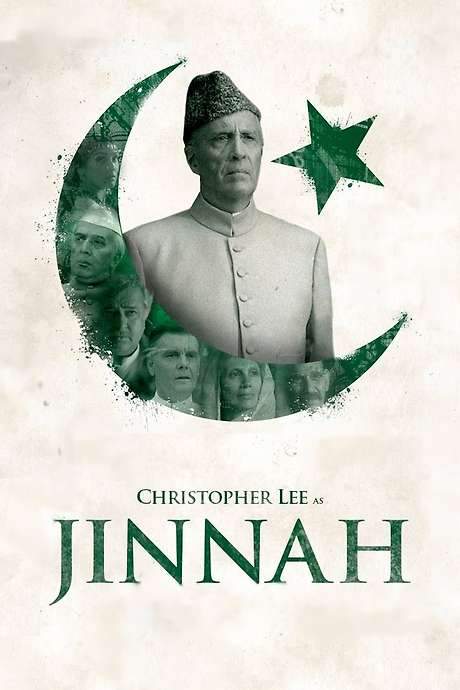
Jinnah 1998

Directed by

Jamil Dehlavi
Made by

Dehlavi Films
Where to Watch Jinnah
See current US streaming, rental, and purchase options for Jinnah (1998) via JustWatch.

Streaming availability powered by 
Jinnah Plot Summary
Read the complete plot summary and ending explained for Jinnah (1998). From turning points to emotional moments, uncover what really happened and why it matters.
A guide takes Muhammad Ali Jinnah, Christopher Lee, to 1947, where, at the Cromwell Conference with James Fox, Jinnah demands a homeland for Indian Muslims. The film anchors this moment in the voice of Professor Stanley Wolpert, guiding the viewer through a life that blends political calculation with personal sacrifice. What follows unfolds in a series of vivid flashbacks, tracing Jinnah’s early years, his steadfast pursuit of moderation, and the personal costs that shaped his path to a new nation.
Flashbacks reveal Jinnah’s marriage to Rattanbai Petit, known as Ruttie Jinnah, a Parsi woman whose courtship defies her parents’ opposition and the age gap between them. The story sketches how love and principle collide with tradition, pulling him into a complex alliance between public duty and private longing. The couple’s union is a bold act, even as it sows tensions between Jinnah and his in-laws, and the strain of public life eventually pushes them apart. Ruttie’s departure and their separation leave a deep imprint on Jinnah, a wound that shadows his political evolution as he navigates a nation on the brink.
The film then follows Jinnah back to British India, where he embraces a political path focused on moderation amid growing Hindu–Muslim antagonism. The personal cost of this stance becomes clear as the strain with Ruttie deepens, and her passing from cancer strikes a heavy blow, shaping his resolve to lead a cohort of Muslims toward a distinct political destiny. This period also marks a turning point as Jinnah hones his message and builds a platform for a new two-nation dynamic, even as he confronts fierce opposition from those who fear concession and coexistence.
At the Muslim League annual conference in 1940, Jinnah speaks to thousands and delivers a firm, forward-looking vision for a divided subcontinent. He articulates the idea of Pakistan as a homeland for Muslims, underscoring the legitimacy of a separate political future while insisting that faith should not justify sectarian hatred. The scene crystallizes the movement’s momentum, laying the groundwork for pivotal changes to come, including the eventual acceptance of the two-nation theory within the party’s ranks. The film makes clear how this moment reframes the struggle, linking it to hard choices about unity, identity, and sovereignty.
During a reflective exchange at another gathering, the Guide asks who else Jinnah loves besides Ruttie. He names his daughter Dina, a moment that adds a human dimension to a figure often portrayed in stark political terms, and it reminds viewers of the personal stakes behind the public decisions that will soon reshape the Subcontinent. Dina’s later fate—and her decision to stay in Bombay with her husband and child—echoes the personal costs of political upheaval and exile.
As 1947 arrives, the film follows the sharpening tensions at a Muslim League conference where fanatics attack, questioning whether Pakistan can be a Muslim state that also guarantees rights for women and non-Muslims. Jinnah responds with a principled defense: Islam does not require fanaticism, but a nation needs visionaries who can build it. The partition is set in motion, and the subsequent migration stage becomes a grim tableau of sorrow and violence, witnessed by Jinnah and the Guide in a shared moment of reckoning. The tragedy of refugees underscores the moral stakes of the new order, even as the political leadership is forced to act.
In the aftermath of independence, Pakistan emerges as a modern nation under Jinnah’s leadership, who is revered as Quaid-e-Azam. He waits for the first train carrying Muslims who left India for their new homeland, but the journey ends in catastrophe: the train arrives and most passengers are killed, save for one infant. The somber moment crystallizes the human cost of partition and the fragility of nation-building in the face of chaos.
The film then shifts to the Kashmir crisis, with Fatima Jinnah, Shireen Shah, and Lady Edwina Mountbatten, Maria Aitken, visiting refugees and witnessing the humanitarian toll. Mountbatten’s role and the political maneuvering around Kashmir intensify, as the Hindu Maharaja Sir Hari Singh hesitates to join either nation. When Indian troops are airlifted into the region and Pakistani irregulars push the population toward upheaval, Jinnah objects to foreign intervention and orders Pakistani forces to move into Kashmir, setting the stage for ongoing conflict in the years that follow.
The story culminates in a surreal, symbolic finale where Jinnah and Lord Louis Mountbatten, the last Viceroy, appear in a Heavenly Court. The two debate betrayal and accountability, traveling back in time to confront the tragedy of the refugees and the upheaval that divided Punjab. As the scene resolves, the people at the center of the conflict cry out in unison, a fervent chorus that encapsulates the enduring mission of the new nation.
“Pakistan Zindabad”
Jinnah Timeline
Follow the complete movie timeline of Jinnah (1998) with every major event in chronological order. Great for understanding complex plots and story progression.
Opening: Jinnah at Cromwell Conference demanding a homeland
The film opens with Professor Stanley Wolpert's words as a guide takes Jinnah to the Cromwell Conference with Lord Mountbatten in 1947. Jinnah declares that Muslims deserve a homeland, setting the political stakes for the rest of the story. This moment frames the destiny of a nation from the outset.
Jinnah's courtship and marriage to Ruttie
In flashbacks, a younger Jinnah falls in love with Ruttie, a Parsi woman, and marries her against parental and social opposition. The union is marked by religious difference and age gap, highlighting personal choices that mirror his later political path. The relationship foreshadows the tensions between personal life and public duty.
1922: moderation and marital strain
By 1922, Jinnah faces political isolation as he champions moderation amid Hindu-Muslim tensions. The strain takes a toll on his marriage; Ruttie grows distant and they eventually separate. This chapter marks a turning point where personal life begins to intertwine with his political ideology.
Ruttie's death and its impact
Ruttie dies of cancer, leaving Jinnah devastated. Her death profoundly affects him and strengthens his resolve to pursue the Pakistan cause. The loss sharpens the focus of his political mission and personal motivations.
Return to British India and the two-nation theory
Jinnah returns to British India and begins a political journey that advocates a separate homeland for Muslims. The narrative frames this return as a shift from personal sorrow to a determined political agenda. He articulates the two-nation theory as the path forward.
1940: Lahori Conference and the Pakistan promise
At the Muslim League's annual conference in 1940, Jinnah addresses thousands of Muslims and asserts the birth of Pakistan. His rhetoric signals a decisive move toward a sovereign Muslim state. The scene solidifies his role as the architect of partition in the public imagination.
The Guide questions Dina’s marriage
The Guide asks who Jinnah loves beyond Ruttie and Fatima. He reveals his daughter Dina, who married a Parsi boy without his permission, highlighting personal loyalties and political implications. The moment underscores the human costs behind political decisions.
1947 conference attacked; Jinnah’s response
While addressing a Muslim League conference in 1947, fanatics attack the gathering and argue against women’s and non-Muslims’ rights. Jinnah counters by saying Islam needs visionaries, not fanatics, who can build a nation. His measured response contrasts with the rising sectarian menace.
Partition and the mass migration catastrophe
The partition is carried out, triggering mass migrations and brutal violence. Jinnah witnesses the massacre of Muslims fleeing to Pakistan, a stark reminder of the immense human cost of independence. The tragedy casts a long shadow over the birth of the new nation.
Governor-General oath and farewell to Dina
Jinnah is sworn in as the first Governor-General of Pakistan and designates Liaquat Ali Khan as the first Prime Minister. He bids farewell to his daughter Dina, who remains in Bombay with her husband and child. The moment blends triumph with personal sacrifice.
Pakistan emerges; Quaid-e-Azam honoured
With independence, Pakistan stands as a new nation and sanctuary for Muslims of the subcontinent. Jinnah is celebrated as Quaid-e-Azam, the founder of the state. The title marks the culmination of his political journey and national identity.
The refugee train tragedy
Jinnah waits for the first train carrying Muslims leaving India for Pakistan; when it arrives, all the refugees are killed except for an infant child. The scene becomes a grim symbol of the division's human cost. It reframes the historical narrative from political triumph to human tragedy.
Kashmir: Fatima, Mountbatten, and the stall of Sir Hari Singh
Fatima and Lady Edwina Mountbatten visit refugees as independence looms. Mountbatten’s stance is seen as betrayal as the Hindu Maharaja of Kashmir stalls the decision on accession. The episode foreshadows the protracted politics of Kashmir’s accession.
Kashmir war escalates; Pakistani troops move in
In October 1947, the Maharaja accedes to India and Indian troops are airlifted in. Jinnah opposes the overt Indian military intervention and orders Pakistani troops to move into Kashmir, triggering a prolonged conflict. The turn heightens the real-world stakes of the two-nation theory.
Heavenly tribunal and the time-travel ending
In a surreal final sequence, Jinnah and Mountbatten appear in a Heavenly Court where Jinnah confronts betrayal. They travel back in time to revisit the refugees’ plight, and Jinnah laments their suffering as the crowd chants 'Pakistan Zindabad' and the film closes. The ending blends fate, memory, and national creed.
Jinnah Characters
Explore all characters from Jinnah (1998). Get detailed profiles with their roles, arcs, and key relationships explained.
Muhammad Ali Jinnah
A central political figure who navigates moderation and decisive action. The film traces his evolution from a voice of reason to the leader who champions a homeland for Indian Muslims. It portrays his resolve, strategic thinking, and the personal losses that reinforce his political path.
Ruttie Jinnah (Rattanbai Petit)
Jinnah’s wife, whose relationship with him exposes the collision of personal life with public duty. Her presence influences his outlook and the emotional toll of his career. The separation and her illness leave a lasting impact on his motivations.
Fatima Jinnah
Jinnah’s sister and confidante who grounds him with familial loyalty. She represents steadfast support in the political maelstrom and stands as a quiet counterbalance to the mounting pressures of partition.
Lord Louis Mountbatten
The last Viceroy whose decisions and diplomacy shape the transfer of power. The film portrays the complexities of his position and the tensions with Jinnah as independence looms. His legacy is depicted through political bargaining and personal interactions with key leaders.
Edwina Mountbatten
Mountbatten’s wife who engages with refugees and witnesses the human cost of independence. Her presence adds a humane perspective to the political shake-up and the emotions surrounding nationhood.
Mahatma Gandhi
A towering figure in the independence movement who advocates nonviolence amid rising tensions. The film places him at the center of moral debates about partition and the future of a free India.
Jawaharlal Nehru
A leading political voice of the Congress who navigates the path to a post-British India. Nehru’s interactions with Jinnah reflect the broader negotiations and conflicts that define the era.
Liaquat Ali Khan
A close ally of Jinnah who becomes Pakistan’s first Prime Minister. The film presents his role in shaping the new state and his collaboration with Jinnah during the critical moments of partition.
Sir Cyril Radcliffe
The commissioner responsible for delimiting the borders between India and Pakistan. The portrayal highlights the technical and ethical pressures of partition work and its lasting impact on communities.
General Gracie
A British military figure who represents the security and strategic concerns of the colonial era. The film uses his presence to illustrate the military oversight during the transition of power.
Jinnah Settings
Learn where and when Jinnah (1998) takes place. Explore the film’s settings, era, and how they shape the narrative.
Time period
1940s
The central arc culminates in 1947, the year of partition and the birth of Pakistan. It also flashes back to earlier decades, including the 1920s and 1940s, to show Jinnah’s evolving political stance. The timeline tracks the conflict between moderation and extremism against the backdrop of British rule.
Location
British India (1940s), Bombay (Mumbai), Kashmir, Lahore
The story unfolds across British India during the late colonial era and the Partition of 1947, with key moments in Bombay as a political and personal center. It portrays the refugee exodus, communal violence, and the redrawing of borders that defined the subcontinent. The film situates Jinnah’s life within the cities and regions that were pivotal to independence and partition.
Jinnah Themes
Discover the main themes in Jinnah (1998). Analyze the deeper meanings, emotional layers, and social commentary behind the film.
🗺️
Nation-building
The film centers on the birth of a new nation and the contentious idea of a two-nation theory. It explores how Jinnah frames a political future for Muslims in a divided subcontinent. The narrative examines the challenges of unifying diverse communities under a single national banner.
💔
Love and Duty
Jinnah's relationship with Ruttie highlights the tension between personal happiness and public responsibility. The separation and the impact of Ruttie’s illness shape his emotional world and political resolve. The story uses private life to illuminate the burdens of leadership.
🔥
Conflict and Partition
Religious tension, violence, and mass displacement frame the partition process. The film presents both the political maneuvering and the human cost of drawing borders. It emphasizes the tragedy of refugees and the long shadow it casts over the subcontinent.

Coming soon on iOS and Android
The Plot Explained Mobile App
From blockbusters to hidden gems — dive into movie stories anytime, anywhere. Save your favorites, discover plots faster, and never miss a twist again.
Sign up to be the first to know when we launch. Your email stays private — always.
Explore the mobile appJinnah Spoiler-Free Summary
Discover the spoiler-free summary of Jinnah (1998). Get a concise overview without any spoilers.
In a richly textured historical tableau, Muhammad Ali Jinnah is guided by an enigmatic narrator who ushers him from the bustling corridors of 1947 into a cascade of memories that define his relentless quest for a separate Muslim homeland. The film’s visual palette shifts between the sleek, solemn halls of late‑colonial negotiations and the softer, amber‑toned recollections of earlier decades, creating a rhythm that feels both intimate and grand. This framing device invites the audience to view the unfolding drama as much a meditation on legacy as a chronicle of political ambition.
The story gently unveils Jinnah’s personal world through the lens of his marriage to Ruttie Jinnah, a defiant Parsi woman whose love and loss echo the larger tensions of the era. Their relationship, juxtaposed against societal expectations and familial resistance, offers a poignant counterpoint to the public battles he wages. The film lingers on moments of quiet introspection, allowing viewers to sense the inner conflict between private yearning and the weight of an emerging nation’s destiny.
Intersecting these private threads is a vivid portrait of a political landscape dominated by towering figures such as Lord Mountbatten, Gandhi and Nehru. Jinnah’s interactions with these leaders are portrayed with a measured intensity, highlighting his strategic brilliance, moral resolve, and the profound personal cost of his decisions. His refusal to assume a conventional political role adds a layer of enigmatic purpose, underscoring a vision that seeks to reshape the subcontinent while remaining rooted in principle.
Guided by the scholarly voice of Professor Stanley Wolpert, the narrative weaves history with lyrical storytelling, balancing archival gravitas with human vulnerability. The film’s tone is reflective yet charged, inviting curiosity about the forces that shaped a nation’s birth and the lingering shadows they cast. Through its evocative flashbacks and restrained drama, the story promises a compelling exploration of duty, love, and the relentless pursuit of a dream that continues to reverberate.
Featured on this page

What's After the Movie?
Not sure whether to stay after the credits? Find out!
Check out our other apps:

SAT Sphere
Build confidence for the Digital SAT.

Mori Atlas
Discover wild places worth protecting.

Luntero
Search smarter for a home in Amsterdam.

Plot Explained
Unravel movie endings and hidden clues.

Pokechamp
Dive into Pokémon data and battle logic.

Driving Theory
Get ready for your European theory test.

Movie Dust
Plan your next cinema trip with ease.

Musemap
Find art and culture as you travel.

Selkobase
Compare credentials before committing.

Local Manual
Turn an unfamiliar country into practical next steps.

Lernavi
Compare school systems before your next move.

GymRoam
Find a workout stop wherever your plans take you.
Explore Our Movie Platform
New Movie Releases (2026)
Famous Movie Actors
Top Film Production Studios
Movie Plot Summaries & Endings
Major Movie Awards & Winners
Best Concert Films & Music Documentaries
Movie Collections and Curated Lists
© 2026 What's After the Movie. All rights reserved.
Privacy Policy