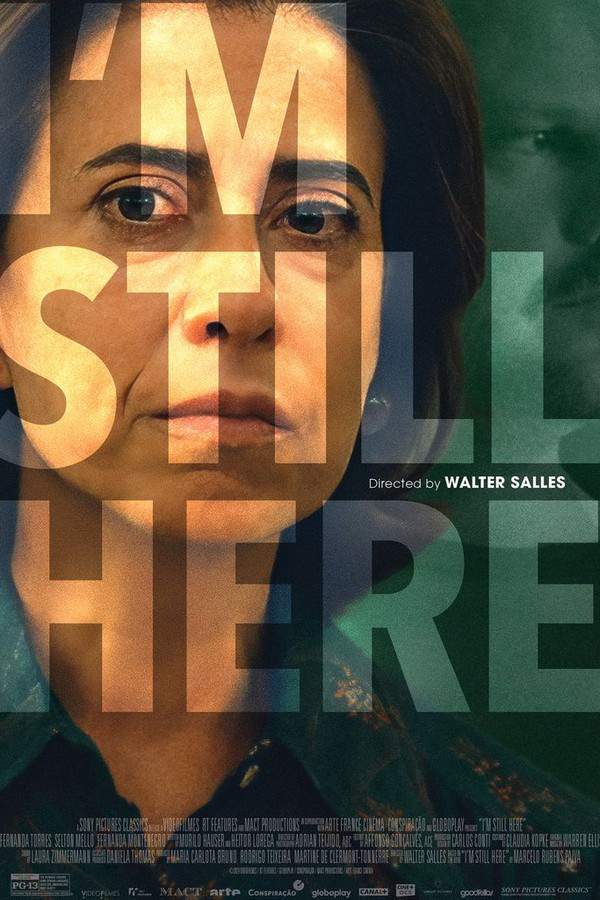
I'm Still Here 2025

Directed by

Walter Salles
Made by

VideoFilmes
I'm Still Here Plot Summary
Read the complete plot summary and ending explained for I'm Still Here (2025). From turning points to emotional moments, uncover what really happened and why it matters.
In December 1970, Rubens Paiva [Selton Mello] lives in an idyllic house near Leblon beach with his wife Eunice Paiva [Fernanda Montenegro] and their five children. Returning to his civil career after the revocation of his tenure at the outset of the 1964 Brazilian coup d’état, Paiva quietly supports political exiles without discussing his activities with his family.
After revolutionary movements kidnap the Swiss ambassador to Brazil, the country faces looming political instability. The Paivas’ friends Fernando Gasparian [Charles Fricks] and Dalva Gasparian [Maeve Jinkings] decide to seek refuge in London, taking the Paivas’ eldest daughter, Vera, with them. A military raid takes place in Paiva’s house, resulting in his arrest and disappearance in January 1971. Eunice’s public inquiries about his whereabouts result in her arrest and torture for 12 days. Eliana [Marjorie Estiano], their teenage daughter, is imprisoned but is released after 24 hours. Eunice is questioned about whether her husband is involved with pro-democracy movements, which she denies.
False newspaper reports claim that Rubens fled the country into exile, but Eunice and her friends suspect otherwise. With the help of lawyer Lino Machado, she files a habeas corpus petition. She also learns from family friend Bocaiuva Cunha that Rubens had been secretly helping political exiles. A former teacher, Martha, confirms she was imprisoned with Rubens but is afraid to speak out publicly. She later writes a letter detailing her arrest. Félix, a journalist and family friend, informs Eunice that Rubens was killed, but the military authorities refuse to confirm it officially. Left to care for her children alone, Eunice sells their home and moves to São Paulo, anticipating a new start close to her maternal family.
Twenty-five years later, in 1996, while Brazil is now once again a democracy, Rubens Paiva’s official death certificate arrives from the state, and Eunice, surrounded by journalists, calls for reparations for victims’ families and accountability for the military dictatorship’s crimes. In 2014, during a family gathering surrounded by her children and grandchildren, the now 85-year-old Eunice lives with advanced Alzheimer’s disease. When a news report about the National Truth Commission addresses Rubens’s case, a distressed Eunice appears to remember him.
An epilogue reveals that five men were identified as responsible for the murder of Paiva, who was killed at the DOI-CODI headquarters between January 21 and 22, 1971, but none was prosecuted. The epilogue also notes that Eunice graduated from law school at 48 and became one of the few experts on indigenous rights in Brazil, serving as a counselor for the federal government, the World Bank, and the United Nations. She died in 2018 at the age of 89.
I'm Still Here Timeline
Follow the complete movie timeline of I'm Still Here (2025) with every major event in chronological order. Great for understanding complex plots and story progression.
Rubens Paiva’s tranquil life near Leblon
In December 1970, Rubens Paiva lives with his wife Eunice in an idyllic house near Leblon beach, resuming his civil career after the coup. He quietly continues to support political exiles, keeping his activities away from his family. The family’s stability is soon upended by the growing political crackdown.
Gasparians flee to London with Vera
Friends Fernando and Dalva Gasparian decide to seek refuge in London and take the Paivas’ eldest daughter, Vera. Vera had previously witnessed military violence, adding urgency to their departure. The family watches as a safer path away from Brazil begins to take shape.
Military raid and Rubens’s arrest
A military raid hits the Paiva household, and Rubens Paiva is arrested and disappears. The incident marks the start of a long, anguished search for truth about his fate. The family’s sense of security collapses in an instant.
Eunice’s arrest and torture
Eunice publicly questions the whereabouts of her husband and is arrested. She endures 12 days of interrogation and torture as the regime pressures her to reveal information. Her resilience becomes a cornerstone of the family’s ongoing fight for accountability.
Eliana’s brief imprisonment
The Paiva family learns that their teenage daughter Eliana is imprisoned for 24 hours. The episode underscores the regime’s indiscriminate reach and the constant threat hanging over the children. The family members suffer through fear and uncertainty from afar.
False reports of exile circulate
Newspaper stories claim Rubens has fled the country, but Eunice and her friends suspect otherwise. The rumors complicate the family’s search for truth and feed public suspicion about the regime’s actions. The discrepancy between media and reality deepens the sense of injustice.
Habeas corpus petition is filed
With the help of lawyer Lino Machado, Eunice files a habeas corpus petition seeking Rubens’s whereabouts. The legal move marks a formal attempt to document state repression. It signals the beginning of a protracted legal battle for accountability.
Bocaiuva Cunha reveals Rubens’s exile aid
Family friend Bocaiuva Cunha informs Eunice that Rubens had secretly been helping political exiles. The revelation deepens the tragedy and reinforces the sense that Rubens’s actions were tied to a broader resistance. Eunice weighs how this complicates the narrative of loss.
Martha’s imprisonment and letter
Martha, a former teacher, recalls being imprisoned with Rubens and later writes a letter detailing her arrest. She fears public testimony but contributes to the historical record. Her account adds a personal perspective to the repression endured by many.
Félix confirms Rubens’s death
Félix, a journalist and family friend, informs Eunice that Rubens was killed. The military authorities refuse to confirm this officially, leaving a void where truth should be. Eunice and others continue to press for recognition despite government stonewalling.
Eunice relocates to São Paulo
Left to care for her children alone, Eunice sells the family home and moves to São Paulo near her maternal family. The move marks a fresh start amid years of separation and uncertainty. She begins rebuilding her life while keeping Rubens’s memory alive.
1996: death certificate and reparations demand
In 1996, Brazil’s return to democracy brings Rubens’s official death certificate, presented publicly with journalists present. Eunice uses the moment to demand reparations for victims’ families and accountability for the dictatorship’s crimes. The event cements the struggle for recognition in the national memory.
2014: family gathering amid memory and Alzheimer's
During a family gathering in 2014, the now 85-year-old Eunice lives with advanced Alzheimer's disease. She grows distressed when a National Truth Commission report addresses Rubens’s case. The moment highlights how personal memory intersects with national reckoning.
Epilogue: five men identified, no prosecution
An epilogue states that five men are identified as responsible for Rubens’s murder at the DOI-CODI headquarters between January 21 and 22, 1971, but none is prosecuted. The lack of accountability underscores the enduring impunity surrounding the dictatorship’s crimes. The Paiva family’s story remains a stark reminder of unresolved history.
Eunice’s later life and death
The epilogue notes that Eunice later earned a law degree at age 48 and became a leading expert on indigenous rights, advising the federal government, the World Bank, and the United Nations. She died in 2018 at the age of 89. Her life embodies resilience, advocacy, and a lasting commitment to justice.
I'm Still Here Characters
Explore all characters from I'm Still Here (2025). Get detailed profiles with their roles, arcs, and key relationships explained.
Eunice Paiva (Fernanda Montenegro)
A devoted mother who endures torture and relentlessly pursues the truth about her husband’s disappearance. She becomes a central figure in demanding accountability and, decades later, rebuilding life in a democratic Brazil. Her journey embodies resilience, courage, and a lifelong commitment to justice for victims and families.
Rubens Paiva (Selton Mello)
A civil servant with ties to political exiles who keeps his activities discreet from his family. His arrest and disappearance become a catalyst for the family’s fight for information and accountability. His legacy drives the narrative of memory, loss, and the pursuit of justice.
Eliana Paiva (Marjorie Estiano)
The Paiva family’s teenage daughter who is imprisoned for a time, reflecting the vulnerability of youth during political repression. Her experience underscores the personal cost of dictatorship and the impact on siblings and parents.
Fernando Gasparian (Charles Fricks)
A friend of the Paiva family who seeks refuge in London with his wife and daughter, illustrating how political persecution forces networks of exile and international escape. His decisions highlight the reach of the regime beyond national borders.
Dalva Gasparian (Maeve Jinkings)
A close ally of Eunice and Rubens whose family also flees to London, sharing the burden of protecting loved ones and maintaining hope in exile. Her presence emphasizes the collective dimension of resistance and resilience.
Baby Bocayuva (Dan Stulbh)
A trusted family friend who aids Eunice by providing information and support as she navigates legal and moral challenges in pursuit of truth and accountability.
I'm Still Here Settings
Learn where and when I'm Still Here (2025) takes place. Explore the film’s settings, era, and how they shape the narrative.
Time period
1970-1971, 1996, 2014
The principal events unfold in December 1970 through January 1971, during the Brazilian military dictatorship. The narrative then advances to 1996, when Eunice confronts the long arc of memory and reparations, and culminates in 2014, as public memory surfaces around the Truth Commission and broader justice efforts.
Location
Leblon, Rio de Janeiro; London; São Paulo; DOI-CODI HQ
The Paiva family begins in an idyllic home near Leblon beach in Rio de Janeiro, a picturesque urban coastal suburb. As political tensions rise, the couple's connections to exiles pull them toward international refuge in London and later threaten a move to São Paulo. A military raid marks Rubens Paiva's arrest at the family residence, and the story centers on the violence associated with the regime, with the DOI-CODI headquarters symbolizing state brutality. The setting oscillates between domestic life and clandestine political danger, reflecting Brazil's turbulent dictatorship era.
I'm Still Here Themes
Discover the main themes in I'm Still Here (2025). Analyze the deeper meanings, emotional layers, and social commentary behind the film.
🕊️
Oppression
The dictatorship's reach is shown through arrests, torture, and disappearances, illustrating how state power disrupts family life and civil rights. The film uses Rubens Paiva's arrest and the subsequent silence surrounding his fate to reveal the mechanisms of political repression. Personal stories become a conduit to expose the broader system of control and fear. By focusing on intimate consequences, the film makes oppression felt rather than abstract.
🧭
Memory & Truth
Memory becomes a driving force for accountability, as Eunice relentlessly pursues information about her husband. The narrative intertwines private memory with public inquiry, culminating in official documents and revelations. The epilogue notes that five individuals were identified as responsible, yet none were prosecuted, underscoring the complicated path from memory to justice. The film suggests that truth-telling is essential but often incomplete without accountability.
💪
Resilience
Families endure separation, displacement, and trauma, yet choose to persevere and protect one another. Eunice's transformation—from a grieving widow to a determined advocate—embodies personal resilience. The younger generations endure imprisonment and witness violence, highlighting the enduring strength of youth and kinship. The narrative emphasizes rebuilding life within a democracy after years of repression.
⚖️
Justice
The film foregrounds post-dictatorship attempts to hold perpetrators accountable and grant reparations to victims' families. The discovery that Rubens was killed at a state facility and the subsequent lack of prosecutions illustrate the gap between recognition and punishment. The story uses public statements, petitions, and official documents to explore the evolving arc toward justice. It also notes the ongoing debate over how to address past crimes within a democratic society.

Coming soon on iOS and Android
The Plot Explained Mobile App
From blockbusters to hidden gems — dive into movie stories anytime, anywhere. Save your favorites, discover plots faster, and never miss a twist again.
Sign up to be the first to know when we launch. Your email stays private — always.
Explore the mobile appI'm Still Here Ending Explained
Unravel the ending of I'm Still Here (2025) with our detailed explanation. Understand the final scenes, character fates, and unresolved questions.
At the end of I’m Still Here, Eunice Paiva finally receives the official document confirming her husband Rubens’ death—an important moment after decades of uncertainty and suffering. This law, which Eunice helped to champion, formally acknowledges his murder by the Brazilian military dictatorship and puts an end to the lingering question of his fate. The receipt of this death certificate is a bittersweet victory; it provides the closure her family desperately needed, confirming that Rubens was indeed killed by the regime, and officially ending the psychological torment they endured for over 25 years. However, the film’s final scenes reveal Eunice in a fragile state — she is shown as unable to speak and seemingly unaware of her surroundings. This condition is linked to her later life with Alzheimer’s disease, which she lived with until her death. The final portrayal of Eunice is poignant: her fight for justice was monumental, yet the toll on her body and mind was immense, emphasizing the enduring human cost of political repression. Throughout the film, it’s made clear that her story is one of resilience and profound loss, capturing the enduring impact of Argentina’s darkest chapter on its victims and their families.
I'm Still Here Spoiler-Free Summary
Discover the spoiler-free summary of I'm Still Here (2025). Get a concise overview without any spoilers.
In the early 1970s, Brazil’s sun‑lit coast conceals a tightening grip of authoritarian rule. Within a modest house overlooking Leblon beach, a seemingly ordinary family enjoys the rhythms of everyday life—school mornings, shared meals, and the simple hopes of a modest middle‑class existence. The world outside is increasingly fraught, yet its tension lingers just beyond the open windows, hinting at the fragile peace that can be shattered in a heartbeat.
The story’s emotional anchor is Eunice Paiva, a mother whose nurturing presence steadies the household. She moves between the roles of caretaker, confidante, and quiet observer, holding her children’s futures close while sense of belonging is tested by forces they cannot fully see. Her bond with Rubens Paiva, a husband whose quiet work in the civil service masks deeper convictions, adds a layer of understated complexity, suggesting that love often carries hidden currents in times of unrest.
When an unexpected act of violence pierces the family’s routine, the calm is disturbed, and Eunice is forced to confront a new reality where the familiar comforts of home and community no longer feel secure. The film follows her as she begins to navigate this altered landscape, drawing on inner strength and an emerging resolve to protect and provide for those she loves. Her journey is marked by moments of quiet rebellion, the pursuit of truth, and a steady, determined effort to rebuild a life that has been abruptly upended.
Rendered with a restrained yet lyrical visual style, the movie balances intimate domestic scenes with the broader, oppressive atmosphere of a nation in turmoil. Its tone is contemplative, reverent to the source memoir, and invites viewers to feel the weight of personal loss against a backdrop of political uncertainty. The narrative lingers on the resilience of the human spirit, leaving audiences attuned to the subtle ways ordinary lives are reshaped by extraordinary circumstances.
Featured on this page

What's After the Movie?
Not sure whether to stay after the credits? Find out!
Check out our other apps:

SAT Sphere
Build confidence for the Digital SAT.

Mori Atlas
Discover wild places worth protecting.

Luntero
Search smarter for a home in Amsterdam.

Plot Explained
Unravel movie endings and hidden clues.

Pokechamp
Dive into Pokémon data and battle logic.

Driving Theory
Get ready for your European theory test.

Movie Dust
Plan your next cinema trip with ease.

Musemap
Find art and culture as you travel.

Selkobase
Compare credentials before committing.

Local Manual
Turn an unfamiliar country into practical next steps.

Lernavi
Compare school systems before your next move.

GymRoam
Find a workout stop wherever your plans take you.
Explore Our Movie Platform
New Movie Releases (2026)
Famous Movie Actors
Top Film Production Studios
Movie Plot Summaries & Endings
Major Movie Awards & Winners
Best Concert Films & Music Documentaries
Movie Collections and Curated Lists
© 2026 What's After the Movie. All rights reserved.
Privacy Policy