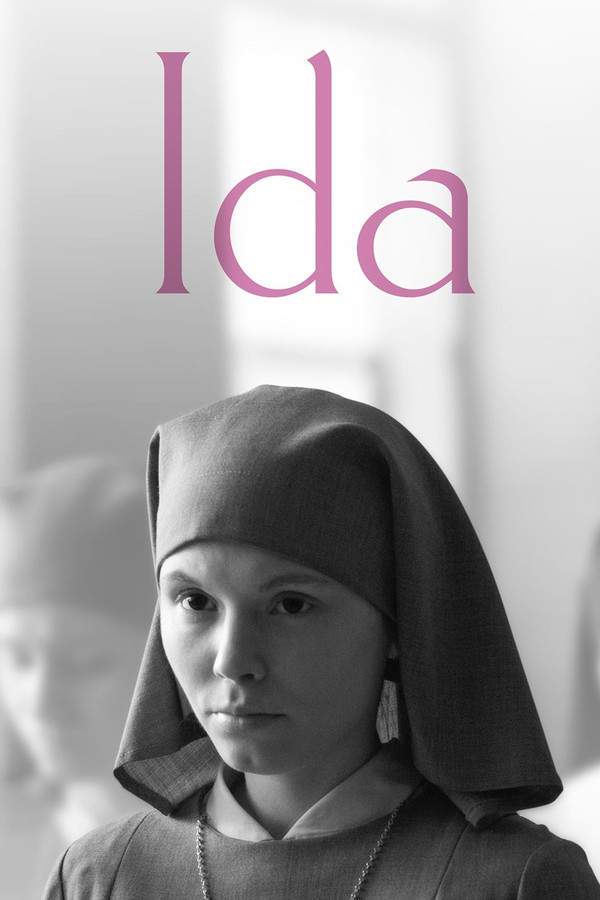
What Is Ida About?
The premise of Ida in 288 words, with nothing given away. The full story follows below.
In the early 1960s, a wintry Poland frames a world of quiet monasteries and lingering shadows from a tumultuous past. The stark, snow‑covered landscape surrounding a convent feels both austere and intimate, its stone walls echoing centuries of prayer while the chill outside hints at stories that have not yet been spoken. The film’s tone is contemplative, moving between the solemn rhythm of religious life and the muted whispers of history that linger in the air.
Anna is a young novice on the cusp of taking her vows, raised as an orphan and steeped in the routines of the convent. Her life has been shaped by devotion, simplicity, and a yearning for belonging that seems just beyond her reach. When a sudden summons brings her face‑to‑face with a long‑forgotten family connection, she is forced to confront a hidden layer of her identity that challenges everything she thought she knew about herself and her future.
Across the road from the cloister lives Wanda, a weathered judge whose sharp wit and cynical outlook contrast sharply with the convent’s quiet piety. Haunted by her own struggles, she becomes the reluctant guide on a tentative pilgrimage that promises answers about lineage, faith, and the lingering echo of the Holocaust. Their uneasy partnership blends reverence with skepticism, creating a delicate dance of trust and tension as they navigate a world where personal history is tangled with the broader scars of a nation.
Together, the film explores the delicate balance between tradition and self‑discovery, inviting viewers to linger in the spaces between prayer and doubt. The muted palette, measured pacing, and nuanced performances evoke a sense of longing and possibility, suggesting that the journey toward truth may be as transformative as the destination itself.
What Happens in Ida?
The complete story of Ida, from the first scene to the last, in 728 words (about 3 minutes). Spoilers throughout.
Spoilers ahead
Circa 1962, the film unfolds in a snowy landscape surrounding a convent, where three novice nuns gather around a statue of Christ, signifying their close friendship. One of these nuns, Anna, is unexpectedly summoned by the Mother Superior to visit her long-lost aunt. Despite her initial reluctance—having grown up as an orphan—Anna acquiesces and sets off on a journey to meet her aunt, Wanda, after a brief stop with another family.
Upon arriving at Wanda’s upscale apartment, Anna discovers that her aunt is a stern and hardened judge, grappling with her own struggles with alcoholism. Wanda shares family photographs with Anna, revealing a shocking truth—Anna is actually Jewish and was born as Ida. Her real parents were tragically killed during the war, a revelation that Anna finds hard to accept. Wanda insightfully observes Anna’s striking red hair, inherited from her artistic mother, who once created stained glass windows even for cows in their barn.
Driven by a desire to locate her parent’s remains, Anna insists on embarking on a quest with Wanda, despite Wanda’s insistence that finding them would be impossible, as Jewish victims were buried in scattered locations during the Holocaust. The two set off, with Anna making heartfelt stops at roadside shrines to pray, while Wanda waits in the car, smoking.
Upon reaching the family home, they are met by a new family who dismisses their inquiries. The young wife and baby in the house claim ignorance about the previous owners, frustrating Anna and Wanda. While Anna seeks solace and clarity in prayer at a nearby church, Wanda’s day unfolds differently as she consumes alcohol and seemingly entertains a man. Their contrasting coping mechanisms create a tension in their relationship.
Eventually, they consult the husband of the new family, who reveals that he is aware of the man who sheltered Anna’s family during the war. Tensions rise as Wanda interrogates him about this history, leading Anna to wander outside, where she discovers a stained glass window in the barn, a poignant reminder of her past.
As the plot thickens, they pick up a hitchhiker, a saxophone player who piques Anna’s interest. Upon arrival in the town, Wanda confronts Anna’s father, now hospitalized. The chilling truths unfold as Wanda implies that this man is responsible for the deaths of Anna’s family. Anna and Wanda share an uneasy room, where the rift between Anna’s pious devotion and Wanda’s cynical worldview grows, leading to confrontational discussions about virtue and sacrifice.
At a local party, Anna declines to join the festivities, highlighting her struggle between her sheltered life and her innate desires. In a moment of desperation, Anna encounters the hostile husband, who offers to reveal the burial site of her parents in exchange for her relinquishing rights to the house their family once lived in. Anna agrees, leading them into a murky forest where the chilling truth of her family’s demise is uncovered.
It is revealed that the husband, not his father, murdered Anna’s parents and that the boy he killed is none other than Wanda’s son. The emotional weight of this revelation leads to a solemn burial of their remains in a family plot, marking a pivotal moment in both women’s lives. With the weight of her past heavy on her heart, Anna returns to the convent, preparing to take her vows, yet feeling an internal conflict as she begins to recognize her own desires.
On the eve of her final ceremony, in a moment of introspection at the Christ statue, Anna confesses to God her uncertainty about taking her vows. As the ceremony unfolds, Anna finds herself unable to suppress her emotions. Meanwhile, Wanda appears to continue her life, moving about her apartment until a tragic accident occurs, her life ending abruptly.
As Anna attends her aunt’s funeral, she grapples with her identity and newfound freedom. In a bold act of defiance, she explores her aunt’s former lifestyle, indulging in drinking and smoking, and eventually seeks out the sax player. Their passionate encounter leads to a proposition of a new life together, including thoughts of domestic bliss.
Yet in the morning, Anna returns to her roots, putting her veil back on and embarking on a path towards the convent once more. As she walks down a snowy road, she captures a sense of longing and resolution, leaving viewers contemplating the complex interplay of identity, choice, and heritage.
Ida Timeline: Every Key Event in Order
15 key events in the order they happen, from “Nuns Gather at the Convent” to “Returning to the Convent”. 15 events name a place, across 10 locations.
- 1
Nuns Gather at the Convent
The movie opens circa 1962 with three novice nuns gathered around a Christ statue outside a snow-covered convent. This scene illustrates their friendship and the serene yet isolated life they lead within the convent's walls.
When:1962 Where:Convent
- 2
Anna Receives News of Her Aunt
Mother Superior calls Anna in to inform her that her aunt, Wanda, has requested her presence for a visit. Surprised by this news, Anna hesitates but, under the insistence of the Mother Superior, prepares to leave the convent for the first time in years.
Where:Convent
- 3
Journey to Meet Aunt Wanda
Anna travels by public transportation to the city, making a brief stop at another family's home. This marks her transition from the cloistered life of the convent to the bustling environment of the city as she approaches meeting her aunt.
Where:City
- 4
Revelation of Anna's Heritage
Meeting her aunt Wanda in her luxurious apartment, Anna learns shocking family secrets. Wanda reveals that Anna, a Catholic novice, is actually Jewish and her birth name is Ida; this alters Anna’s entire understanding of her identity.
Where:Wanda's Apartment
- 5
Search for Family's Graves
Driven by a desire to connect with her roots, Anna insists on finding the bodies of her parents who were killed during the war, despite Wanda's reluctance. This sparks a journey across Poland that reflects on past traumas and losses.
Where:Various Locations
- 6
Visit to the Family Home
Arriving at her family home, Anna and Wanda find that it is now occupied by another family. The young wife is unhelpful, denying any knowledge about Anna's past, leaving Anna feeling hopeless as she grapples with what remnants of her family remain.
Where:Family Home
- 7
Clashing with the Homeowner
As Wanda interrogates the hostile husband of the new family, tensions rise. Anna, feeling abandoned, wanders outside and is drawn to a barn where she notices a stained glass window, harkening back to her mother's artistic talents.
Where:Barn
- 8
Confrontation in the Woods
With the reluctant help of the homeowner, Anna and Wanda venture into the woods where the father of the former occupants might be hiding. Amid confusion, the truth begins to unravel as Anna realizes the real horrors faced by her family.
Where:Woods
- 9
Uncovering the Past
In a grim revelation, the homeowner admits to killing Anna's parents and their son, revealing the darkness of his past. This crucial moment uncovers the intertwined fates of Anna, Wanda, and their painful history.
Where:Forest
- 10
Reburial of the Remains
After discovering the bones of her parents, Anna collects them with Wanda to give them a proper burial. This act serves as a cathartic moment for both women as they confront their shared grief.
Where:Family Plot
Show the other 5 events of Ida Hide the last 5 events
- 11
Anna's Final Vow Preparations
Returning to the convent, Anna prepares for her vows but struggles with the implications of her newly uncovered identity. This conflict emerges as she experiences carnal desires for the first time, contrasting the life she’s known.
Where:Convent
- 12
Aunt Wanda's Tragic End
While leading a seemingly normal life, Wanda unexpectedly falls to her death after an intense morning routine. Her demise illustrates the fragility of life and the impact of unresolved trauma that haunted her character.
Where:Wanda's Apartment
- 13
The Funeral and Aftermath
At Wanda's funeral, Anna confronts her aunt's absence and her own disconnection from both her past and her present. As she explores Wanda's apartment alone, the weight of her choices begins to settle on her.
Where:City
- 14
Reclaiming Identity
Experimenting with alcohol and new outfits from Wanda’s closet, Anna embraces a more liberated identity. Her encounter with the sax player reflects her desire to step into a life she has never imagined before.
Where:City
- 15
Returning to the Convent
In a heart-wrenching decision, Anna puts her veil back on and departs with her suitcase for the convent. This final scene encapsulates her internal struggle as she chooses the path of her former life despite newfound freedom.
Where:Unknown Road
Who Are the Main Characters in Ida?
3 characters, among them Anna (Ida) - Agata Trzebuchowska, Wanda - Agata Kulesza and Hitchhiker/Sax Player - Unknown: who each one is and the part they play in the story. 2 of them link to the actor’s page.
-

Anna (Ida) - Agata Trzebuchowska
Played by Agata Trzebuchowska
Anna, also known as Ida, is a young nun on the verge of taking her final vows. Raised in a convent, she represents innocence and devotion but embarks on a life-altering journey of self-discovery. As she learns about her Jewish roots and confronts her family's dark past, Anna experiences a profound internal conflict between her religious commitments and her desire for personal fulfillment.
- 👩🦰 Identity
- 🙏 Faith
- 💔 Loss
-

Wanda - Agata Kulesza
Played by Agata Kulesza
Wanda is Anna's estranged aunt, a stern judge with a troubled past. Her character is marked by her alcoholism and cynicism, contrasting sharply with Anna's innocence. As they journey together, Wanda serves as a catalyst for Anna's awakening to her heritage, while also grappling with her own regrets and choices in life.
- 👩⚖️ Complexity
- 🍷 Conflict
- 🚬 Regret
- HP
Hitchhiker/Sax Player - Unknown
The hitchhiker and sax player represents the allure of a life full of experiences and choices outside the convent. His casual attitude towards life and relationships offers Anna a glimpse of a different world, challenging her views on independence and intimacy. His character serves as a symbol of potential love and adventure, contrasting with her repressive upbringing.
- 🎷 Adventure
- ❤️ Romance
Where and When Is Ida Set?
Ida is set in Poland, Convent, Town and Family Home (1962). Here is why the time and place matter to the story.
When
1962
Set in the early 1960s, the film explores the aftermath of World War II and its lingering effects on Polish society. This period is characterized by a deep reflection on personal identities and cultural roots amid the backdrop of a recovering nation. The characters navigate their past traumas while facing the complexities of faith, family, and existential choices.
Where
Poland, Convent, Town, Family Home
The movie predominantly takes place in Poland during a snowy winter. Key locations include a convent where Anna (Ida) begins her journey, a family home that holds dark secrets of her past, and various towns along the way. The stark contrast between the cold, isolated convent and the vibrancy of the town reflects Anna's internal struggle between her religious vows and her desire to connect with her lost heritage.
- 🏰 Setting
- 🌲 Forest
- 🏡 Home
What Are the Themes of Ida?
3 ideas the story keeps returning to, among them Identity, Loss and Faith vs. Desire.
-
01
Identity
The theme of identity is central to Anna's journey as she discovers her Jewish heritage and struggles with her Catholic upbringing. Her internal conflict highlights the search for self in a society marked by trauma and loss. The film poignantly captures how personal history shapes one's identity and the journey of self-discovery amidst cultural expectations.
-
02
Loss
Loss permeates the narrative, as Anna grapples with the deaths of her parents and the familial bonds shattered by war. The film illustrates the emotional weight of grief and the impact of unresolved trauma on future generations. Through her journey, Anna seeks closure for her family's tragic past, highlighting the significance of remembrance in the healing process.
-
03
Faith vs. Desire
The conflict between faith and personal desire is a recurring theme in Anna's story. As she prepares to take her final vows, she is torn between her spiritual commitments and a burgeoning sense of self and sexual desire. This struggle encapsulates the tension between religious obligations and the pursuit of a fulfilled life, leading to her ultimate decision at the film's conclusion.
What Kind of Film Is Ida?
Melancholic in tone, with slow pacing and a moderate story, going by the plot summary.
- Tone
- Melancholic
- Pacing
- Slow
- Story
- Moderate
- Intensity
- Medium
- Ending
- Ambiguous
A slow, atmospheric, and melancholic journey through snowy Poland, where quiet contemplation and profound revelations about identity and loss create an emotionally heavy, introspective viewing experience.
- melancholic
- introspective
- somber
- quiet
- poignant
- uneasy
- identity crisis
- confronting the past
- family secrets
- holocaust
Content notes: holocaust, suicide, murder, human remains.
Quiz
How well do you remember Ida? Test yourself on the story.