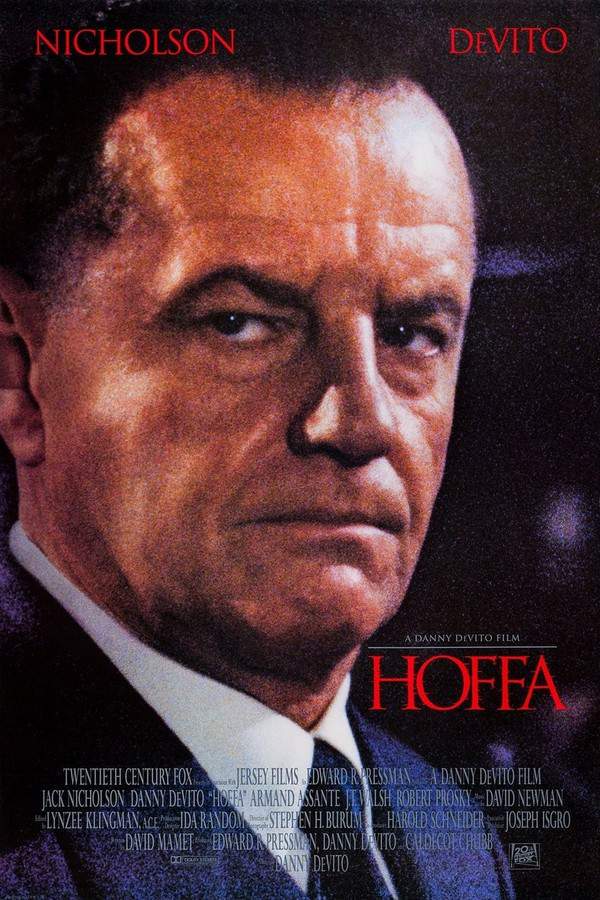
What Is Hoffa About?
The premise of Hoffa in 285 words, with nothing given away. The full story follows below.
In the gritty landscape of mid‑century America, a sweeping biopic follows the rise of a charismatic organizer whose voice reverberates through factories, truck stops, and town halls. The film opens on a quiet roadhouse parking lot, a modest setting that hints at the larger stage where labor, politics, and power intersect. The world feels both expansive and intimate, with the hum of assembly lines and the undercurrent of whispered deals painting a portrait of an era where ambition could reshape a nation’s workforce.
At the heart of the story is Jimmy Hoffa, a tenacious figure whose drive to unite workers propels him from the streets of Detroit to the pinnacle of the Teamsters Union. His partnership with a longtime confidant, Bobby Ciaro, adds a personal dimension to the political chess game, highlighting a bond forged in shared purpose and mutual loyalty. Their interactions are marked by a blend of rough camaraderie and strategic calculation, underscoring how personal relationships become the scaffolding for broader influence.
The narrative’s tone is measured and somber, allowing the audience to feel the weight of public scrutiny and the relentless pressure of legal challenges that accompany Hoffa’s ascent. Through carefully crafted vignettes, the film suggests the constant presence of powerful, unseen forces—politicians, business titans, and shadowy figures—without spelling out their machinations. The atmosphere remains taut, balancing moments of quiet reflection with the ever‑present tension of a man navigating a world where every decision carries profound consequence.
While the biopic charts four decades of ambition, triumph, and conflict, it leaves viewers with an enduring mystery. Hoffa’s sudden disappearance looms as an unanswered question that haunts his legacy, inviting speculation about the cost of influence and the fragile line between power and peril.
What Happens in Hoffa?
The complete story of Hoffa, from the first scene to the last, in 703 words (about 3 minutes). Spoilers throughout. Names in the text link to 2 cast member pages.
Spoilers ahead
On July 30, 1975, Jimmy Hoffa and his longtime friend Bobby Ciaro linger in the parking lot of a roadhouse diner, a quiet frame that opens a deeper, sprawling portrait of Hoffa’s past. The film unfolds in a series of vignettes that trace four decades of his life, starting with his early days as an International Brotherhood of Teamsters organizer in and around Detroit, and how his drive to unite workers sets him on a collision course with power, loyalty, and crime.
In 1935, Hoffa boards a parked truck where he meets driver Ciaro, pitching the benefits of joining the union and slipping a business card into Ciaro’s hands, inscribing the bold line, > Give this man whatever he needs. A few days later, Ciaro reports to work to find Hoffa already courting his fellow drivers to unionize. Hoffa’s bold, relentless approach backfires when he blurts out that he already spoke to Ciaro, getting Ciaro fired. The tension escalates as Ciaro confronts Hoffa with a knife, but Hoffa’s longtime bodyguard Billy Flynn steps in, forcing the aggressor to drop the weapon at gunpoint. This rough partnership between Hoffa and Ciaro intensifies as they help in the arson of a laundry that refuses to cooperate with the Teamsters. Flynn’s injuries from the fire prove fatal, and Ciaro transitions into Hoffa’s new bodyguard and trusted aide.
The narrative continues with a brutal street-level strike that erupts into a clash between union and non-union workers, drawing Hoffa into a perilous grab for power. He is kidnapped by men working for Detroit Mafia boss Carl D’Allesandro, but Ciaro’s intervention helps negotiate a bargain: D’Allesandro will lend muscle and influence to the Teamsters in exchange for illicit “loans” from the union treasury. Hoffa’s public fate becomes entangled with political scrutiny when he is questioned at a Congressional hearing by Robert F. Kennedy over allegations of organized crime influence over the Teamsters. Hoffa eventually rises to the presidency in 1957, only to see his relationship with Kennedy’s brother, John F. Kennedy, sour into a fierce, public feud as Bobby Kennedy becomes Attorney General.
A hunting trip with D’Allesandro reveals a secret embezzlement scheme involving the Teamsters’ pension fund, sketched haphazardly on the back of a hunting license when there is no paper handy to record the plan. The betrayal by Teamsters official Peter Connelly compounds Hoffa’s troubles: Connelly testifies at Hoffa’s labor racketeering trial and provides the crucial evidence—the very license that bears the scheme’s outline. Hoffa surrenders to federal authorities, and Frank Fitzsimmons, a powerful insider, seizes control of the union while Ciaro is convicted on lesser charges and granted early release.
Political maneuvering continues as D’Allesandro urges a strategic gambit: endorse Richard Nixon in 1968 in exchange for a presidential pardon for Hoffa. The payoff appears when Hoffa is pardoned, but a harsh constraint follows—he is forbidden to contact the Teamsters for ten years due to a deal between the White House and Fitzsimmons. Enraged, Hoffa presses D’Allesandro to eliminate Fitzsimmons, triggering a failed car-bomb attempt and leaving Hoffa isolated from the union’s inner circle. D’Allesandro signals that he won’t help further, suggesting that a direct confrontation may become public.
The tension finally shifts to the diner’s parking lot, where Hoffa enlists Ciaro to deliver a message to D’Allesandro—a warning that if Fitzsimmons is not dealt with, Hoffa will go to the press. When D’Allesandro does not show, the waiting game ends in a brutal confrontation. A driver in the diner’s parking lot, armed with a silenced pistol, ends Hoffa’s life—yet Ciaro’s body is also disposed of in Hoffa’s car as men from a truck pull the vehicle away. The grim sequence underlines a life spent balancing power, loyalty, danger, and the ever-present possibility of being erased by the very forces Hoffa sought to control.
Throughout the film, the narrative moves with a somber, measured tempo, grounding Hoffa’s meteoric rise and catastrophic fall in personal loyalties and the hidden costs of leadership. The blend of intimate scenes and public power plays paints a portrait of a man whose ambition pulled him into a web of crime, politics, and betrayal, and it leaves the viewer with a clear, unflinching view of the costs of influence in American labor history.
Hoffa Timeline: Every Key Event in Order
12 key events in the order they happen, from “Hoffa meets Ciaro on a parked truck” to “Murder in the parking lot”. 12 events name a place, across 10 locations.
- 1
Hoffa meets Ciaro on a parked truck
In 1935 Hoffa boards a parked truck and meets Bobby Ciaro. He pitches the benefits of joining the Teamsters and gives Ciaro a business card promising support when needed. This encounter marks the start of Hoffa's long campaign to organize drivers around Detroit.
When:1935 Where:Detroit area
- 2
First violent confrontation and arson
A few days later Ciaro reports to work to find Hoffa pressuring drivers to unionize. Hoffa reveals he already spoke to Ciaro, causing Ciaro to be fired. Ciaro confronts Hoffa with a knife, but Hoffa's longtime bodyguard forces him to drop the weapon. The two later participate in the arson of a laundry that refuses to cooperate, and Hoffa's associate Flynn dies from injuries he sustains. Ciaro becomes Hoffa's new bodyguard and assistant.
When:1935-1936 Where:Detroit area
- 3
Strikes, abduction, and a dangerous bargain
During a Teamsters strike that erupts into a street brawl, Hoffa is snatched by Detroit Mafia boss Carl D'Allesandro. Ciaro intervenes and a bargain is struck: D'Allesandro will back the Teamsters in exchange for illegal loans from the union treasury. This alliance binds Hoffa to organized crime figures for years to come.
When:late 1930s Where:Detroit
- 4
Congressional hearing on organized crime
At a Congressional hearing, Hoffa is questioned by Robert F. Kennedy about allegations that the Teamsters are controlled by organized crime. The proceedings highlight the tension between Hoffa's leadership and federal scrutiny.
When:1957 Where:Washington, D.C.
- 5
Hoffa rises to Teamsters president
Hoffa is elected president of the Teamsters in 1957, consolidating his power within the union. His leadership sets the stage for ongoing clashes with political figures and criminal interests. The ascent also places him at the center of national attention and scrutiny.
When:1957 Where:Teamsters headquarters
- 6
Kennedy era deepens the feud
The feud with the Kennedy family intensifies after John F. Kennedy is elected president in 1960 and Bobby Kennedy becomes Attorney General. Hoffa's influence and the government's crackdown bring their rivalries into sharp public focus.
When:1960-1961 Where:Washington, D.C.
- 7
Hunting trip and pension fraud plan
During a hunting trip with D'Allesandro, Hoffa and the mobster discuss an embezzlement scheme involving the Teamsters pension fund. They sketch the plans on the back of a hunting license because they have no paper. The informal planning underscores the depth of corruption surrounding the union.
When:early 1960s Where:Unknown location
- 8
Betrayal, trial, and leadership change
Teamsters official Peter Connelly betrays Hoffa by testifying at Hoffa's labor racketeering trial and providing crucial evidence: the hunting license. Hoffa surrenders to federal authorities and receives a long sentence, while Frank Fitzsimmons takes control of the Teamsters.
When:early 1960s Where:Federal court
- 9
Ciaro's conviction and Nixon era planning
Ciaro is convicted on lesser charges and soon released; D'Allesandro urges the Teamsters to back Richard Nixon for president in 1968 in exchange for Hoffa receiving a presidential pardon. The deal hints at the political power dynamics connected to the union.
When:1960s-1968 Where:Prison / political offices
- 10
Pardon, ban, and rising anger
Hoffa is pardoned by the Nixon administration but learns that a deal with Frank Fitzsimmons bars him from contacting the Teamsters for ten years. He becomes furious and begins plotting ways to regain influence while staying outside the official channels.
When:1971 Where:White House / Washington, D.C.
- 11
The diner showdown begins
Hoffa and Ciaro spend hours waiting in a diner's parking lot for D'Allesandro to appear, hoping to work out a plan to deal with Fitzsimmons. The tension builds as other drivers lounge inside, unaware of the deadly meeting looming outside.
When:July 30, 1975 Where:Diner parking lot
- 12
Murder in the parking lot
A silenced gunman arrives and shoots Hoffa and Ciaro in the roadhouse diner's parking lot. Their bodies are loaded into Hoffa's car and driven away as men emerge from a truck, sealing the hit and ending Hoffa's era.
When:July 30, 1975 Where:Roadhouse diner's parking lot
Who Are the Main Characters in Hoffa?
5 characters, among them Jimmy Hoffa (Jack Nicholson), Bobby Ciaro (Danny DeVito) and Carl D’Allesandro: who each one is and the part they play in the story. 2 of them link to the actor’s page.
-
Jimmy Hoffa (Jack Nicholson)
Played by Jack Nicholson
A charismatic yet fiercely ambitious labor leader who reshapes the Teamsters. He uses ruthless tactics to secure control, and his confidence often blinds him to looming betrayals. His magnetism masks a relentless drive for power, pulling him into a web of politics, crime, and rivalries. His fate reflects the high cost of bold leadership and stubborn pride.
- 💼
- 💥
- 🕴️
- 🤝
-
Bobby Ciaro (Danny DeVito)
Played by Danny DeVito
Hoffa’s longtime friend and driver, a pragmatic ally who acts as a bridge between Hoffa and the mob. He balances loyalty with realism, often mediating between Hoffa’s aims and the interests of powerful others. Ciaro’s arc underscores the human sacrifices that accompany high-stakes power plays.
- 🤝
- 🛡️
- 💼
- CD
Carl D’Allesandro
Detroit mob boss who provides muscle and political leverage for the Teamsters in exchange for illicit loans. He embodies the fusion of organized crime with labor politics and drives key shifts in Hoffa’s trajectory. His calculated moves shape the plot’s twists and outcomes.
- 🕵️♂️
- 🧯
- 🫶
- PC
Peter Connelly
A Teamsters official who betrays Hoffa by testifying against him, delivering a crucial evidence piece—the hunting license—that seals Hoffa’s legal troubles. He personifies internal risk and self-interest within the union. His actions illustrate how internal politics can be as dangerous as external foes.
- 🔎
- 💼
- 🗡️
- FF
Frank Fitzsimmons
Teamsters president who rivals Hoffa from within the union and makes deals with the White House to restrain him. He embodies institutional power and political maneuvering over idealistic leadership. His actions help facilitate Hoffa’s downfall through calculated political arrangements.
- 🏛️
- 💼
- ⚖️
Where and When Is Hoffa Set?
Hoffa is set in Detroit, Michigan and United States (1935–1975). Here is why the time and place matter to the story.
When
1935–1975
The narrative spans from Hoffa’s early organizing days in the 1930s through his peak influence in the 1950s and 60s, to his downfall in the mid-70s. It traverses the Great Depression aftermath, postwar industrial growth, and the turbulent politics of the 1960s. The timeline tracks the evolution of the Teamsters, its political entanglements, and the rise of criminal associations.
Where
Detroit, Michigan, United States
The movie unfolds in Detroit’s gritty, industrial heart, reflecting a blue-collar atmosphere. It centers on the rise of a powerful labor leader amid the city’s trucking and laundry networks. The action shifts between roadhouse parking lots, warehouses, and union halls, all set against mid-20th century American labor tensions.
- 🏙️ Urban industrial landscape
- 🏭 Auto industry hub
- 🗺️ American Midwest
What Are the Themes of Hoffa?
4 ideas the story keeps returning to, among them Power and Corruption, Loyalty and Betrayal and Public Scrutiny and Politics.
-
01
Power and Corruption
The story traces how ambition within the Teamsters becomes a vehicle for political leverage and criminal influence. Hoffa’s pursuit of control collides with institutional limits and rival interests. Risky decisions driven by a hunger for power propel both strategy and violence. The film suggests that power can erode ideals and strain loyal relationships.
-
02
Loyalty and Betrayal
Hoffa’s core alliances, especially with Ciaro, are tested by opportunists and enemies. Trust becomes a fragile currency in a world of whispers, testimonies, and retaliation. Betrayals ripple through the union and organized crime, culminating in brutal consequences. The narrative emphasizes how loyalty can sustain or destroy a person.
-
03
Public Scrutiny and Politics
Congressional hearings, presidential dealings, and political maneuvering shape Hoffa’s fate as much as street violence. The film shows how labor power, media narratives, and government investigations intersect. Public perception becomes a battleground that can elevate or ruin a leader. The political arena mirrors the danger and intrigue off the record.
-
04
Organized Crime & Unionism
The plot reveals an uneasy alliance between labor unions and criminal elements in 20th‑century America. Illicit loans, protection schemes, and rackets blur the line between legitimate leadership and criminal enterprise. This interdependence fuels the union’s growth while amplifying the risks of violence. The story shows how criminal ties can shape a labor movement’s direction.
What Kind of Film Is Hoffa?
Dark in tone, with steady pacing and a complex story, going by the plot summary.
- Tone
- Dark
- Pacing
- Steady
- Story
- Complex
- Intensity
- High
- Ending
- Bleak
A dark and somber biopic that grips the viewer with its unflinching portrayal of a man's ambitious rise and catastrophic fall into a web of crime and betrayal, culminating in a bleak and mysterious end.
- somber
- gripping
- oppressive
- brooding
- melancholic
- anxious
- rise and fall
- political corruption
- organized crime
- betrayal
Content notes: murder, kidnapping, arson, violent confrontation, organized crime.
Quiz
How well do you remember Hoffa? Test yourself on the story.
Where to Watch Hoffa
Rent or buy it from Amazon Video and Apple TV Store. US availability and prices from JustWatch.





Streaming availability in the US, powered by