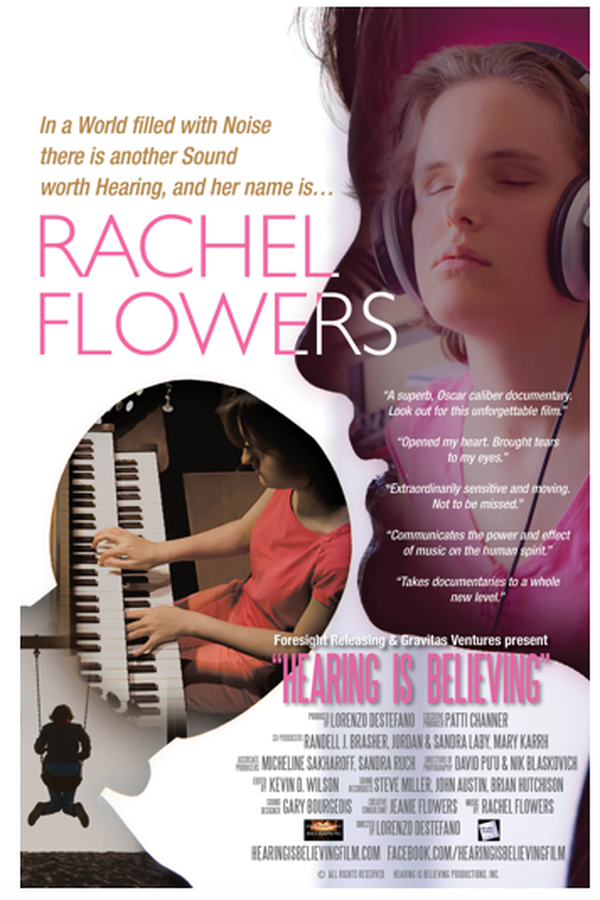
Hearing Is Believing 2017


Directed by

Lorenzo DeStefano
Made by

Gravitas Ventures
Where to Watch Hearing Is Believing
See current US streaming, rental, and purchase options for Hearing Is Believing (2017) via JustWatch.

Amazon Prime Video
HD
Amazon Prime Video with Ads
HD
Hoopla
SD
Amazon Prime Video Free with Ads
HD
Fandango at Home Free
HD
Amazon Video
SD
Apple TV Store
HD Fandango At Home
SD
Google Play Movies
SD
YouTube
SD Streaming availability powered by 
Hearing Is Believing Plot Summary
Read the complete plot summary and ending explained for Hearing Is Believing (2017). From turning points to emotional moments, uncover what really happened and why it matters.
Making a film about a person’s life, even if it’s just a glimpse into a specific period, is a significant endeavor that carries a lasting impact. Award-winning filmmaker Lorenzo DeStefano had to reshape his vision when he encountered the extraordinary talents of Rachel Flowers. Born on December 21, 1993, a mere 15 weeks premature, Rachel weighed only one pound and five ounces at birth. Unfortunately, she lost her sight due to Retinopathy of Prematurity (ROP), yet this did not hinder her musical journey.
By the age of two, Rachel could play any song she heard by ear, showcasing her perfect pitch. Her musical education began at just four years old when she became a student at the Southern California Conservatory of Music. Over the next decade, she immersed herself in piano studies and learned both Braille Music Code and adaptive computer music applications. Notably, Rachel was featured in segments on 60 Minutes in 2005 and 2008, highlighting the Music Academy for the Blind in Los Angeles.
Rachel shares her life with her 14-year-old brother Vaughan Flowers and her mother Jeanie Flowers, who is also a talented singer and musician, in Oxnard, California. Her father, Dan Flowers, a fellow musician residing in Ventura, California, adds depth to the narrative as he navigates his own struggles with failing eyesight, a genetic condition that differs from Rachel’s. Dan attends mobility training classes at the Braille Institute in Santa Barbara, where Rachel has also been supported since she turned ten, all while finding guidance from a daughter who has triumphed against adversity.
The film highlights the contributions of various renowned artists, including the legendary Stevie Wonder, Keith Emerson of Emerson Lake & Palmer, Dweezil Zappa, jazz trumpeter Arturo Sandoval, Patrick Maraz of the Moody Blues, jazz pianist Taylor Eigsti, and the Santa Barbara Youth Symphony, who recorded Rachel’s original piece, “At The End Of The Day.”
The team behind Hearing is Believing has made substantial progress since production began in March 2014, capturing 42 days of footage focused on a compelling portrayal of a close-knit American family living on the edge financially. Through a blend of joyful and challenging moments, the Flowers family presses on, with Rachel’s music serving as their uplifting soundtrack. The film seeks to uncover the greatness that lies within small moments, celebrating Rachel’s vibrant and free-spirited love for music.
Despite the inherent uncertainties faced by independent films, Hearing is Believing aims to resonate with audiences. Rachel Flowers, now 21, is a remarkable survivor and an inspiring figure whose deeply human experience and astounding musical abilities possess the potential to shine brightly, illuminating the strength of family ties and the intricate nature of musical expression.
Hearing Is Believing Timeline
Follow the complete movie timeline of Hearing Is Believing (2017) with every major event in chronological order. Great for understanding complex plots and story progression.
Birth of Rachel Flowers
Rachel Flowers was born on December 21, 1993, at just 15 weeks premature, weighing a mere one pound and five ounces. Despite this difficult start to life, she demonstrated tremendous resilience that would shape her future.
Loss of Sight
Due to Retinopathy of Prematurity, Rachel unfortunately lost her sight, marking a significant challenge in her early life. However, this setback did not deter her from exploring her innate musical talents.
Early Musical Talent
By the age of two, Rachel showcased her extraordinary gift by playing songs she heard by ear, revealing her perfect pitch. This remarkable ability hinted at her future as a gifted musician.
Musical Education Begins
Rachel began her formal music education at just four years old, enrolling as a student at the Southern California Conservatory of Music. This early start set the foundation for her lifelong passion for music.
Learning Braille Music Code
Over the next decade, Rachel dedicated herself to piano studies and learned the Braille Music Code along with adaptive computer music applications. This knowledge would prove essential in her musical journey.
Features on 60 Minutes
Rachel gained national attention as she was featured in segments on 60 Minutes in 2005 and 2008. These appearances spotlighted the Music Academy for the Blind in Los Angeles, showcasing both her talent and resilience.
Life in Oxnard
Rachel shares her life with her mother Jeanie, her brother Vaughan, and her father Dan in Oxnard, California. This close-knit family dynamic plays a crucial role in Rachel's life and musical development.
Father's Struggles with Sight
Dan Flowers, Rachel's father, faces his own struggles with failing eyesight due to a genetic condition. His attendance at mobility training classes at the Braille Institute in Santa Barbara reflects the challenges that the family navigates together.
Support from the Music Community
The film features contributions from music legends such as Stevie Wonder, Dweezil Zappa, and jazz trumpeter Arturo Sandoval. Their involvement highlights the support and recognition Rachel receives from the wider music community.
Production Begins
Production on *Hearing is Believing* commenced in March 2014, as the film team began capturing Rachel's life and family dynamics over 42 days of footage. This period of filming is crucial to telling their story.
Challenges of Independent Film
The team faced inherent uncertainties that come with independent filmmaking while focusing on the Flowers family's compelling story. Despite the obstacles, their aim is to create a resonating portrayal of Rachel's experience.
Rachel's Original Composition
Rachel's original piece, 'At The End Of The Day,' was recorded by the Santa Barbara Youth Symphony, showcasing her exceptional musical abilities. This accomplishment emphasizes her talent and dedication to her craft.
Celebration of Family and Music
Throughout the film, the Flowers family navigates both joyful and challenging moments, with Rachel’s music serving as their inspiring soundtrack. The narrative focuses on the strength of family ties and the beauty of musical expression.
Rachel's Resilience
Now 21 years old, Rachel exemplifies resilience as she continues her journey as a musician. Her story serves as an inspiration, shedding light on the strength found in adversity and the power of music.
Hearing Is Believing Characters
Explore all characters from Hearing Is Believing (2017). Get detailed profiles with their roles, arcs, and key relationships explained.
Rachel Flowers
Rachel Flowers is a profoundly talented young musician who, despite losing her sight shortly after birth, has thrived musically. Her extraordinary ability to play by ear and her dedication to mastering music reflect her spirit and determination. Rachel is portrayed as an uplifting force within her family, using her music to inspire and motivate others.
Vaughan Flowers
Vaughan Flowers is Rachel's supportive brother, who shares a close bond with her. At 14 years old, he navigates his own adolescence while being a source of encouragement for Rachel as she pursues her musical dreams. His character represents familial loyalty and the importance of sibling relationships.
Jeanie Flowers
Jeanie Flowers, Rachel's mother, is a talented singer and musician whose love and support for her children are central to the family's story. She plays a vital role in nurturing Rachel's musical abilities and provides emotional strength as the family confronts their challenges together.
Dan Flowers
Dan Flowers, Rachel's father, is a musician who also faces his own struggles with failing eyesight. His journey complements Rachel's, as both navigate the challenges posed by their conditions. Dan's character adds depth to the narrative, illustrating the diverse ways in which family members support each other.
Hearing Is Believing Settings
Learn where and when Hearing Is Believing (2017) takes place. Explore the film’s settings, era, and how they shape the narrative.
Time period
2014 - Present
The narrative of 'Hearing Is Believing' spans from March 2014 during its production to the present day, showcasing Rachel Flowers' evolving journey as a musician and survivor. This period reflects the significance of storytelling through film in capturing intimate and transformative life experiences.
Location
Oxnard, California, Ventura, California, Santa Barbara, California
Oxnard, California, is known for its beautiful beaches and vibrant agricultural community. The city is home to the Flowers family, whose story unfolds in the film, showcasing a close-knit familial bond against the backdrop of challenges. Nearby Ventura and Santa Barbara also play significant roles, particularly in the context of music education and foundational support for Rachel's journey.
Hearing Is Believing Themes
Discover the main themes in Hearing Is Believing (2017). Analyze the deeper meanings, emotional layers, and social commentary behind the film.
🎵
Musical Journey
The film underscores the transformational power of music, particularly within the life of Rachel Flowers. Despite her visual impairment, Rachel's extraordinary talent and perfect pitch allowed her to thrive musically, illustrating how passion and resilience can transcend adversity. Music serves as both a personal and familial soundtrack that uplifts and binds together the Flowers family.
🛤️
Family Bonds
At its core, 'Hearing Is Believing' is a testament to the strength of family connections. The film portrays the struggles and triumphs of the Flowers family as they navigate Rachel's challenges, with their unwavering support being a pivotal theme. The narrative highlights how love and unity can foster resilience and hope in the face of adversity.
✨
Overcoming Adversity
Rachel's journey represents a profound narrative of overcoming challenges. Her determination to excel in music, despite being born prematurely and losing her sight, inspires audiences. The film captures how resilience and hope can shine through even the darkest moments, encouraging viewers to celebrate inner strength.

Coming soon on iOS and Android
The Plot Explained Mobile App
From blockbusters to hidden gems — dive into movie stories anytime, anywhere. Save your favorites, discover plots faster, and never miss a twist again.
Sign up to be the first to know when we launch. Your email stays private — always.
Explore the mobile appHearing Is Believing Spoiler-Free Summary
Discover the spoiler-free summary of Hearing Is Believing (2017). Get a concise overview without any spoilers.
In a sun‑kissed corner of Southern California, the documentary Hearing Is Believing opens on a quiet home where music flows like conversation. At its heart is Rachel Flowers, a prodigious pianist and composer whose early life was defined by a fight for survival and an innate gift for sound. Born far too early and left blind by a rare eye condition, she turned what could have been a limitation into a limitless auditory landscape, astonishing everyone around her with perfect pitch and an instinctive ability to translate any melody she hears onto the keys.
The film gently pulls the viewer into the rhythm of Rachel’s family life, where each member contributes a distinct hue to the tapestry of resilience. Vaughan Flowers, her teenage brother, shares the hallway with the soft hum of practice sessions, while Jeanie Flowers, their mother, adds a warm, lyrical counterpoint as both caretaker and fellow musician. The presence of Dan Flowers, a father navigating his own vision challenges, adds a layer of quiet determination that echoes through their shared journey. Director Lorenzo DeStefano steps back, allowing the family’s everyday moments—cooking, rehearsing, laughing—to become the canvas on which Rachel’s extraordinary talent is painted.
The tone of the film is intimate and uplifting, balancing the stark realities of financial strain with the transcendent power of music. Light filters through the modest home, illuminating a world where adaptive technology, Braille scores, and a supportive community of fellow artists converge to nurture a young woman’s dreams. Subtle glances at legendary musicians who admire her work hint at a broader stage awaiting her, while the camera lingers on the simple joy of a child coaxing notes from a piano, inviting the audience to feel the unspoken promise that lies within each chord.
Through a blend of gentle observation and vibrant sound, Hearing Is Believing celebrates not only Rachel’s remarkable abilities but also the unbreakable bonds of a family that turns adversity into a symphony of hope.
Movies with Similar Twists and Themes
Uncover films that echo the narrative beats, emotional arcs, or dramatic twists of the one you're exploring. These recommendations are handpicked based on story depth, thematic resonance, and spoiler-worthy moments — perfect for fans who crave more of the same intrigue.

Featured on this page

What's After the Movie?
Not sure whether to stay after the credits? Find out!
Check out our other apps:

SAT Sphere
Build confidence for the Digital SAT.

Mori Atlas
Discover wild places worth protecting.

Luntero
Search smarter for a home in Amsterdam.

Plot Explained
Unravel movie endings and hidden clues.

Pokechamp
Dive into Pokémon data and battle logic.

Driving Theory
Get ready for your European theory test.

Movie Dust
Plan your next cinema trip with ease.

Musemap
Find art and culture as you travel.

Selkobase
Compare credentials before committing.

Local Manual
Turn an unfamiliar country into practical next steps.

Lernavi
Compare school systems before your next move.

GymRoam
Find a workout stop wherever your plans take you.
Explore Our Movie Platform
New Movie Releases (2026)
Famous Movie Actors
Top Film Production Studios
Movie Plot Summaries & Endings
Major Movie Awards & Winners
Best Concert Films & Music Documentaries
Movie Collections and Curated Lists
© 2026 What's After the Movie. All rights reserved.
Privacy Policy