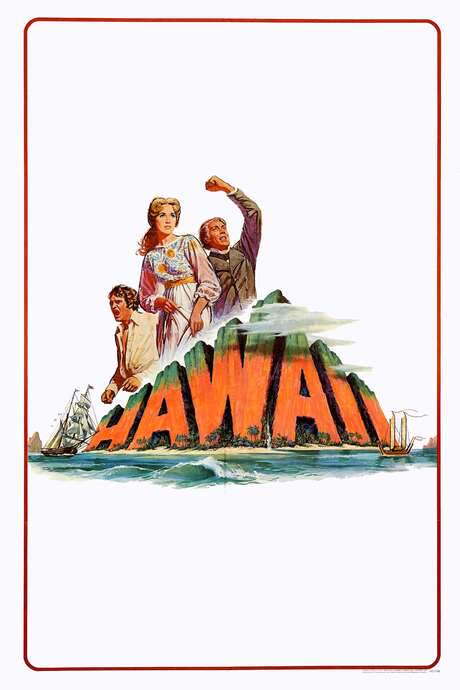
Hawaii 1966


Directed by

George Roy Hill
Made by

The Mirisch Company
Where to Watch Hawaii
See current US streaming, rental, and purchase options for Hawaii (1966) via JustWatch.






Hawaii Plot Summary
Read the complete plot summary and ending explained for Hawaii (1966). From turning points to emotional moments, uncover what really happened and why it matters.
In 1819, Prince Keoki Kanakoa appeals to Yale Divinity School to bring Christianity to the Hawaiian Islands. Among the volunteers is Abner Hale, newly ordained, who must be married before embarking on the mission. Reverend Thorn introduces Abner to his young niece, Jerusha Bromley Hale, who is in love with Rafer Hoxworth, a whaler currently away at sea. Believing Hoxworth has forgotten her, Jerusha agrees to marry Abner after a brief courtship.
The couple, along with Mason and other missionaries, sails to Lahaina on the island of Maui. They are shocked by what they perceive as the islanders’ sins, including incest within the royal family. Kelolo is both husband and biological brother of Malama Kanakoa, the island’s ruler, a tradition meant to preserve the royal bloodline. Keoki, who longs to serve as a minister, faces pressure to marry his sister Noelani, who is next in line to rule, in order to secure dynastic continuity.
On Lahaina, Jerusha throws herself into parish life, volunteering to help the native people and to curb infanticide after rescuing a baby with a facial birthmark. She gives birth to a son, Micah, in the midst of hardship. During a stopover in one of his whaling voyages, Rafer Hoxworth returns, learns of Jerusha’s marriage to Abner, and is consumed by jealousy, even threatening Abner. Despite the tension, Abner baptizes Iliki, a young Hawaiian girl who had been given to the Hales as a servant, marking a small victory for conversion efforts.
Malama agrees to learn about Christianity but resists full conversion, knowing it would force her to send Kelolo away. At the Hales’ insistence, Malama imposes a curfew on sailors and forbids fraternizing with native women, sparking a riot among the sailors. Hoxworth presses Jerusha to leave with him, but she remains steadfast. When sailors retaliate by partially burning the church, the Hawaiians rally to defend the Hales, driving the sailors back to their ships. In a later act of vengeance, Hoxworth entices Iliki to leave the island with him, and Abner, trying to retrieve her, is cast overboard and attacked by a shark, leaving him permanently lame.
Years pass. Abner reveals to Keoki that he will likely never be ordained because he is not white, proposing that Keoki take a deacon’s role to oversee the natives’ activities. Keoki refuses, and his faith is strained as he renounces Christianity. On Malama’s deathbed, she agrees to be baptized, renouncing Kelolo as her husband. As the natives had foretold, a powerful gale strikes the town and destroys the church at Malama’s death.
Noelani becomes the Aliʻi Nui and marries Keoki. Abner disrupts the wedding, revealing that Malama’s baptism was a move for the people’s benefit. Kelolo departs for Bora Bora with Malama’s heart, and Abner prays for divine retribution to punish the islanders. When Noelani and Keoki’s child is born severely deformed, Abner argues against saving the infant, despite Jerusha’s pleas. Keoki drowns the child, and a measles outbreak soon devastates the native population, killing hundreds, including Keoki, who dies while denouncing God.
Jerusha’s years of toil and childbearing take a heavy toll on her health, and she dies prematurely. Devastated, Abner becomes more compassionate toward the Hawaiians, opposing settlers and plantation owners who seek more land. He is reassigned to Connecticut, though he stays in Hawaii and sends his children to New England. Returning to his hut, Abner is greeted by a young Hawaiian man who wishes to be his assistant. The man is the disfigured infant Jerusha had saved years before, and Abner’s happiness swells at the thought of a renewed partnership in the work he once believed was lost to him.
Hawaii Timeline
Follow the complete movie timeline of Hawaii (1966) with every major event in chronological order. Great for understanding complex plots and story progression.
Mission begins: Yale appeals to Hawaii
In 1819, Prince Keoki Kanakoa appeals to the Yale Divinity School to bring Christianity to the Hawaiian Islands. A group of volunteers, including Reverend Abner Hale, prepares to embark on a mission. They plan to sail to Maui to establish a Christian presence in the islands.
Voyage to Lahaina and cultural clash
The couple, along with other missionaries and Keoki, sail to Lahaina on Maui to begin work. They are confronted by what they perceive as the islanders' sinful practices, including an incestuous royal tradition. This clash foreshadows the cultural and religious tensions that dominate the story.
Jerusha aids natives and saves infant
Jerusha takes an active role in aiding the natives, including rescuing a baby with a facial birthmark and opposing infanticide. Her actions demonstrate compassion and leadership that earns the locals' trust and support for the mission.
Micah's birth deepens ties to the community
After a challenging labor, Jerusha gives birth to her son Micah. The birth strengthens her bonds with the community and deepens her belief in the mission's purpose.
Hoxworth's jealousy threatens Abner
During a stopover in a whaling voyage, Rafer Hoxworth learns of Jerusha's marriage to Abner and, filled with jealousy, vows to kill Abner. The threat hangs over the mission and personal relationships from this point forward.
Iliki baptized; church grows
Abner baptizes his first convert, Iliki, a young Hawaiian girl who was given to the Hales as a servant. This baptism marks the early growth of the church and tests the Hales' approach to sharing their faith with locals.
Malama's ambivalence and curfew
Malama Kanakoa agrees to learn about Christianity but resists conversion, fearing personal loss. She imposes a curfew on sailors and forbids fraternizing with native women, sparking a riot among sailors.
Sailors burn the church; Hawaiians defend it
Sailors retaliate by partially burning the church, and the Hawaiians come to the Hales' aid to drive them back to their ships. Hoxworth pressures Jerusha to leave with him, but she refuses to abandon Abner or the mission.
Abner overboard; shark attack
Hoxworth entices Iliki to leave the island; Abner tries to retrieve her but is thrown overboard. He survives but is attacked by a shark, leaving him permanently lame.
Years later: ordination denied
Years later, Abner reveals to Keoki that he will never be ordained because he is not white. He urges Keoki to take a deacon role to oversee native activities, but Keoki refuses, straining their friendship and amplifying resistance to Christianity.
Malama's deathbed baptism and gale
On her deathbed, Malama agrees to be baptized and renounces Kelolo as her husband. Soon after, a strong gale destroys the church, fulfilling a local prophecy.
Noelani rises; wedding clash and departure
Noelani becomes Alii Nui and marries Keoki, but Abner crashes the wedding, highlighting the rift between native authority and the mission. Kelolo departs for Bora Bora with Malama's heart, signaling the end of one era.
Deformed child, Keoki's death, measles
The birth of Noelani and Keoki's severely deformed child leads Abner to view it as punishment from God. Keoki drowns the child, and a measles outbreak devastates the population, killing hundreds, including Keoki.
Jerusha dies; Abner's transformation
Jerusha's years of toil take their toll and she dies, and Abner grows more compassionate toward Hawaiians and opposes land seizures by settlers. He is reassigned to Connecticut but remains in Hawaii to raise his children.
Final reunion: the disfigured infant returns
Back in Hawaii, Abner is greeted by a young Hawaiian man who wishes to be his assistant and is revealed to be the disfigured infant Jerusha had saved years before. Abner is overjoyed by the reunion, sensing a new purpose in his life.
Hawaii Characters
Explore all characters from Hawaii (1966). Get detailed profiles with their roles, arcs, and key relationships explained.
Jerusha Bromley Hale
Newly married to Abner Hale, Jerusha travels to Maui to aid the mission. She is compassionate, proactive, and resilient, helping locals, rescuing an infant, and bearing and raising Micah while navigating the island’s upheavals.
Abner Hale
A newly ordained Reverend who marries Jerusha and leads the Maui mission. His idealism is tested as he confronts limits of authority and, years later, learns he will never be ordained because he is not white, shifting his role toward deacon and mentor to native communities.
Rafer Hoxworth
A jealous whaler who Belongs to Jerusha’s past and travels with the crew, returning to the island and threatening Abner after discovering Jerusha’s marriage. His actions catalyze conflict between settlers and Hawaiians.
Keoki
Hawaiian royal and ally of the mission who grows into a pivotal figure for native leadership. He resists early conversion but remains central to the island’s evolving power dynamic.
Kelolo
Keoki’s father and Malama Kanakoa’s husband, representing royal tradition and the complex family loyalties that frame the political landscape.
Malama Kanakoa
The ruling matriarch who engages with Christianity while safeguarding her people’s customs. She wavers between conversion and autonomy, ultimately dying after a life of political and spiritual tension.
Noelani
The new Ali'i Nui who marries Keoki, symbolizing the island’s transition as traditional leadership meets new religious and social orders.
Micah Hale (4 Years)
The infant Jerusha saves from drowning, who grows up as part of the Hale household and becomes a symbol of the long-term impact of the mission on Hawaiian families.
Micah Hale (12 Years)
A preteen in the continuing story of mission life, witnessing the changes and tensions on the island as generations pass.
Micah Hale (18 Years)
The grown Micah, the disfigured infant Jerusha saved long ago, who returns as a young man to become a possible assistant to Abner, completing a circle of fate.
Iliki
A young Hawaiian girl baptized by Abner Hale, representing the mission’s reach into native communities and the personal cost of conversion for the island.
Gideon Hale
Abner’s ally within the mission’s social network, reflecting the broader community of Hawaiians and missionaries who share in the island’s struggles.
Hawaii Settings
Learn where and when Hawaii (1966) takes place. Explore the film’s settings, era, and how they shape the narrative.
Time period
1819
The events unfold in 1819, a period of first sustained contact between Hawaiians and Western missionaries. Indigenous customs, royal succession, and new religious ideas collide as Abner and Jerusha establish a mission in a changing society. The era features, whaling voyages, and escalating clashes between native sovereignty and colonial influence.
Location
Lahaina, Maui
Lahaina on the island of Maui serves as the initial settlement for the missionaries. The coastal town with grassy huts and a growing church becomes the stage for cultural clash as Western religious ideas meet native Hawaiian traditions. The harbor and local politics introduce tension between sailors, royalty, and the arriving missionaries.
Hawaii Themes
Discover the main themes in Hawaii (1966). Analyze the deeper meanings, emotional layers, and social commentary behind the film.
🌺
Culture Clash
Christian missionaries confront native Hawaiian customs and royal traditions. Jerusha and Abner push for Western norms, while Malama Kanakoa and others resist or reinterpret them. The story centers on power, lineage, and the meaning of baptism within a deeply rooted culture. Tensions surface in marriage arrangements and social expectations as outsiders arrive.
⛪
Religion and Power
Faith is used to justify control and shape communities. Abner's evolving stance—revealing limits of white authority—highlights the imperfect reach of Western dominance. The church grows amid political and economic pressures from settlers and planters. The interplay between evangelism and sovereignty drives much of the conflict.
🌊
Conflict and Loss
The island experiences violence, riot, and personal tragedy as missionaries encounter resistance and betrayal. The church is assaulted, a shipboard tension simmers, and a devastating measles outbreak follows. Deaths and disillusionment intensify as native and settler interests clash, leaving a lasting mark on the community.

Coming soon on iOS and Android
The Plot Explained Mobile App
From blockbusters to hidden gems — dive into movie stories anytime, anywhere. Save your favorites, discover plots faster, and never miss a twist again.
Sign up to be the first to know when we launch. Your email stays private — always.
Explore the mobile appHawaii Spoiler-Free Summary
Discover the spoiler-free summary of Hawaii (1966). Get a concise overview without any spoilers.
In the early 19th century, a wave of New‑England idealism sets sail for the distant archipelago of Hawaii, driven by a fervent desire to bring Christianity to a land that still follows ancient customs. The island’s volcanic horizons and lush valleys provide a breathtaking backdrop for a story that pits disciplined doctrine against a vibrant, centuries‑old way of life, creating a mood that feels both grand and intimate.
At the heart of the mission is Abner Hale, a newly ordained minister whose stern, humorless demeanor masks a deep sense of purpose. Pressured to marry before departing, he is introduced to Jerusha Bromley, a beautiful, headstrong young woman whose own aspirations clash with the expectations placed upon her. Their brief courtship leads to a partnership that is as much about personal survival as it is about spiritual ambition, setting the stage for a delicate balance between duty and desire.
Upon reaching the island, the newcomers encounter a society ruled by tradition as forceful as any sermon. Keoki, a Hawaiian prince yearning to serve as a minister, embodies the island’s internal struggle: a longing for the new faith that must be weighed against the responsibility to uphold his people’s heritage. Royal customs, such as sibling marriages designed to protect bloodlines, and a communal rhythm that celebrates the land, stand in stark contrast to the missionaries’ rigid worldview, hinting at an inevitable clash of expectations.
The film unfolds with a measured, lyrical tone, inviting viewers to feel the heat of the sun, hear the surf against the cliffs, and sense the quiet tension between reverence and resistance. As cultures collide, the story raises timeless questions about conviction, compassion, and the true cost of imposing one belief system upon another, leaving the audience poised on the edge of an inevitable, yet uncharted, transformation.
Movies with Similar Twists and Themes
Uncover films that echo the narrative beats, emotional arcs, or dramatic twists of the one you're exploring. These recommendations are handpicked based on story depth, thematic resonance, and spoiler-worthy moments — perfect for fans who crave more of the same intrigue.





Featured on this page

What's After the Movie?
Not sure whether to stay after the credits? Find out!
Check out our other apps:

SAT Sphere
Build confidence for the Digital SAT.

Mori Atlas
Discover wild places worth protecting.

Luntero
Search smarter for a home in Amsterdam.

Plot Explained
Unravel movie endings and hidden clues.

Pokechamp
Dive into Pokémon data and battle logic.

Driving Theory
Get ready for your European theory test.

Movie Dust
Plan your next cinema trip with ease.

Musemap
Find art and culture as you travel.

Selkobase
Compare credentials before committing.

Local Manual
Turn an unfamiliar country into practical next steps.

Lernavi
Compare school systems before your next move.

GymRoam
Find a workout stop wherever your plans take you.
Explore Our Movie Platform
New Movie Releases (2026)
Famous Movie Actors
Top Film Production Studios
Movie Plot Summaries & Endings
Major Movie Awards & Winners
Best Concert Films & Music Documentaries
Movie Collections and Curated Lists
© 2026 What's After the Movie. All rights reserved.
Privacy Policy