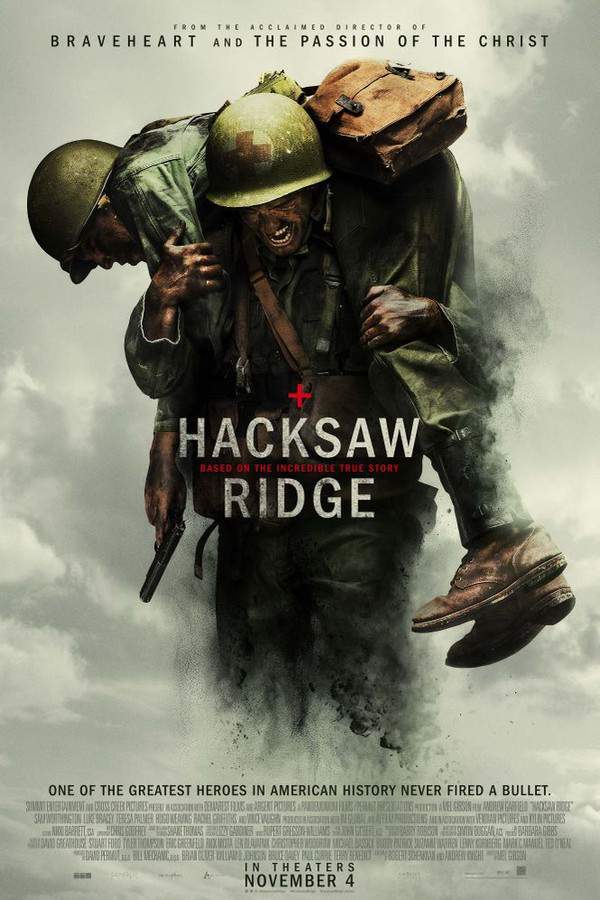
Hacksaw Ridge 2016


Made by

Summit Entertainment
Where to Watch Hacksaw Ridge
See current US streaming, rental, and purchase options for Hacksaw Ridge (2016) via JustWatch.

Angel Studios
4K
fuboTV
HD
Lionsgate+ Amazon Channels
HD
Amazon Video
4K
Apple TV Store
4K
Fandango At Home
4K
FlixFling
HD
Google Play Movies
SD
YouTube
SD Streaming availability powered by 
Hacksaw Ridge Plot Summary
Read the complete plot summary and ending explained for Hacksaw Ridge (2016). From turning points to emotional moments, uncover what really happened and why it matters.
While growing up in Lynchburg, Virginia during 1929, a young Desmond Doss (Andrew Garfield) experiences a pivotal moment when he nearly causes the death of his younger brother, Hal. The brothers are engaged in a typical childhood tussle when Desmond accidentally strikes Hal on the head with a metal bar, briefly stopping his breathing until their father intervenes. This traumatic incident, combined with Desmond’s staunch Seventh-day Adventist upbringing, reinforces his conviction in the commandment “Thou shalt not kill.” Their father, Tom, has his own demons, as a World War I veteran who confronts his painful memories by speaking to the graves of his lost comrades, particularly alarming for the boys with his violent and abusive behavior towards their mother, Bertha.
Fast forward 15 years, and Doss’s life takes a significant turn when he rushes an injured man to the hospital where he meets Dorothy Schutte (Teresa Palmer). Demonstrating remarkable skill, he saves the man’s life by improvising a tourniquet with his belt to stem severe bleeding. This moment sparks a relationship filled with love and admiration, as Desmond shares his aspirations to become a medic after being inspired by the doctor’s praise for his quick thinking.
As World War II breaks out, Doss feels compelled to enlist in the Army, viewing it as a means to protect family and country despite the conflict it poses with his beliefs. His brother Hal has already joined up and tries to persuade Desmond that fighting for freedom isn’t contrary to their upbringing. However, their father, Tom (played by Hugo Weaving), is dismayed with Desmond’s choice, shadowed by PTSD from his wartime experiences.
Doss’s journey leads him to Fort Jackson, South Carolina, where he commands the attention of Sergeant Howell ([Vince Vaughn]) and Captain Glover (Sam Worthington). Struggling against the hostility of fellow soldiers, who see his refusal to carry a firearm as cowardice, Doss remains determined to serve as a combat medic. Captain Glover, along with Howell, attempts to have Doss discharged on psychiatric grounds, but their efforts are thwarted as the camp doctor recognizes Doss’s deeply held religious beliefs.
Despite enduring torment and physical abuse from his peers, including a brutal encounter with Smitty (Luke Bracey), Doss perseveres through basic training, clinging to the hope of marrying Dorothy. However, his steadfast adherence to his principles leads to his arrest for insubordination when he again refuses to carry a weapon, causing him to miss his wedding.
In a surprising turn of events, a letter from a former commanding officer during his tribunal affirms that Doss’s beliefs are protected by law, leading to the dismissal of the charges against him. Later, he is deployed to the Pacific theater with the 77th Infantry Division during the harrowing Battle of Okinawa. Doss finds himself amidst a fierce battle at Hacksaw Ridge, where his unit faces unfathomable losses.
Courageously resisting the urge to flee, Doss repeatedly enters the fray to rescue his fellow soldiers, saving numerous lives amidst the chaos, even as explosions and gunfire surround him. His bravery soon evolves into a legendary tale as he successfully brings injured men back to safety, firmly believing in the power of saving “one more.” The perseverance shown leads to a shift in morale among the troops, who began to look to Doss as an inspiration.
After one particular onslaught where many in his team are left injured, including Smitty, Doss races back into the danger zone, providing aid to as many as he can, all while clutching the Bible that Dorothy had given him. His selfless actions culminate in rescuing 75 soldiers, a feat that earns him the Medal of Honor, awarded by President Harry S. Truman.
Ultimately, Doss’s remarkable journey of faith and courage resonates deeply, leaving a lasting legacy as he remains with Dorothy until her passing in 1991, and he himself departs this world on March 23, 2006, at the venerable age of 87.
Hacksaw Ridge Timeline
Follow the complete movie timeline of Hacksaw Ridge (2016) with every major event in chronological order. Great for understanding complex plots and story progression.
Childhood Incident
While living in Lynchburg, Virginia, in 1929, Desmond Doss nearly causes the death of his younger brother Hal during a childhood tussle. This traumatic experience significantly impacts Desmond's outlook on life and reinforces his commitment to the belief that 'Thou shalt not kill.'
Father's Struggles
Desmond's father, Tom, a World War I veteran, grapples with his own haunting memories, often talking to the graves of his deceased comrades. His violent and abusive behavior towards their mother, Bertha, creates a tense household atmosphere and leaves a lasting impression on the Doss brothers.
Inspiration to Help
Fifteen years later, Desmond's life takes a transformative turn when he meets Dorothy Schutte after saving an injured man. His quick thinking in improvising a tourniquet earns him admiration and inspires him to pursue a career as a medic.
Enlistment in the Army
With the outbreak of World War II, Desmond feels compelled to enlist in the Army despite his religious convictions. His decision causes a rift with his father, who struggles with PTSD and feels betrayed by Desmond's choice to serve.
Basic Training Challenges
At Fort Jackson, South Carolina, Desmond faces hostility from fellow soldiers who perceive his refusal to carry a weapon as cowardice. Despite attempts by his superiors to have him discharged, Desmond remains committed to his principles.
Physical Abuse and Resilience
Throughout basic training, Desmond endures torment and physical abuse from his peers, including a violent confrontation with Smitty. Nevertheless, he perseveres, maintaining hope of marrying Dorothy despite the escalating pressures around him.
Arrest for Insubordination
Desmond's steadfast adherence to his beliefs leads to his arrest for insubordination when he again refuses to carry a weapon. This pivotal moment causes him to miss his wedding, heightening the stakes of his moral stance.
Legal Affirmation of Beliefs
In a decisive turn, a letter from a former commanding officer during Desmond's tribunal affirms that his religious beliefs are protected by law. This leads to the dismissal of the charges against him and allows him to continue serving.
Deployment to Okinawa
Desmond is deployed to the Pacific theater with the 77th Infantry Division, where he participates in the brutal Battle of Okinawa. His unit faces staggering losses, setting the stage for his remarkable acts of bravery.
Heroism at Hacksaw Ridge
Amidst the chaos of battle at Hacksaw Ridge, Desmond displays extraordinary courage, repeatedly rushing into danger to rescue injured soldiers. His conviction to save 'one more' begins to shift the morale of his fellow troops.
Rescue of 75 Soldiers
During a fierce assault, Desmond's relentless bravery culminates in him rescuing 75 wounded soldiers. He clutches the Bible given to him by Dorothy, embodying his faith and commitment amidst the chaos.
Medal of Honor
Desmond's incredible acts of valor earn him the Medal of Honor, which is presented to him by President Harry S. Truman. His journey from a conscientious objector to a war hero captivates all around him and elevates his legacy.
Lasting Legacy
Desmond Doss's remarkable journey of faith and bravery resonates deeply as he continues to live with Dorothy until her passing. He leaves an indelible mark on those who knew him and around the world, symbolizing the power of conviction.
Passing of Desmond Doss
Desmond Doss passes away on March 23, 2006, at the age of 87, solidifying his status as a legend of faith and courage. His life story and values continue to inspire future generations.
Hacksaw Ridge Characters
Explore all characters from Hacksaw Ridge (2016). Get detailed profiles with their roles, arcs, and key relationships explained.
Desmond Doss
Desmond Doss is a deeply principled and faith-driven individual who becomes a combat medic during World War II. His refusal to carry a weapon stems from his Seventh-day Adventist beliefs, leading to profound struggles with fellow soldiers. Despite the hardships he faces, Doss's bravery and determination to save lives epitomize true heroism.
Dorothy Schutte
Dorothy Schutte is Desmond's love interest, providing him with emotional support and encouragement through his tumultuous journey. Her admiration for Desmond's strength and commitment to his beliefs serves as a moral compass for him, embodying the respect and love that underpin their relationship.
Tom Doss
Tom Doss, Desmond's father, is a World War I veteran whose trauma influences his relationship with his family. Struggling with PTSD, his violent tendencies create a challenging environment for Desmond and his brother, shaping Desmond's pacifist ideals in stark contrast to his father's memories of war.
Hacksaw Ridge Settings
Learn where and when Hacksaw Ridge (2016) takes place. Explore the film’s settings, era, and how they shape the narrative.
Time period
1929, World War II (1940s)
The film begins in 1929, a time of significant social and cultural development in America. As World War II unfolds, the early 1940s bring immense conflict, emerging ideologies, and battles that define the era, showcasing the clash between personal beliefs and the demands of duty.
Location
Lynchburg, Virginia, Fort Jackson, South Carolina, Pacific theater, Hacksaw Ridge
Lynchburg, Virginia is where Desmond Doss grows up, shaped by his family's values and traumatic experiences. Fort Jackson, South Carolina serves as the training ground where Doss faces hostility for his beliefs. The Pacific theater and Hacksaw Ridge become the backdrop for the intense battles of World War II, highlighting the brutal reality of war.
Hacksaw Ridge Themes
Discover the main themes in Hacksaw Ridge (2016). Analyze the deeper meanings, emotional layers, and social commentary behind the film.
✝️
Faith
Faith plays a central role in Desmond Doss's convictions, guiding his actions as both a medic and a soldier. His adherence to the commandment 'Thou shalt not kill' shapes his identity and decisions throughout the movie, demonstrating the power of belief in challenging circumstances.
💪
Courage
Desmond's unwavering courage in the face of adversity illustrates the true meaning of bravery. Despite torment from his peers and the battlefield dangers, he stands resolute in his mission to save lives, underlining the theme that true courage is not the absence of fear but the determination to act regardless of it.
🕊️
Peace
The pursuit of peace amidst a backdrop of war is a poignant theme throughout the film. Doss's quest to serve without taking lives presents a contrast to the violence surrounding him, showcasing the struggle for peaceful resolution in a war-torn world.

Coming soon on iOS and Android
The Plot Explained Mobile App
From blockbusters to hidden gems — dive into movie stories anytime, anywhere. Save your favorites, discover plots faster, and never miss a twist again.
Sign up to be the first to know when we launch. Your email stays private — always.
Explore the mobile appHacksaw Ridge Ending Explained
Unravel the ending of Hacksaw Ridge (2016) with our detailed explanation. Understand the final scenes, character fates, and unresolved questions.
At the climax of the film, Desmond Doss remains atop Hacksaw Ridge during a fierce battle, risking his life to save wounded soldiers amidst ongoing combat and artillery fire. Despite heavy danger from Japanese soldiers and explosions, he chooses to stay and rescue as many as possible, saving 75 men—some Japanese soldiers included. His knowledge of enemy tunnels allows him to mount a counter-attack that helps turn the tide of the battle, which contributes to the eventual Japanese retreat and the larger Allied victory in Okinawa. This moment of heroism culminates in Doss being injured by a grenade after kicking it away from his comrades—a remarkable act that actually happened in real life. Following the battle, he is evacuated from the ridge, injured but victorious, and later awarded the Medal of Honor by President Truman. The film also shows him marrying Dorothy, living happily until her death in 1991, and himself passing away in 2006 from health complications. While the movie simplifies some aspects of Doss’s post-war life, such as the awards he received and his remarriage, it captures the essence of his unwavering faith, bravery, and moral conviction. After the battle, the film reflects on the broader significance of Doss’s story: the power of steadfast belief, compassion, and nonviolence in the face of war’s brutality. The closing scenes highlight that the true heroism lies not in weapons or violence but in having the courage to uphold one’s conscience, with Doss’s faith and perseverance inspiring viewers to see beyond judgments and recognize the strength of conviction and love. The ending also hints at the cultural significance of Japanese tradition with the Japanese commander’s ritual suicide—a reference to samurai honor—adding historical depth. Ultimately, the film ends with real footage of Doss recounting his experiences, cementing the story’s authenticity and message: that true heroism is rooted in moral integrity and unwavering belief in something greater.
Hacksaw Ridge Spoiler-Free Summary
Discover the spoiler-free summary of Hacksaw Ridge (2016). Get a concise overview without any spoilers.
In the heat of World War II’s Pacific campaign, the battle‑scarred cliffs of Okinawa loom as a stark backdrop for a story that intertwines the brutal realities of war with a quiet, unshakable faith. Soldiers confront relentless artillery, choking mud, and the roar of machine‑guns, while the rhythm of life and death echoes across the island’s jagged terrain. Within this unforgiving theater, a lone army medic becomes an unexpected beacon, his presence a paradox of gentle purpose amid the chaos.
Born and raised in the modest town of Lynchburg, Virginia, Desmond Doss grows up under the stern guidance of a Seventh‑day Adventist household, his early life marked by a traumatic childhood accident that cements his vow never to take a life. His brother, Hal, already enlisted, urges him toward service, while his father, Tom, a haunted World‑I veteran, watches with wary disapproval. Amid these familial tensions, Dorothy Schutte enters his world, offering a tender connection that fuels his resolve to aid others without compromising his convictions. The young couple dreams of a peaceful future, even as the world around them teeters on the brink of conflict.
When Doss steps onto the training grounds of Fort Jackson, his refusal to bear a weapon immediately sets him at odds with a cadre of hardened soldiers who equate bravery with firepower. The film’s tone shifts between gritty battlefield realism and a contemplative reverence for personal conviction, as the medic endures both mockery and brutal harassment while steadfastly clinging to his moral compass. This clash of ideals—courage without a gun, devotion without compromise—creates a simmering tension that promises to test the limits of faith, loyalty, and the very definition of heroism.
Movies with Similar Twists and Themes
Uncover films that echo the narrative beats, emotional arcs, or dramatic twists of the one you're exploring. These recommendations are handpicked based on story depth, thematic resonance, and spoiler-worthy moments — perfect for fans who crave more of the same intrigue.




Featured on this page

What's After the Movie?
Not sure whether to stay after the credits? Find out!
Check out our other apps:

SAT Sphere
Build confidence for the Digital SAT.

Mori Atlas
Discover wild places worth protecting.

Luntero
Search smarter for a home in Amsterdam.

Plot Explained
Unravel movie endings and hidden clues.

Pokechamp
Dive into Pokémon data and battle logic.

Driving Theory
Get ready for your European theory test.

Movie Dust
Plan your next cinema trip with ease.

Musemap
Find art and culture as you travel.

Selkobase
Compare credentials before committing.

Local Manual
Turn an unfamiliar country into practical next steps.

Lernavi
Compare school systems before your next move.

GymRoam
Find a workout stop wherever your plans take you.
Explore Our Movie Platform
New Movie Releases (2026)
Famous Movie Actors
Top Film Production Studios
Movie Plot Summaries & Endings
Major Movie Awards & Winners
Best Concert Films & Music Documentaries
Movie Collections and Curated Lists
© 2026 What's After the Movie. All rights reserved.
Privacy Policy