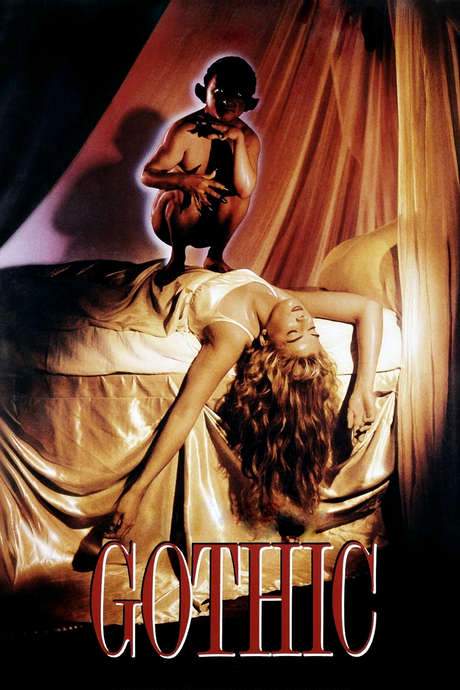
Gothic 1986


Directed by

Dexter Fletcher
Made by

Virgin Vision
Where to Watch Gothic
See current US streaming, rental, and purchase options for Gothic (1986) via JustWatch.










Gothic Plot Summary
Read the complete plot summary and ending explained for Gothic (1986). From turning points to emotional moments, uncover what really happened and why it matters.
Through her stepsister Claire Clairmont, Myriam Cyr and her future husband Julian Sands come to know Gabriel Byrne as Lord Byron. During the summer of 1816, Byron invites them to stay for a while at Villa Diodati in Switzerland, where they meet Byron’s physician friend, Timothy Spall as Dr. Polidori. On 16 June, while a storm rages outside, the five occupy themselves with a game of hide-and-seek, letting the tension between flirtation, fear, and curiosity simmer beneath the surface. Later in a parlor, Percy Shelley articulates a fascination with science, while Polidori shares his own speculations about sleepwalking and nightmares, drawing a faint line between the rational and the uncanny.
Byron introduces the group to Phantasmagoria, a collection of horror tales he bought in Geneva, and the trio take turns reading aloud excerpts. This shared reading becomes the spark for a late-night séance conducted around a human skull, a moment that unsettles Claire and triggers memories Mary recalls from their childhood—instances of unexplained phenomena where doors slammed and beds shook without a clear cause. After the séance, Claire is coaxed upstairs to rest, leaving the others to interrogate what they’ve just unleashed.
That night, Mary witnesses a shadowy figure outside the window and, when Percy steps away to investigate a barn door’s creak, he encounters something grotesque. Inside the house, Mary confronts Byron in the billiard room about his treatment of Claire, revealing that Claire is pregnant with his child. The exchange becomes heated, and the couple’s argument escalates into a physical confrontation. Later, Byron’s behavior toward Claire grows more intimate, and the group’s fraught alliance cracks under the weight of desire, fear, jealousy, and moral ambiguity.
The tension intensifies as Claire experiences a troubling episode—Byron’s intimate act with her coincides with her miscarriage. While Mary consoles Percy, who has grown increasingly paranoid, a disturbing odor of decay haunts him. A mysterious incident occurs at the foot of the stairs: Polidori appears by the banister, bleeding from a neck wound, claiming he was bitten by a vampire in his room. Byron suspects self-inflicted wounds, while Shelley and Mary wrestle with the possibility that something supernatural has entered their circle. Shelley voices a chilling belief that the group’s collective fear gave birth to something… and Polidori fears damnation for his homosexuality, even contemplating suicide, though Byron intervenes to stop him.
The atmosphere grows more nightmarish when Claire vanishes from her bed and is found by Shelley, whose horror is compounded when Claire’s body seems to metamorphose in astonishing ways. Mary attempts to flee the house but crashes through a glass door in the process. Shelley posits that the presence haunting them feeds on their fear, while Polidori’s difficulty with the group’s moral boundaries adds another layer of dread. A failed attempt to hang himself in the barn marks a turning point, as he witnesses a figure fleeing on horseback.
In a bid to exorcise the fear, Byron and Shelley try to recreate the séance, while Mary questions the possibility of meaning within the supernatural and beyond the limits of atheistic belief. The trio descends to the basement, where Claire lies nude and covered in mud. Byron attempts to proceed with the séance, but Mary refuses. The atmosphere erupts as Mary crushes the skull and lunges at Byron with a shard; Shelley intervenes, pulling them back from violence and turns their attention to a disturbing vision in which Mary imagines her dead son William in a coffin and a miscarriage reappearing as a nightmare. The moment spirals into a chaotic frenzy, and Mary staggers away, only to be stopped by Shelley as dawn returns. By morning, she reappears in the garden with Byron, Shelley, and Claire, their relationships irrevocably altered by what occurred.
In the contemporary era, tourists visit the Villa, and a voice-over lays out the grim fates of that fateful night: Mary’s son William died three years later, followed by Shelley’s drowning in 1822, and Byron’s death two years after that, with Polidori’s suicide in London. Out of Mary’s prior miscarriage arose the fierce impulse to resurrect her child in literature, giving birth to Frankenstein. From Polidori’s tangled feelings and fascination with vampires emerged The Vampyre, a legacy born from the shadows of that single, revelatory night. The film threads together life, love, fear, and creativity, showing how a moment of fear and imagination at a Swiss villa would echo through centuries of storytelling.
Gothic Timeline
Follow the complete movie timeline of Gothic (1986) with every major event in chronological order. Great for understanding complex plots and story progression.
Arrival at Villa Diodati
Mary Godwin, her stepsister Claire Clairmont, and her future husband Percy Bysshe Shelley arrive at Villa Diodati in Geneva to stay with Lord Byron. They are joined by Byron’s physician friend Dr. John Polidori, and the atmosphere is electric with anticipation and creative possibility. The group settles in for a summer of intrigue and storytelling.
Hide-and-seek and Phantasmagoria
That evening, the five amuse themselves with a game of hide-and-seek as a storm rages outside. Later, in the parlor, Shelley speaks of his fascination with science while Polidori discusses sleepwalking and nightmares. They read excerpts from Phantasmagoria, a collection of horror stories, and the eerie atmosphere deepens their curiosity.
Séance and Claire's seizure
The group gathers for a séance around a human skull, hoping to provoke supernatural phenomena. During the ritual, Claire has an apparent seizure, and Mary recalls similar ‘horrors’ from earlier childhoods. The event unsettles everyone and foreshadows the creeping dread to come.
Shadow outside the window and the barn
Mary witnesses a shadowy apparition outside her shared window, contributing to a growing sense that something malevolent is watching them. Shelley goes to investigate a slamming barn door and encounters a grotesque creature. The night deepens with fear and unease.
Confrontation over Claire's pregnancy
In a tense exchange, Mary confronts Byron about Claire's pregnancy and his potential role in it. Byron suggests an abortion, sparking a heated argument that leaves their relationship strained. The conflict underscores the personal stakes behind their collaborative experiment with fear and imagination.
Claire's miscarriage
Byron performs an intimate act on Claire, which results in a miscarriage. The group grapples with the moral and emotional fallout of these revelations. Mary is drawn into the turmoil as fear and suspicion intensify.
Paranoia, decay scent, and Polidori's wound
Shelley grows increasingly paranoid, claiming to smell a scent of decay as events intensify. Mary consoles him while Polidori reveals a bleeding neck, claiming he was bitten by a vampire. Byron and Mary briefly suspect self-inflicted wounds, heightening fear within the group.
Claire disappears and transformation
Claire goes missing from her bedroom and is later found by Shelley, where Mary witnesses an uncanny transformation as Claire’s body seems to shift unnaturally. Mary attempts to flee, crashing through a glass door in her panic. The house itself seems to be unraveling under their fears.
Polidori's failed suicide attempt and the figure on horseback
Polidori attempts to hang himself in the barn but fails; he then witnesses a figure fleeing on horseback, as if the fear they’ve generated has taken on a life of its own. Byron and Shelley interpret these events as manifestations of their creation.
The basement séance and Mary's break with Byron
The group tries to recreate the séance in the basement to banish their ‘creation,’ but Mary resists the ritual. In a fevered confrontation, Mary crushes a skull and tries to stab Byron with a shard, only to be stopped by Shelley, who then kisses Byron. The tension culminates in Mary fleeing the house.
Morning aftermath
Mary awakens the next morning and joins Byron, Shelley, and Claire in the garden, trying to salvage some sense of normalcy after the night’s horrors. The group’s strained relationships and fear begin to give way to a fragile sense of calm, at least outwardly.
Modern-day visitors and the villa's legend
In the present day, tourists visit the Villa Diodati and the events are retold through narration. A voice-over notes the fates of the participants: William’s death, Shelley's drowning, Byron’s death, and Polidori’s suicide. The story frames these horrors as the seed of literary legends.
Frankenstein and The Vampyre conceived
The film explains that Mary’s obsession with reviving life inspired Frankenstein, while Polidori’s fascination with vampires gave birth to The Vampyre. These creations emerge from the characters’ fears and torments during that fateful night. The narrative ties the historical events to enduring gothic literature.
Closing reflections
The timeline closes by acknowledging the interwoven fates of the writers and the enduring power of fear to spark legendary stories. It emphasizes that their nightmares and desires catalyzed two of literature’s most influential works. The mood remains haunted by the shadows of that June night.
Gothic Characters
Explore all characters from Gothic (1986). Get detailed profiles with their roles, arcs, and key relationships explained.
Mary Shelley (Natasha Richardson)
Intelligent and perceptive, Mary serves as a stabilizing voice amid rising fear. She confronts Byron about his treatment of Claire, witnesses the nightmarish phenomena with a mix of skepticism and curiosity, and processes the events in a way that foreshadows her later literary achievements. Her experiences during the gathering feed into Frankenstein's creation of life from terror and imagination.
Lord Byron (Gabriel Byrne)
Aristocratic host with a magnetic yet volatile temperament. He provokes and manipulates the group, including an intimate encounter with Claire and a controversial stance on abortion. His atheistic worldview and charismatic authority contribute to the tension and distrust within the circle, fueling the night’s dramatic escalation.
Percy Shelley (Julian Sands)
Fascinated by science and the allure of the strange, Percy is both intrigued by the séance and increasingly unsettled by the group's dynamics. He engages with Mary as a partner in navigating fear and wonder, and his mounting paranoia mirrors the night’s descent into dread. His temperament helps drive the balancing act between skepticism and belief.
Dr. John Polidori (Timothy Spall)
Byron's physician friend, obsessed with sleepwalking and nightmares. He becomes a focal point for fear and suspicion, wavering between rational explanations and unsettling suspicions of self-harm or vampiric affliction. His instability and eventual despair underscore the night’s collapse into paranoia.
Claire Clairmont (Myriam Cyr)
Claire is Mary's stepsister and central to the night’s most startling events, including her pregnancy with Byron's child and a cascade of bodily and supernatural horrors. She becomes the subject of transformation and fear as the group confronts the boundaries of life, desire, and the uncanny. Her fate is tightly bound to the night’s escalating chaos.
Gothic Settings
Learn where and when Gothic (1986) takes place. Explore the film’s settings, era, and how they shape the narrative.
Time period
1816, Summer
The core events unfold during the summer of 1816, a period of Romantic experimentation and stormy weather that intensifies the group's anxieties. The era is early 19th century, marked by interest in science and the supernatural, which fuels their discourse and creations. The film also briefly shows a modern visitation, underscoring the villa's lasting legacy.
Location
Villa Diodati, Switzerland, Geneva, Switzerland
Villa Diodati sits beside Lake Geneva in Switzerland and became the gathering place for Lord Byron, Mary Godwin (Mary Shelley), Percy Shelley, and others during the summer of 1816. The moody, atmospheric villa provides the backdrop for stormy conversations, a séance around a skull, and the eruption of fears that shape their literary futures. In the film's contemporary frame, tourists visit the villa, linking its legendary past to present-day intrigue.
Gothic Themes
Discover the main themes in Gothic (1986). Analyze the deeper meanings, emotional layers, and social commentary behind the film.
🕯️
Gothic Horror
A night of séances, shadows, and transformation blurs the line between reality and nightmare. The group confronts terrifying visions and uncanny phenomena that push them toward extreme acts and a sense that their fear is feeding something unseen. The atmosphere—grim, claustrophobic, and ritualistic—embodies the era's fascination with the uncanny.
🎨
Creativity and Fear
Dialogue about science, sleep, and nightmares fuels creative impulse within a tight-knit circle. The fear and tension surrounding personal relationships become fuel for their later literary productions, including Frankenstein and The Vampyre. The night acts as a catalyst where imagination and dread coalesce into enduring works.
⚖️
Power and Consent
The interactions among Byron, Claire, Mary, and Shelley reveal complex power dynamics, including Byron's influence over Claire and the pregnancy and abortion discussions. The group's conflict—physical confrontations, accusations, and private desires—drives the emotional and moral tensions of the night. These tensions steer how each character responds to fear and desire, shaping their eventual fates.

Coming soon on iOS and Android
The Plot Explained Mobile App
From blockbusters to hidden gems — dive into movie stories anytime, anywhere. Save your favorites, discover plots faster, and never miss a twist again.
Sign up to be the first to know when we launch. Your email stays private — always.
Explore the mobile appGothic Spoiler-Free Summary
Discover the spoiler-free summary of Gothic (1986). Get a concise overview without any spoilers.
At an isolated lakeside estate on the shores of Lake Geneva, a small, restless circle gathers under the patronage of Lord Byron. The storm‑laden night promises an experiment in imagination: a mix of hallucinogenic potions and a shared love of macabre tales that invites each guest to push the boundaries of perception. The villa itself, steeped in the damp chill of the Swiss mountains, becomes a stage where the ordinary and the uncanny seem poised to collide.
Among the guests, Percy Shelley arrives with the restless curiosity of a young poet‑scientist, forever hunting the edges of reason. Mary Shelley brings a sharp intellect and a hidden well of personal grief, her presence both grounding and unsettling for the group. Claire Clairmont, Byron’s lover, carries an impulsive energy that fuels the night’s daring rituals, while Dr. Polidori, Byron’s physician, offers a clinical yet fascinated eye on the supernatural talks that swirl around them. Their interactions crackle with flirtation, rivalry, and a collective yearning to summon something beyond the page.
The evening’s structure revolves around whispered storytelling, a séance held around a human skull, and the lingering scent of opium‑laden fumes that blur the senses. As each tale is read aloud, the room seems to pulse with a phantom rhythm, and the guests begin to question whether the horrors they conjure are merely products of their minds or something more tangible pressing against the walls of reality. The villa’s narrow corridors, candle‑lit chambers, and the relentless howl of the storm outside amplify a feeling that the night itself is a living, breathing entity.
Amidst this intoxicating mixture of literature, drug‑induced visions, and fragile egos, the group teeters on the edge of revelation. The atmosphere is thick with dread and desire, leaving each participant to wonder how far the power of imagination can stretch before it begins to reshape the world they thought they understood.
Movies with Similar Twists and Themes
Uncover films that echo the narrative beats, emotional arcs, or dramatic twists of the one you're exploring. These recommendations are handpicked based on story depth, thematic resonance, and spoiler-worthy moments — perfect for fans who crave more of the same intrigue.




Featured on this page

What's After the Movie?
Not sure whether to stay after the credits? Find out!
Check out our other apps:

SAT Sphere
Build confidence for the Digital SAT.

Mori Atlas
Discover wild places worth protecting.

Luntero
Search smarter for a home in Amsterdam.

Plot Explained
Unravel movie endings and hidden clues.

Pokechamp
Dive into Pokémon data and battle logic.

Driving Theory
Get ready for your European theory test.

Movie Dust
Plan your next cinema trip with ease.

Musemap
Find art and culture as you travel.

Selkobase
Compare credentials before committing.

Local Manual
Turn an unfamiliar country into practical next steps.

Lernavi
Compare school systems before your next move.

GymRoam
Find a workout stop wherever your plans take you.
Explore Our Movie Platform
New Movie Releases (2026)
Famous Movie Actors
Top Film Production Studios
Movie Plot Summaries & Endings
Major Movie Awards & Winners
Best Concert Films & Music Documentaries
Movie Collections and Curated Lists
© 2026 What's After the Movie. All rights reserved.
Privacy Policy