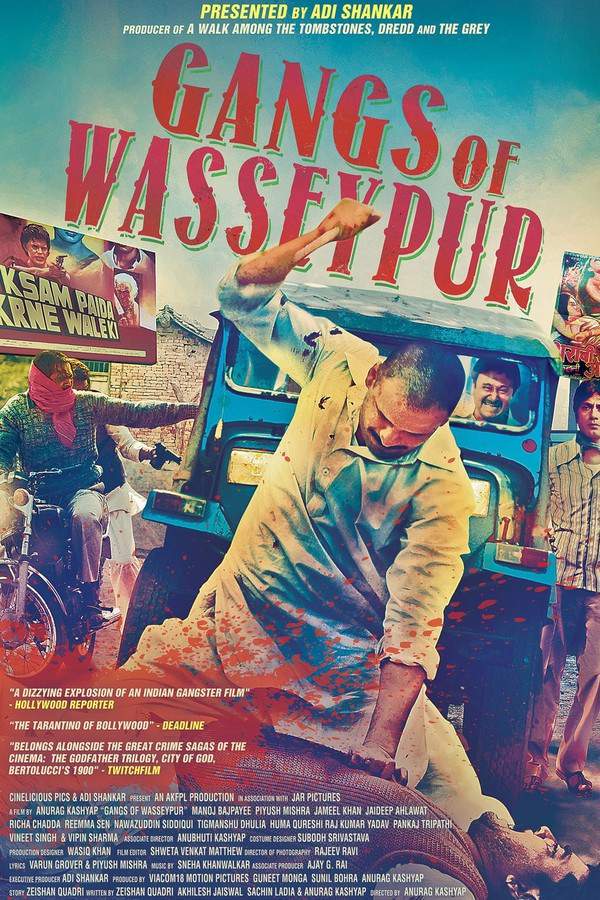
Gangs of Wasseypur 2015

Directed by

Anurag Kashyap
Made by

Cinelicious Pics
Gangs of Wasseypur Plot Summary
Read the complete plot summary and ending explained for Gangs of Wasseypur (2015). From turning points to emotional moments, uncover what really happened and why it matters.
Set against the waning days of colonial rule and the rise of industrial power in India, the tale unfolds in and around Dhanbad and the neighboring village of Wasseypur, where land, loyalty, and vengeance collide in a decades-spanning saga. In 1941, a Pashtun named Shahid Khan is banished from Wasseypur for impersonating a Qureshi hero who robbed ferry trains, and his family resettles in Dhanbad. There, Shahid returns to the mines and creates a life around the coal industry. After his wife dies in childbirth, Shahid’s grip tightens in a brutal moment of violence when he murders the muscleman who refused him leave that day. The scene foreshadows a world where might often rises where law falters.
As India gains independence, the old imperial mines pass into Indian hands, reshaping the local balance of power. Ramadhir Singh hires Shahid as the new muscle in the area, having received some mines in Dhanbad himself. Yet Shahid’s ascent unsettles Ramadhir, who sees in his rival a threat to his own control. To eliminate that threat, Ramadhir arranges Shahid’s murder through an assassin, Yadav. In the wake of these power moves, Ehsaan Qureshi is sent to watch over Shahid’s family, yet only his son, Sardar, survives the onslaught. The boy grows up carrying the weight of truth he eventually learns about his father and the vow he makes to avenge the murder.
The mid-1960s bring a shift in the political landscape as Ramadhir Singh moves into local politics, becoming a formidable workers’ leader. In 1972, the coal mines are nationalised, and Ramadhir escalates his ruthlessness by ordering the assassination of a Coal India official who dares to interfere with his business. His reputation for fearsome measures expands across Dhanbad. Meanwhile, Sardar marries Nagma Khatoon, and together they have three sons: Danish, Faizal, and Babua (Perpendicular). Nagma understands her husband’s volatile libido and permits him to sleep with other women. In a twist of loyalties, Sardar, his cousin Asgar, and Nasir begin working for Ramadhir’s son, but they secretly rob a petrol pump and a train bogie belonging to the Singh family. When Sardar and Asgar are jailed, Ramadhir realises that his target might still be alive.
In 1979, Sardar and Asgar escape from prison. Seeking refuge in Wasseypur at the home of Qamar Makhdoomi, Sardar marries his cook, Durga. The 1980s see Wasseypur merge with Dhanbad, intensifying a clash between the Qureshi clan and others in the area. The Qureshis, led by Sultan (the nephew of Sultana), continue to terrorise non-Qureshi Muslims, prompting Makhdoomi to seek help. This leads to a bold bombing campaign against Qureshi shops and houses, a strike that cements Sardar’s growing aura of fear and authority. He even returns to Nagma, who becomes pregnant again, but a mix of frustration and ambition drives him back to Durga, who gives birth to his fourth son, Definite.
As Sardar’s influence peaks, Ramadhir aligns with Sultan to consolidate power. Sultan asks Ramadhir for modern automatic weapons, and an uneasy alliance forms around the promise of arms. By 1989, the landscape has shifted: coal theft has become a petty crime, money flows elsewhere, and Sardar quits the coal trade to take on a contract to fill defunct mines in Dhanbad. He also pushes the Qureshi clan out of Wasseypur, redirecting his business toward iron ore. An elder Danish joins the family enterprise, signaling the expansion of the clan’s reach. In a bid to secure guns, Faizal is sent to Varanasi, only to be jailed; upon release, he kills the gun seller Yadav, unwittingly avenging his grandfather’s murder. On the peacekeeping side, Danish convinces Badoor Qureshi, uncle to Sultan, to step back from the blood feud and end the open war between their clans, even as he marries Shama Parveen, Sultan’s sister, despite the latter’s attempts to prevent it.
The romance between Faizal and Mohsina Hamid, another relative of Sultan, adds a personal thread to the volatile politics of the region. In a moment of recklessness, while high on marijuana, Faizal reveals to his friend Fazlu that his father would be traveling without security the next day. Fazlu leaks this information to the Qureshi camp, who track Sardar’s car the following day. The ambush proves decisive: Sardar is shot multiple times and dies after a hail of gunfire, marking a brutal, public end to a man who built a dynastic power through fear, ambition, and relentless family loyalty.
Gangs of Wasseypur Timeline
Follow the complete movie timeline of Gangs of Wasseypur (2015) with every major event in chronological order. Great for understanding complex plots and story progression.
British seizure of Dhanbad farmland to start coal mining
During colonial rule, the British seize farmland in the Dhanbad area to establish coal mining. The move creates early tensions between local communities and mining interests. It also seeds a landscape where future feuds will play out over control of resources.
Shahid Khan banished from Wasseypur
In 1941, Shahid Khan is banished from Wasseypur for impersonating a Qureshi hero who robbed ferry trains. His exile compels his family to relocate to Dhanbad, setting in motion a cycle of revenge. The incident marks the beginning of Shahid’s long shadow over the region.
Shahid settles in Dhanbad and murders a muscleman
Shahid begins work in a coal mine in Dhanbad after his move. Following his wife’s death in childbirth, he violently murders the muscleman who refused him leave that day. The murder cements his reputation and triggers retaliatory violence.
Shahid becomes Ramadhir’s muscle; Ramadhir orders his murder
After India gains independence and mines change hands, Shahid is hired as the new muscle by Ramadhir Singh, who owns mines in Dhanbad. Realizing Shahid’s ambitions threaten his power, Ramadhir has him murdered by an assassin named Yadav. The killing removes a wildcard and sets Sardar on a path of retribution.
Ehsaan Qureshi assigned to Shahid’s family; Sardar survives
Ehsaan Qureshi is sent to care for Shahid’s family, but Shahid’s son Sardar survives the murder plot. The survivor grows up amid a climate of violence and clan loyalties that will shape his future actions. The protective attention also entwines the Qureshi family with ongoing power struggles.
Ramadhir enters politics
In 1965, Ramadhir enters local politics and becomes a powerful workers’ leader. His ascent blends political authority with ruthless business acumen, enabling him to control local economics. This political rise will later intersect with Sardar’s family saga.
Mines nationalised; Ramadhir’s power grows; Coal India official killed
By 1972, coal mines are nationalised, consolidating state control but also intensifying rivalries. Ramadhir’s ruthless tactics intensify as he orders the assassination of a Coal India official who interferes with his business. His growing ruthlessness makes him feared across Dhanbad.
Sardar marries Nagma Khatoon; three sons are born
An older Sardar marries Nagma Khatoon, and together they have three sons: Danish, Faizal, and Babua. Nagma knows of Sardar’s hyperactive libido and tolerates his indiscretions while maintaining the family’s stability. The growing clan will become central to the coming feuds.
Sardar’s crew robs petrol pump and train bogie; jailed
Sardar, his cousin Asgar, and Nasir start working for Ramadhir’s son but secretly rob a petrol pump and a train bogie belonging to the Singh family. They are jailed for their crime, but Ramadhir realizes that Sardar is not dead and remains a potential threat. The incident deepens the animosity between clans.
Jailbreak and new alliance: Durga enters Sardar’s life
In 1979, Sardar and Asgar escape from jail and hide in Wasseypur at Qamar Makhdoomi’s home. Sardar then marries his cook, Durga, marking a new personal alliance that strengthens his influence. This period signals a shift in Sardar’s personal sphere as he consolidates power.
The 80s: Wasseypur’s power erupts into open conflict
During the 80s, Wasseypur merges with Dhanbad, and the Qureshi clan continues to terrorize non-Qureshi Muslims. Makhdoomi asks Sardar for help, triggering a major bomb attack on Qureshi shops and houses. Sardar’s response earns him fear and wider influence in the region.
Sardar consolidates power and shifts to iron ore
As Sardar’s clout grows, he quits coal and secures a contract to fill defunct mines, expanding into iron ore theft. He pushes the Qureshis out of Wasseypur and brings his family deeper into the lucrative underworld. Danish joins the family business, signaling a durable multi-generational empire.
Faizal travels to Varanasi; guns bought and Yadav killed
Faizal travels to Varanasi to buy guns, is jailed briefly, and upon release kills the gun seller Yadav, unwittingly avenging his grandfather’s murder. The act cements the next generation’s direct involvement in vengeance politics. The family’s criminal footprint expands beyond traditional coal interests.
Sardar’s downfall: Mohsina, Fazlu, and the ambush
Meanwhile, Faizal courts Mohsina Hamid, a relative of Sultan, even as Fazlu informs the Qureshis of Sardar’s movements. The next day, Sardar’s car is tracked and he is shot multiple times, dying amid the escalating cycle of retribution. The Sardar era ends as the feud’s next generation continues the cycle of violence.
Gangs of Wasseypur Characters
Explore all characters from Gangs of Wasseypur (2015). Get detailed profiles with their roles, arcs, and key relationships explained.
Shahid Khan
A Pashtun banished from Wasseypur in 1941 for impersonating a Qureshi hero. His family resettles in Dhanbad where Shahid begins work in a coal mine. After his wife dies in childbirth, he murders the muscleman who refused him leave that day, setting off a violent feud that echoes across generations.
Ramadhir Singh
A ruthless local power broker who becomes a political leader in the coal belt. He has Shahid murdered to secure his own position, later leveraging alliances and fear to expand influence into Dhanbad’s mining world.
Sardar
The surviving son of Shahid, who grows into a formidable patriarch with a dangerous blend of charisma and ruthlessness. He builds a sprawling power base through mining, theft, and political influence, becoming feared in Wasseypur and beyond.
Nagma Khatoon
Wife of Sardar, aware of his libido and the complexity of his numerous affairs. She oversees family dynamics as their three sons—Danish, Faizal, and Babua—are raised within a world of loyalty, conflict, and ambition.
Faizal
Son of Sardar who travels to purchase guns, is jailed, and upon release kills gun seller Yadav, unwittingly avenging his grandfather Shahid Khan’s murder.
Danish
Older son who joins the family enterprise as the clan’s power expands and shifts, contributing to the evolving balance of violence and wealth.
Durga
Sardar’s wife, whom he marries while hiding in Wasseypur at Qamar Makhdoomi’s home; she later bears a son with Sardar during these turbulent times.
Definite
The fourth son of Sardar and Durga, born amid the ongoing power struggles and symbolizing the continuing lineage of the family’s empire.
Yadav
An assassin hired to murder Shahid Khan; later becomes a gun seller killed by Faizal, an event that fuels the cycle of revenge.
Asgar
Sardar’s cousin who collaborates with Ramadhir’s faction, involved in early robberies that intensify the clan conflict.
Nasir
Alioth with Asgar and Sardar as they work for Ramadhir’s men, taking part in robberies that disrupt both clans and set the stage for larger feuds.
Qamar Makhdoomi
A host in Wasseypur who provides shelter to Sardar and, during this period, Sardar marries Durga, consolidating bonds within the community.
Gangs of Wasseypur Settings
Learn where and when Gangs of Wasseypur (2015) takes place. Explore the film’s settings, era, and how they shape the narrative.
Time period
1941–1989
The narrative spans from Shahid Khan's banishment in 1941, through India's independence and coal mine nationalisation in 1972, to the late 1980s. It tracks how political ambition, crime, and family loyalties shape a violent, enduring conflict in a transforming region.
Location
Wasseypur, Dhanbad, Jharkhand, India
Wasseypur sits within the coal-rich belt of Dhanbad, a setting where mining profits fuel clan rivalries. The area blends traditional village networks with the growth of industrial labor and commerce. Its streets host a fierce power struggle that ripples through families and communities.
Gangs of Wasseypur Themes
Discover the main themes in Gangs of Wasseypur (2015). Analyze the deeper meanings, emotional layers, and social commentary behind the film.
🗡️
Power and Revenge
Ambition drives characters to seize control of mines and territory, while murders trigger cycles of retaliation. The pursuit of power is fuelled by fear, strategic alliances, and calculated betrayals.
👪
Family and Loyalty
Family ties anchor loyalties and shape rivalries across generations. Fathers, sons, uncles, and cousins navigate duty, honor, and survival within a world where bloodlines determine influence.
💰
Crime and Wealth
Wealth grows from the coal economy and opportunistic theft, turning crime into a major engine for power. Illicit deals and coercion redefine social hierarchies and neighborhood fortunes.
🏭
Industrial Legacy
Colonial extraction gives way to post-independence industrial growth and nationalisation, expanding opportunities for exploitation. Mines and related industries become the backbone of political and criminal influence.

Coming soon on iOS and Android
The Plot Explained Mobile App
From blockbusters to hidden gems — dive into movie stories anytime, anywhere. Save your favorites, discover plots faster, and never miss a twist again.
Sign up to be the first to know when we launch. Your email stays private — always.
Explore the mobile appGangs of Wasseypur Spoiler-Free Summary
Discover the spoiler-free summary of Gangs of Wasseypur (2015). Get a concise overview without any spoilers.
In the dust‑laden coal belts of Dhanbad, a town where the roar of mining machines masks whispers of power, a simmering rivalry roots itself in the very soil. The film opens with the 1940s, a period when the British have carved out the landscape for coal extraction, and a band of locals wrestle with the new order. Within this crucible, Shahid Khan arrives as a charismatic outlaw whose presence rattles the fragile balance between the community and the emerging industrial elite. His ambition sets the stage for a legacy that will echo through generations, framing a tale of two families locked in an unrelenting struggle for dominance.
The story follows his son, Sardar, who inherits more than a name—he inherits a burning drive to carve his own path amid the shifting sands of post‑Independence India. As the mines transition from foreign hands to Indian owners and later to state control, the town’s power structures evolve, pulling the families into increasingly tangled alliances and betrayals. The atmosphere is thick with smoky corridors, bustling markets, and dimly lit taverns where loyalties are tested and ambitions flare. A gritty realism permeates every scene, underscored by a soundtrack that fuses folk rhythms with a modern edge, giving the narrative a raw, unapologetic pulse.
Against this backdrop, the film paints a portrait of masculinity, honor, and the intoxicating lure of authority. The characters move through a world where every decision can reshape the social fabric, and the line between protector and oppressor blurs. The tone oscillates between brutal honesty and darkly comic relief, inviting the audience to feel the weight of history while being drawn into the intimate, volatile dynamics of a community forever changed by coal, conflict, and the relentless pursuit of power.
Featured on this page

What's After the Movie?
Not sure whether to stay after the credits? Find out!
Check out our other apps:

SAT Sphere
Build confidence for the Digital SAT.

Mori Atlas
Discover wild places worth protecting.

Luntero
Search smarter for a home in Amsterdam.

Plot Explained
Unravel movie endings and hidden clues.

Pokechamp
Dive into Pokémon data and battle logic.

Driving Theory
Get ready for your European theory test.

Movie Dust
Plan your next cinema trip with ease.

Musemap
Find art and culture as you travel.

Selkobase
Compare credentials before committing.

Local Manual
Turn an unfamiliar country into practical next steps.

Lernavi
Compare school systems before your next move.

GymRoam
Find a workout stop wherever your plans take you.
Explore Our Movie Platform
New Movie Releases (2026)
Famous Movie Actors
Top Film Production Studios
Movie Plot Summaries & Endings
Major Movie Awards & Winners
Best Concert Films & Music Documentaries
Movie Collections and Curated Lists
© 2026 What's After the Movie. All rights reserved.
Privacy Policy