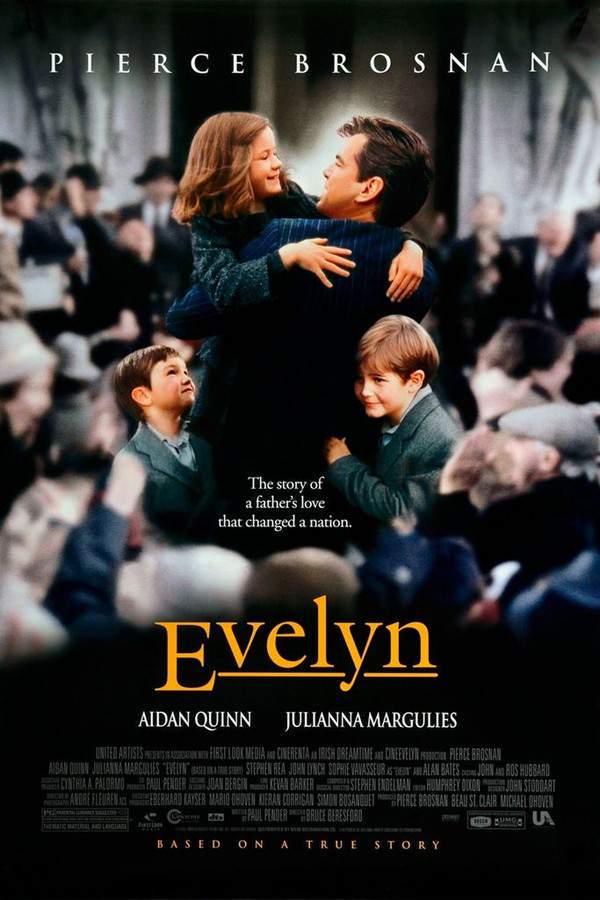
Evelyn 2002


Directed by
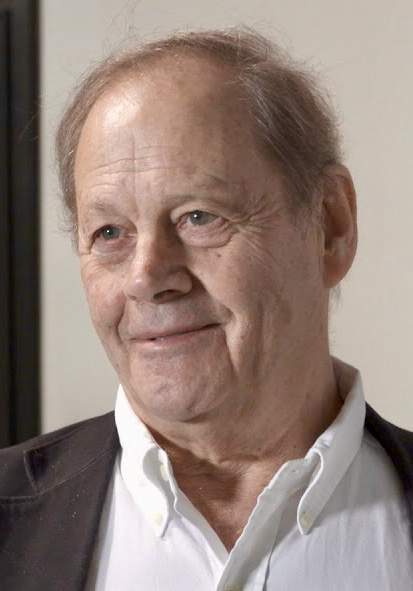
Bruce Beresford
Made by

United Artists
Where to Watch Evelyn
See current US streaming, rental, and purchase options for Evelyn (2002) via JustWatch.

fuboTV
HD
MGM Plus Roku Premium Channel
HD
MGM+ Amazon Channel
HD
Philo
HD
Hoopla
SD
YouTube Free
HD
Amazon Video
SD
Apple TV Store
HD
Fandango At Home
HD
Google Play Movies
SD
YouTube
SD Streaming availability powered by 
Evelyn Plot Summary
Read the complete plot summary and ending explained for Evelyn (2002). From turning points to emotional moments, uncover what really happened and why it matters.
Nine-year-old Evelyn Doyle and her two brothers, Maurice and Dermot, become motherless when their mother leaves their alcoholic, out-of-work father, Desmond Doyle [Pierce Brosnan]. A judge decrees that a child cannot be raised in a broken home, and the siblings are sent to church-run orphanages to be cared for by those institutions. Desmond, though present in spirit, struggles to secure a future for his children as he fights against mounting odds and a system that seems set against him.
Evelyn’s grandfather accompanies her to the girls’ orphanage and explains a hopeful superstition he calls the “angel rays”—lanes of sunlight breaking through the clouds that symbolize a guardian watching over her. But the reality inside the orphanage is stern and harsh, with older residents bearing the brunt of strict discipline and a sense that many have lived there for years. The atmosphere is far from welcoming, and Evelyn feels the weight of being separated from her brothers and the life she once knew.
Desmond fights to regain custody, leaning on the help of Bernadette, a part-time bartender and chemist who works with his case. Desmond finds occasional decorating jobs and spends his nights singing for tips at the pub where Bernadette works. When a letter from Evelyn reveals she has not adjusted well and that Sister Brigid has beaten her for questioning authority, Desmond confronts the sister in a moment of rage, threatening violent retaliation if she ever harms his daughter again. This confrontation marks a turning point as Desmond begins to confront his own temper and the broader forces stacked against him. Julianna Margulies portrays Bernadette, whose steadfast support becomes crucial as Desmond tries to rebuild his life.
Legal allies appear in the form of Nick Barron, an American, and Thomas Connolly, a lawyer with a rebellious streak, who argue Desmond’s plea to regain custody. Their efforts meet stiff opposition in the courts, and the initial verdict denies Desmond his children, leaving the family fractured and hoping for a change in fortune. Yet a gambler’s intervention forces a desperate turn of events, and Connolly proposes a bold legal strategy: argue that the persistent lack of parental custody contravenes the Irish Constitution—a novel issue that the Supreme Court has never confronted successfully.
Public pressure builds as the new argument is prepared, and Desmond’s case receives a hearing at the highest court. In his testimony, Desmond speaks with quiet conviction about his love for his children, while Evelyn is called to testify as well. In court, Evelyn admits she previously lied about her bruises to protect Sister Brigid; she also shares that she had once stood by her story, but now reveals the truth. A moment of grace arrives when rays of light stream through the courtroom windows, which Evelyn interprets as her grandfather watching over her. In that moment, the courtroom witnesses her with a mix of sympathy and laughter as she prays, > “God is merciful,” therefore God would not want Sister Brigid to beat the children for forgetting Scripture.
The verdict follows a powerful public and legal response: two of the three judges side with Desmond, and the children are returned to his custody. Desmond, moved by the turn of events, acknowledges his love for Bernadette as they begin to envision a shared future for their now-reunited family. The film closes on a Christmas Day scene that highlights the new sense of unity and hope—a family restored, and a father determined to protect and provide for his children with the support of those who stood by him.
Evelyn Timeline
Follow the complete movie timeline of Evelyn (2002) with every major event in chronological order. Great for understanding complex plots and story progression.
Mother leaves the Doyle household
Desmond Doyle's wife abruptly leaves, leaving him to care for three children. When a mother-in-law reports the situation, a judge orders the children into church-run orphanages. The family is suddenly fractured as the kids are separated from their father.
Children enter church-run orphanages
The children are placed in harsh church-run orphanages where comforts are scarce and discipline is strict. Evelyn, Maurice, and Dermot confront crowded dormitories and an environment where many girls have already been there for years. The separation marks the start of a long, anxious wait for reunification.
Grandfather escorts Evelyn to the girls' orphanage and explains angel rays
Evelyn's grandfather takes her to the girls' orphanage and explains that rays of light through clouds are signs of a guardian angel watching over her. Evelyn senses a glimmer of hope even as she steps into the austere new world. The idea of angel rays becomes a brief beacon amid the hardship.
Desmond's custody bid fails; life spirals toward drink
Desmond discovers he cannot regain custody because he cannot afford a lawyer and his situation remains unstable. He begins taking decorating jobs and singing for tips at the pub where Bernadette works, trying to stabilize the family finances. He also seeks help from Bernadette's brother, Michael, who insists he get his act together before any legal aid is possible.
Desmond confronts Sister Brigid during Evelyn's retrieval
Desmond goes to the orphanage to retrieve Evelyn and confronts Sister Brigid after learning of mistreatment. He shakes the Sister and threatens to tear her limb from limb if she ever harms his daughter again, signaling a dangerous escalation. The confrontation reveals his fierce protective resolve.
Desmond's relapse and Bernadette ends the relationship; he reforms
Desmond briefly returns to drinking, prompting Bernadette to end their relationship until he shapes up. He begins to show progress by taking decorating jobs and performing at the pub where Bernadette works. The personal struggle becomes a turning point toward rebuilding a stable life.
Gambler rigs Desmond to win money for legal bills
That same night Desmond quits drinking, a gambler rigs him to win copious money to pay mounting legal fees. The supposed windfall offers a glimmer of hope but rests on shady maneuvering. The episode underscores how desperation can drive risky shortcuts.
Connolly proposes constitutional challenge to custody
Thomas Connolly proposes taking a novel legal path: arguing that depriving a parent of custody contravenes the Irish Constitution. The idea reframes the case as a landmark constitutional issue rather than a straightforward family dispute. The plan gains momentum among Desmond's supporters and legal allies.
Public pressure drives the case toward a hearing
Public advocacy and media attention build momentum, creating pressure for the case to be heard before the Supreme Court. The rising visibility galvanizes supporters and puts the spotlight on the constitutional argument. The atmosphere shifts from a private family fight to a national issue.
Desmond gives a compelling courtroom testimony
Desmond delivers a persuasive testimony about his love for his children and his determination to provide for them. His account resonates with the judges and the public gallery. The testimony becomes a pivotal moment in the legal battle.
Evelyn recants her earlier story; angel rays appear
The following day, Evelyn admits that she previously held to a false bruised-face story to avoid trouble for Sister Brigid. She grows animated as ‘angel rays’ shine through the courtroom windows, signaling to her that her guardian grandfather is watching over her. Her responses draw sympathetic chuckles from the audience as she speaks openly.
Judges side with Desmond; the children are returned
Two of the three judges rule in Desmond's favor, acknowledging the strength of his case. The children are eventually returned to his custody, and a relieved Desmond expresses his love for Bernadette. The moment marks a dramatic reversal in their fate.
Family celebrates together on Christmas Day
Desmond, Bernadette, and the children celebrate their restored family on Christmas Day. The film closes with a hopeful vision of a united household and a new beginning for all of them. The holiday scene underscores the triumph of family bonds over hardship.
Evelyn Characters
Explore all characters from Evelyn (2002). Get detailed profiles with their roles, arcs, and key relationships explained.
Desmond Doyle
The children's father, initially a heavy drinker who fights to regain custody of his kids. He demonstrates fierce love, eventually reforms, and delivers a powerful courtroom testimony that helps win back his family.
Evelyn Doyle
Nine-year-old Evelyn endures harsh conditions in the orphanage but maintains hope. She questions authority, testifies in court, and sees a sign of guardian protection in the ‘angel rays’ that appear in the courthouse.
Maurice Doyle
One of Evelyn’s brothers who, like his sister, faces separation and hardship as the family fights for custody.
Dermot Doyle
The younger Doyle brother who accompanies his sister through the custody battle, sharing the family’s trials and dreams of a stable home.
Bernadette
A supportive figure who works at the pub; she encourages Desmond to reform and eventually forms a close bond with him and the family.
Sister Brigid
The strict nun who enforces discipline in the orphanage and is cited as beating a child for perceived rule-breaking.
Father O'Malley
The priest involved in the family’s fight against the harsh treatment in the orphanages; he clashes with Desmond during the custody dispute.
Michael
A solicitor who helps Desmond outline a plan to regain custody, but requires Desmond to get his life in order first.
Nick Barron
An American involved in the narrative who influences the events surrounding Desmond's case.
Thomas Connolly
A rebellious lawyer who proposes a constitutional argument that the lack of parental custody contravenes the Irish Constitution, a novel move in the case.
Grandfather Doyle
Evelyn’s grandfather who brings her to the girls’ orphanage and later witnesses the family’s eventual reunion.
Evelyn Settings
Learn where and when Evelyn (2002) takes place. Explore the film’s settings, era, and how they shape the narrative.
Time period
1950s
Takes place in the early 1950s Ireland, a time when Catholic influence pervaded everyday life and institutional authorities controlled child custody. The era's conservative social climate framed the stakes of each decision, from beatings in the orphanages to courtroom battles for family unity. Public interest and constitutional questions elevate a personal custody case into a wider debate about parental rights.
Location
Ireland
The film is set in mid-20th century Ireland, where church-run orphanages and a rigid legal framework shape family life. Orphanages and religious institutions reflect the era's social norms, while the courts determine custody outcomes. The setting highlights the tension between parental love, religious authority, and state power in ordinary Irish life.
Evelyn Themes
Discover the main themes in Evelyn (2002). Analyze the deeper meanings, emotional layers, and social commentary behind the film.
🏠
Family
A central thread is the Doyle family's commitment to stay together despite abandonment and hardship. Desmond's struggle to reunite with Evelyn and her brothers tests loyalty, poverty, and resilience. The children's love and hope anchor the family through separation and danger.
⚖️
Justice
The custody battle drives a legal drama, raising questions about the rights of parents versus the state's guardianship of children. The case moves through courts and culminates in a constitutional argument that challenges established norms. Public testimony and courtroom moments shape the outcome and the audience's view of justice.
✨
Hope
Angel rays symbolize a protective sign for Evelyn, underscoring the quiet hope that a family can endure and be restored. The characters cling to moments of faith and possibility amid hardship. The depiction suggests that hope can influence decisions as much as laws.
⛪
Religion
Religious institutions and figures play a potent role, from school discipline to the moral authority of the church. The story critiques how religious power can shape children’s lives and influence guardianship outcomes. Yet faith also provides a lens through which characters seek forgiveness, mercy, and reconciliation.

Coming soon on iOS and Android
The Plot Explained Mobile App
From blockbusters to hidden gems — dive into movie stories anytime, anywhere. Save your favorites, discover plots faster, and never miss a twist again.
Sign up to be the first to know when we launch. Your email stays private — always.
Explore the mobile appEvelyn Spoiler-Free Summary
Discover the spoiler-free summary of Evelyn (2002). Get a concise overview without any spoilers.
In post‑war Dublin, the city’s streets are still lit by the lingering shadows of conflict, a place where scarcity and hope move side by side. Against this stark backdrop, a father awakens to an empty home on Christmas Day, his wife having vanished without a trace. The sudden loss leaves him to shoulder the impossible task of caring for three young children, each clinging to the remnants of a once‑stable family. The atmosphere is one of quiet desperation, where the cold wind off the River Liffey mirrors the internal chill of unemployment and the looming threat of state intervention.
Desmond Doyle, a once‑steady laborer now reduced to menial jobs and nightly serenades in a local pub, is haunted by the prospect of losing his children to an indifferent bureaucracy. His fierce love for them is matched only by his frustration with a legal system that seems to favor institutional care over a father’s devotion. Adding a sliver of light to his struggle is Bernadette, a bartender‑chemist whose compassion and pragmatic spirit become an unexpected anchor. Their developing partnership hints at a fragile but resilient bond that could help him navigate the murky waters ahead.
The film’s tone balances the gritty realism of a city trying to rebuild with moments of understated optimism. The children’s world is framed by the harsh routine of orphanage life, yet the story is constantly reminded of a whispered superstition—“angel rays” breaking through clouds—that suggests an unseen guardianship. As winter deepens, the narrative teases the tension between personal sacrifice and societal expectation, inviting the audience to wonder whether love and determination can carve a path through the rigid structures of post‑war Irish society.
Movies with Similar Twists and Themes
Uncover films that echo the narrative beats, emotional arcs, or dramatic twists of the one you're exploring. These recommendations are handpicked based on story depth, thematic resonance, and spoiler-worthy moments — perfect for fans who crave more of the same intrigue.


Featured on this page

What's After the Movie?
Not sure whether to stay after the credits? Find out!
Check out our other apps:

SAT Sphere
Build confidence for the Digital SAT.

Mori Atlas
Discover wild places worth protecting.

Luntero
Search smarter for a home in Amsterdam.

Plot Explained
Unravel movie endings and hidden clues.

Pokechamp
Dive into Pokémon data and battle logic.

Driving Theory
Get ready for your European theory test.

Movie Dust
Plan your next cinema trip with ease.

Musemap
Find art and culture as you travel.

Selkobase
Compare credentials before committing.

Local Manual
Turn an unfamiliar country into practical next steps.

Lernavi
Compare school systems before your next move.

GymRoam
Find a workout stop wherever your plans take you.
Explore Our Movie Platform
New Movie Releases (2026)
Famous Movie Actors
Top Film Production Studios
Movie Plot Summaries & Endings
Major Movie Awards & Winners
Best Concert Films & Music Documentaries
Movie Collections and Curated Lists
© 2026 What's After the Movie. All rights reserved.
Privacy Policy