
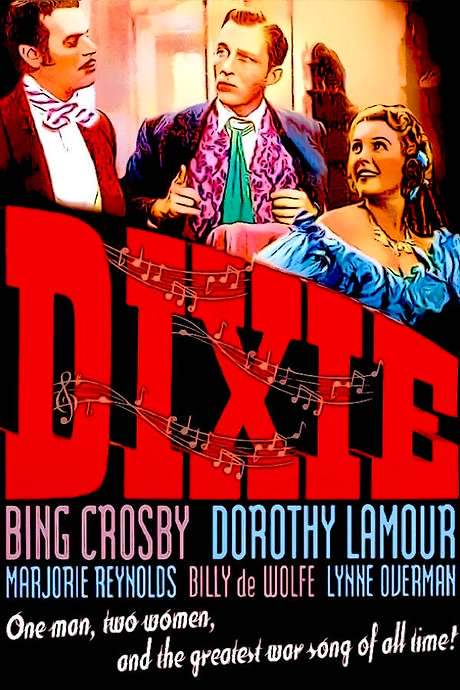


Dixie Plot Summary
Read the complete plot summary and ending explained for Dixie (1943). From turning points to emotional moments, uncover what really happened and why it matters.
Dan Emmett and Jean Mason sit beneath a spreading magnolia tree in the garden of her home as he sings “Sunday, Monday or Always.” The house behind them is ablaze, and though he hurries off to the fire station for help, the building burns to the ground. Jean’s angry father Mr. Mason blames the singer for leaving his pipe in the hall, and forbids Dan from seeing his daughter again. Dan explains that he hopes to marry Jean once he finds success as an actor and composer, but Mr. Mason, sure he will fail, will only consent to the marriage if Dan returns successful within six months.
Dan heads to New Orleans, and on a riverboat he performs, singing “Swing Low, Sweet Chariot.” He meets Mr. Bones who cheats him at cards and wins $500. After Bones leaves, Dan discovers the cards were faked; they meet again in New Orleans and he demands the money back. Bones denies cheating but offers to put him in his act. They can’t afford a meal; they are assaulted, and Bones leads him to the boarding house run by Mr. Cook and his daughter Millie Cook. Neither Bones nor two other boarders can pay their rent, and Millie refuses to let Dan stay until Mr. Cook intervenes; he tells him the manager of Maxwell Theatre has said Bones could try out his act that evening.
On the stage, the four perform; the other two boarders sing “Laughing Tony” to Bones, but he refuses to let them join the act. Dan reminds Bones of the promised place in the act; Bones insists that his act is a single, until Millie threatens to lock him in his room unless all four appear. She suggests that to cover their battered features they should use black make-up.
On stage, the four sing “Old Dan Tucker” and “The Last Rose of Summer” with minstrel-style patter, and Dan sings “She’s From Missouri.” They are successful, and Millie becomes attracted to Dan who, however, tells her about Jean. The act continues to do well and is enlarged to a twenty-four artist minstrel show, with Mr. Cook joining as the only white-faced member.
Although Dan is also attracted to Millie, he tells her he will remain loyal to Jean and Millie, in a fit of pique, agrees to marry Bones. The new minstrel show opens: the company sings “Minstrel Show” and “Buffalo Gals,” while Dan sings “A Horse That Knows the Way Back Home.” At a celebration supper, Dan and Millie make up their quarrel, but the sound of fire bells and a burning theatre, caused by Dan’s pipe, puts them all out of a job.
Dan returns to his home-town to find that Jean has been stricken with paralysis and will never walk again. He insists on going through with the marriage, and they travel to New York City. In New Orleans, Bones again asks Millie to marry him, and they learn that the theatre will be repaired in three weeks’ time. When Dan sings his new song, “If You Please,” to Jean, she suggests that he tries to sell his songs, but a publisher refuses “Dixie” when Dan sings it for him. He manages, however, to sell ten other songs for 100 dollars, but refuses to part with “Dixie” when he is offered only one dollar for it.
Mr. Cook arrives and tells Jean of Dan’s success in New Orleans, inadvertently revealing the situation between Millie and Dan. Cook urges Dan to return to New Orleans and join a new show of forty artists; when Jean supports this plea, Dan agrees. On their arrival in New Orleans, Millie is still angry with Dan until she sees that Jean is an invalid.
The new Minstrel Show is booked into the Opera House for three months, but when “Dixie” is sung by one of the minstrels, it is not well received. Jean suggests that it should be played at a quicker tempo, but Dan disagrees. Jean, under the impression that Dan is in love with Millie, tells her servant, Lucius, to place a letter of farewell in Dan’s dressing room. The show proceeds, and Dan and the company sing “Sunday, Monday or Always” while the minstrels sing “She’s From Missouri”; Millie, backstage, tells Bones that she will marry him that night and breaks the news to Jean.
On stage, Dan and the company sing “Dixie” while his pipe, once again left lying around, starts a fire. As the tempo of the song speeds up, the entire audience joins in the rousing chorus. The fire burns Dan’s dressing room and Jean’s valedictory letter.
Dixie Timeline
Follow the complete movie timeline of Dixie (1943) with every major event in chronological order. Great for understanding complex plots and story progression.
Garden moment and the fire
Dan and Jean sit beneath a magnolia tree as he sings. A fire breaks out at Jean's house, and Dan rushes to the firehouse for help, but the home is burned to ashes. Jean's angry father blames Dan for leaving his pipe in the hall and forbids the couple from seeing each other.
Father imposes a six-month challenge
Jean's father confronts Dan about the disaster, blaming him for the tragedy. Dan vows to marry Jean once he becomes successful as an actor and composer, but Mason challenges him with a six-month deadline to prove his worth.
Dan travels to New Orleans and is cheated
Dan leaves for New Orleans to pursue his dreams. On a Mississippi river boat, he sings 'Swing Low, Sweet Chariot' and is cheated by Mr. Bones in a card game, losing $500. He later learns the cards were faked and vows to confront Bones when they next meet in New Orleans.
Boarding house and the audition opportunity
Bones takes Dan to the boarding house run by Mr. Cook. The other tenants can't pay the rent, and Millie initially refuses to let Dan stay until Mr. Cook arranges an audition with the Maxwell Theatre's manager that evening.
Audition night and makeup
The four boarders perform on stage, with the other two initially sidelined. Millie threatens to lock Bones in his room unless all four appear. They decide to cover their battered faces with black makeup and perform as a four-person act, opening with 'Old Dan Tucker' and 'The Last Rose of Summer', followed by Dan's solo 'She's From Missouri'.
Minstrel show grows and loyalties form
The act expands into a twenty-four-artist minstrel show, with Mr. Cook joining as the only white-faced member. Dan remains loyal to Jean despite an attraction to Millie, while Millie, in a moment of pique, agrees to marry Bones.
Openings and a fire interrupts
The new minstrel show opens and features songs like 'Minstrel Show' and 'Buffalo Gals' as Dan sings 'A Horse That Knows the Way Back Home'. During a celebration supper, a fire breaks out because of Dan's pipe, forcing them to lose the theatre job.
Return home to Jean's paralysis
Dan returns to his hometown to find Jean paralyzed and unable to walk. He decides to marry her and the couple travels to New York City; meanwhile Bones pursues Millie in New Orleans as they await repairs to the theatre.
Songs and publishing odds in New Orleans
In New Orleans, Bones asks Millie to marry him again; they learn the theatre will be repaired in three weeks. Dan sings 'If You Please' to Jean and attempts to sell his songs; a publisher refuses 'Dixie' but Dan sells ten other songs for $100 and refuses to part with 'Dixie'.
Mr. Cook calls Dan back
Mr. Cook informs Jean of Dan's success in New Orleans and reveals the situation with Millie. He urges Dan to return to New Orleans and join a new show of forty artists.
Forty-artist minstrel show and opera bound
The new minstrel show, featuring about forty artists, is booked into the Opera House for three months, marking a major step in Dan's career. Jean stands by Dan as he embarks on this new chapter.
Final performance and the fire
During the finale, the company performs 'Dixie' as Dan's pipe, left on stage, starts a fire. The tempo of the song accelerates and the audience joins in, but the fire burns Dan's dressing room and destroys Jean's valedictory letter.
Dixie Characters
Explore all characters from Dixie (1943). Get detailed profiles with their roles, arcs, and key relationships explained.
Dan Emmett (Daniel Decatur Emmett) — played by Bing Crosby
A talented, ambitious songwriter and performer who dreams of success in New Orleans and beyond. He navigates love, loyalty, and professional rivalries as he forms a minstrel act. Dan values his craft and fiercely defends his songs, notably resisting pressure to part with 'Dixie' until the right moment.
Millie Cook — Dorothy Lamour
A determined boarding-house owner who becomes a catalyst in Dan's rise to fame. She is practical, protective, and uses her wit to support the troupe, while also grappling with her feelings for Dan and her own ambitions.
Jean Mason — Marjorie Reynolds
Dan's first love whose paralysis reshapes his priorities. She embodies loyalty and resilience, supporting Dan's career while facing personal hardship. Jean's illness anchors the emotional stakes of Dan's choices.
Mr. Mason — Grant Mitchell
Jean's protective father who doubts Dan's reliability and imposes a test: prove success within six months or lose permission to marry. He represents parental authority and the social obstacles facing artists seeking approval.
Mr. Cook — Raymond Walburn
Owner of the boarding house where Dan and the troupe stay. He intervenes to help secure an audition, and his household becomes a springboard for the minstrel venture.
Mr. Bones — Billy De Wolfe
An opportunistic performer who initially cheats Dan but eventually becomes part of the minstrel act. His presence drives conflict and comedic tension within the troupe.
Waiter — Fortunio Bonanova
A minor but memorable figure in the theatre world who is part of the odds-and-ends cast surrounding the main act. He adds to the film's bustling show business atmosphere.
Mr. Deveraux — Olin Howland
A supporting character who interacts with Dan on the journey, contributing to the actor's development and the troupe's dynamics.
Riverboat Captain — James Burke
Helps move the minstrel troupe along the river circuit, a key setting for early performances and the spread of Dan's songs.
Dixie Settings
Learn where and when Dixie (1943) takes place. Explore the film’s settings, era, and how they shape the narrative.
Time period
Mid-19th century
Set in the era of minstrel shows before and around the Civil War, the film follows aspiring performers as they chase success and navigate social expectations. It captures the Southern entertainment circuit and the touring life of 19th-century performers. The music and performances reflect the era’s popular stage culture and its lasting legacy in American folk music.
Location
Jean Mason's garden, New Orleans, Maxwell Theatre, Opera House, riverboat, New York City
The story starts in a family garden, then moves through the bustling entertainment hubs of New Orleans. Key locations include the Maxwell Theatre and later an Opera House where minstrel shows thrive. The troupe travels by riverboat between venues, with at least one stop in New York City shaping the wider scope of the performance circuit.
Dixie Themes
Discover the main themes in Dixie (1943). Analyze the deeper meanings, emotional layers, and social commentary behind the film.
🎭
Ambition
Dan pursues recognition as an actor and composer, leaving his hometown to seek success. The minstrel troupe’s rise hinges on persistence, talent, and the willingness to navigate rough beginnings. Ambition drives both his personal and artistic decisions throughout the story.
❤️
Love and Loyalty
Romance threads through Dan's loyalty to Jean and his evolving relationship with Millie. The characters wrestle between romantic interest and steadfast commitment, testing loyalties as opportunities and obstacles arise. The emotional stakes are tied to the fate of their careers and personal futures.
🔥
Minstrelsy and Social Context
Minstrel shows form the spine of the plot, depicting a historical entertainment form that carries complex racial and cultural implications. The production relies on stage patter, makeup, and musical numbers, inviting reflection on representation in 19th-century performance. The fire and high-stakes performances heighten the drama around talent, fame, and the era’s social dynamics.

Dixie Spoiler-Free Summary
Discover the spoiler-free summary of Dixie (1943). Get a concise overview without any spoilers.
In the bustling crossroads of the post‑Civil War United States, a hopeful Kentucky songwriter sets out on a journey that promises fame, music, and the restless energy of a nation in transition. Dan Emmett carries with him the raw talent of a young composer and a burning desire to turn his melodies into a legacy, dreaming that a single tune could capture the spirit of an entire South. The story opens with his departure from the quiet hills of his home, chasing the alluring promise of the river‑bound stages of New Orleans and the bright, unforgiving lights of New York’s publishing houses.
The world he steps into is a kaleidoscope of riverboats, lively taverns, and glittering minstrel stages where song and showmanship blend into a vibrant tapestry of American entertainment. Along the way, Jean appears as a steadfast love whose support anchors his ambitions, while the charismatic yet mischievous performer Mr. Bones offers both camaraderie and a taste of the unpredictable side of show business. In the boarding houses run by the practical Mr. Cook and his bright‑spirited daughter Millie, Dan finds a makeshift family, each character adding a distinct hue to his musical odyssey. The tone is lively and slightly mischievous, punctuated by exuberant musical numbers that celebrate both the joy of creation and the challenges of the rising entertainment industry.
At the heart of the tale lies Dan’s attachment to his most treasured composition: the anthem “Dixie.” This song becomes both his signature and his bargaining chip as he navigates the cut‑throat world of publishers who are eager to profit from his talent. Torn between the lure of commercial success and the personal significance of his masterpiece, Dan must strike a balance while nurturing the relationships that inspire him. The film blends humor, romance, and spirited performances, inviting the audience to feel the pulse of an era where music could launch a dream—or become a hard‑won compromise.
Movies with Similar Twists and Themes
Uncover films that echo the narrative beats, emotional arcs, or dramatic twists of the one you're exploring. These recommendations are handpicked based on story depth, thematic resonance, and spoiler-worthy moments — perfect for fans who crave more of the same intrigue.



Featured on this page

What's After the Movie?
Not sure whether to stay after the credits? Find out!




Explore Our Movie Platform
New Movie Releases (2026)
Famous Movie Actors
Top Film Production Studios
Movie Plot Summaries & Endings
Major Movie Awards & Winners
Best Concert Films & Music Documentaries
Movie Collections and Curated Lists
© 2026 What's After the Movie. All rights reserved.