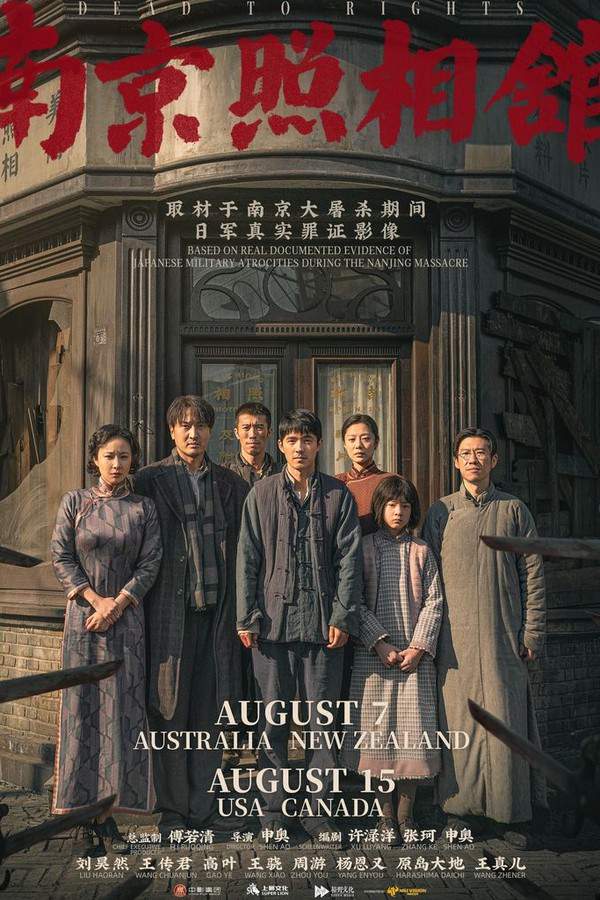
Dead to Rights 2025

Directed by

Ao Shen

Where to Watch Dead to Rights
See current US streaming, rental, and purchase options for Dead to Rights (2025) via JustWatch.

Fawesome
HD
Kanopy
HD
Fandango at Home Free
HD
Plex
HD
Plex Channel
HD
Tubi TV
SD
Xumo Play
HD
Amazon Video
HD
Apple TV Store
HD Fandango At Home
HD
Google Play Movies
SD
YouTube
SD Streaming availability powered by 
Dead to Rights Plot Summary
Read the complete plot summary and ending explained for Dead to Rights (2025). From turning points to emotional moments, uncover what really happened and why it matters.
The film unfolds against the brutal backdrop of the Japanese occupation of Nanjing during the Second Sino-Japanese War, where violence, fear, and survival collide in a city under siege. In the center of this turmoil is a web of intimate choices and dangerous alliances. A Chinese quisling translator, Wang Guanghai, becomes a pivotal figure by enabling the occupying power to tighten its grip on the city. His personal life is strained by an affair with Lin Yuxiu, an opera performer who navigates the occupation by performing for the soldiers and by clinging to fragile slips of dignity. Wang’s cunning plan is simple but morally complex: secure extra passports for Lin so she can escape with him, even as the marriage he maintains to appear loyal to his country is stretched to the breaking point.
Chuan-jun Wang plays the opportunistic translator Wang Guanghai, who wields his position to influence who can leave and who must stay. Meanwhile, the Japanese assign a calculated photographer, Ito Hideo, to chronicle the massacre as propaganda. Ito’s initial orders push him toward brutal displays of loyalty—he even orders the execution of a civilian to prove his devotion. His path crosses with Ah Chang, a postman who carries photographs and quickly becomes entangled in a game of photographic deception. Ah Chang’s resourcefulness keeps him one step ahead as he partners with others to preserve damning evidence of the brutality while trying to survive.
Daichi Harashima as Ito Hideo, a man whose professional veneer begins to crack as he discovers a hidden world beneath the official images. He is drawn to the studio where Jin Chengzong and his family shelter from the horror, and where Lin’s loyalties—both to survival and to her fellow Chinese—are tested. Xiao Wang as Jin Chengzong helps anchor the group, using a quiet courage to shield his wife, his child, and the others who seek safety in a small, hidden space. You Zhou as Song Cunyi enters the story through a crucial act of courage: a man smuggled into the studio who becomes a lifeline for the group, risking his own safety to keep others alive.
As the hidden inhabitants work to survive, Lin Yuxiu becomes a central figure whose courage under pressure reveals the human cost of the occupation. Ye Gao brings Lin’s resolve to life, including the moment she is forced to perform in harrowing conditions and the later decision to protect a hidden soldier, Song Cunyi. The group’s improvised darkroom becomes a battlefield of ethics as Ah Chang, Jin, Lin, Song, and the others steadily develop and duplicate photographs that reveal the true extent of the massacre. The early negatives present a fabricated harmony, but deeper processing uncovers scenes of executions, burnings, mutilations, and assaults. The group quietly duplicates and hides these misrepresented images to preserve evidence of the crimes.
The tension within the studio mounts as Ito’s loyalty to the regime hardens and he moves toward increasing brutality. The pursuit of safety and the fear of discovery drive each character toward drastic choices. Wang, ever watchful for opportunity, makes threats to maintain control, while the others cling to a fragile plan that might secure their lives but not their souls. As the occupation persists and Japanese forces face setbacks, the pressure to reveal or destroy hiding spots intensifies. Ito secures another photographer to press the operation, and when Song acts to protect the group, he pays a steep price.
A pivotal moment comes when Itō devises a way to develop the photos himself and orders the group to dispose of Ah Chang. The decision leads to a tragic confrontation in which Itō’s violence is finally challenged. The group decides to cast lots for who will take the remade passports—meant to facilitate escape—only to discover that Itō has sabotaged the plan: the passports are marked to be a death sentence for anyone who uses them. Jin’s wife and daughter ultimately win the opportunity to go with the passports, but the moment of escape is crushed when the guards, tipped off by Itō, shoot and rape Lin and her companions. The studio erupts into a deadly confrontation in which Wang is killed, Itō’s plan unravels, and Jin wounds the superior with acid as chaos erupts around them.
In the ensuing struggle, Ah Chang defends Lin and the others as Itō reappears with renewed violence. The group escapes the studio, aided by Jin’s decisive sacrifice: he allows Lin, their infant son, and the others to reach the Nanjing Safety Zone. They escape into the night with Itō’s plan seemingly shattered, only to discover that their earlier deception has a broader impact: they have sewn duplicates of the atrocity negatives into their clothes, and their films now reveal the truth to the world. The real negatives are disseminated to international journalists, triggering global condemnation and forcing the regime’s hand to confront the moral weight of its crimes. Itō, unable to erase his own complicity, commits harakiri, and a superior later ends his death to mask the truth as a “heroic” act.
In the wake of the war, the Nanjing Massacre’s architects face tribunals and punishment, but the truth has already begun to outpace them. Lin, now a mother, documents the executions of the regime’s leaders in the stark, unflinching style of the atrocities she once endured. The spirits of Ah Chang, Wang, Song, Jin, and countless others linger as the film closes, a quiet reminder that history itself bears witness to the past. The end credits showcase footage of real sites in modern-day Nanjing, with a hand holding up photographs taken at the same locations during the massacre, tying memory to place and time.
This sprawling, intimate drama uses its tightly wound interior to reveal a larger picture of war’s cruelty, resilience, and the stubborn human will to bear witness. It examines how individuals navigate moral lines under occupation, how art and photography can both document and distort the truth, and how a city scarred by violence seeks light through memory and justice.
Dead to Rights Timeline
Follow the complete movie timeline of Dead to Rights (2025) with every major event in chronological order. Great for understanding complex plots and story progression.
Nanjing falls under brutal occupation
Japanese forces decimate the city with mass killings, rapes, and looting as the occupation begins. Civilians are massacred in the streets while the city’s infrastructure collapses under the onslaught. The world will later learn of these crimes, but in the moment the massacre dominates every corner of Nanjing.
Wang Guanghai aligns with the Japanese to protect his family
Wang Guanghai becomes a quisling translator who helps the occupying forces maintain control over the city. He secures passports for his family as a means of survival, while engaging in an affair with Lin Yuxiu to strengthen the ruse. Lin’s position becomes entangled with war, loyalty, and personal risk.
Itō Hideo arrives to document the massacre
Japanese military photographer Itō Hideo is tasked with producing propaganda by capturing the horrors of the occupation. In a moment of cruelty, he orders an execution to prove his loyalty, then learns that a civilian named Ah Chang carries photographs of the events. This assignment sets the stage for a fragile alliance of survival and deception.
Ah Chang seeks refuge and a chance to develop the film
Ah Chang hides with Jin Chengzong and his family inside a photo studio, hoping to use the developing process as a cover for the dangerous photographs. The studio becomes a sanctuary and a front for counterfeiting reality through images. Itō’s presence adds a tense urgency to their covert operation.
Itō tests Ah Chang’s skill with the camera negatives
Itō hands Ah Chang a stack of negatives and watches him develop them on the spot to prove his reliability. The process is meticulous and nerve-wracking, as any mistake could reveal their secret. When Ah Chang handles the process well, Itō begins to trust him—just enough to press the bounds of their alliance.
The passport scheme expands: Lin joins the ruse
Wang declares that Ah Chang has a wife named Lin, using this claim to secure two passports. Lin is brought into the studio to live with Ah Chang as his wife, reinforcing the deception. They also hide Song Cunyi, a soldier, behind the scenes to bolster their chances of survival.
The group forms a fragile survival network
Lin reveals Song Cunyi to Ah Chang by opening her boxes and exposing the hidden survivor. The family, Song, and Ah Chang agree to cooperate, using the basement as a covert sanctuary while they slowly develop and duplicate the photographs. Trust is fragile as danger looms from every corner.
Propaganda vs. truth: the rolls reveal war crimes
The initial propaganda photographs are manipulations, but deeper processing uncovers true images of executions, burnings, mutilations, and assaults. The group begins secretly duplicating and hiding the authentic negatives. Itō’s outward humanity gives way to a chilling opportunism, as he collects the photos as souvenirs.
A brutal turning point: a killer introduces a new threat
Frustrated with quality and fearing exposure, Itō brings in another Japanese photo developer to handle the work. Song kills the newcomer during a trip outside the studio, a decisive act that raises the group's stakes. Wang's demeanor grows more desperate as Lin’s safety becomes paramount.
The passport ruse backfires; Lin and her family are threatened
Itō plans to dispose of Ah Chang but cannot bring himself to shoot him. The group votes to use the passports, but Itō has told guards that anyone using them would be shot on sight. This leads to a tragic moment where Lin and her infant daughter are killed and raped by the guards, a devastating consequence of the deception.
Violence erupts in the studio; a scramble for escape
Itō and his superior arrive, triggering a violent confrontation over Lin. Wang is shot by Itō, Jin kills the superior, and Itō is blinded by acid thrown by Jin. Ah Chang destroys his own negatives with a distraction, allowing the survivors to flee amid a burning studio.
A sacrifice and a narrow escape to safety
At the gate, the baby’s cry exposes the survivors. Jin sacrifices himself so Lin and the child can reach the Nanjing Safety Zone. The group goes on the run, concealing copies of war crime negatives on their clothes to survive the journey.
Itō’s end: suicide and a cover-up
Itō, humiliated by the failure to secure the footage, commits suicide by harakiri. A superior then shoots Itō in an apparent heroic death, attempting to rewrite the record and preserve the regime’s reputation. The truth of the photographs remains a perilous secret.
Post-war tribunals punish the massacre’s architects
After the war, the leaders and perpetrators behind the Nanjing Massacre are tried and sentenced to death. The world slowly reckons with the extent of the crimes and begins to seek accountability. The era’s consequences linger in courtrooms and memory.
Lin preserves the victims’ story and memory
Lin raises Jin’s son while photographing the executions of the architects in the style of the atrocity images. The spirits of Ah Chang, Wang, Song, Jin, and other victims appear in the memory of history, signaling that their stories endure. The film closes with footage of historical sites in modern Nanjing, linking past and present.
Dead to Rights Characters
Explore all characters from Dead to Rights (2025). Get detailed profiles with their roles, arcs, and key relationships explained.
Itō Hideo (Daichi Harashima)
A Japanese military photographer assigned to document the massacre. He begins with a veneer of civility but reveals a capacity for cruelty, participating in or endorsing atrocities to prove loyalty. He tests and ultimately manipulates the studio workers, and, after failing to prevent exposure of the truth, commits suicide rather than face accountability.
Wang Guanghai (Chuan-jun Wang)
A quisling translator who helps the Japanese consolidate control over Nanjing. He leverages fear and the promise of passports to pressure others, and he orchestrates dangerous ruses to secure benefits for his own family at the expense of others. His opportunism intensifies the danger faced by Lin and the studio group.
Lin Yuxiu (Ye Gao)
An opera actress who performs to survive under occupation and becomes romantically entangled with Wang. She proves loyalty to China by risking everything, including hiding Song Cunyi and revealing the existence of a family in the studio. She endures humiliation yet remains resilient as the group presses toward an escape.
Jin Chengzong (Xiao Wang)
A studio owner who uses his space for shelter and leverage, ultimately sacrificing himself to enable Lin and the infant to reach the Nanjing Safety Zone. He negotiates danger and death with quiet resolve, helping to keep the group alive long enough to pursue safety and justice.
Song Cunyi (You Zhou)
A hidden soldier smuggled into the studio who becomes a crucial ally. He commits to protecting the group and sacrifices himself by martyring during a mission, enabling others to survive within the studio’s fragility.
Ah Chang
The postman who lies to protect himself and helps develop the photographs, acting as a bridge between the studio and the outside world. His trust is betrayed, and he dies in the fire while trying to cover up the truth behind the negatives.
Jin Wanyi (Enyou Yang)
The infant son of Jin Chengzong who becomes the focus of the group’s survival plan. The quest to safeguard him drives the protagonists to accept dangerous risks and make difficult choices, culminating in a flight for safety with Lin.
Dead to Rights Settings
Learn where and when Dead to Rights (2025) takes place. Explore the film’s settings, era, and how they shape the narrative.
Time period
1937–1938
The events take place during the late 1930s when Japan's invasion of China culminates in the Nanjing Massacre. The film portrays the chaotic months of occupation, cold calculations for survival, and the attempt to document atrocities for global audiences. This period is defined by mass violence, censorship, and the international reaction to the crimes.
Location
Nanjing, China
Nanjing is depicted as a city under brutal occupation during the Second Sino-Japanese War. The story unfolds around a cramped photo studio that becomes a microcosm of survival amid killings, looting and public terror. The setting emphasizes the precarious line between life and death as civilians endure the occupation's violence.
Dead to Rights Themes
Discover the main themes in Dead to Rights (2025). Analyze the deeper meanings, emotional layers, and social commentary behind the film.
🩸
War Crimes
The narrative centers on the mass killings, sexual violence, and looting that accompany the occupation. It questions how easily photographs can be weaponized for propaganda and how survivors bear witness to atrocities. The film follows characters who navigate moral compromises to document and expose the crimes. It also contrasts the brutality of occupation with acts of courage and resistance.
📷
Propaganda & Photography
Images become currency in the occupation: the Japanese use photography to manufacture a narrative, while the studio crew fights to reveal the truth. The development process mirrors the manipulation of memory, blurring lines between truth and staged harmony. As negatives are discovered and duplicated, the group battles to ensure real events reach a wider world. The theme raises questions about responsibility of photographers and witnesses.
🛡️
Survival & Loyalty
In the face of terror, families and strangers form precar alliances to protect each other. Characters are forced to choose between loyalty to country, family, or their own survival, often at a heavy cost. The resolution hinges on whether they can preserve evidence of the crimes and reach safety. The narrative frames survival as both a personal and moral test.

Coming soon on iOS and Android
The Plot Explained Mobile App
From blockbusters to hidden gems — dive into movie stories anytime, anywhere. Save your favorites, discover plots faster, and never miss a twist again.
Sign up to be the first to know when we launch. Your email stays private — always.
Explore the mobile appDead to Rights Spoiler-Free Summary
Discover the spoiler-free summary of Dead to Rights (2025). Get a concise overview without any spoilers.
In the smoldering summer of 1937, Nanjing is a city caught in the grip of an occupying army, its streets layered with fear, whispers, and the stark contrast between public compliance and private defiance. The atmosphere is thick with the hum of military patrols, the clang of foreign boots on ancient stone, and the uneasy rhythm of ordinary life being forced to march to an alien drum. Within this tense tableau, the camera becomes both a tool of propaganda and a potential weapon—its lenses poised to capture truth or disguise it.
- A Chang*, a modest postman, finds himself thrust into a precarious double life. By day he presents himself as a humble photo developer, a role that grants him limited access to the occupiers’ bureaucratic machinery and a fragile veneer of trust. Beneath that façade, he quietly transforms his modest studio into a sanctuary, sheltering a handful of desperate refugees who have nowhere else to turn. The quiet clicks of shutter and the soft rustle of developing trays mask a deeper current of resistance, as every roll of film holds the possibility of exposing what the world is being kept from seeing.
The film’s tone balances the oppressive weight of occupation with moments of quiet humanity, letting the audience feel the strain of living under constant surveillance while highlighting the small acts of compassion that keep hope alive. The interplay between public compliance and secret rebellion drives the narrative tension, suggesting that even in the darkest corners of a city under siege, ordinary people can become custodians of truth.
Against this backdrop, A Chang’s covert operation teeters on a razor’s edge—any misstep could unravel the fragile safety of those he hides and jeopardize the very evidence he hopes to preserve. The story invites viewers to wonder how far one man will go when the ordinary duties of a postman intersect with the extraordinary responsibility of bearing witness.
Featured on this page

What's After the Movie?
Not sure whether to stay after the credits? Find out!
Check out our other apps:

SAT Sphere
Build confidence for the Digital SAT.

Mori Atlas
Discover wild places worth protecting.

Luntero
Search smarter for a home in Amsterdam.

Plot Explained
Unravel movie endings and hidden clues.

Pokechamp
Dive into Pokémon data and battle logic.

Driving Theory
Get ready for your European theory test.

Movie Dust
Plan your next cinema trip with ease.

Musemap
Find art and culture as you travel.

Selkobase
Compare credentials before committing.

Local Manual
Turn an unfamiliar country into practical next steps.

Lernavi
Compare school systems before your next move.

GymRoam
Find a workout stop wherever your plans take you.
Explore Our Movie Platform
New Movie Releases (2026)
Famous Movie Actors
Top Film Production Studios
Movie Plot Summaries & Endings
Major Movie Awards & Winners
Best Concert Films & Music Documentaries
Movie Collections and Curated Lists
© 2026 What's After the Movie. All rights reserved.
Privacy Policy