Dead to Rights 2025

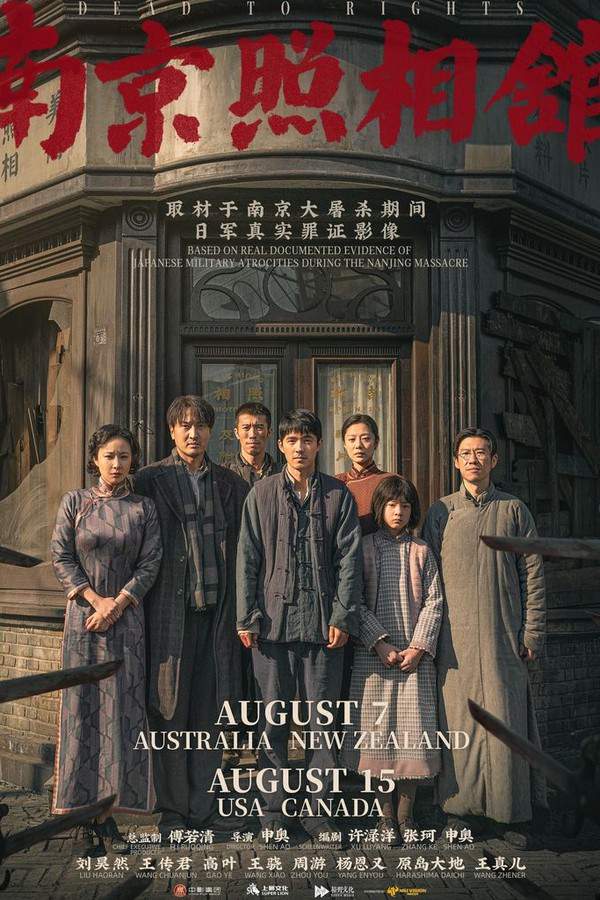
Set amid the 1937 Nanjing Massacre, postman A Chang masquerades as a photo developer, cooperating with Japanese troops while covertly sheltering Chinese refugees. He ultimately risks his life to evacuate them and expose photographic proof of the brutal atrocities.


Does Dead to Rights have end credit scenes?
No!
Dead to Rights does not have end credit scenes. You can leave when the credits roll.
Where to Watch Dead to Rights
See current US streaming, rental, and purchase options for Dead to Rights (2025) via JustWatch.

Fawesome
HD
Kanopy
HD
Fandango at Home Free
HD
Plex
HD
Plex Channel
HD
Tubi TV
SD
Xumo Play
HD
Amazon Video
HD
Apple TV Store
HD Fandango At Home
HD
Google Play Movies
SD
YouTube
SD Streaming availability powered by 
Meet the Full Cast and Actors of Dead to Rights
Explore the complete cast of Dead to Rights, including both lead and supporting actors. Learn who plays each character, discover their past roles and achievements, and find out what makes this ensemble cast stand out in the world of film and television.


External Links and Streaming Options
Discover where to watch Dead to Rights online, including streaming platforms, rental options, and official sources. Compare reviews, ratings, and in-depth movie information across sites like IMDb, TMDb, Wikipedia or Rotten Tomatoes.








Ratings and Reviews for Dead to Rights
See how Dead to Rights is rated across major platforms like IMDb, Metacritic, and TMDb. Compare audience scores and critic reviews to understand where Dead to Rights stands among top-rated movies in its genre.

The Movie Echo Score
In terms of overall impact, the film delivers a compelling portrayal of the Nanjing Massacre, balancing historical fidelity with emotional resonance. Reviewers consistently highlight the disciplined direction, strong performances, and effective use of archival material, which together create a sustained sense of gravity. The pacing is noted as fluid, allowing a two-hour runtime to feel brisk while maintaining narrative clarity. While the subject matter is inherently harrowing, the collective feedback suggests the film succeeds in informing and moving audiences without resorting to sensationalism.
The Movie Echo Score Breakdown for Dead to Rights

Art & Craft
The film’s art and craft receive consistent commendation, with critics noting disciplined direction and superb cinematography that capture the period’s visual texture. Production design is described as authentic, reinforcing the historical setting, while editing maintains a measured rhythm that supports narrative flow. Overall, the technical execution is regarded as a strong foundation for the film’s thematic goals.

Character & Emotion
Acting is repeatedly praised as nuanced and emotionally resonant, with reviewers highlighting the depth of both adult leads and the child performer. Performances are characterized as expert and on‑point, contributing to a character‑driven narrative that sustains audience engagement. The emotional authenticity noted across reviews suggests the cast effectively conveys the human dimension of the historical tragedy.

Story & Flow
The narrative is described as strong and fluid, with a plot that maintains coherence despite the weighty historical content. Reviewers comment on measured pacing that prevents the two‑hour film from feeling protracted, allowing engagement throughout. While the story adheres closely to documented events, its structured approach is seen as effective for conveying the tragedy’s scope.

Sensory Experience
Sound design and music receive positive remarks, with the haunting soundtrack cited as a complementary undercurrent to the visual narrative. Cinematography is praised for its sober aesthetic, contributing to an immersive atmosphere without excessive sensationalism. The overall sensory experience is therefore regarded as cohesive, reinforcing the film’s emotional and historical intentions.

Rewatch Factor
Audiences indicate a lasting impact, noting that the film remains thought‑provoking and emotionally resonant upon subsequent viewings. The disciplined storytelling and authentic visual style are highlighted as factors that encourage revisiting, while the historical relevance sustains its appeal over time. Consequently, the rewatch factor is assessed as strong, though the heavy subject matter may limit casual repeats.


%
TOMATOMETER

0%
User Score
Take the Ultimate Dead to Rights Movie Quiz
Challenge your knowledge of Dead to Rights with this fun and interactive movie quiz. Test yourself on key plot points, iconic characters, hidden details, and memorable moments to see how well you really know the film.
Dead to Rights (2025) Quiz: Test your knowledge of the 2025 film *Dead to Rights*, set during the Japanese occupation of Nanjing.
What occupation is the city of Nanjing under during the events of the film?
Full Plot Summary and Ending Explained for Dead to Rights
Read the complete plot summary of Dead to Rights, including all major events, twists, and the full ending explained in detail. Explore key characters, themes, hidden meanings, and everything you need to understand the story from beginning to end.
The film unfolds against the brutal backdrop of the Japanese occupation of Nanjing during the Second Sino-Japanese War, where violence, fear, and survival collide in a city under siege. In the center of this turmoil is a web of intimate choices and dangerous alliances. A Chinese quisling translator, Wang Guanghai, becomes a pivotal figure by enabling the occupying power to tighten its grip on the city. His personal life is strained by an affair with Lin Yuxiu, an opera performer who navigates the occupation by performing for the soldiers and by clinging to fragile slips of dignity. Wang’s cunning plan is simple but morally complex: secure extra passports for Lin so she can escape with him, even as the marriage he maintains to appear loyal to his country is stretched to the breaking point.
Chuan-jun Wang plays the opportunistic translator Wang Guanghai, who wields his position to influence who can leave and who must stay. Meanwhile, the Japanese assign a calculated photographer, Ito Hideo, to chronicle the massacre as propaganda. Ito’s initial orders push him toward brutal displays of loyalty—he even orders the execution of a civilian to prove his devotion. His path crosses with Ah Chang, a postman who carries photographs and quickly becomes entangled in a game of photographic deception. Ah Chang’s resourcefulness keeps him one step ahead as he partners with others to preserve damning evidence of the brutality while trying to survive.
Daichi Harashima as Ito Hideo, a man whose professional veneer begins to crack as he discovers a hidden world beneath the official images. He is drawn to the studio where Jin Chengzong and his family shelter from the horror, and where Lin’s loyalties—both to survival and to her fellow Chinese—are tested. Xiao Wang as Jin Chengzong helps anchor the group, using a quiet courage to shield his wife, his child, and the others who seek safety in a small, hidden space. You Zhou as Song Cunyi enters the story through a crucial act of courage: a man smuggled into the studio who becomes a lifeline for the group, risking his own safety to keep others alive.
As the hidden inhabitants work to survive, Lin Yuxiu becomes a central figure whose courage under pressure reveals the human cost of the occupation. Ye Gao brings Lin’s resolve to life, including the moment she is forced to perform in harrowing conditions and the later decision to protect a hidden soldier, Song Cunyi. The group’s improvised darkroom becomes a battlefield of ethics as Ah Chang, Jin, Lin, Song, and the others steadily develop and duplicate photographs that reveal the true extent of the massacre. The early negatives present a fabricated harmony, but deeper processing uncovers scenes of executions, burnings, mutilations, and assaults. The group quietly duplicates and hides these misrepresented images to preserve evidence of the crimes.
The tension within the studio mounts as Ito’s loyalty to the regime hardens and he moves toward increasing brutality. The pursuit of safety and the fear of discovery drive each character toward drastic choices. Wang, ever watchful for opportunity, makes threats to maintain control, while the others cling to a fragile plan that might secure their lives but not their souls. As the occupation persists and Japanese forces face setbacks, the pressure to reveal or destroy hiding spots intensifies. Ito secures another photographer to press the operation, and when Song acts to protect the group, he pays a steep price.
A pivotal moment comes when Itō devises a way to develop the photos himself and orders the group to dispose of Ah Chang. The decision leads to a tragic confrontation in which Itō’s violence is finally challenged. The group decides to cast lots for who will take the remade passports—meant to facilitate escape—only to discover that Itō has sabotaged the plan: the passports are marked to be a death sentence for anyone who uses them. Jin’s wife and daughter ultimately win the opportunity to go with the passports, but the moment of escape is crushed when the guards, tipped off by Itō, shoot and rape Lin and her companions. The studio erupts into a deadly confrontation in which Wang is killed, Itō’s plan unravels, and Jin wounds the superior with acid as chaos erupts around them.
In the ensuing struggle, Ah Chang defends Lin and the others as Itō reappears with renewed violence. The group escapes the studio, aided by Jin’s decisive sacrifice: he allows Lin, their infant son, and the others to reach the Nanjing Safety Zone. They escape into the night with Itō’s plan seemingly shattered, only to discover that their earlier deception has a broader impact: they have sewn duplicates of the atrocity negatives into their clothes, and their films now reveal the truth to the world. The real negatives are disseminated to international journalists, triggering global condemnation and forcing the regime’s hand to confront the moral weight of its crimes. Itō, unable to erase his own complicity, commits harakiri, and a superior later ends his death to mask the truth as a “heroic” act.
In the wake of the war, the Nanjing Massacre’s architects face tribunals and punishment, but the truth has already begun to outpace them. Lin, now a mother, documents the executions of the regime’s leaders in the stark, unflinching style of the atrocities she once endured. The spirits of Ah Chang, Wang, Song, Jin, and countless others linger as the film closes, a quiet reminder that history itself bears witness to the past. The end credits showcase footage of real sites in modern-day Nanjing, with a hand holding up photographs taken at the same locations during the massacre, tying memory to place and time.
This sprawling, intimate drama uses its tightly wound interior to reveal a larger picture of war’s cruelty, resilience, and the stubborn human will to bear witness. It examines how individuals navigate moral lines under occupation, how art and photography can both document and distort the truth, and how a city scarred by violence seeks light through memory and justice.

Coming soon on iOS and Android
The Plot Explained Mobile App
From blockbusters to hidden gems — dive into movie stories anytime, anywhere. Save your favorites, discover plots faster, and never miss a twist again.
Sign up to be the first to know when we launch. Your email stays private — always.
Explore the mobile appDiscover Film Music Concerts Near You – Live Orchestras Performing Iconic Movie Soundtracks
Immerse yourself in the magic of cinema with live orchestral performances of your favorite film scores. From sweeping Hollywood blockbusters and animated classics to epic fantasy soundtracks, our curated listings connect you to upcoming film music events worldwide.
Explore concert film screenings paired with full orchestra concerts, read detailed event information, and secure your tickets for unforgettable evenings celebrating legendary composers like John Williams, Hans Zimmer, and more.


Dead to Rights Other Names and Titles
Explore the various alternative titles, translations, and other names used for Dead to Rights across different regions and languages. Understand how the film is marketed and recognized worldwide.
Quick Links: Summary, Cast, Ratings, More

What's After the Movie?
Not sure whether to stay after the credits? Find out!
Check out our other apps:

SAT Sphere
Build confidence for the Digital SAT.

Mori Atlas
Discover wild places worth protecting.

Luntero
Search smarter for a home in Amsterdam.

Plot Explained
Unravel movie endings and hidden clues.

Pokechamp
Dive into Pokémon data and battle logic.

Driving Theory
Get ready for your European theory test.

Movie Dust
Plan your next cinema trip with ease.

Musemap
Find art and culture as you travel.

Selkobase
Compare credentials before committing.

Local Manual
Turn an unfamiliar country into practical next steps.

Lernavi
Compare school systems before your next move.

GymRoam
Find a workout stop wherever your plans take you.
Explore Our Movie Platform
New Movie Releases (2026)
Famous Movie Actors
Top Film Production Studios
Movie Plot Summaries & Endings
Major Movie Awards & Winners
Best Concert Films & Music Documentaries
Movie Collections and Curated Lists
© 2026 What's After the Movie. All rights reserved.
Privacy Policy