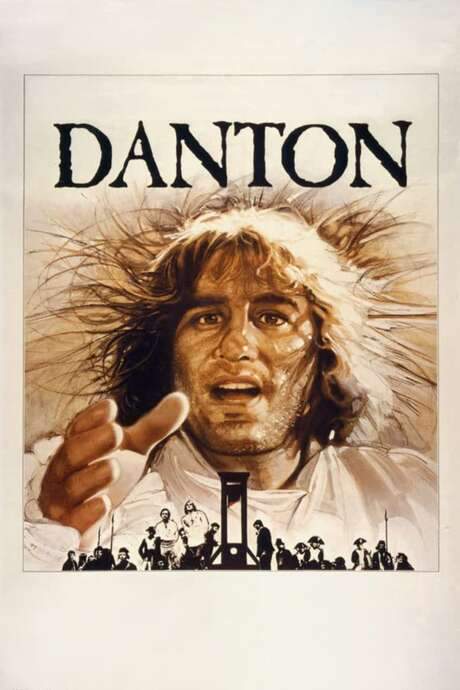
Danton 1983


Directed by

Patrice Chéreau
Made by

Gaumont
Where to Watch Danton
See current US streaming, rental, and purchase options for Danton (1983) via JustWatch.

Streaming availability powered by 
Danton Plot Summary
Read the complete plot summary and ending explained for Danton (1983). From turning points to emotional moments, uncover what really happened and why it matters.
Paris, spring 1794, and the Reign of Terror has the city under the watchful eye of fear, with scarce bread and rain-soaked queues that slow the daily grind. Robespierre, Wojciech Pszoniak, lies ill in a dim flat but remains deeply tuned to the currents of power outside his door. He watches Danton, Gérard Depardieu, ride back into the capital to thunderous public acclaim, his return feeding the hope of ordinary people who hunger not just for bread but for a voice they can trust. The pair occupy opposite ends of a widening political chasm, even as Robespierre’s own grip on the revolutionary project tightens around him.
Across town, the machinery of repression moves with cold efficiency. Héron, Alain Macé, head of the secret police, arrives to crush Desmoulins’ print shop, halting the flow of Le Vieux Cordelier’s pro‑Danton circulars. Camille Desmoulins, Patrice Chéreau, is furious at the blow to his publishing work and resists any attempt to be silenced, while his wife Lucile Desmoulins, Angela Winkler, pleads for calm and life for her husband. Robespierre, briefly cared for by his barber, is urged by his ally Saint-Just, Bogusław Linda, to move decisively against Danton. Yet Robespierre hesitates, not wanting to sacrifice the fragile balance he believes keeps the Republic intact, even as the Committee of Public Safety presses forward with its plan.
Before the day’s sitting of the National Convention, General Westermann, Jacques Villeret, and his supporters sketch a plan for a coup to topple Robespierre’s inner circle. Danton disapproves of any illegal venture, even as friends warn that Robespierre intends to jail him. Danton acts with a stubborn belief in the power of his newspaper and the people’s affection to shield him, and he asks his ally Bourdon, Andrzej Seweryn, to denounce Héron and the secret police in the Convention, a move that rattles the gauntlet of power and signals the widening rift between them.
That night, Danton invites Robespierre to an elaborate dinner, hoping to sway him, but Robespierre refuses to eat and presses for a candid talk. After Robespierre leaves, Danton encounters a group of armed men who turn out to be Westermann’s conspirators, though Danton refuses to join their illegal venture. With the pressure mounting, Robespierre makes a decisive move and travels to Desmoulins’ house, where he tries to persuade him that Danton is using him, a claim Desmoulins rejects. Desmoulins’ wife again begs for life, and Robespierre returns to the Committee with an order for the arrest of Danton, Desmoulins, Westermann and several associates, signaling a dramatic escalation in the struggle for control.
The next morning at the National Convention, outraged delegates confront Robespierre’s justification: Danton is branded an enemy of the Republic and must be tried, regardless of his popularity. Although Danton initially evades arrest, Bourdon shifts sides and supports Robespierre, broadening the coalition against him. In the Revolutionary Tribunal, the prosecutors’ task is hampered by Danton’s interruptions, which threaten the appearance of due process. Yet even as a fellow prisoner whispers with glee about Danton’s fate, the condemned men press on, hoping to sway jurors who seem reluctant to convict.
In the studio of Jacques-Louis David, Robespierre learns from Fouquier-Tinville, Roger Planchon, that Danton’s constant interruptions threaten to turn the trial into a farce. A decree follows: anyone who speaks out of turn will be removed from court, and within minutes the accused are ushered out as the verdict of guilt is read. The atmosphere tightens as the sense of inevitability settles on the proceedings; the public gaze weighs every gesture, every interruption, every breath.
On the eve of execution, Danton contemplates his own failure to protect the people he sought to champion, a weight thatoutweighs personal fear. The condemned are paraded through silent crowds to the scaffold and guillotined, and in the moment of their deaths Robespierre’s carefully maintained tension finally fractures. Saint-Just, Bogusław Linda, brings fresh encouragement, urging Robespierre toward dictatorship, but the leader recoils in horror, recognizing that a dictatorship would erase the very democracy the Revolution claimed to defend. A child recites the Declaration of the Rights of Man and of the Citizen, a haunting reminder of ideals that seem, in hindsight, fatally compromised.
Across the political desert that follows, the revolution’s players—Lazare Carnot, Leonard Pietraszak among them, and Georges Couthon, Tadeusz Huk—move in the wake of power shifts, while the memory of what the Revolution promised lingers in the air like a fading chorus. The film ends on a note of uneasy reflection: even as old certainties crumble, the ideals that gave birth to the Revolution echo in the empty spaces left by the guillotine, challenging every future storyteller to reconcile noble intention with brutal consequence.
Danton Timeline
Follow the complete movie timeline of Danton (1983) with every major event in chronological order. Great for understanding complex plots and story progression.
Danton returns to Paris amid popular acclaim
Danton arrives back in Paris in the cold spring of 1794 and is greeted by hungry, dispirited crowds who hail him as a hero. Robespierre watches from his flat as the people's praise for Danton sharpens the political rift between them. The scene establishes the mounting tension between personal loyalties and revolutionary power.
Robespierre orders Desmoulins' print shop destroyed
From his flat, Robespierre instructs Héron to destroy Desmoulins' printing operation, where pro-Danton circulars are being published. The move demonstrates Robespierre's willingness to suppress Danton's influence. The action heightens the sense that political combat is being fought with censorship and force.
Saint-Just urges Danton's execution
While Robespierre is attended by his barber, Saint-Just urges him to have Danton guillotined. Robespierre resists, arguing that he does not wish to see his former ally erased. The exchange signals the personal and political conflict simmering within the leadership.
Committee of Public Safety presses for Danton's elimination
Robespierre attends a meeting of the Committee of Public Safety where other members push for the removal of Danton. He hesitates, aware of Danton's popularity with ordinary people. The committee's pressure pushes Robespierre toward a decisive move against his rival.
Coup discussions with Westermann; Bourdon denounces Héron
Before the National Convention's sitting, General Westermann discusses a coup with Danton, who disapproves and bets on popular support instead. He asks Bourdon to denounce Héron, leading to Héron's arrest. The episode showcases the volatile alliances shaping the crisis.
Danton hosts Robespierre; gruesome dinner ends with a street encounter
That night, Danton invites Robespierre to an elaborate private dinner, hoping to sway him with wine and persuasion. Robespierre refuses to join the scheme, and as he leaves, Danton encounters armed men who are part of Westermann's coup plans and again declines to join them. The moment underscores how factions and loyalties fracture at all levels.
Robespierre confronts Desmoulins; Desmoulins' wife pleads
Robespierre visits Desmoulins, who is furious about his destroyed print shop and refuses to listen to him. Desmoulins' wife pleads for her husband to live, hoping Robespierre can still be persuaded. Robespierre leaves empty-handed as the personal and political consequences deepen.
Arrest warrants issued for Danton and associates
Robespierre returns to the Committee of Public Safety and orders a warrant for the arrest of Danton, Desmoulins, Westermann and several associates. The action marks a turning point as the political alliance fractures become legal jeopardy. The arrests provoke outrage and fear within the revolutionary leadership.
Danton accepts arrest to protect the people
Danton agrees to be arrested, choosing not to inflame further bloodshed and trusting that his oratory and the people's affection will offer protection. Bourdon, now aligned with Robespierre, helps shift the balance of support. The scene moves the actors toward a dramatic trial.
National Convention reacts to the arrests
The National Convention meets in the morning, outraged by the arrests and the threat to republican order. Robespierre defends the actions by labeling Danton an enemy of the Republic. Bourdon's switch in allegiance strengthens Robespierre's grip on power.
Trial begins before the Revolutionary Tribunal
In the Revolutionary Tribunal, the trial of Danton, Desmoulins and their allies opens amid the irregularities of hastily arranged proceedings. Danton's interruptions irritate the prosecutor Fouquier, who laments the lack of solid grounds for conviction. The trial reveals how politics and legal process have been fused for political ends.
Decree to silence dissent; verdict read the next day
On the day after the trial, Fouquier informs Robespierre that Danton's interruptions have turned the proceedings into a farce. Robespierre issues a decree that anyone who speaks out of turn will be removed from court, and the accused are soon bundled out as the guilty verdict is read. The verdict seals the political fate of the defendants.
Danton's despair on the eve of execution
The day before their execution, Danton sinks into depression, not fearing death but lamenting that he has not truly served the people. His confidence wanes as he confronts the collapse of his revolutionary project. The mood in the prison chamber is heavy with impending catastrophe.
The condemned go to the scaffold
Danton, Desmoulins, and Westermann are paraded through silent crowds to the scaffold and guillotined. Robespierre's long-held tension fractures into shock, and Saint-Just urges him toward dictatorship. Robespierre recoils, declaring that dictatorship would destroy democracy and that the Revolution's noble ideals have been fatally compromised.
Robespierre contemplates dictatorship as ideals erode
The film ends on Robespierre's horror at the possibility of becoming a dictator, recognizing that such power would erase the revolution's democracy. Saint-Just's provocations underscore a dangerous turn toward authoritarian rule. The Declaration's ideals are shown as irreversibly compromised in the wake of the executions.
Danton Characters
Explore all characters from Danton (1983). Get detailed profiles with their roles, arcs, and key relationships explained.
Georges Danton (Gérard Depardieu)
A charismatic yet pragmatic revolutionary leader whose popularity with the common people makes him a potential threat to Robespierre. He navigates alliances carefully, choosing restraint even as he faces arrest. His confidence in the people’s affection contrasts with the brutal machinery of the revolutionary state.
Maximilien Robespierre (Wojciech Pszoniak)
A principled yet calculating member of the Committee who seeks to crush threats to the Revolution. He resists Danton at first but escalates to ordering arrests and decrees, showing how fear and power can override ideals. The stress of leadership reveals a man torn between doctrine and brutality.
Camille Desmoulins (Patrice Chéreau)
A journalist and ally of Danton whose printing presses become a target. His rhetoric helps mobilize popular support, and his wife’s pleas highlight the human cost of political struggle. He embodies both the spark of revolutionary energy and the danger it invites.
François-Louis Bourdon (Andrzej Seweryn)
A conspiratorial ally weighing a coup against Robespierre. He represents the tension between revolutionary aims and the prudence needed to avoid bloodshed. His choices reflect the fragmentation within revolutionary leadership.
Antoine de Saint-Just (Bogusław Linda)
A radical voice within the Committee who aligns with Robespierre and embodies the era’s zeal for revolutionary justice. His hardline stance intensifies the drive toward harsh measures. He heightens the sense that time is running out for dissent.
François-Joseph Westermann (Jacques Villeret)
A general who helps plan a coup, illustrating the convergence of military power and political ambition. His involvement shows how the revolution’s violence extends beyond the streets into the army. He embodies the potential for force to alter political trajectories.
Jacques-Louis David (Franciszek Starowieyski)
A painter whose studio becomes a hub of political plotting and moral debate. His engagement signals how art and intellect intersect with revolutionary passion. He personifies the era’s reformist spirit and its complicity in political drama.
Lazare Carnot (Leonard Pietraszak)
A key planner in the Revolutionary War effort, representing the strategic and administrative side of governance during upheaval. His presence underscores the broader machinery that drives the Terror beyond Paris. He embodies the calculated nature of political power.
Georges Couthon (Tadeusz Huk)
A fervent Robespierre ally who participates relentlessly in prosecutions. He embodies unwavering dedication to the revolutionary cause, sometimes at the expense of humane consideration. His zeal amplifies the Terror’s moral cost.
Jean-Lambert Tallien (Gérard Hardy)
A politician who moves through the revolution’s theater of power, reflecting shifting loyalties and opportunism. His presence adds to the sense of a tight circle where alliances are constantly renegotiated. He contributes to the sense of political play surrounding Danton’s fall.
Marie-Jean Hérault de Séchelles (Jean-Loup Wolff)
A Convention member whose actions illustrate the revolution’s broad political spectrum. He shows how the revolution pulls together diverse voices that can pivot under pressure. His involvement highlights the complexity of revolutionary governance.
Antoine Fouquier-Tinville (Roger Planchon)
The public prosecutor whose drive for convictions fuels the tribunal’s momentum. He embodies the legal machinery that can be weaponized for political ends. His role underscores how justice can be bent to serve revolutionary aims.
Louison Danton (Emmanuelle Debever)
Danton’s wife, offering a personal lens on the upheaval. Her presence emphasizes the human costs of political decisions. She represents the families caught in the crossfire of revolutionary violence.
Bertrand Barère de Vieuzac (Marek Kondrat)
A Committee member who helps drive the agenda against Danton and his allies. He embodies the political pragmatism that surfaces when revolutionary fervor collides with personal and factional interests. His actions push the state toward harsher measures.
Lucile Desmoulins (Angela Winkler)
Desmoulins’s wife who bears witness to the personal cost of political warfare. Her reactions illuminate the intimate impact of public decisions and the cost of standing by loved ones in danger. She embodies loyalty amid chaos.
André Amar (Krzysztof Globisz)
A revolutionary ally whose role signals the broader spectrum of actors within the Terror. His presence emphasizes the collective nature of revolutionary leadership, not just the marquee figures. He represents the many voices that contribute to the fevered political climate.
Pierre Philippeaux (Serge Merlin)
One of the revolutionary tribunals’ figures who participates in the legal drama surrounding Danton. His involvement underscores the procedural side of revolutionary justice and how it can be used to legitimize execution. He helps illustrate the machinery of the Terror behind the scenes.
Éléonore Duplay (Anne Alvaro)
A close ally to Desmoulins and a witness to the revolution’s effects on intimate circles. Her perspective highlights the personal dimensions of political upheaval and the way relationships navigate danger and loyalty during the Terror.
Danton Settings
Learn where and when Danton (1983) takes place. Explore the film’s settings, era, and how they shape the narrative.
Time period
Spring 1794
The action takes place in the spring of 1794, amid the French Revolution’s brutal phase known as the Reign of Terror. The Committee of Public Safety wields immense power, using secret police and tribunals to purge perceived enemies. Everyday life is dominated by political maneuvering, arrests, and looming executions that redefine the city’s moral landscape.
Location
Paris, France
The film unfolds in Paris during the cold spring of 1794, at the heart of the Reign of Terror. The city’s streets are rain-soaked as authorities search vehicles and crowds line up in the rain for scarce bread. Scenes move between Danton’s ill-fated apartment, the private restaurant, and the National Convention, showing how Paris becomes a theater of revolutionary power and fear.
Danton Themes
Discover the main themes in Danton (1983). Analyze the deeper meanings, emotional layers, and social commentary behind the film.
⚖️
Power
The movie centers on how Robespierre and the Committee consolidate authority, turning revolutionary zeal into coercive rule. Danton’s popularity is treated as a political threat, prompting strategic moves and arrests. The pursuit of justice becomes a tool for political survival, revealing how quickly liberty can yield to tyranny.
📰
Propaganda
Desmoulins’ Le Vieux Cordelier, a pro-Danton publication, and the press play pivotal roles in shaping public opinion. Robespierre’s order to destroy Desmoulins’ print shop shows how information becomes a battleground. The people’s perception of Danton and the Revolution is filtered through pamphlets, newspapers, and speeches.
🧭
Ideals
The film juxtaposes the Declaration of the Rights of Man with the brutality of the tribunals, questioning what the Revolution truly stands for. A child reciting the rights echoes the hollow promise of democracy amid executions. Robespierre’s warning that dictatorship may be necessary exposes the fragility of revolutionary ideals.

Coming soon on iOS and Android
The Plot Explained Mobile App
From blockbusters to hidden gems — dive into movie stories anytime, anywhere. Save your favorites, discover plots faster, and never miss a twist again.
Sign up to be the first to know when we launch. Your email stays private — always.
Explore the mobile appDanton Spoiler-Free Summary
Discover the spoiler-free summary of Danton (1983). Get a concise overview without any spoilers.
Paris in the spring of 1794 is a city cloaked in dread, its streets slick with rain and its markets emptied of bread. The very air seems charged with the echo of distant gunfire and whispered accusations, while the Revolutionary Committee looms over the populace like an unforgiving overseer. Every alley, every queue, every hurried conversation bears the weight of an uneasy peace, a fragile veneer that could shatter at any moment. The film captures this oppressive atmosphere with stark, weather‑worn cinematography that lets the viewer feel the cold stone of the prisons and the oppressive heat of the crowded tribunals.
Into this cauldron returns Danton, a charismatic orator whose very presence ignites murmurs of hope among the weary citizens. Once a leading voice of the Revolution, he now stands as a bold challenger to the regime’s relentless severity, demanding that the promises of liberty and equality be lived rather than merely proclaimed. Opposite him, Robespierre—ill in a dim flat yet ever‑present in the corridors of power—represents the ironhanded architect of the Terror, a man whose conviction that the Republic must be protected at any cost has already reshaped the city’s moral landscape. Their rivalry is less a personal vendetta than a clash of ideals: the yearning for a humane governance versus an uncompromising vision of revolutionary purity.
Surrounding these two titans are figures who embody the Revolution’s tangled loyalties. Desmoulins, a fervent journalist, and his steadfast wife Lucile strive to keep the flame of dissent alive, while Saint‑Just serves as the unwavering aide whose counsel nudges the leader toward ever‑tighter control. The secret police chief Héron and the outspoken deputy Bourdon each navigate a treacherous dance between loyalty and conscience, their whispers and accusations adding layers to the mounting tension. Together, this ensemble paints a portrait of a society teetering on the edge, where the line between hero and oppressor blurs, and every conversation hints at an inevitable confrontation that could reshape the fate of a nation.
Movies with Similar Twists and Themes
Uncover films that echo the narrative beats, emotional arcs, or dramatic twists of the one you're exploring. These recommendations are handpicked based on story depth, thematic resonance, and spoiler-worthy moments — perfect for fans who crave more of the same intrigue.


Featured on this page

What's After the Movie?
Not sure whether to stay after the credits? Find out!
Check out our other apps:

SAT Sphere
Build confidence for the Digital SAT.

Mori Atlas
Discover wild places worth protecting.

Luntero
Search smarter for a home in Amsterdam.

Plot Explained
Unravel movie endings and hidden clues.

Pokechamp
Dive into Pokémon data and battle logic.

Driving Theory
Get ready for your European theory test.

Movie Dust
Plan your next cinema trip with ease.

Musemap
Find art and culture as you travel.

Selkobase
Compare credentials before committing.

Local Manual
Turn an unfamiliar country into practical next steps.

Lernavi
Compare school systems before your next move.

GymRoam
Find a workout stop wherever your plans take you.
Explore Our Movie Platform
New Movie Releases (2026)
Famous Movie Actors
Top Film Production Studios
Movie Plot Summaries & Endings
Major Movie Awards & Winners
Best Concert Films & Music Documentaries
Movie Collections and Curated Lists
© 2026 What's After the Movie. All rights reserved.
Privacy Policy