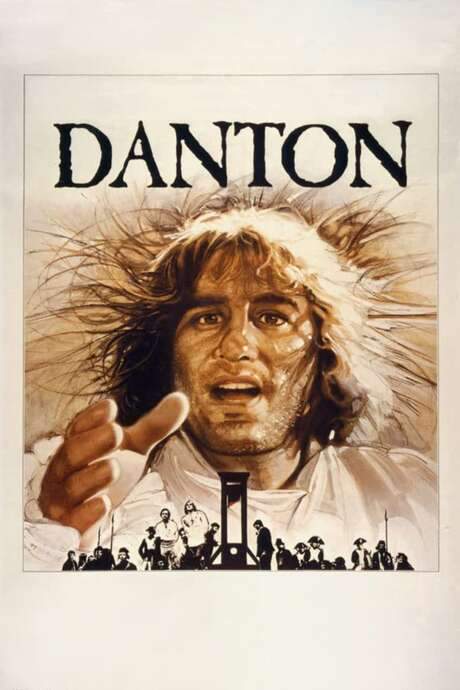
Danton 1983


Directed by

Patrice Chéreau
Made by

Gaumont
Where to Watch Danton
See current US streaming, rental, and purchase options for Danton (1983) via JustWatch.

Streaming availability powered by 
Danton Plot Summary
Read the complete plot summary and ending explained for Danton (1983). From turning points to emotional moments, uncover what really happened and why it matters.
Robespierre [Wojciech Pszoniak] sits at the heart of a Paris gripped by the Reign of Terror in the cold spring of 1794, where city streets are searched, rain blurs the cobbles, and long lines form for scarce bread. Ill in his flat, he watches Danton [Gérard Depardieu], freshly returned from the countryside and greeted as a hero by a hungry, dispirited people who crave leadership and courage. The atmosphere is thick with tension as Robespierre weighs his next moves against the rising question of whether mercy or iron will can sustain a republic.
Desmoulins [Patrice Chéreau], a bold printer, feeds public feeling with pro-Danton pamphlets from his shop, and Robespierre soon orders Héron to destroy that print shop, setting in motion a skirmish between intelligence, influence, and popular will. While the pressure mounts, Robespierre is tended by his barber, and his ally Saint-Just [Bogusław Linda] urges a harder line, pressing him to remove Danton from the political stage. Robespierre resists, preserving a wary line between friendship and the brutal necessity he believes the Revolution demands.
Before the National Convention sits, Westermann [Jacques Villeret] pressures for a coup to topple Robespierre’s power, while Danton declines, convinced that the people’s support and the power of his newspaper, Le Vieux Cordelier, will shield him. Yet he asks Bourdon [Andrzej Seweryn] to denounce Héron and his secret police in the Convention, a move that will pull others into the fray and expose the fragility of alliances in revolutionary times. The city breathes with a fragile hope that oratory and popular affection can outlast a tightening net.
That night, Robespierre invites Danton to a private dinner, building himself up with wine as he offers a chance to reconcile, while Danton drinks and coolly refuses to join Robespierre’s cause. The scene underscores a core tension: the more Robespierre seeks to line up the future of the Republic, the more Danton’s charisma and street-level support threaten to outpace him. After Robespierre leaves, a confrontation in the streets reveals a group of armed men—Westermann’s coup cohort—though Danton again refuses to be part of an illegal plot.
When Robespierre goes to Desmoulins’ house, he finds Desmoulins furious at the destruction of his printing work and unwilling to listen to Robespierre’s arguments about political strategy. Desmoulins’ wife pleads for him to live and think of the people, but Robespierre can do little more than press the case that the leadership must be unified, or the Republic will fracture. Robespierre then moves to the Committee of Public Safety and orders warrants for the arrest that night of Danton, Desmoulins, Westermann and several core associates, a drastic step that sends shockwaves through the revolutionary city. Danton, though he could rally more troops, chooses restraint, allowing the arrest to proceed and declaring that his oratory and the affection of the people will protect him.
The next morning, the National Convention reacts with outrage as Robespierre justifies the arrests by branding Danton an enemy of the Republic. Bourdon publicly shifts sides to back Robespierre, a turn that adds weight to Robespierre’s cause, while Danton faces the prospect of leadership being erased from the nation’s stage. At the Revolutionary Tribunal, the trial begins with uneasy silence as jurors grapple with the charges, and Danton’s interruptions threaten to derail the proceedings. The courtroom itself feels like a battlefield, where authority, legitimacy, and the people’s trust hang in the balance.
In prison, Danton’s confidence flinches when a fellow inmate mocks the possibility of a triumphant verdict, heightening the sense that the trial is more about political theater than due process. The following day, Robespierre learns from Fouquier-Tinville [Roger Planchon] that Danton’s constant interruptions have turned the process into a farce, spurring Robespierre to push through a decree that silences any speaker who steps out of line. The accused are quickly herded from court, and the verdict of guilt is announced with clinical finality.
On the eve of execution, Danton reflects that his greatest failure may not be his own harm but his inability to truly fulfill the people’s trust. As the condemned men are paraded through silent crowds to the scaffold and guillotined, Robespierre’s long-held composure ruptures. Saint-Just cheers him on, urging a declaration of dictatorship, while Robespierre recoils at the thought, admitting that if dictatorship becomes necessary, democracy itself may be an illusion. The trial’s drama closes on a sobering note: the Declaration of the Rights of Man and of the Citizen, once recited as a beacon of liberty, is shown here under the shadow of fear, doubt, and the moral compromise of revolution. The film leaves the viewer with a stark meditation on how the noblest ideals of the Revolution are fatally compromised.
Danton Timeline
Follow the complete movie timeline of Danton (1983) with every major event in chronological order. Great for understanding complex plots and story progression.
Paris under the Terror: Robespierre spots Danton
In cold spring 1794 Paris, bread lines stretch through the rain and fear grips the city. Robespierre peers out onto the streets and sees Danton returning from the countryside, celebrated by a hungry, dispirited populace who still regard him as a hero. The political climate foreshadows the looming confrontation between the two former allies.
Héron orders destruction of Desmoulins' print shop
Héron, head of the secret police, visits Robespierre and is told to crush Desmoulins' print shop, which is publishing pro-Danton circulars. Robespierre sanctions the move, signaling the regime's readiness to silence dissent. The print shop’s destruction marks the first direct blow against Danton's influence.
Saint-Just urges Danton’s execution
While Robespierre is attended by his barber, Saint-Just enters and presses for Danton to be guillotined. Robespierre refuses to bow to this pressure, trying to balance friendship with revolutionary duty. The tension reveals the rift between personal loyalties and political necessity.
Committee of Public Safety pushes to eliminate Danton
At a meeting of the Committee of Public Safety, other members advocate for removing Danton, arguing he threatens the Republic. Robespierre, torn by his friendship with Danton, resists the push and delays any drastic move. The power struggle escalates as rivals try to outmaneuver him.
Westermann discusses coup with Danton; Danton refuses
General Westermann discusses a coup to overthrow Robespierre with Danton, who refuses to join such illegal action. Danton believes the people's support through his newspaper and presence will shield him. He urges Bourdon to denounce Héron, hoping to expose the secret police.
Héron arrested following Bourdon’s denunciation
Bourdon's denunciation of Héron triggers the arrest of Héron and several of his associates. The secret police's grip on power begins to crack as one of its chief instruments is neutralized. The arrests ignite further warnings of the danger Robespierre faces from within his own coalition.
Danton invites Robespierre to a private dinner; Robespierre's attempt to win him over; Westermann's men outside
That night, Danton hosts Robespierre for a lavish dinner in a private room, hoping to win him to a more moderate stance. Robespierre refuses to yield and leaves after failed talks. On the street, he encounters a group of armed men who turn out to be Westermann's coup force, who Danton still refuses to join.
Robespierre confronts Desmoulins; Desmoulins' fury; wife pleads
Robespierre goes to Desmoulins' house, where Desmoulins is furious about the destruction of his press and refuses to talk. Desmoulins' wife begs him to stay and live, asking Robespierre to intervene with gentler measures. Robespierre leaves unable to change his friend’s path.
Arrest warrant issued for Danton, Desmoulins, Westermann
Robespierre returns to the Committee of Public Safety and obtains a warrant for the arrest of Danton, Desmoulins, Westermann, and several associates. The interior politics of the Revolution snap into a new, deadly phase. The act sets the stage for an irreversible collapse of Danton’s coalition.
National Convention reacts; Bourdon switches sides
The National Convention erupts in outrage at the arrests, while Bourdon abandons Danton to back Robespierre. The political landscape shifts as an old ally joins the faction of the Committee. Robespierre’s position gains the upper hand, though at a steep moral cost.
Trial before the Revolutionary Tribunal begins
The trial opens with Danton, Desmoulins, Westermann and allies facing a tribunal that is short of jurors but proceeds. Danton interrupts repeatedly, challenging the proceedings. Prosecutor Fouquier complains that there is little ground for conviction, but the court presses on.
No-tolerance gag order; guilty verdict after interruptions
A decree is issued prohibiting anyone from speaking out of turn in court. Within minutes, the accused are bundled out and the verdict of guilty is read. The legal process is revealed as a hollow instrument in service of political ends.
Danton’s final reflections before execution
On the eve of their deaths, Danton sits in prison, depressed at having failed the people rather than the Revolution’s goals. He questions whether his life mattered as the crowd’s passionate support wanes. His emotional state foreshadows the bloodshed to come.
Execution and Robespierre’s breakdown
Danton, Desmoulins, and Westermann are led to the scaffold and guillotined as the crowd falls silent. Robespierre’s long-suppressed tension fractures; Saint-Just presses him toward dictatorship. Robespierre recognizes that dictatorial power would betray the Revolution’s ideals, symbolized by a child reciting the Rights of Man amid the tragedy.
Danton Characters
Explore all characters from Danton (1983). Get detailed profiles with their roles, arcs, and key relationships explained.
Georges Danton - Gérard Depardieu
Danton is depicted as a charismatic, persuasive leader whose connection with the people makes him a formidable political force. He values pragmatism and is wary of bloodshed, yet remains loyal to his friends. His confidence in popular support contrasts with Robespierre's relentless pursuit of control, and his arrest and execution reveal the brutal costs of revolutionary politics.
Maximilien Robespierre - Wojciech Pszoniak
Robespierre is presented as an uncompromising ideologue who believes in purging threats to the Republic. He seeks to consolidate power through the Committee of Public Safety and the Revolutionary Tribunal. His calculated moves, fear of dissent, and eventual breakdown after the executions show the terrifying arc of revolutionary principle turning into dictatorship.
Camille Desmoulins - Patrice Chéreau
Desmoulins is a passionate defender of liberty who uses his newspaper to challenge Robespierre and mobilize the people. He is a loyal ally to Danton and a fierce advocate for free expression, yet he fears the consequences of political violence. His frustration with the destruction of his press underscores the humans costs of revolution.
Jacques-Louis David - Franciszek Starowieyski
David appears as a witness to the upheaval, embodying the role of art and portraiture in revolutionary politics. His studio becomes a site where political factions and public narratives are shaped, reflecting the era's tension between creativity and propaganda. He stands as a symbol of how artists participate in shaping history.
Danton Settings
Learn where and when Danton (1983) takes place. Explore the film’s settings, era, and how they shape the narrative.
Time period
Spring 1794
The events take place during the height of the French Revolution's Reign of Terror. Leaders of the Revolution maneuver for control as Danton and Desmoulins rally public opinion against Robespierre's faction. The period is marked by executions, political purges, and intense public emotion.
Location
Paris, France
The story unfolds in Paris during the cold spring of 1794, a city gripped by the Reign of Terror, bread shortages, and constant political pressure. The action moves through streets, taverns, and the halls of the National Convention, where power games shape life and death. The film uses the city as a stage for arrests, trials, and the volatile relationship between popular support and state violence.
Danton Themes
Discover the main themes in Danton (1983). Analyze the deeper meanings, emotional layers, and social commentary behind the film.
⚖️
Power Struggle
The film centers on how revolutionary ideals can be twisted into political control. Danton and Robespierre clash as they seek to shape the regime, and the fear of losing power drives arrests and trials. The balance between justice, loyalty, and expediency drives the characters toward drastic choices and bloody outcomes.
🗞️
Public Opinion
Danton's popularity with the people and the influence of his newspaper highlight how public support can shield or threaten leaders. The regime uses propaganda and media to justify actions, while citizens react with hope or fear. The story shows how crowds and public sentiment become a tool in revolutionary politics.
🕊️
Revolution Ideals
The Declaration of the Rights of Man and of the Citizen is invoked as a beacon, even as its ideals are compromised by necessity and violence. The characters confront whether democracy can survive amid executions and dictatorial measures. The film ends by exposing the fragility of lofty ideals when confronted with political survival.

Coming soon on iOS and Android
The Plot Explained Mobile App
From blockbusters to hidden gems — dive into movie stories anytime, anywhere. Save your favorites, discover plots faster, and never miss a twist again.
Sign up to be the first to know when we launch. Your email stays private — always.
Explore the mobile appDanton Spoiler-Free Summary
Discover the spoiler-free summary of Danton (1983). Get a concise overview without any spoilers.
In the winter‑gray streets of Paris, 1793, every cobblestone seems to echo the weight of a nation teetering between liberty and oppression. Bread lines snake through rain‑slick alleys, and the air hums with whispered rumors of committees, tribunals, and an ever‑watchful gaze that turns ordinary citizens into cautious spectators. The city is a pressure cooker of fear, scarcity, and fleeting hope, painted in muted tones that make even sunlight feel like a distant memory.
At the heart of this charged atmosphere sits Robespierre, a gaunt figure whose rigid convictions have helped shape the Revolution’s most uncompromising policies. He moves through the streets with an air of detached resolve, his decisions dictating the rhythm of daily life. Across the same tumultuous stage, Danton bursts back from the provinces, greeted by a crowd that still remembers his fiery oratory and his reputation as a champion of the people. His return ignites a surge of populist energy that challenges the prevailing order, while Desmoulins, a bold printer, circulates pamphlets that keep the conversation alive in cafés and hidden rooms.
The clash between these two once‑allied titans fuels the film’s relentless tension, turning political philosophy into a personal duel. As rain falls over lantern‑lit squares, allegiances shift like shadows, and the audience is drawn into a world where idealism battles pragmatism on every street corner. The tone is a stark, almost theatrical portrait of a society on the brink, where eloquence can sway a crowd as surely as fear can silence it. Within this crucible, the characters navigate loyalty, ambition, and the haunting question of what a Republic must sacrifice to survive.
Movies with Similar Twists and Themes
Uncover films that echo the narrative beats, emotional arcs, or dramatic twists of the one you're exploring. These recommendations are handpicked based on story depth, thematic resonance, and spoiler-worthy moments — perfect for fans who crave more of the same intrigue.


Featured on this page

What's After the Movie?
Not sure whether to stay after the credits? Find out!
Check out our other apps:

SAT Sphere
Build confidence for the Digital SAT.

Mori Atlas
Discover wild places worth protecting.

Luntero
Search smarter for a home in Amsterdam.

Plot Explained
Unravel movie endings and hidden clues.

Pokechamp
Dive into Pokémon data and battle logic.

Driving Theory
Get ready for your European theory test.

Movie Dust
Plan your next cinema trip with ease.

Musemap
Find art and culture as you travel.

Selkobase
Compare credentials before committing.

Local Manual
Turn an unfamiliar country into practical next steps.

Lernavi
Compare school systems before your next move.

GymRoam
Find a workout stop wherever your plans take you.
Explore Our Movie Platform
New Movie Releases (2026)
Famous Movie Actors
Top Film Production Studios
Movie Plot Summaries & Endings
Major Movie Awards & Winners
Best Concert Films & Music Documentaries
Movie Collections and Curated Lists
© 2026 What's After the Movie. All rights reserved.
Privacy Policy