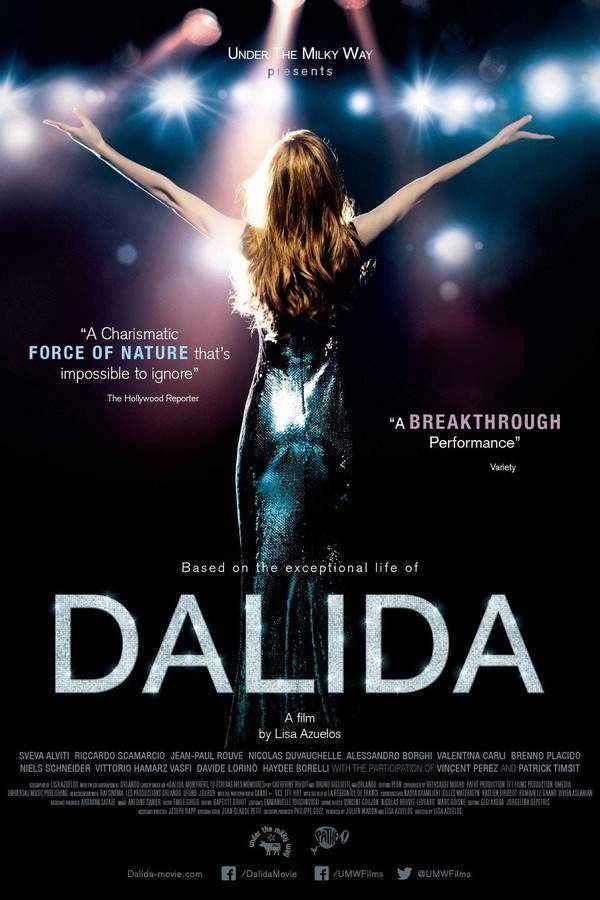
Dalida 2017

Directed by

Lisa Azuelos
Made by

NFP Marketing & Distribution
Where to Watch Dalida
See current US streaming, rental, and purchase options for Dalida (2017) via JustWatch.









Dalida Plot Summary
Read the complete plot summary and ending explained for Dalida (2017). From turning points to emotional moments, uncover what really happened and why it matters.
In 1967, Dalida makes a desperate hotel exit that ends in suicide attempts, and the people closest to her rush in to piece together the many facets of her life. Standing with her are three men who each see a different side of who she is: her ex-husband Lucien Morisse, her former lover Jean Sobieski, and her brother Orlando (Bruno). Together, they lay out a story of a woman whose inner world was shaped by love, fame, insecurity, and a fierce drive to create.
Dalida grew up with a passionate love for music, inspired by a father who was a violinist in Cairo, yet she carried the ache of feeling unattractive because of the large glasses she wore. Her talents would carry her to Paris, where Lucien Morisse, a radio programmer, discovered her and fell for her, even leaving his wife for a chance at something lasting. She married him, but his focus on building her career and delaying marriage sometimes left her feeling unsettled. Soon after, she began an affair with artist Jean Sobieski, a relationship that would again complicate her sense of self. The pattern continued when she left Sobieski to pursue a romance with the temperamental musician Luigi Tenco.
Tenco’s volatile presence culminates in tragedy when he has a breakdown and walks off stage at the 1967 Sanremo Music Festival, later taking his own life. Dalida discovers his body, and many friends and family believe this moment helps precipitate the deepening storm in her mental health. The shock reverberates through her life, but it is not the end of her story. With the support of her brother, she begins to rebuild, returning to the recording studio and finding new audiences as she travels to perform in Italy.
As a new chapter unfolds, she meets a young 22-year-old student with whom she starts a love affair. When she learns she is pregnant, she makes the difficult choice to terminate the pregnancy, believing the timing wouldn’t allow for a responsible upbringing and recognizing the strain of parenthood in a life still intertwined with romance. The relationship ends, but her career and resilience begin to reassert themselves.
Orlando steps into a more active role, managing her career and guiding a period of renewed public success. In the meantime, Morisse’s shadow grows heavier, and he ultimately dies in their old apartment, leaving a complex void in the narrative of her life.
Dalida then enters a relationship with media personality Richard Chanfray. For the first time, she feels a sense of safety and stability, yet the relationship soon sours. He becomes entangled in a violent incident, accidentally shooting the boyfriend of her housekeeper, and Dalida is left to navigate a messy settlement to keep him out of legal trouble. Jealousy and tension arise as Richard’s interference with her career grows, and Dalida even records an album with him, despite his lack of singing talent. A second pregnancy looms in her mind, but another abortion devastates her body—she discovers the procedure has destroyed her uterus, ending any chance of carrying a child herself. A New Year’s Eve party becomes a breaking point: after Richard’s public taunts about her struggle with an eating disorder, she ejects him from her life. He would not survive the night.
With the personal turmoil gradually contained, Dalida returns to work and achieves critical and popular success, notably starring in Le Sixième Jour, a performance that earns her high praise and helps her regain a national welcome, even as she travels back to Egypt to be celebrated by her fans there. Yet the triumph is haunted by the emotional toll of years of heartbreak, creative pressure, and the relentless spotlight. The isolation deepens, and the bulimia grows more severe, pushing her toward a painful conclusion. In the end, Dalida’s life closes in the face of unbearable sorrow, leaving behind a note that speaks to life’s overwhelming difficulty and the quiet necessity of rest.
This portrait threads together music, romance, fame, and pain, tracing how a woman who began with a violinist’s dream and glasses that made her feel unseen moved through a world that kept asking for more—until the weight became too heavy to bear.
Dalida Timeline
Follow the complete movie timeline of Dalida (2017) with every major event in chronological order. Great for understanding complex plots and story progression.
Cairo childhood and musical awakening
Dalida grows up in Cairo, nurturing a deep passion for music thanks to her violinist father. She later recalls feeling unattractive because of her large glasses, shaping her lifelong insecurities. These early experiences set the emotional foundations for her later on-stage confidence and fragility.
Discovery in Paris and Morisse's pledge
Dalida is discovered in Paris by Lucien Morisse, a radio programmer who becomes her advocate and lover. He eventually leaves his wife for her, signaling a bold shift in her personal life. Morisse's support helps propel her toward a national and international audience.
Marriage to Morisse and Sobieski affair
Dalida marries Lucien Morisse, hoping for stability even as the relationship strains under career pressures. Morisse's reluctance to marry or have a child creates distance between them. She begins an affair with artist Jean Sobieski, signaling her restless search for passion.
Affair with Luigi Tenco and rising fame
Dalida ends her affair with Sobieski to pursue a relationship with Luigi Tenco, a temperamental musician whose intensity mirrors her own drive. Their romance fuels her art but also deepens emotional turmoil. The coupling becomes a defining chapter of her personal life.
Tenco's Sanremo breakdown and suicide
Tenco performs at Sanremo and suffers a breakdown, walking off stage. He later commits suicide, a shock to Dalida. Dalida discovers his body, an event that weighs heavily on her and marks a turning point in her life.
1967 hotel suicide attempt
In 1967, Dalida goes to a hotel and makes an unsuccessful suicide attempt. Her ex-husband Morisse, ex-lover Sobieski, and brother Orlando rush to her side during recovery. The episode exposes the web of relationships that haunt her.
Recovery with brother Orlando
After the crisis, Dalida begins to recover with the support of her brother Orlando. Orlando takes on management duties, guiding a new phase of successful recordings and performances. This marks a turning point toward renewed professional achievement.
Italy trip: affair with a 22-year-old student
Dalida travels to Italy to perform and meets a 22-year-old student with whom she begins a passionate affair. She discovers she is pregnant and decides not to keep the child, fearing he is too young to be a responsible parent. She has an abortion and ends the relationship.
Lucien Morisse's suicide
Back in Paris, Morisse's mental health crashes and he commits suicide in their old apartment. His death adds to the mounting personal tragedies surrounding Dalida. The loss deeply affects her and influences her ongoing insecurities.
Meeting Richard Chanfray
Dalida is introduced to media personality Richard Chanfray and enters a relationship that feels safe and stabilizing. She believes she has found security for the first time in a long while. However, the relationship soon strains under jealousy and career pressures.
Dangerous incident and legal pressure
Richard accidentally shoots the boyfriend of Dalida's housekeeper, creating a potential legal crisis. Dalida pays off the family to keep him out of jail, trying to shield him from consequences. The incident stains their relationship and tests her resolve.
Recording with Richard and pregnancy scare
Dalida records an album with Richard despite his limited talent, seeking to sustain their partnership. She later believes she is pregnant, only to learn that her abortion has damaged her uterus. This revelation darkens her outlook on motherhood and future relationships.
New Year's Eve fallout and his suicide
On New Year’s Eve, after a public humiliation and Richard's unpleasant behavior toward her, Dalida ends the relationship. Shortly afterward, Richard Chanfray commits suicide, leaving her to cope with another loss. The sequence intensifies her sense of isolation.
Le Sixième Jour and Egyptian homecoming
Dalida stars in the acclaimed film Le Sixième Jour and returns to Egypt, where she is feted by fans. Public triumph contrasts with private fragility as her bulimia deepens. The crown of success sits alongside a mounting inner despair.
Final decline and suicide
Despite outward professional success, Dalida falls into a profound depression, with bulimia spiraling out of control. She ultimately commits suicide, leaving behind a note explaining that life is too difficult.
Dalida Characters
Explore all characters from Dalida (2017). Get detailed profiles with their roles, arcs, and key relationships explained.
Dalida (Sveva Alviti)
Dalida is shown as a passionate, globe-trotting singer who carries a deep-seated sense of insecurity about her looks. The movie traces her rise from Cairo’s musical roots to Paris’s superstar stage, while she grapples with tumultuous relationships and intense public scrutiny. Her resilience surfaces as she navigates abortion, a collapsing career, and a spiraling battle with bulimia before a final, tragic act.
Lucien Morisse (Patrick Timsit)
A Paris radio programmer who discovers Dalida, falls for her, and ultimately becomes entangled in a career-focused relationship. He postpones marriage and children, contributing to the emotional complexity of their romance. His life ends in tragedy with his suicide, echoing the film’s motif of fame’s dark underbelly.
Jean Sobieski
An artist and Dalida’s ex-lover, whose relationship reflects the pattern of intense, passionate entanglements that shape her emotional landscape. The affair contributes to her sense of being desired yet unstable, underscoring the film’s theme of love’s cost on a public figure.
Orlando (Bruno)
Dalida’s brother who enters the music world as her manager, helping her rebound to success. His support and perception of his sister’s career reflect the familial bond that sustains her through peaks and troughs. The character’s presence marks a stabilizing force amid chaotic fame.
Richard Chanfray (Nicolas Duvauchelle)
A media personality who becomes Dalida’s partner for a period. Their relationship is marked by jealousy, manipulation, and a reckoning with the consequences of a professional collaboration. His erratic behavior, including a fatal incident, and his eventual suicide, contribute to Dalida’s mounting sense of danger and vulnerability.
Dalida Settings
Learn where and when Dalida (2017) takes place. Explore the film’s settings, era, and how they shape the narrative.
Time period
1960s
The central events occur in the late 1960s, beginning with a pivotal 1967 suicide attempt and the Sanremo Music Festival year. The era’s glamorous yet pressurized showbiz environment frames Dalida’s romances, career moves, and emotional lows.
Location
Cairo, Paris, Egypt
The story unfolds across key locations in Dalida’s life: she grows up in Cairo, is discovered and rises to fame in Paris, and later returns to perform and be feted in Egypt. The film uses these places to mirror her personal journey from outsider to global star. Each location anchors a chapter of her public persona and private struggles.
Dalida Themes
Discover the main themes in Dalida (2017). Analyze the deeper meanings, emotional layers, and social commentary behind the film.
🎤
Fame
Fame drives Dalida’s ascent from a shy music lover to a global icon, while also sharpening the public gaze on her personal life. The film shows how career ambitions, spotlight, and public expectations shape her choices and self-image. It reveals the cost of stardom when private turmoil collides with public adulation.
💘
Love & Relationships
Dalida’s loves—marriage to Morisse, affairs with Sobieski and Tenco, and later partnerships—are a through line of passion and pain. The relationships pull her in different directions, alternately lifting her career and destabilizing her emotionally. The film portrays how love, betrayal, and motherhood decisions intertwine with fame.
🌧️
Mental Health
The narrative traces Dalida’s mental health struggles, including bulimia and periods of isolation. The emotional toll of fame, heartbreak, and tragedy culminates in a suicide attempt and, ultimately, Dalida’s own death. The movie presents a portrait of a brilliant performer haunted by inner demons.
📰
Media & Public Scrutiny
Dalida’s life is filtered through the media storm and public gaze, including the influence of a controversial partner who embodies the era’s sensationalism. The film shows how media attention shapes perception, personal safety, and decision-making. It also depicts how the press and fame can manipulate a vulnerable artist’s path.

Coming soon on iOS and Android
The Plot Explained Mobile App
From blockbusters to hidden gems — dive into movie stories anytime, anywhere. Save your favorites, discover plots faster, and never miss a twist again.
Sign up to be the first to know when we launch. Your email stays private — always.
Explore the mobile appDalida Spoiler-Free Summary
Discover the spoiler-free summary of Dalida (2017). Get a concise overview without any spoilers.
In the vibrant aftermath of World War II, a young woman with a violinist’s dream and distinctive glasses rises from the bustling streets of Cairo to the glittering stages of Paris. The film paints a sprawling portrait of the post‑war music world, where nightclubs pulse with new rhythms and radio waves carry the promise of fame across continents. Against this backdrop, the story follows a singular talent whose voice becomes a bridge between cultures, inviting audiences into a universe where art and yearning intertwine.
Dalida is introduced as both a dazzling star and a quietly conflicted soul. Her passion for melody is matched only by an acute awareness of her own vulnerabilities, a duality that fuels her relentless drive to create. Early encounters with industry figures—Lucien Morisse, a charismatic radio programmer, and Jean Sobieski, a captivating artist—hint at a life where personal affection and professional ambition constantly collide. Each relationship offers a different lens through which her aspirations and insecurities are reflected, shaping the complex mosaic of her inner world.
The narrative unfolds with an intimate focus on the people who orbit her orbit. Her brother, Orlando, emerges as a steadfast presence, guiding her through the turbulent currents of celebrity while offering a familial anchor. Later, a charismatic media personality, Richard Chanfray, enters her orbit, promising stability yet introducing new tensions that test the limits of her resilience. Through these connections, the film explores the delicate balance between public adulation and private doubt, framing her journey as a perpetual dance between exhilaration and melancholy.
Rendered with lyrical cinematography and a soundtrack that echoes her iconic hits, the film invites viewers to feel the weight of a life lived in the spotlight. The tone oscillates between the dazzling allure of performance and the stark intimacy of personal struggle, leaving a lingering sense of curiosity about how a woman so beloved navigates the relentless demands of fame, love, and self‑discovery.
Movies with Similar Twists and Themes
Uncover films that echo the narrative beats, emotional arcs, or dramatic twists of the one you're exploring. These recommendations are handpicked based on story depth, thematic resonance, and spoiler-worthy moments — perfect for fans who crave more of the same intrigue.


Featured on this page

What's After the Movie?
Not sure whether to stay after the credits? Find out!
Check out our other apps:

SAT Sphere
Build confidence for the Digital SAT.

Mori Atlas
Discover wild places worth protecting.

Luntero
Search smarter for a home in Amsterdam.

Plot Explained
Unravel movie endings and hidden clues.

Pokechamp
Dive into Pokémon data and battle logic.

Driving Theory
Get ready for your European theory test.

Movie Dust
Plan your next cinema trip with ease.

Musemap
Find art and culture as you travel.

Selkobase
Compare credentials before committing.

Local Manual
Turn an unfamiliar country into practical next steps.

Lernavi
Compare school systems before your next move.

GymRoam
Find a workout stop wherever your plans take you.
Explore Our Movie Platform
New Movie Releases (2026)
Famous Movie Actors
Top Film Production Studios
Movie Plot Summaries & Endings
Major Movie Awards & Winners
Best Concert Films & Music Documentaries
Movie Collections and Curated Lists
© 2026 What's After the Movie. All rights reserved.
Privacy Policy