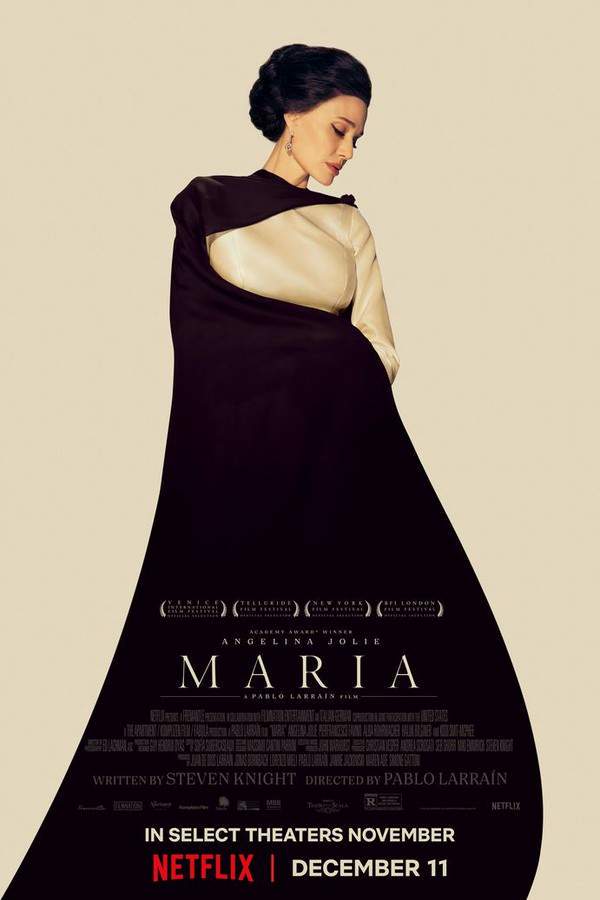
Maria 2024

Directed by

Pablo Larraín
Made by

The Apartment
Maria Plot Summary
Read the complete plot summary and ending explained for Maria (2024). From turning points to emotional moments, uncover what really happened and why it matters.
Maria Callas, Angelina Jolie, a world‑famous soprano, spends a tense week in a Paris apartment trying to sing again after years of faltering health, while her devoted butler Ferruccio, Pierfrancesco Favino, and housekeeper Bruna, Alba Rohrwacher, keep the home running and manage the pressures of her fragile condition.
Her routine is upended when Ferruccio insists she consult a doctor, but Maria clings to a troubling remedy: Mandrax, a medication she overuses despite its harsh side effects. The tension escalates as a television crew arrives to interview her about her life, led by a young filmmaker introduced as Mandrax, Kodi Smit-McPhee. The sight of these visitors unleashes a cascade of vivid hallucinations that Ferruccio and Bruna cannot perceive, turning the apartment into a liminal space where reality and dream blur.
Across the week, Maria is drawn into memories that reveal the private side of a public life. She remembers a passionate but complicated romance with Aristotle Onassis, Haluk Bilginer, the Greek magnate who would later become entwined with Jackie Kennedy. In these recollections, she recalls rejecting him at first in 1957, then yielding to a deep, contradictory love before public scrutiny and personal fear redirected her path. She also remembers leaving her husband Giovanni Battista Meneghini, Alessandro Bressanello, yet never entirely erasing the tenderness of those years, and she admits that, on his deathbed, Onassis remained an ache she couldn’t fully extinguish.
The hallucinations extend to her youth, when, as a teenager during World War II, her mother forced her to sing for Italian and German officers in exchange for money. These memories haunt her as she tries to reconcile the past with the fragile present. A confrontation with her older sister, Yakinthi Callas, Valeria Golino, offers a rare moment of reconciliation over how their mother treated them, a small, human counterpoint to the grander arc of fame and tragedy.
During a final round of medical consultations, Dr. Fontainebleau, Vincent Macaigne, confirms that her health has worsened and that singing at previous heights may no longer be possible. In subsequent sessions with a conductor, Tate, Maria records her voice on an audio device, hoping to preserve what remains of her art even if the live performance has slipped away. A Le Figaro journalist intrudes, probing for a sensational angle, only to be dismissed when Ferruccio steps in.
In a quiet, reverent moment, Maria thanks Ferruccio and Bruna for their steadfast presence. The next morning, with the apartment’s windows open to the city, she sings Vissi d’arte one last time, a release and a grieving testament to a life defined by art and longing. The performance draws curiosity and sympathy from neighbors on the street, as well as from Onassis and Mandrax, who watch from inside the room before fading from view. When Ferruccio and Bruna re-enter, they discover Maria unconscious and, ultimately, dead on the floor. Ferruccio calls Dr. Fontainebleau to report the death, and the authorities arrive, closing a remarkable, haunted chapter in a legend’s twilight.
Maria Timeline
Follow the complete movie timeline of Maria (2024) with every major event in chronological order. Great for understanding complex plots and story progression.
Maria in Paris begins a fragile comeback
In 1977, Maria Callas lives in a Paris apartment with her butler Ferruccio and housekeeper Bruna, trying to sing again after years of declining health. She relies on medications, especially Mandrax, despite increasing side effects, while Ferruccio urges her to see a doctor and get proper treatment.
A TV crew arrives that is actually a hallucination
A television crew arrives to interview Maria, led by a young filmmaker named Mandrax. It becomes clear the crew is a hallucination caused by her medication, with Ferruccio and Bruna unable to see them.
Hallucinations spark memories of Onassis (1957)
Through the drug-induced visions, Maria recalls her romance with Aristotle Onassis, the moment she fell in love and left her husband Giovanni Battista Meneghini. The relationship is marked by public scrutiny and its emotional cost.
Leaving Meneghini for Onassis
She initially declined Onassis’s advances in 1957, but quickly fell in love and left her husband Meneghini. The relationship is overshadowed by press scrutiny and social expectations that accompany their affair.
Secret deathbed encounter with Onassis
Though separated by public scrutiny, Maria secretly sees Onassis on his deathbed and admits that she loved him. The moment underscores the depth of her attachment despite the consequences.
WWII-era trauma: forced singing for officers
During World War II in Italy, a teenage Maria is forced by her mother to sing for Italian and German officers in exchange for money. The memory reveals the coercive pressures she faced and foreshadows the costs of fame.
Reconciliation with sister Yakinthi
Maria meets her older sister Yakinthi and the sisters reconcile over how their mother treated them. The moment grounds her amid the drug haze and shifting memories.
First session with Dr. Fontainebleau
In her first appointment, Maria lies about her drug usage to Dr. Fontainebleau. The doctor begins to uncover the truth but is hindered by her obfuscation.
Second appointment reveals worsening health
During the second appointment, Fontainebleau reveals that her health has worsened after reviewing medical reports Ferruccio provided, suggesting she may no longer be able to sing. The revelation deepens the sense of irreversible decline.
Final Tate session and voice recording
Maria attends a final session with conductor Jeffrey Tate and brings an audio recorder to capture her voice. The recording makes clear that her singing has not recovered to her former heights.
Le Figaro journalist intrudes
A Le Figaro journalist spies on the session and rudely questions her about her career; Ferruccio shoves him away, defending Maria.
Gratitude and last open-window performance
Maria expresses gratitude to Ferruccio and Bruna for their support. The next morning she sings Vissi d'arte with the windows open, drawing Parisians on the street who listen, while Onassis and Mandrax silently listen from inside before vanishing.
Death in the apartment
Ferruccio and Bruna return from groceries to find Maria dead on the floor. He calls Dr. Fontainebleau and authorities arrive to address the situation.
Maria Characters
Explore all characters from Maria (2024). Get detailed profiles with their roles, arcs, and key relationships explained.
Maria Callas (Angelina Jolie)
A legendary opera singer grappling with serious health problems and a years-long hiatus. She is haunted by memories, dependent on medications, yet still clings to the possibility of a comeback. Her vitality ebbs as she confronts mortality and the cost of fame.
Dr. Fontainebleau (Vincent Macaigne)
A cautious physician who evaluates Maria's condition and questions the viability of her singing future. He presents medical reports that reveal deterioration and pressures her to acknowledge reality. He embodies clinical detachment amid emotional crisis.
Mandrax (Kodi Smit-McPhee)
A hallucinated young filmmaker who leads an interview during the week. He is not visible to Ferruccio or Bruna, but he shapes Maria's memories and confrontations with her past. The figure is a product of drug-induced visions rather than a real person.
Yakinthi Callas (Valeria Golino)
Maria's older sister whose relationship with Maria is strained by their family history. They reconcile during the week, reflecting themes of sisterhood and forgiveness. She embodies familial bonds that endure beyond fame and illness.
Bruna (Alba Rohrwacher)
Housekeeper and close ally who stands by Maria through illness and media pressure. She offers practical support, protects Maria, and anchors the emotional tone of the story. Her loyalty provides stability amid vulnerability.
Ferruccio (Pierfrancesco Favino)
Maria's devoted butler who manages the household, medical visits, and interview intrusions. He acts as a practical anchor, balancing care with the realities of her fragile health. His quiet resilience highlights duty and companionship.
Aristotle Onassis (Haluk Bilginer)
Her former lover whose memory intrudes on the present through memory and longing. His influence lingers despite their break and the public scrutiny surrounding their relationship. He embodies the tension between private desire and public image.
Giovanni Battista Meneghini (Alessandro Bressanello)
Maria's husband before her Onassis years; a symbol of a long, complicated marriage overshadowed by later affairs. His memory marks a different life stage and influences Maria's present vulnerability. The film hints at how past partnerships still shape her today.
Maria Settings
Learn where and when Maria (2024) takes place. Explore the film’s settings, era, and how they shape the narrative.
Time period
1977
Takes place over the course of a week in 1977, following Maria's attempt to sing again while grappling with prescription drug use and health decline. The late-70s setting emphasizes media attention and a world still fascinated by Maria's legend. The period frames an intimate drama against a public, celebrity-saturated backdrop.
Location
Paris, France
The action unfolds in a Parisian apartment in 1977, a hub of private life amid the city's public glamour. Paris serves as a backdrop of art, media attention, and European elegance, contrasting the singer's fragile health with the bustle outside. The apartment becomes the intimate stage where memory, illness, and artistic longing play out.
Maria Themes
Discover the main themes in Maria (2024). Analyze the deeper meanings, emotional layers, and social commentary behind the film.
💊
Health decline
Maria's health deterioration drives the plot as medication misuse blurs reality. The film treats illness as a lens on fame, memory, and agency, showing how dependence reshapes choices and relationships. The visions that accompany the drugs reveal pain, fear, and a longing to recapture a past voice, even when it harms the present.
🧠
Memory
Memories flood the week with past loves, family tensions, and wartime experiences. Hallucinations pull Maria between who she was and who she is now, shaping her sense of self. The film explores how memory constructs identity, especially under the weight of illness and celebrity.
💔
Love
Romantic history with Onassis and the public gaze shape Maria's choices and sense of belonging. The pressure of glamour and scrutiny intensifies the strain of intimate relationships. The narrative contrasts private longing with public performance, underscoring loneliness within fame.
🎶
Artistry
Maria pursues a final act of musical expression, attempting to sing Vissi d'arte one last time. The effort questions whether art can endure illness and time, serving as a meditation on resilience. Her tentative performance becomes a symbol of accepting mortality while preserving artistic voice.

Coming soon on iOS and Android
The Plot Explained Mobile App
From blockbusters to hidden gems — dive into movie stories anytime, anywhere. Save your favorites, discover plots faster, and never miss a twist again.
Sign up to be the first to know when we launch. Your email stays private — always.
Explore the mobile appMaria Ending Explained
Unravel the ending of Maria (2024) with our detailed explanation. Understand the final scenes, character fates, and unresolved questions.
In the final moments of the film, Maria Callas’s life reaches a quiet, poetic end. She sits with her close friends, Bruna and Ferrucio, playing cards and reflecting on their bond, which she encourages them to cherish. Shortly after, she appears to drown her despair by taking an overdose of medication, leading to her death from a heart attack. Throughout the film, we see her haunted by her physical decline, her unresolved emotional pain, and her desire to perform one last time. She imagines herself sharing a final, triumphant performance, embracing her younger self and her past struggles. These visions serve as a way for her to find closure, blending her reality with her mind’s desire for a perfect ending. The movie leaves it open whether her death was a suicide, a natural cardiac arrest brought on by her weakened body, or a hallucination, emphasizing instead the poetic nature of her end. Ultimately, her passing symbolizes the toll that fame, loss, and inner turmoil took on her life. The film’s focus shifts from the mystery of her disappearance from the public eye to an intimate portrait of her internal world, portraying her final moments as a delicate mixture of reality, memory, and longing—an ending that poeticizes her enduring spirit and complex history.
Maria Spoiler-Free Summary
Discover the spoiler-free summary of Maria (2024). Get a concise overview without any spoilers.
In the quiet heart of 1970s Paris, a once‑legendary soprano lives in an elegant yet secluded apartment, haunted by the echo of arias that once filled concert halls around the world. Maria Callas spends her days navigating the fragile space between her former, soaring performances and the present reality of a body that no longer obeys. The city outside drifts by like a distant orchestra, its muted streets mirroring her own subdued rhythm as she contemplates whether the voice that defined her can ever be reclaimed.
Around her, a devoted butler and a careful housekeeper tend to the details of daily life, anchoring the stillness with quiet competence. Ferruccio moves through the rooms with a measured calm, while Bruna maintains the household’s delicate balance, both aware of the tension that lingers beneath the surface. Their presence creates a sanctuary where the walls seem to listen, and the apartment itself becomes a liminal stage where memory and present moment intertwine. Subtle hints of lingering remedies and occasional visits from curious observers suggest an undercurrent of pressure, yet the focus remains on the intimate choreography of care and the lingering scent of opera that still clings to the rooms.
The film shrouds its narrative in a contemplative, almost dream‑like tone, allowing the audience to feel the weight of a life lived in the spotlight now softened by age and introspection. Through soft lighting, lingering close‑ups, and a soundscape that melds distant city noise with the faint resonance of forgotten melodies, the story invites viewers into a world where fame has faded into quiet reverence. As Maria drifts between recollection and the present, the audience is left with a lingering curiosity about the delicate balance between art, memory, and the inevitable passage of time.
Movies with Similar Twists and Themes
Uncover films that echo the narrative beats, emotional arcs, or dramatic twists of the one you're exploring. These recommendations are handpicked based on story depth, thematic resonance, and spoiler-worthy moments — perfect for fans who crave more of the same intrigue.

Featured on this page

What's After the Movie?
Not sure whether to stay after the credits? Find out!
Check out our other apps:

SAT Sphere
Build confidence for the Digital SAT.

Mori Atlas
Discover wild places worth protecting.

Luntero
Search smarter for a home in Amsterdam.

Plot Explained
Unravel movie endings and hidden clues.

Pokechamp
Dive into Pokémon data and battle logic.

Driving Theory
Get ready for your European theory test.

Movie Dust
Plan your next cinema trip with ease.

Musemap
Find art and culture as you travel.

Selkobase
Compare credentials before committing.

Local Manual
Turn an unfamiliar country into practical next steps.

Lernavi
Compare school systems before your next move.

GymRoam
Find a workout stop wherever your plans take you.
Explore Our Movie Platform
New Movie Releases (2026)
Famous Movie Actors
Top Film Production Studios
Movie Plot Summaries & Endings
Major Movie Awards & Winners
Best Concert Films & Music Documentaries
Movie Collections and Curated Lists
© 2026 What's After the Movie. All rights reserved.
Privacy Policy