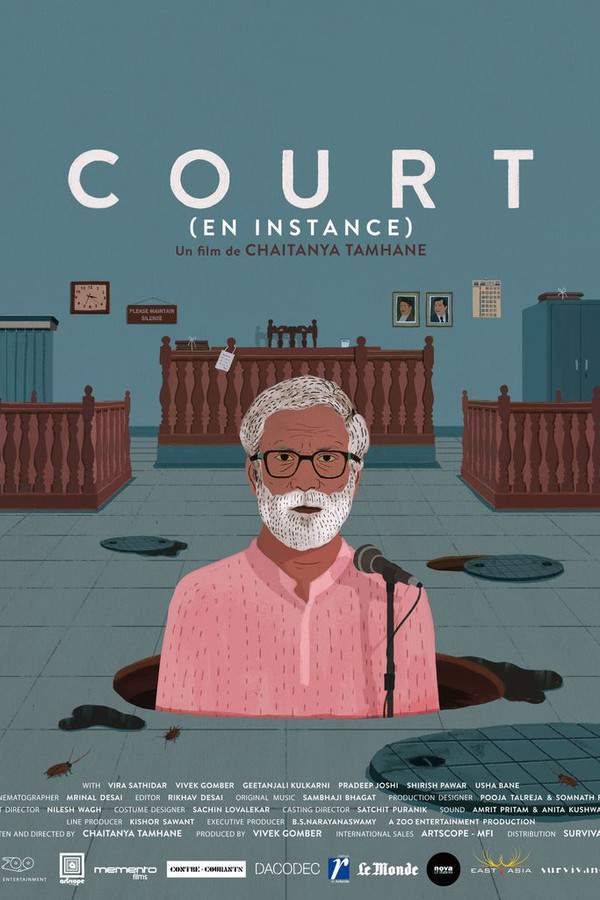
Court 2015

Directed by

Chaitanya Tamhane
Made by

Zeitgeist Films
Where to Watch Court
See current US streaming, rental, and purchase options for Court (2015) via JustWatch.






Court Plot Summary
Read the complete plot summary and ending explained for Court (2015). From turning points to emotional moments, uncover what really happened and why it matters.
Narayan Kamble, a teacher, social activist and protest singer, finds himself swept up in a legal battle after being arrested on the charge of prompting Vasudev Pawar, a manhole worker, to commit suicide. The prosecution asserts that Pawar, who allegedly heard one of Kamble’s protest songs, was driven to end his life. In court, Kamble maintains that while he has sung many songs about suicide, he cannot recall whether any were performed on the day of Pawar’s death, and he denies any intention to provoke self-harm in others. A witness steps forward claiming to have seen the manhole worker singing Kamble’s song, adding to the tension surrounding the case.
In the following hearing, the investigating officer introduces a new angle, linking Kamble to an incarcerated man, Ashwin Bhagat, through a letter that accuses them of plotting illegal activity in the city. Kamble’s lawyer, Vinay Vora, explains that Bhagat had asked Kamble to look after his ailing mother while Bhagat was behind bars. The public prosecutor, Nutan, reveals that Kamble possessed two banned books—the first on Yoga and the second a critique of certain rituals of the Goyamari sect. The tension between defense and state authorities grows when Vora is beaten by members of the Goyamaris. Meanwhile, Pawar’s widow testifies that her husband worked without safety gear, lost an eye from exposure to poisonous sewer gases, and was also an alcoholic, though she denies any discussion of suicide or any prior mention of Kamble. The autopsy report is read aloud, indicating Pawar died from respiratory failure due to inhalation of hydrogen sulfide, with no signs of self-harm, and the testimony of the initial witness is criticized as that of a stock witness who has appeared in multiple other cases.
Despite Kamble’s deteriorating health and the lack of decisive evidence, the court grants bail set at ₹100,000 (about US$1,200), which Vora pays on Kamble’s behalf. However, Kamble is soon arrested again, this time on charges of conducting seditious camps under the cover of folk-artist workshops, and he is remanded to police custody. Kamble maintains that the charges and the accompanying evidence are fabricated, and Vora pleads for a reconsideration due to the severity of Kamble’s health condition; the judge instructs Kamble to appeal to the High Court. The film closes with a striking domestic vignette: the judge is shown enjoying a holiday with his family, but a playful disruption by children awakens him, and he reacts with a sharp slap, leaving the audience to ponder the fragile line between authority, responsibility, and human frailty.
Court Timeline
Follow the complete movie timeline of Court (2015) with every major event in chronological order. Great for understanding complex plots and story progression.
Arrest of Narayan Kamble
Narayan Kamble, a teacher, activist and protest singer, is arrested on charges that he prompted Vasudev Pawar to commit suicide through his songs. The prosecution argues that his music influenced the worker to take his own life. The arrest marks the initial spark of a courtroom drama revolving around motive, influence, and accountability.
Trial leads to bail
Kamble is brought before a court and granted bail after a hearing. The defense argues for his release while the investigation continues. The decision highlights the tension between civil liberty and ongoing criminal inquiry.
Kamble admits singing about suicide but questions intent
During testimony Kamble concedes he sang several songs about suicide but cannot confirm he sang that specific day or intended to provoke self-harm. He asserts he does not act with the intent to incite others and says his memory of the day is unclear. The exchange underscores the central question of whether art can influence real-world actions.
Witness testifies to seeing Kamble's song
A witness testifies that he saw Pawar singing Kamble's song, attempting to connect the artist to the alleged influence. The testimony raises questions about what the witness observed and whether it establishes Kamble's responsibility. The defense challenges the credibility and weight of this account.
Link to Ashwin Bhagat emerges via letter
In the next hearing, the investigating officer reveals a link between Kamble and incarcerated Ashwin Bhagat through a letter accusing them of planning illegal activity in the city. The discovery broadens the case beyond the original suicide charge and suggests a wider alleged conspiracy. The development intensifies pressure on Kamble and his defense.
Bhagat's request to care for his mother explained
Vora explains that Bhagat was requesting Kamble to take care of his ailing mother while Bhagat was in jail, providing context to the letter. The defense argues this demonstrates Kamble's non-violent intent and personal connection rather than criminal collaboration. The exchange aims to reframe Kamble's relationship with Bhagat.
Banned books found in Kamble's possession
Nutan, the public prosecutor, states that Kamble possessed two banned books, raising concerns about illicit influences. Vora counters that one book is about Yoga and the other critiques certain rituals, arguing that possession does not prove criminal intent. The exchange reveals the tension between censorship, scholarly interest, and the case's political overtones.
Defense lawyer attacked by Goyamaris
Vora is beaten by members of the Goyamaris, illustrating the volatile atmosphere surrounding the trial and the risks faced by Kamble's defense. The assault reinforces the sense that outside groups are exerting pressure on the legal process. The incident prompts concerns about security and fairness in proceedings.
Pawar's widow testifies about the death
Pawar's widow testifies that her husband worked without safety gear and died from exposure to poisonous sewer gases, having lost an eye in the process. She describes him as an alcoholic who never spoke of suicide or Kamble's influence. Her testimony challenges the narrative that Kamble pushed Pawar toward death.
Autopsy contradicts suicide theory
The autopsy report indicates Pawar died from respiratory failure due to inhalation of hydrogen sulphide, with no signs of self-harm. The medical findings undermine the prosecution's suicide theory and provide a counterpoint to earlier testimony. The defense uses the report to cast doubt on the charge of provoking suicide.
Stock witness credibility questioned
The court notes that the witness who testified against Kamble is a stock witness with a history of testifying in multiple cases, casting doubt on his reliability. The defense argues this undermines the prosecution's case against Kamble. The atmosphere in the courtroom grows tenser as credibility becomes a focal point.
Bail granted again; health concerns cited
Considering Kamble's deteriorating health, the court grants bail of ₹100,000 (US$1,200) with Vora posting the money. He is later arrested again on charges of conducting seditious camps under the cover of folk-artist workshops and is remanded to police custody. The sequence underscores the volatility of the case and the fragility of Kamble's situation.
Judge advises appeal to High Court
The judge tells Kamble to appeal to the High Court for relief, outlining the procedural path forward. Kamble's legal team weighs this option, hoping for a more favorable review given health concerns and what has transpired in court. The guidance signals a potential strategic pivot in the case.
Judge's holiday scene and incident with children
The film cuts to a scene showing the judge enjoying a family holiday, creating a stark contrast with the courtroom drama. Some mischievous children wake him, and he slaps one of them before the others flee. The moment adds a human, unsettling dimension to the judge's character.
Court Characters
Explore all characters from Court (2015). Get detailed profiles with their roles, arcs, and key relationships explained.
Narayan Kamble
A teacher, social activist and protest singer who becomes the central figure of the trial. He acknowledges composing songs about suicide but maintains he did not intend to provoke anyone and cannot confirm he sang on the day of the incident. His health deteriorates through the proceedings, highlighting the personal toll of public dissent and legal battles. He remains steadfast in defending his artistic and political beliefs in court.
Vinay Vora
A defense lawyer who fights to prove Kamble’s innocence and to keep him from harsher charges. He negotiates bail, presents autopsy details, and challenges the idea of fabrications in the evidence. He confronts intimidation and advocates for Kamble’s health and due process, while seeking a reconsideration by the High Court. He embodies the defense's commitment to fair legal procedure against political manipulation.
Nutan
The public prosecutor driving the state's case against Kamble. She presents the narrative of Kamble’s alleged influence on a worker’s death and points to the possession of banned books as part of the case. She emphasizes witness credibility and the seriousness of the charges, shaping the court’s perception of the defendant. Her role highlights prosecutorial intensity within the legal process.
Ashwin Bhagat
An incarcerated man whose connection to Kamble is suggested by a letter used to accuse them of planning illegal activity. The case hints at conspiratorial links, raising questions about evidence and manipulation within the judiciary. His presence underscores how individuals inside and outside of jail can influence court narratives.
Court Settings
Learn where and when Court (2015) takes place. Explore the film’s settings, era, and how they shape the narrative.
Location
Courtroom, Indian city streets, government offices
The core action unfolds in a bustling Indian courtroom, with the surrounding cityscape reflecting activism and social tension. Scenes shift from the courtroom to adjacent public spaces and offices, illustrating how law, politics, and everyday life intersect. The setting emphasizes a formal judicial process where evidence, witnesses, and rhetoric shape outcomes. It portrays the courtroom as a stage for dissent, authority, and the fatigue of long legal battles.
Court Themes
Discover the main themes in Court (2015). Analyze the deeper meanings, emotional layers, and social commentary behind the film.
⚖️
Justice
The film questions what true justice means when health, evidence, and institutional power influence outcomes. Kamble’s frailty and disputed autopsy raise doubts about the fairness of the verdict. The reliability of witnesses and the weight of legal procedure challenge a straightforward sense of truth. Overall, justice is presented as a fragile, contested process within a complex legal system.
🗣️
Freedom of Speech
Protest songs become a focal point for debates over expression and potential incitement. The state grapples with the boundary between artistic protest and public safety, while Kamble defends his right to sing against social ills. The courtroom weaves competing narratives of voice versus control, highlighting how speech is scrutinized in a democracy. The film uses music and rhetoric to explore the costs of dissent.
🪙
Power & Corruption
Power dynamics surface in how testimonies and accusations are shaped, including the use of a linked letter to implicate Kamble with an incarcerated man. The presence of a stock witness and the manipulation of narrative reveal vulnerabilities in the system. Bail decisions followed by a renewed arrest suggest that political pressures can steer legal outcomes. The story hints at broader mechanisms of influence within the justice process.
🗳️
Accountability
The case exposes gaps between legal duty and personal circumstance, such as the judge's offhand holiday that interrupts proceedings. Kamble’s health and the court’s handling of evidence illustrate the tenuous link between accountability and humane treatment. Prosecutors and defenders navigate a system where credibility and procedure can shift the balance. The ending underscores ambiguity in accountability, with the case lingering as the judge indulges in a private moment.

Coming soon on iOS and Android
The Plot Explained Mobile App
From blockbusters to hidden gems — dive into movie stories anytime, anywhere. Save your favorites, discover plots faster, and never miss a twist again.
Sign up to be the first to know when we launch. Your email stays private — always.
Explore the mobile appCourt Spoiler-Free Summary
Discover the spoiler-free summary of Court (2015). Get a concise overview without any spoilers.
In a bustling Indian city where the remnants of colonial legislation still shape everyday life, the legal system feels both towering and absurd. Procedures stretch on like endless corridors, and the very walls of the courthouse echo with a disquieting mix of formality and inefficiency. This environment serves as the backdrop for a story that examines how a rigid bureaucracy can become indifferent to the human stories that pass through it, turning ordinary disputes into bewildering spectacles.
At the heart of the narrative is Narayan Kamble, a beloved folk singer and social activist revered as the “people’s poet.” His songs, charged with hope and protest, have made him a household name among ordinary citizens while simultaneously placing him under the wary gaze of the authorities. When a tragic incident involving a municipal worker draws Kamble into the courts, his charismatic presence collides with an unyielding legal machinery. He is accompanied by his steadfast lawyer, Vinay Vora, whose quiet determination contrasts sharply with the flamboyant rhetoric of the state’s prosecutor, Nutan. The characters navigate a maze of testimony, paperwork, and procedural delays that seem to multiply rather than resolve.
The film’s tone is a blend of unsettling realism and subtle satire, portraying the courtroom as a stage where power, tradition, and human vulnerability perform a uneasy dance. Every hearing feels like a rehearsal for a larger question about justice in a world where outdated statutes clash with contemporary conscience. Through lingering shots of weary faces, whispered conversations, and the quiet hum of bureaucratic machinery, the story invites viewers to ponder how far an individual can stretch a system that often appears designed to resist change.
Movies with Similar Twists and Themes
Uncover films that echo the narrative beats, emotional arcs, or dramatic twists of the one you're exploring. These recommendations are handpicked based on story depth, thematic resonance, and spoiler-worthy moments — perfect for fans who crave more of the same intrigue.


Featured on this page

What's After the Movie?
Not sure whether to stay after the credits? Find out!
Check out our other apps:

SAT Sphere
Build confidence for the Digital SAT.

Mori Atlas
Discover wild places worth protecting.

Luntero
Search smarter for a home in Amsterdam.

Plot Explained
Unravel movie endings and hidden clues.

Pokechamp
Dive into Pokémon data and battle logic.

Driving Theory
Get ready for your European theory test.

Movie Dust
Plan your next cinema trip with ease.

Musemap
Find art and culture as you travel.

Selkobase
Compare credentials before committing.

Local Manual
Turn an unfamiliar country into practical next steps.

Lernavi
Compare school systems before your next move.

GymRoam
Find a workout stop wherever your plans take you.
Explore Our Movie Platform
New Movie Releases (2026)
Famous Movie Actors
Top Film Production Studios
Movie Plot Summaries & Endings
Major Movie Awards & Winners
Best Concert Films & Music Documentaries
Movie Collections and Curated Lists
© 2026 What's After the Movie. All rights reserved.
Privacy Policy