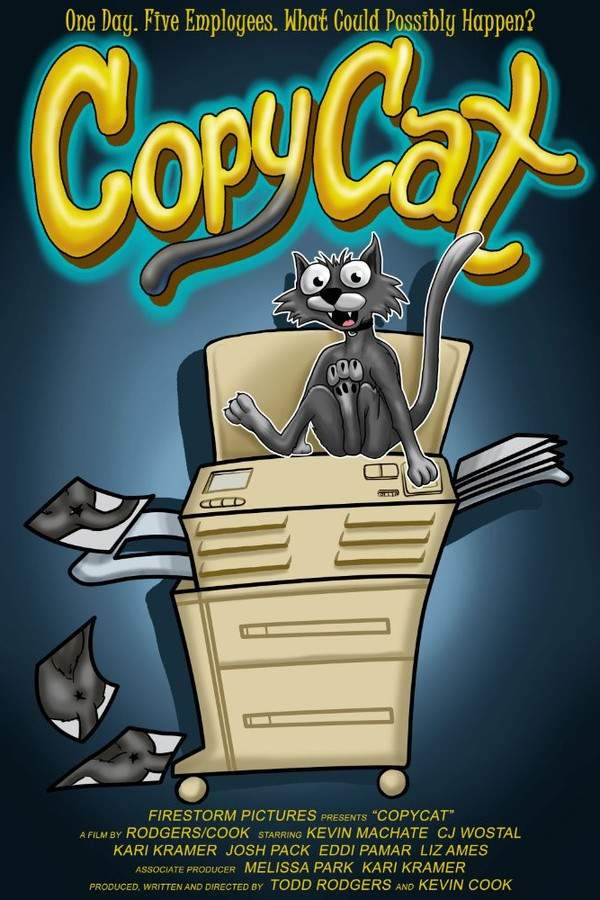
Copycat 1995

Directed by

Jon Amiel
Made by

Warner Bros. Pictures
Where to Watch Copycat
See current US streaming, rental, and purchase options for Copycat (1995) via JustWatch.








Copycat Plot Summary
Read the complete plot summary and ending explained for Copycat (1995). From turning points to emotional moments, uncover what really happened and why it matters.
Dr. Helen Hudson Holly Hunter, a respected expert on serial killers, begins the sequence by delivering a guest lecture on criminal psychology at a local university. The moment she leaves the lecture hall, an escaped subject, Daryll Lee Cullum, corners her in the restroom, where he murders a police officer and brutally assaults her. A second officer manages to subdue Cullum, who is then sent back to prison. The trauma from the attack leaves Helen with a crippling agoraphobia, confining her to a sprawling apartment and pushing her to conduct almost every aspect of her life through a computer screen, with the steady support of her live-in assistant, Andy.
Homicide detective M.J. Monahan Sigourney Weaver and her partner, Ruben Goetz, are immediately drawn into the case as a string of similar murders sweeps through San Francisco. Reluctantly, Helen agrees to lend her expertise, recognizing that the killer is playing a dangerous game of mental chess with the authorities. As the killings continue, it becomes clear that the perpetrator draws inspiration from infamous figures—Albert DeSalvo, The Hillside Strangler, David Berkowitz, Jeffrey Dahmer, and Ted Bundy—tying the murders to a chilling pattern. The killer begins to reach out to Helen directly, even stalking her, which drives a painful rift between her and the outside world. Cullum, now more connected to the case than ever, claims to have insider knowledge about the killer and reveals where the next attack will occur, offering a dangerous bridge between survivor and hunter.
The investigation hits a brutal snag when another unrelated incident at the police station unfolds: a suspect gains access to a firearm, takes Ruben hostage, and forces a dramatic confrontation. M.J. shoots the suspect in the right shoulder, who then rises again and kills Ruben with his left hand, leaving M.J. with a heavy burden of guilt. Rather than bow out, she resolves to continue the pursuit alone, driven by the need to bring the killer to justice and to honor the memory of her fallen partner.
As the clues mount, Helen realizes that the copycat killer is following the exact sequence of killers she outlined in her university lecture—an eerie echo of the night she was attacked. The team surmises that the next target would be Jeffrey Dahmer’s method, but they remain unsure of the when and where. The investigation takes a darker turn when Andy is abducted by the killer during a night out at a club and is killed in a manner reminiscent of Dahmer. A club witness identifies the killer as Peter Foley, a man known to the police for his correspondence with Cullum. A failed attempt to capture Foley at his residence leads M.J. to Helen’s home, where she discovers that Foley has kidnapped Helen and left a chilling video asking M.J. to guess Helen’s location.
M.J. races back to the lecture hall restroom—the site of Cullum’s earlier assault—and uncovers a grim tableau: Helen is bound, hanged, and gagged in the same terrifying pose Cullum used. Foley shoots M.J. in the chest, though her protective vest saves her from lethal harm, and she slumps unconscious. Foley then turns his attention to Helen, preparing to kill her in another staged crime scene. In a tense moment, Helen attempts to sabotage Foley’s plan by attempting to hang herself, but Foley intervenes and cuts her down. The struggle drives them to the rooftop, where Helen’s agoraphobia spikes, leaving her momentarily overwhelmed and cornered.
In a pivotal moment of resolve, M.J. arrives and shoots Foley in the arm, buying Helen a split-second chance to survive. Foley brandsishs his gun toward M.J., but Helen, gathering every ounce of courage, shoots Foley repeatedly—first at his torso and then finally in the head—ending his murderous spree. The climactic confrontation affirms Helen’s survival and resilience, even as the trauma of the ordeal continues to echo in the minds of those who fought to stop the killer.
In the aftermath, Cullum writes to another serial killer, outlining how to kill Helen and revealing that he had been assisting Foley all along. The closing note leaves the door open for further menace, hinting at a chilling continuation beyond the events depicted, and underscoring the fragile line between victim and target in a game that feeds on fear and psychological precision.
Copycat Timeline
Follow the complete movie timeline of Copycat (1995) with every major event in chronological order. Great for understanding complex plots and story progression.
Helen Hudson is attacked after her lecture
Dr. Helen Hudson is cornered in the university lecture hall restroom by her escaped subject, Daryll Lee Cullum. He kills a police officer and brutalizes Helen before a local officer subdues him and re-captures him. The assault leaves Helen traumatized and sets the stage for her agoraphobic withdrawal.
Helen retreats into agoraphobia
In the wake of the attack, Helen becomes severely agoraphobic and secludes herself inside her large apartment. She conducts her life through a computer and is supported by her live-in assistant, Andy. The world outside the apartment becomes a dangerous unknown she refuses to face.
Copycat murders begin; investigators call Helen
A string of similar murders spreads fear across San Francisco, drawing homicide detective M.J. Monahan and her partner Ruben Goetz to seek Helen's expertise. Public danger forces the team to turn to the woman who studied serial killers for insight. Helen is reluctantly pulled back into the case.
Killer mimics famous serial killers
As the murders escalate, the killer draws inspiration from famous killers that Helen lectured about, including Albert DeSalvo, The Hillside Strangler, David Berkowitz, Jeffrey Dahmer, and Ted Bundy. The killer seems to be following Helen's lecture map, reinforcing the connection to her. The threat becomes a game of wits between hunter and subject.
Killer contacts and stalks Helen
The murderer begins contacting and stalking Helen directly, and Cullum offers his knowledge of the killer to help locate the next strike. The cat-and-mouse game tightens as Helen's safety becomes a concern. She is forced to confront the return of danger she thought she had escaped.
Police station incident; Ruben is killed
During an unrelated incident at the police station, a suspect gains access to a gun and takes Ruben hostage. M.J. shoots the suspect in the shoulder, but the man recovers and shoots Ruben in the chest with his left hand, killing him. The episode deepens M.J.'s guilt and resolve.
M.J. resolves to pursue alone
The officers are unable to intercept the killer, and M.J. decides to continue the investigation by herself. She focuses on the killer's pattern and the copycat's next move. The tragedy steels her resolve to pursue the case solo.
Copycat targets Dahmer next
Helen realizes the copycat will follow the list in the same order and suspects the next murder will imitate Jeffrey Dahmer. The team races to anticipate where and when the next Dahmer-like act will occur.
Andy is killed in a club
A killer abducts Andy from a club and murders him in a Dahmer-esque manner, confirming the copycat's grim pattern. A witness later ties the killer to Peter Foley.
Peter Foley identified
A witness identifies the killer as Peter Foley, a man known to the police for corresponding with Cullum. The identifying evidence connects Foley to Cullum's influence.
Foley kidnaps Helen
M.J. reaches Helen's residence to find that Foley has kidnapped her and left a video taunting M.J. to guess where she is. The stakes rise as Helen becomes the focal point of the killer's game.
Rescue attempt at the lecture hall restroom
M.J. returns to the lecture hall restroom and discovers Helen bound, hanged, and gagged in the copycat's reenactment of Cullum's crime. The confrontation forces M.J. to confront the killer and rescue Helen in a high-tension moment.
Foley shoots M.J.; Helen attempts self-sabotage
Foley shoots M.J. in the chest, though she wears a bulletproof vest, and closes in on Helen. Helen tries to sabotage Foley's crime scene by hanging herself, hoping to derail his plan. Foley cuts her down, and the struggle continues.
Escape to the roof; final confrontation
Helen escapes to the building's roof, overwhelmed by agoraphobia, as Foley corners her. M.J. arrives and shoots Foley's arm, giving him a chance to surrender. When Foley aims at Helen, she returns fire and kills him with shots to the head.
Cullum's later letter to another killer
Some time after Foley's death, Cullum writes to another serial killer, instructing him on how to kill Helen and revealing that he had been aiding Foley all along. The antagonist's manipulations continue beyond the main events.
Copycat Characters
Explore all characters from Copycat (1995). Get detailed profiles with their roles, arcs, and key relationships explained.
Dr. Helen Hudson (Holly Hunter)
A renowned criminology expert on serial killers, Helen is drawn back into a live investigation after a traumatic attack. She now solves from behind a computer, relying on intellect, analysis, and steely resolve despite crippling agoraphobia. Her guarded demeanor hides a deep determination to outsmart the killer and protect others.
Detective M.J. Monahan (Sigourney Weaver)
A lead homicide detective who pushes through fear and guilt to pursue the copycat. She partners with Helen, balancing professional resolve with the personal toll of the case and a traumatic incident that colors her judgment. Her determination drives the investigation forward as she hunts the killer.
Ruben Goetz
M.J.’s partner who is violently robbed during the case and dies, sparking guilt and a fierce resolve in the detective to continue the pursuit alone. His death underscoring the real stakes of the killer’s game.
Daryll Lee Cullum
A former subject of Hudson who assists the investigation by sharing insights about the killer and his targets. He acts as a bridge between the detectives and the truth, though his loyalties and motives remain murky.
Peter Foley
The copycat killer who emulates infamous serial killers, orchestrating attacks to fit a planned sequence and challenging the detectives to anticipate the next move. He kidnaps Helen and creates a climactic confrontation with M.J.
Andy
Dr. Hudson’s live-in assistant who supports her daily life and the investigation from behind the scenes. He becomes a victim of the killer, illustrating the human cost of the cat-and-mouse game.
Copycat Settings
Learn where and when Copycat (1995) takes place. Explore the film’s settings, era, and how they shape the narrative.
Time period
Mid-1990s
Set in the mid-1990s, the story unfolds before the era of smartphones, relying on early computer communication and forensic psychology. Police work leans on mental profiling and media-driven investigation, reflecting the period’s investigative trends. The urban crime atmosphere and sensational headlines amplify the tension as the killer mimics famous serials from the past.
Location
San Francisco, California, University lecture hall, City apartment building
Set in San Francisco, the film unfolds across the city’s urban landscape. Key locations include a university lecture hall where the original assault occurred and a large apartment complex where Dr. Hudson isolates herself. The city’s foggy streets and busy public spaces become a stage for the killer’s games and the detectives’ pursuit.
Copycat Themes
Discover the main themes in Copycat (1995). Analyze the deeper meanings, emotional layers, and social commentary behind the film.
🧠
Copycat Crimes
The killer models behavior after infamous murderers, turning their notoriety into a dangerous playbook. The film probes how public fascination with criminals can fuel replication. Helen Hudson’s expertise becomes vital because the pattern is intentional imitation, not random chaos. The theme explores how knowledge can empower investigators while sometimes enabling a dangerous mimicry.
🚪
Agoraphobia
Dr. Hudson’s fear of open spaces traps her inside a cluttered apartment, shaping how she engages with the case. She relies on a computer and careful deduction rather than direct field work. The narrative uses isolation to amplify the threat and test her resilience. The rooftop confrontation ultimately strains her limits, forcing a high-stakes decision.
🎭
Media Influence
Media attention and public curiosity around serial killers frame both the investigation and the public’s fear. The killer’s acts travel through the same academic lecture that inspired his blueprint, highlighting the dangerous loop between education and sensationalism. The investigation becomes a performance where facts compete with headlines. The film critiques how fame and rumor can shape justice.

Coming soon on iOS and Android
The Plot Explained Mobile App
From blockbusters to hidden gems — dive into movie stories anytime, anywhere. Save your favorites, discover plots faster, and never miss a twist again.
Sign up to be the first to know when we launch. Your email stays private — always.
Explore the mobile appCopycat Spoiler-Free Summary
Discover the spoiler-free summary of Copycat (1995). Get a concise overview without any spoilers.
In the waning hours of a beloved but struggling neighborhood shop, the day’s routine gives way to an unsettling undercurrent. As the final bell rings, the four eclectic clerks—each with their own quirks and hidden hopes—find themselves thrust into a series of odd encounters that feel both ordinary and oddly off‑kilter. The shop, a microcosm of the community it has served, becomes a stage where the mundane world seems to tilt, inviting a sense of unease that lingers in every aisle and behind every counter.
The atmosphere grows increasingly strange as a parade of unusual customers drifts through the doorway, each interaction hinting at something beyond the surface. Whispered jokes turn into uneasy laughter, and the flickering fluorescent lights seem to pulse in time with the clerks’ rising anxiety. The line between what is happening and what might be imagined starts to blur, casting shadows over the familiar routine and prompting the staff to question the very fabric of their reality.
Amidst this growing disquiet, the clerks’ personalities clash and complement one another, creating a dynamic blend of humor, tension, and reluctant camaraderie. Their differing outlooks—ranging from skeptical cynicism to hopeful idealism—serve as both a buffer and a catalyst for the strange events that unfold. As the day draws to a close, the shop becomes more than a place of commerce; it transforms into a reflective space where ordinary lives intersect with the uncanny, leaving both characters and viewers alike to wonder just how thin the veil truly is between the ordinary and the extraordinary.
Movies with Similar Twists and Themes
Uncover films that echo the narrative beats, emotional arcs, or dramatic twists of the one you're exploring. These recommendations are handpicked based on story depth, thematic resonance, and spoiler-worthy moments — perfect for fans who crave more of the same intrigue.


Featured on this page

What's After the Movie?
Not sure whether to stay after the credits? Find out!
Check out our other apps:

SAT Sphere
Build confidence for the Digital SAT.

Mori Atlas
Discover wild places worth protecting.

Luntero
Search smarter for a home in Amsterdam.

Plot Explained
Unravel movie endings and hidden clues.

Pokechamp
Dive into Pokémon data and battle logic.

Driving Theory
Get ready for your European theory test.

Movie Dust
Plan your next cinema trip with ease.

Musemap
Find art and culture as you travel.

Selkobase
Compare credentials before committing.

Local Manual
Turn an unfamiliar country into practical next steps.

Lernavi
Compare school systems before your next move.

GymRoam
Find a workout stop wherever your plans take you.
Explore Our Movie Platform
New Movie Releases (2026)
Famous Movie Actors
Top Film Production Studios
Movie Plot Summaries & Endings
Major Movie Awards & Winners
Best Concert Films & Music Documentaries
Movie Collections and Curated Lists
© 2026 What's After the Movie. All rights reserved.
Privacy Policy