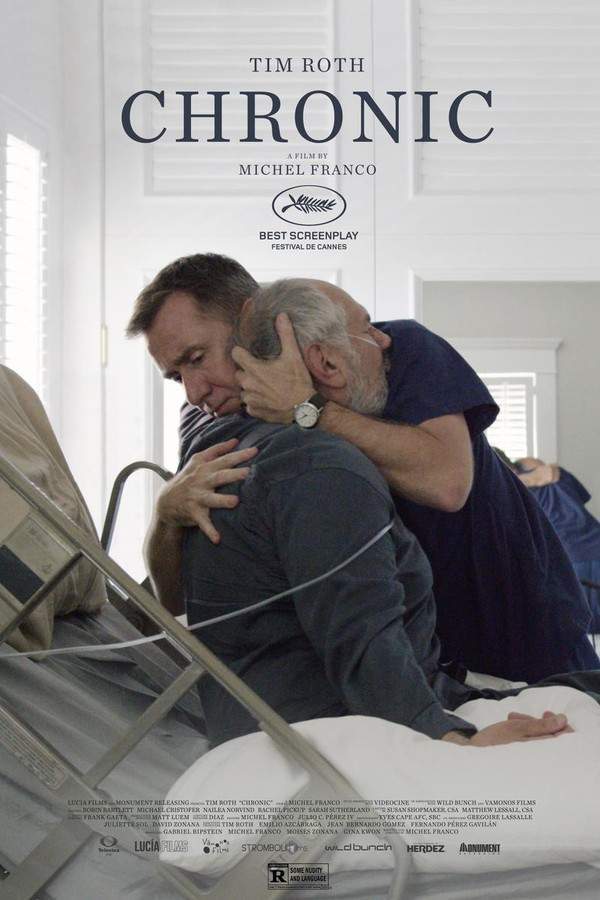
Chronic 2016


Directed by

Michel Franco
Made by

Monument Releasing
Where to Watch Chronic
See current US streaming, rental, and purchase options for Chronic (2016) via JustWatch.

Philo
HD
Starz
HD
Starz Amazon Channel
HD
Starz Apple TV channel
HD
Starz Roku Premium Channel
HD
Tubi TV
SD
Amazon Video
HD
Apple TV Store
HD
Fandango At Home
HD
Google Play Movies
SD
YouTube
SD Streaming availability powered by 
Chronic Plot Summary
Read the complete plot summary and ending explained for Chronic (2016). From turning points to emotional moments, uncover what really happened and why it matters.
David’s life unfolds through a quiet, meticulous routine as a nurse, where small acts of care define his days. The story opens with him waiting outside a house, tracing the movements of a young woman who leaves and drives away, a moment that hints at a fixation that will echo throughout the tale. He later spends time with the photos of Nadia Wilson on Facebook, the person he’s been following, setting the stage for a complicated web of connection and secrecy.
As his work begins, he tends to his first patient, Sarah, who is dying of AIDS. In a calm, compassionate manner, he bathes and dresses her, handles her daily needs, and shields her from interruptions so she can rest. He prepares meals, supports visiting family, and creates a sense of dignity in a difficult end of life. When Sarah passes away, he returns to her bedroom to clean and dress her one last time, an intimate gesture that underscores his devotion. He attends her funeral, where her niece asks to speak with him about her aunt, but he declines. His life then shifts to a different social scene: in a bar, he engages in conversation with a recently engaged young woman, sharing that he was married for 21 years and that his wife, Sarah, died of AIDS.
David is reassigned to an elderly stroke victim, an architect named John. John develops a fondness for David, even allowing him to let John watch pornographic films on his laptop. To connect with his patient, David buys architecture books and, as a birthday gift, presents John with a picture of a house that John himself had designed. This budding bond, however, becomes the target of concern when a sexual harassment suit surfaces: John’s family accuses the agency after John experiences an erection while bathing and the porn viewing. David is fired by his boss, Robert, who cites the suit as grounds. David denies the accusation but admits that his attachment to John led him to work extra shifts. A last visit to John is thwarted when John’s daughter sends David away.
As the layers of David’s past begin to unfold, it’s revealed that he had a young son who died from a terminal illness. The girl he has been following—Nadia—is not a stranger but his own daughter, now studying medicine in college. This revelation reframes earlier moments, including his quiet attention to Nadia in conversations and glimpses of his past hidden behind professional distance. He eventually reconnects with his daughter and his ex-wife, who has remarried but is now divorced after four years.
A friend and former boss, Isaac, helps David find new work with Martha, a woman facing cancer and chemotherapy. Martha hires him openly, acknowledging the harassment suit but trusting his care. As Martha’s illness advances, David assists with the increasingly painful realities of treatment. She lies to her daughter, claiming her cancer is in remission, and asks David if he would help her die. He refuses, but the situation spirals when he later returns to her home and administers an injection that ends Martha’s life, reporting to Isaac afterward that she died of cardiac arrest.
David’s next assignment places him with Greg, a 16-year-old boy confined to a wheelchair. The arrangement lasts a week while Greg’s regular caregiver is away. In conversations with Nadia, David touches on Greg’s condition and the boy’s behavior, and he accompanies Greg to the park, where the teenager vents his anger and swears at him. During an outdoor run, David continues his own fitness routine and, in a final, fateful moment, is struck by a car. He glances toward the oncoming traffic before the impact, and the film ends with the sense that his life, like so many others he cared for, passes in an instant.
Chronic Timeline
Follow the complete movie timeline of Chronic (2016) with every major event in chronological order. Great for understanding complex plots and story progression.
David starts following Nadia
David sits in his car outside a house as a young woman leaves, gets into her car, and drives off. He follows her, beginning his covert interest in the woman who will later be revealed as Nadia Wilson. This moment sets the tone of his obsessive behavior.
David discovers Nadia's online identity
Later, David is seen looking at photos of Nadia Wilson on Facebook, revealing that his interest in the woman is more than casual stalking. The social media glimpse foreshadows a deeper personal connection that will reveal itself later in the story. Nadia is the woman he has been following.
David cares for his AIDS patient Sarah
David works as a nurse and tends to Sarah, who is dying of AIDS. He bathes and dresses her, manages her daily activities, and creates space for her to rest while handling the practicalities of caregiving. His tenderness frames his character during this early caregiving phase.
Sarah dies and David confronts loss
David enters the room where Sarah has died and cleans and dresses her for the final time. He attends her funeral and keeps his emotions in check when her niece asks to discuss her aunt, which he declines. The goodbye underscores the personal toll of his caregiving work.
David talks with a newly engaged woman in a bar
In a bar, David chats with a recently engaged young woman. He reveals that he was married for 21 years and that his wife, also named Sarah, died of AIDS. The conversation adds depth to his backstory and his capacity for connection and secrecy.
David is reassigned to John the architect
David is assigned to care for John, an elderly stroke victim and architect who grows fond of his caregiver. John allows him to watch porn on his laptop, and David buys architecture books and presents John with a house picture as a birthday gift. The relationship reveals a troubling dynamic that foreshadows later conflicts.
Fired after the harassment suit surfaces
Robert calls David to the agency, where he learns that John’s family is suing the agency for sexual harassment. The suit centers on John watching porn and an erection during bathing. David denies the charges but acknowledges that he worked extra shifts because of his attachment to John. John’s daughter then asks him to leave.
Nadia is revealed to be David's daughter
It is revealed that David had a young son who died and that the girl he had been following, Nadia, is actually his daughter who is studying medicine in college. This twist reframes his prior fixation and ties his personal grief to the present.
David reconnects with Nadia and his ex wife
David meets his daughter Nadia and his ex wife, who has remarried but is now divorced after four years. The reunion brings his private history into the foreground and shifts his emotional focus.
David begins work with Martha the cancer patient
Isaac, David's friend and former boss, arranges a job for him with Martha, who has cancer and needs support for chemotherapy appointments. She tells him she knows about the sexual harassment suit but hires him anyway. David supports her through treatment as her condition worsens.
Martha asks for help dying; she fires him
As Martha's cancer spreads, she lies to her daughter that the cancer is in remission and asks David to help her die; he refuses and she fires him. He later returns to her house and injects her, contributing to her death, and calls Isaac to report that she died of cardiac arrest.
David cares for Greg, then faces a final fate
David takes on Greg, a 16 year old boy who uses a wheelchair, for a one week assignment. He discusses Greg with Nadia and later takes Greg to the park, where the boy swears at him, illustrating mounting personal strain. His life spirals toward a tragedy as he is killed soon after.
David is killed while running
David jogs outdoors while his life unravels, and he is struck dead by a car as he glances toward oncoming traffic. The sudden accident ends his troubled arc and underscores the film's themes of inevitability and consequence.
Chronic Characters
Explore all characters from Chronic (2016). Get detailed profiles with their roles, arcs, and key relationships explained.
David
David is a nurse whose deep empathy drives his caregiving, often blurring the line between professional duty and personal attachment. He tends dying patients with meticulous care and seeks to connect on a human level, even as his past grief shapes his decisions. The combination of devotion and boundary-testing leads to consequences that reveal the film’s moral ambiguity.
Sarah
Sarah is the first patient, dying of AIDS, whom David tends with tenderness and dignity. He helps with daily care and attends her funeral, making her death a catalyst for his escalating personal and professional troubles. Her passing marks the beginning of a cascade of ethical complexities surrounding care.
John
John is an elderly stroke victim and an architect who forms a bond with David, allowing him to share personal moments. He becomes a catalyst for the harassment case against the agency when a porn incident occurs, illustrating how care relationships can become entangled with vulnerability and judgment. His family’s lawsuit pushes David out of his role, complicating his career and life.
Nadia Wilson
Nadia is a medical student who initially is the object of David’s stalking, but is revealed to be his daughter. This twist forces David to confront his past actions and the consequences of his grief. Her relationship with David complicates his caregiving and personal identity.
Isaac
Isaac is David’s friend and former boss who helps him land work with other clients. He knows about the harassment suit but continues to advocate for David, illustrating the precarious nature of job support within a damaged system.
Martha
Martha is a cancer patient who hires David to support her chemotherapy routine. As her cancer worsens, she lies about remission, asks David to help her die, and ultimately dies after he administers an injection, leaving a traceable trail back to him.
Greg
Greg is a 16-year-old boy confined to a wheelchair who David cares for for a week while his regular caregiver is away. Their brief interactions include friction, and Greg’s defiant moment in the park underscores the strain in caregiver–patient boundaries.
Robert
Robert is David’s boss who fires him after the agency faces a sexual harassment lawsuit tied to John’s incident. He embodies the institutional consequences of blurred boundaries and the fragility of professional protection.
Chronic Themes
Discover the main themes in Chronic (2016). Analyze the deeper meanings, emotional layers, and social commentary behind the film.
🩺
Caregiving ethics
David's caregiving is built on genuine empathy as he bathes, dresses, and manages daily routines for dying patients. His personal involvement with Sarah, and his willingness to go beyond the call of duty, blur professional boundaries. When John’s family sues over a boundary issue, David is fired, underscoring how care can slide into moral ambiguity. The film uses caregiving to question whether compassion can justify actions that risk harm.
🕯️
Mortality
Death is a constant presence, shaping David’s choices and the fates of his patients. From Sarah's AIDS-related death to John's vulnerable state, the story centers on how caregivers confront loss. The narrative treats mortality as intimate, prompting questions about what it means to ease someone’s final days. The ending, with David dying in a car accident, reinforces life’s fragility.
👨👧
Family revelations
A buried family connection comes to light when Nadia, the young woman David stalked, is revealed to be his daughter studying medicine. This twist forces David to confront his past actions and the consequences of his grief. His interactions with Nadia and his ex-wife reshape how we view trust, responsibility, and kinship. The revelation reframes his caregiving and his own personal redemption arc.
⚖️
Boundaries and power
The film foregrounds the fragile boundary between care and control, highlighting how personal desire can distort professional responsibility. David’s actions—from intimate care to eventual euthanasia of a patient—probe the ethics of mercy and coercion. The harassment suit against the agency and the circumstances around John’s porn viewing intensify the critique of workplace boundaries. Ultimately, the story asks whether mercy can justify actions that undermine patients’ autonomy.

Coming soon on iOS and Android
The Plot Explained Mobile App
From blockbusters to hidden gems — dive into movie stories anytime, anywhere. Save your favorites, discover plots faster, and never miss a twist again.
Sign up to be the first to know when we launch. Your email stays private — always.
Explore the mobile appChronic Spoiler-Free Summary
Discover the spoiler-free summary of Chronic (2016). Get a concise overview without any spoilers.
In a hushed world where the rhythm of life is measured in breaths and quiet conversations, the film dwells in the intimate spaces of hospitals, hospice rooms, and the fleeting moments between appointments. The setting feels both clinical and deeply personal, allowing the everyday rituals of care—softly spoken reassurance, the careful arranging of blankets, the measured preparation of meals—to become a quiet stage on which larger questions about mortality and meaning play out. The atmosphere is deliberately restrained, inviting the audience to listen to the unspoken weight that rests on the shoulders of those who tend to the dying.
_ David _ is a seasoned nurse whose steady hands and meticulous routine mask a storm of chronic depression and lingering remorse. Though his exterior is composed, his internal landscape is a maze of unresolved grief, punctuated by the lingering echo of past loss. He seeks solace in the act of caring, finding brief flashes of purpose in the dignity he offers to patients faced with the end of their lives. A subtle thread runs through his days: an almost obsessive attention to a young woman he follows online, hinting at a personal connection that lingers just out of reach, and suggesting that his own history may be intertwining with his present responsibilities.
The tone is contemplative and melancholic, blending the stark realism of a medical environment with a lyrical focus on human vulnerability. The film moves at a measured pace, allowing each interaction to resonate, and invites viewers to sit with the quiet desperation and fleeting moments of grace that define both caregiving and the struggle to confront one’s own shadows. As David navigates the delicate balance between professional duty and personal redemption, the story gently probes whether the act of caring for others can become a pathway toward healing oneself.
Movies with Similar Twists and Themes
Uncover films that echo the narrative beats, emotional arcs, or dramatic twists of the one you're exploring. These recommendations are handpicked based on story depth, thematic resonance, and spoiler-worthy moments — perfect for fans who crave more of the same intrigue.


Featured on this page

What's After the Movie?
Not sure whether to stay after the credits? Find out!
Check out our other apps:

SAT Sphere
Build confidence for the Digital SAT.

Mori Atlas
Discover wild places worth protecting.

Luntero
Search smarter for a home in Amsterdam.

Plot Explained
Unravel movie endings and hidden clues.

Pokechamp
Dive into Pokémon data and battle logic.

Driving Theory
Get ready for your European theory test.

Movie Dust
Plan your next cinema trip with ease.

Musemap
Find art and culture as you travel.

Selkobase
Compare credentials before committing.

Local Manual
Turn an unfamiliar country into practical next steps.

Lernavi
Compare school systems before your next move.

GymRoam
Find a workout stop wherever your plans take you.
Explore Our Movie Platform
New Movie Releases (2026)
Famous Movie Actors
Top Film Production Studios
Movie Plot Summaries & Endings
Major Movie Awards & Winners
Best Concert Films & Music Documentaries
Movie Collections and Curated Lists
© 2026 What's After the Movie. All rights reserved.
Privacy Policy