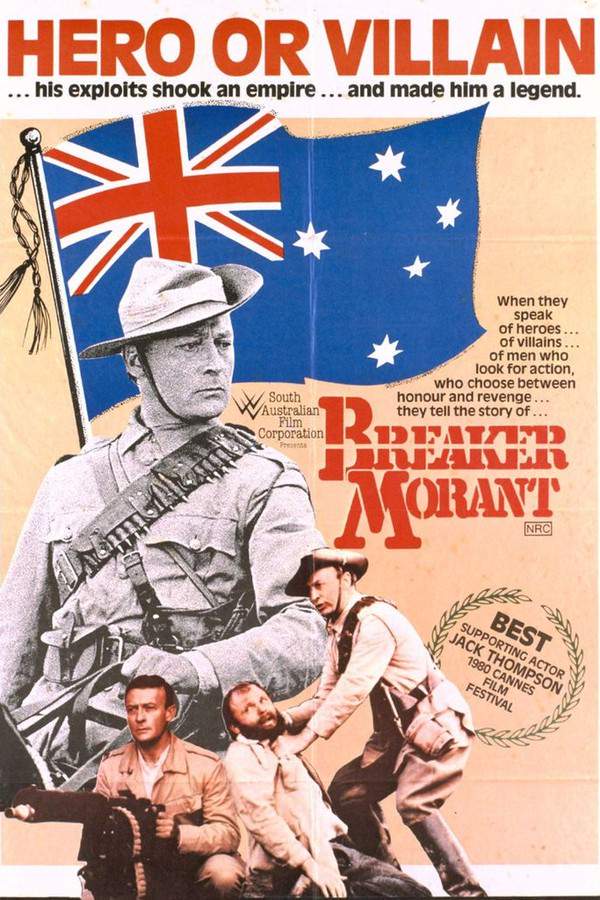
What Is Breaker Morant About?
The premise of Breaker Morant in 276 words, with nothing given away. The full story follows below.
In the dusty heat of South Africa’s Second Boer War, a band of Australian officers from the elite Bushveldt Carbineers finds themselves caught in a clash of duty and conscience. The remote frontier camp, rattling with gunfire and the murmurs of uneasy alliances, serves as a stark backdrop for a story that balances the brutal realities of guerrilla combat with the weighty expectations of empire. Within this volatile setting, the men’s loyalties are tested not only by the enemy beyond the fences but also by the invisible judgments of the distant British high command.
At the heart of the conflict stand Harry “Breaker” Morant, Peter Handcock and George Witton, three soldiers whose camaraderie and rugged individualism have earned both admiration and suspicion. Their outspoken nature and fierce dedication to one another draw the attention of Lord Kitchener, the ambitious commander determined to shape the war’s outcome and his own legacy. As political negotiations loom, Kitchener’s resolve to demonstrate the empire’s moral authority brings the trio under a cloud of legal scrutiny, setting the stage for a high‑stakes confrontation that blurs the line between justice and expediency.
Guiding the defense is Major Thomas, a pragmatic lawyer tasked with navigating a labyrinthine military tribunal that moves at a relentless pace. The atmosphere is thick with tension: the clatter of boots on dusty roads, the echo of distant artillery, and the oppressive silence of a courtroom where every word could tilt the balance of power. Amidst the stark landscape and the looming specter of imperial politics, the film weaves a brooding, character‑driven narrative that asks how far obedience can stretch before it becomes a sacrifice of one’s own humanity.
What Happens in Breaker Morant?
The complete story of Breaker Morant, from the first scene to the last, in 589 words (about 3 minutes). Spoilers throughout. Names in the text link to 1 cast member page.
Spoilers ahead
Breaker Morant delves into the harrowing murder trial of three Australian soldiers, who serve as officers of the elite Bushveldt Carbineers in South Africa. The accused—Harry “Breaker” Morant, Peter Handcock, and George Witton—stand trial for the murder of a Boer prisoner, followed by the execution of six additional prisoners, while Morant and Handcock are implicated in the sniper-style death of a German missionary, the Rev. Hesse. Their defense, led by Major Thomas, is severely hampered, having only one day to prepare a viable argument.
At the heart of this trial is Lord Kitchener, who aims to terminate the Boer War through a peace conference. To demonstrate his commitment to military ethics, he uses the Morant trial as an example of his willingness to hold his own soldiers accountable when they breach warfare regulations. However, the trial is fraught with complexity, as noted by one character—the intricacies of charging active-duty personnel with murder are anything but straightforward. Nevertheless, Kitchener remains resolute in pursuing a guilty verdict, with the chief of the court supporting him.
The narrative explores the events and motivations leading to the trial. Morant’s execution of the Boer prisoners stems from a desperate need for revenge following the mutilation and death of his friend and commanding officer, Captain Hunt. Following this tragic event, Morant leads a brutal attack on a Boer camp, resulting in the capture of a Boer clad in Captain Hunt’s uniform, whom he executes without hesitation.
Similarly, the murders of six Boer prisoners unfold in a ruthless manner. Morant attempts to rationalize these deaths, asserting, > “You know the orders from Whitehall. If they show a white flag, we don’t see it. I didn’t see it.” His conviction leads him to suspect the German missionary, Rev. Hesse, of being a spy after witnessing him converse with Boer captives. In a fit of anger, Morant expresses his fury, which prompts Handcock to follow the missionary, who is discovered dead the following morning.
As the trial progresses, the bias of the court toward a predetermined guilty outcome becomes strikingly evident, alongside the political maneuvering fueling it. The central question revolves around whether Kitchener issued orders to execute all Boer prisoners; Major Thomas argues convincingly that there were indeed unrecorded orders to that effect, communicated verbally. However, disproving their existence proves impossible since Captain Hunt conveyed them to Morant through informal channels.
Amidst the irony of Morant’s compliance with orders leading to his actions, it is revealed that he and Handcock are guilty of Hesse’s murder. Handcock, after meticulously crafting an alibi with two acquaintances, confides in Witton about his clandestine pursuit and shooting of Hesse. Although the court acquits them of this particular charge, they are nonetheless found guilty of the other offenses.
Conveniently, Kitchener is absent during the critical pleas for a reprieve. Though he reduces Witton’s sentence to life imprisonment, Morant and Handcock’s fates are sealed, and they face execution the following morning. An ironic twist awaits even in death; Handcock’s coffin is too small for his frame, necessitating a grotesque effort by the soldiers to fit his body inside.
In a reflective conclusion, the audience learns of the fates that befall these characters post-trial. Major Thomas returns to Australia, where he continues his law practice focused primarily on estate management and wills. Witton endures a three-year prison sentence but eventually earns his release amidst public outcry, later penning a controversial book titled Scapegoats of the Empire. This inflammatory account of the Breaker Morant affair proves so contentious that it is suppressed during the World Wars.
Breaker Morant Timeline: Every Key Event in Order
14 key events in the order they happen, from “Murder Trial Begins” to “Legacy of the Trial”.
- 1
Murder Trial Begins
The film opens with the start of the murder trial of three Australian soldiers, Harry 'Breaker' Morant, Peter Handcock, and George Witton. They are accused of murdering a Boer prisoner, which sets the stage for the unfolding legal and moral complexities of the case.
- 2
Accusations and Charges
The accused soldiers face serious charges, including the murder of six additional Boer prisoners. The prosecution consists of military officials who underscore the gravity of the accusations, highlighting the implications for soldiers in wartime.
- 3
Lord Kitchener's Involvement
Lord Kitchener, determined to end the Boer War, uses the trial to showcase military accountability. His goal is to emphasize that even his own soldiers must face justice if they violate wartime ethics, placing significant pressure on the trial proceedings.
- 4
Morant's Motivations
The narrative delves into Morant's motivations, revealing his fierce desire for revenge after the death of his commanding officer, Captain Hunt. This personal loss drives him to take extreme actions against Boer captives, shaping the story's tragic trajectory.
- 5
Brutal Attack on Boer Camp
In retaliation for Captain Hunt's mutilation, Morant leads a brutal attack on a Boer camp. This violent act results in capturing a Boer wearing Captain Hunt's uniform, culminating in Morant executing him without hesitation, illustrating the raw emotions driving him.
- 6
Execution of Boer Prisoners
Morant's rationale for executing six Boer prisoners highlights his belief that they posed a threat. He claims orders from higher authorities allowed for such actions, illustrating his moral justifications amidst the chaos of war and personal loss.
- 7
Death of Rev. Hesse
The plot thickens with the involvement of the German missionary, Rev. Hesse. Suspecting him of espionage, Morant's fury leads to Hesse's murder, a decision that weighs heavily on the court's trial as both Morant and Handcock navigate their culpability.
- 8
The Trial's Bias
As the trial progresses, the biases of the court become glaringly evident. Major Thomas argues that unrecorded orders existed to execute Boer prisoners, yet the informal nature of communications complicates the defense, showcasing the intertwined politics of the trial.
- 9
Murder of Hesse Acquittal
Despite the evidence against Morant and Handcock regarding Hesse's murder, the court acquits them of this charge. However, they are found guilty on other counts, emphasizing the moral ambiguities that underpin their actions during the war.
- 10
Verdict and Sentences
The trial concludes with devastating outcomes. While Witton's sentence is reduced to life imprisonment, Morant and Handcock face execution, highlighting the cruel ironies of a wartime justice system that prioritizes accountability over individual lives.
When:The following morning
Show the other 4 events of Breaker Morant Hide the last 4 events
- 11
Execution Day
On the day of their execution, an ironic twist of fate occurs; Handcock's coffin is too small for his body. This grotesque moment underscores the tragic consequences of the soldiers' actions and the toll of war on their lives.
- 12
Aftermath of the Trial
The aftermath of the trial reveals the fates of the soldiers. Major Thomas returns to Australia to continue his law practice, while Witton endures a lengthy prison sentence, ultimately finding a controversial avenue for storytelling.
Where:Australia
- 13
Witton's Publication
Witton writes *Scapegoats of the Empire*, a book detailing the events surrounding the Breaker Morant affair. However, the book's content is so inflammatory that it is suppressed during the World Wars, reflecting societal tensions over historical narratives.
- 14
Legacy of the Trial
The trial leaves a lasting impact on military ethics and wartime accountability. It serves as a poignant case study illuminating the complexities and moral dilemmas faced by soldiers during conflicts.
Who Are the Main Characters in Breaker Morant?
4 characters, among them Harry 'Breaker' Morant, Major Thomas and Peter Handcock: who each one is and the part they play in the story. 1 of them link to the actor’s page.
- H'
Harry 'Breaker' Morant
Morant is characterized by his fierce loyalty and a deep sense of vengeance, which drives him to commit acts that ultimately lead to his trial. His moral conflicts and pragmatic approach to warfare showcase the complexities of a soldier's psychology under extreme duress.
- ⚔️ Soldier
- 🎖️ Loyal
- 🔥 Vengeful
-

Major Thomas
Played by Bryan Brown
Leading the troubling defense of Morant, Major Thomas embodies the struggle of maintaining ethics in a morally dubious situation. His credibility as a lawyer is tested as he grapples with the constraints imposed by the military court while trying to establish a solid defense.
- 🕵️♂️ Lawyer
- ⚖️ Advocate
- 💔 Resigned
- PH
Peter Handcock
Handcock, an essential character in the trial, represents the chaotic nature of wartime loyalty and the desperate measures taken in the heat of battle. His internal struggles play a key role in deepening the narrative around culpability and remorse.
- ⚔️ Soldier
- 🔪 Reckless
- 🧩 Complicated
- GW
George Witton
As a fellow soldier on trial, Witton confronts the reality of the decisions made under pressure. His eventual journey to authorship after imprisonment reflects the theme of seeking truth amid adversity and the burdens of memory and guilt.
- 📚 Author
- 🔍 Truth-Seeker
- 💔 Haunted
Where and When Is Breaker Morant Set?
Breaker Morant is set in South Africa (Second Boer War (1899-1902)). Here is why the time and place matter to the story.
When
Second Boer War (1899-1902)
The movie is set during the Second Boer War, a pivotal conflict between the British Empire and the Boer republics in South Africa. This period was characterized by guerrilla warfare, shifts in military strategies, and significant political ramifications, ultimately leading to the formation of the Union of South Africa.
Where
South Africa
South Africa serves as the backdrop for the events of the trial and the Boer War, known for its complex historical context involving colonial tensions. The region was marked by conflict and a struggle for power, particularly during the late 19th and early 20th centuries as European powers sought to expand their empires.
- 🌍 Location
- ⚔️ War Zone
What Are the Themes of Breaker Morant?
3 ideas the story keeps returning to, among them Justice, War Crimes and Legacy.
-
01
Justice
The theme of justice is central to Breaker Morant, as the characters navigate a flawed military court system amid the chaos of war. The trial raises critical questions about accountability and the ethics of warfare, especially regarding orders and individual actions during armed conflict.
-
02
War Crimes
War crimes become a focal point, highlighting the moral ambiguity in the soldiers' actions. The brutal realities of war and the consequences of following orders lead to a harrowing exploration of how personal and military ethics clash in the face of survival and revenge.
-
03
Legacy
The legacy of the trial and its outcomes informs the personal journeys of the characters after the war. The film delves into how historical events shape individual lives, particularly through Witton’s publication of a contentious account of the trial that sparks debate and reflection on the nature of truth.
What Kind of Film Is Breaker Morant?
Tense in tone, with steady pacing and a moderate story, going by the plot summary.
- Tone
- Tense
- Pacing
- Steady
- Story
- Moderate
- Intensity
- High
- Ending
- Sad
A relentless and morally fraught courtroom drama that builds with palpable tension, exposing the grim realities of war and political expediency through a sobering tale of injustice and sacrifice.
- tense
- somber
- oppressive
- grim
- dramatic
- morally complex
- court-martial
- war crimes
- political scapegoat
- military injustice
Content notes: war violence, execution, mutilation, political injustice.
Quiz
How well do you remember Breaker Morant? Test yourself on the story.