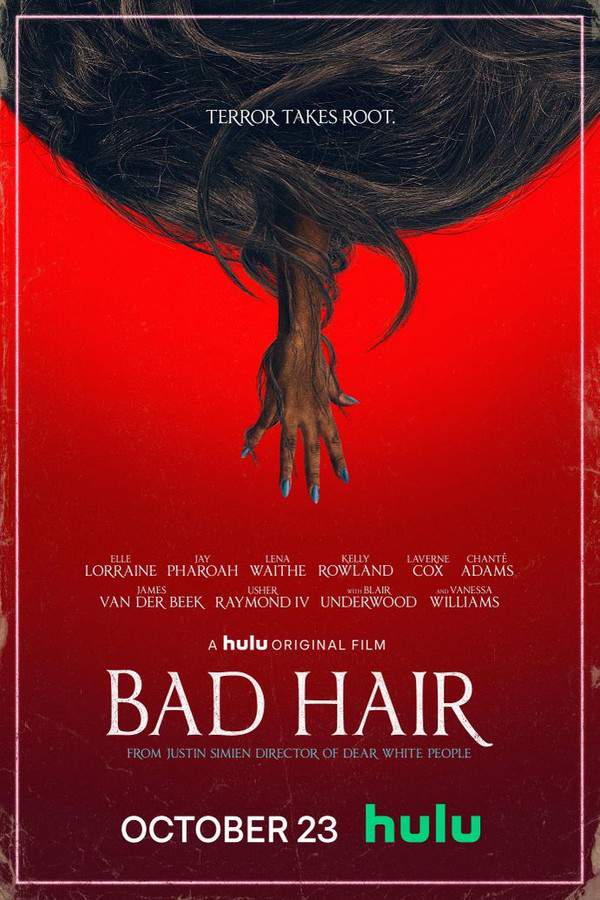
What Is Bad Hair About?
The premise of Bad Hair in 271 words, with nothing given away. The full story follows below.
In the late‑1970s, a young woman named Anna experiences a painful mishap while trying to relax her hair, leaving a scar that lingers both physically and in memory. Years later, she works as an ambitious assistant at Culture, a vibrant television station that showcases African‑American music and style. When the station’s leadership shifts and the new image demands sleek, commercial looks, Anna is pushed to replace her natural afro‑textured hair with a fashionable weave—a seemingly simple upgrade that promises the career boost she craves.
The film immerses viewers in a world where personal image is a currency and the pressure to conform is palpable. Anna’s journey introduces a cast of influential figures: the charismatic former supermodel turned executive Zora, the seasoned mentor Edna who embodies a more authentic vision, and the enigmatic salon owner Virgie, whose reputation for flawless transformations is whispered about in industry circles. The atmosphere balances the glossy allure of late‑80s music television with an undercurrent of unease, blending horror’s tension with darkly comic commentary on the lengths people will go to meet beauty standards.
As Anna embraces her new look, the weave begins to act as more than a stylistic statement, hinting at a restless agency that mirrors her inner conflicts about identity, ambition, and belonging. The tone oscillates between bright, retro‑glamour and subtle dread, inviting the audience to wonder whether the true horror lies in the hair itself or in the society that values polished appearances above all else. This unsettling mix of satire and suspense sets the stage for a story that probes how far one will let an ideal shape—and possibly control—their very self.
What Happens in Bad Hair?
The complete story of Bad Hair, from the first scene to the last, in 878 words (about 4 minutes). Spoilers throughout. Names in the text link to 6 cast member pages.
Spoilers ahead
In the late 1970s, a young Anna Bludso, Elle Lorraine tries to relax her hair with the help of her older cousin Linda Corinne Massiah. The chemical cream backfires, leaving a permanent scar on the back of her head and a memory that will shadow her for years to come.
Many years later, in 1989, an adult Anna is an assistant at Culture, a television station centered on African‑American music artists. The station is led by a formidable owner, Grant Madison James Van Der Beek, who makes a sweeping change by ousting Edna Judith Scott from her role as head of programming and replacing her with the glamorous Zora Vanessa Williams, a former supermodel whose presence signals a sharp shift in the station’s image. Anna, driven and ambitious, pitches a bold idea: to diversify the Culture VJs’ style and bring a live music video countdown show to the forefront. Impressed by her plan, Zora takes Anna on as her assistant, but with a demanding condition: Anna must swap her natural Afro-textured hair for a weave to fit the station’s new, cut‑throat image. To set the plan in motion, Zora hands her the address of Virgie’s, a high‑end hair salon that promises transformation.
Back at her aunt and uncle’s home, Anna receives support from her family—her uncle lends a book on African American slave lore, while her aunt provides enough money for the hair appointment. She travels to the salon, hoping for a fresh start, but when the receptionist informs her that the earliest slot is months away, Anna pleads directly with Virgie, the hairdresser herself, and persuades her to accommodate at the end of the day. Waiting, Anna experiences a nightmare that unsettles the nerves beneath the surface. The process is painful, and she faints as the weave takes hold. Virgie hands her a pink bottle of hair product and warns her never to let the weave get wet. In a brief moment of relief, Anna encounters her idol Sandra, whose weave once tangled in studio mishap, and she expresses a heartfelt fan‑to‑idol admiration.
Anna’s new hair brings her success, catching the eye of an old flame, Julius, Jay Pharoah. She tells him of her dream to host the countdown, and the VJs reluctantly agree to adopt the new look. Yet soon strange phenomena begin to surface: the hair seems to move on its own, Anna experiences intense hunger, and she dreams of hair being severed on a plantation. When her drunk landlord, Mr. Tannen, attempts to assault her, the hair unleashes its power, stabbing him and draining his blood in the process. Horrified, Anna witnesses the danger of the transformation and the growing sense that something monstrous is awakening.
At a party, Zora probes Anna about whether she’s still using the hair product, hinting that Zora may be afflicted as well. Edna reappears, disappointed by Anna’s abandonment of Culture’s original identity and critical of the weave as a sign of compromised integrity. The revelation lands hard when Anna learns that Zora has claimed the host position for herself and has begun an affair with Julius. When Anna and Julius later have sex, the hair possessively takes control again, and the ensuing struggle results in Julius’s death as the hair feeds on his blood.
Terrified, Anna flees to a natural hair salon to have the weave removed. She encounters Edna again, seeking guidance and redemption, but the stylist’s attempt to cut the weave out proves deadly: the hair kills everyone in the salon. In a flash of ancestral memory, Anna remembers a tale from the Moss Haired Girl, a slave lore story from her uncle’s book: a woman once wore a wig made from tree moss to imitate the straight hair of her enslavers, only to discover the moss is the hair of dead witches who possess the wearer. The frightening realization deepens as Anna discovers Zora and others who received Virgie’s weaves are now possessed.
The hair, fully in command, pursues Anna through the building. Trapped in a sound booth, she spots a gun‑lighter beneath the desk and prepares for what could be her final act. A spark from the lighter lights a cigarette, and a sprinkler system nearby—triggered by the lighter—douses the room with water. The wetness weakens the possessed hair just enough for Anna to sever the weave.
Returning to her aunt and uncle’s home, Anna learns that the hair product is made with pig’s blood, a disturbing ingredient meant to nourish and feed the hair. New advertisements for Culture feature Zora, who survived and remains fully possessed by the witches’ hair. Anna finishes reading the Moss Haired Girl and discovers that the plantation masters’ descendants continue to harvest and farm the hair. A truck bearing the same tree moss logo drives toward a plantation, loading boxes of hair and unloading the corpses of its victims. The plantation owner is revealed to be Grant Madison, the very man who once reshaped Culture’s image, and the tree moss grows nearby as a chilling symbol of control and consumption.
Amid the mounting dread, Anna’s cousin Linda Corinne Massiah announces she has secured an appointment at Virgie’s to get a weave put in, setting the stage for a renewed threat as the cycle seems poised to begin again.
Bad Hair Timeline: Every Key Event in Order
15 key events in the order they happen, from “Scar from the hair-relaxer disaster” to “Aftermath: pig’s blood and plantation horror”. 15 events name a place, across 12 locations.
- 1
Scar from the hair-relaxer disaster
In the late 1970s, a young Anna tries to relax her hair with help from her cousin Linda. The chemical reaction leaves a permanent scar on the back of her head. The scar becomes a lasting symbol of the cost of beauty and foreshadows the danger linked to hair.
When:Late 1970s Where:Aunt and Uncle's home
- 2
Anna joins Culture under a new regime
In 1989, Anna works as an assistant at Culture, a TV station centered on African-American music. The owner ousts her mentor Edna and installs Zora as head of programming. Anna sees a chance to influence the network, but it comes with the station's demand for a more commercial image.
When:1989 Where:Culture TV station
- 3
Weave mandate and opportunity
Anna pitches a plan to diversify Culture's VJs with a new look and a live music countdown. Impressed, Zora hires her as an assistant but requires Anna to wear a weave to fit the updated image. Anna is pointed toward Virgie's, the upscale salon that will do the transformation.
When:1989 Where:Culture studio
- 4
Aunt and uncle lend support
Anna returns to her aunt and uncle’s home where her uncle lends her a book on African American slave lore and her aunt provides money for the hair appointment. The lore echoes later in the film as a warning about hair’s power. This family support sets the stage for her decision.
When:1989 Where:Aunt and Uncle's home
- 5
Appointment delayed; a desperate plea
At Virgie's salon, Anna cashes in the book’s value to pay for the weave, but the receptionist says the appointment is months out. Anna pleads directly with Virgie, who agrees to do her hair at the end of the day. The moment marks a dangerous bargain that ties her fate to the weave.
When:1989 Where:Virgie's hair salon
- 6
Nightmare and first warnings
While waiting, Anna experiences a vivid nightmare. The hair process is painful, she faints, and Virgie gives her a pink bottle with a warning to never let the weave get wet. This bottle marks the start of a perilous, almost supernatural bond between Anna and her new hair.
When:1989 Where:Virgie's salon
- 7
The weave fuels her rise
Anna's new hair helps her stand out and catches Julius's eye. The weave empowers her presence, and she convinces the VJs to adopt the new look for the countdown. Her career begins to surge as the culture shift takes hold.
When:1989 Where:Culture studio
- 8
Supernatural signs emerge
Strange phenomena accompany the weave: the hair seems to move on its own, Anna experiences intense hunger, and dreams revisit a plantation. The line between fashion and a parasitic power starts to blur as the weave reveals its dark side.
When:1989 Where:Culture studio
- 9
The first murder: the landlord attack
A drunken landlord, Mr. Tannen, attempts to rape Anna. The hair activates, she stabs him, and it drains his blood from the wound. The horror of what the weave can do sinks in as Anna realizes she’s become a conduit for violence.
When:1989 Where:Anna's building/apartment
- 10
The party and the affliction reveal
At a party, Zora cryptically questions whether Anna is still using the hair product, hinting that she too is afflicted. Edna confronts Anna about selling Culture's image and criticizes the weave as a sign of compromised integrity. Anna begins to see how the power is reshaping everyone around her.
When:1989 Where:Party
Show the other 5 events of Bad Hair Hide the last 5 events
- 11
Affair and possession intensify
Anna learns Zora has become the host and is having an affair with Julius. Later, Anna and Julius sleep together, but the hair possesses her and she stabs him, feeding on his blood. The seductive lure of power has become a lethal threat.
When:1989 Where:Julius's place
- 12
Salon massacre and Moss Haired Girl lore
Anna flees to a natural hair salon to remove the weave and encounters Edna. As the stylist begins to cut, the hair kills everyone in the salon. Anna recalls the Moss Haired Girl tale from the uncle’s book, warning of dead witches whose hair holds power over the living.
When:1989 Where:Natural hair salon
- 13
Possession spreads and the final chase
Zora and others who wore Virgie’s weaves become possessed, and the hair starts chasing Anna through the building. Zora attempts to cut the hair away and is killed. The grotesque power of the moss-lit hair closes in on Anna as she runs.
When:1989 Where:Culture building
- 14
Final stand in the sound booth
In a tense climax, Anna uses a lighter to ignite a spark and a sprinkler to drench the hair’s mass. The water weakens the possessed, giving her just enough margin to cut the weave away. The confrontation unfolds inside a sound booth, testing her resolve to survive.
When:1989 Where:Sound booth, Culture building
- 15
Aftermath: pig’s blood and plantation horror
Back home, Anna learns the hair product is built with pig's blood to feed the hair. She sees new ads featuring Zora, who remains possessed, and discovers the plantation owner Grant Madison is tied to Culture. A truck arrives at a plantation, unloading hair and the corpses of its victims, while a mossy tree glows nearby.
When:1989 Where:Uncle and Aunt's home; Plantation site
Who Are the Main Characters in Bad Hair?
11 characters, among them Anna Bludso (Elle Lorraine), Zora (Vanessa Williams) and Grant Madison (James Van Der Beek): who each one is and the part they play in the story. Every profile links to the actor’s page.
- AB
Anna Bludso (Elle Lorraine)
Played by Elle Lorraine
A driven assistant at Culture who negotiates ambition, loyalty, and integrity in a fast-moving, image-driven industry. Her desire for advancement clashes with memory of a family history and the danger of succumbing to fashion's pressures. The evolving weave becomes a concrete symbol of her inner conflict and resilience.
- 💇 Hair
- 🎭 Identity
- 🔥 Ambition
-

Zora (Vanessa Williams)
Played by Vanessa Williams
Culture's rising power figure who pushes a glamorous, commercial transformation and becomes Anna's rival. She embodies the seductive lure of success at any cost and wields manipulation to secure dominance. Her charisma conceals a ruthless drive for control over Culture.
- 👑 Power
- ✨ Glamour
- 💔 Rivalry
-

Grant Madison (James Van Der Beek)
Played by James Van Der Beek
Culture's owner who ousts Edna and steers the station toward a more commercial image. He embodies corporate ambition and uses the hair product industry to extend his grip on Culture. His charm masks a readiness to exploit people for profit.
- 💼 Boss
- 🧠 Manipulation
- ⚖️ Ambition
-

Julius (Jay Pharoah)
Played by Jay Pharoah
Anna's old flame who becomes entangled in Culture's new order. His relationship with Anna, and his affair with Zora, reveal the corrosive effects of power and desire within a media-driven environment. He becomes a focal point of the weave's pull and danger.
- 💘 Romance
- 🎭 Showbiz
- ⚔️ Conflict
- E(
Edna (Judith Scott)
Played by Judith Scott
The former head of programming who resists the new direction and challenges the price of compromise. She embodies mentorship and integrity within a shifting corporate climate. Her critique of Anna's path exposes the cost of selling out for success.
- 🧭 Mentorship
- 🛡️ Integrity
- 👩🏻💼 Industry
- L(
Linda (Young Linda, Corinne Massiah)
Played by Corinne Massiah
Anna's older cousin who anchors family ties and offers practical and emotional support. Linda's presence highlights the pull between tradition and modern career ambitions. Her choices reflect the pressure of cultural memory on personal decisions.
- 👪 Family
- 🧭 Memory
- 🪶 Support
-

Amos Bludso (Blair Underwood)
Played by Blair Underwood
Anna's uncle who grounds the story with family history and provides a book on African American slave lore. He broadens the film's historical lens and explains the deeper roots of the beauty industry's violence. His guidance frames the safety net of knowledge against exploitation.
- 📚 Lore
- 🌀 Heritage
- 🛡️ Protector
-

Maxine Bludso (Michelle Hurd)
Played by Michelle Hurd
Anna's aunt who offers financial support and represents the practical side of pursuing beauty on one's own terms. She embodies familial resilience in the face of industry pressure. Her presence underscores the economic realities behind self-presentation.
- 💵 Support
- 🧑🤝🧑 Family
- 🏠 Home
-

Brook-Lynne (Lena Waithe)
Played by Lena Waithe
A Culture insider who participates in the shift toward a more commercial, image-focused environment. Brook-Lynne demonstrates the subtle power dynamics within media circles and their impact on careers. Her actions illuminate the social networks shaping Anna's ascent.
- 🎭 Influence
- 🗂️ Networks
- 🗨️ Gossip
- YA
Young Anna (Zaria Kelley)
Played by Zaria Kelley
A younger version of Anna whose late-1970s hair mishap foreshadows the film's folk-horror thread. This moment anchors the trauma that informs the later choices and underscores the legacy of beauty rituals. It acts as a cautionary tale about dangerous experiments with hair care.
- 👶 Past
- 🧬 Trauma
- 🧵 Memory
- RV
RMV VJ (Madeleine Byrne)
Played by Madeleine Byrne
A backstage figure within Culture who embodies the VJ era's glamour and the show's broader branding. The role illustrates how media representation shapes audience perceptions and the environment Anna seeks to influence. Their presence marks the era's aspirational image.
- 🎤 Media
- 🗓️ Era
- 🪄 Branding
Where and When Is Bad Hair Set?
Bad Hair is set in Culture TV Station, Virgie's Hair Salon, Anna's Aunt and Uncle's Home, Moss… (Late 1970s and 1989). Here is why the time and place matter to the story.
When
Late 1970s and 1989
The narrative begins in the late 1970s with a disastrous hair-relaxer incident, then jumps to 1989 when Anna works as an assistant at Culture. The 1989 era brings a flashy, image-driven media environment that clashes with older values and folklore. The contrast highlights how time shifts power, fashion, and fear within Black communities.
Where
Culture TV Station, Virgie's Hair Salon, Anna's Aunt and Uncle's Home, Moss Haired Plantation
Set in Los Angeles, the story centers on a Black-owned TV station and the salon culture that fuels it. The action moves between the sleek Culture studio, the upscale Virgie's salon, and the intimate family home, grounding the horror in everyday spaces. The ending expands to a plantation setting, hinting at a systemic horror tied to the hair product's origins.
- 🏙️ Urban LA
- 🎬 TV Industry
- 💇 Hair Salon Scene
- 🗺️ Cultural History
What Are the Themes of Bad Hair?
3 ideas the story keeps returning to, among them Identity, Power and Horror & Folklore.
-
01
Identity
Anna's sense of self is tested as she pursues professional success through a newly fashionable weave. The hair becomes a literal and metaphorical mask that reveals how beauty standards shape agency and vulnerability. The Moss Haired Girl folklore frames identity as something inherited, haunted by history and memory.
-
02
Power
Power is exerted through appearance, branding, and workplace hierarchy at Culture. Grant Madison and Zora manipulate image to consolidate control, while Anna struggles to maintain autonomy. The weave acts as a weapon that can be wielded or resisted, depending on who holds influence.
-
03
Horror & Folklore
The film blends horror with folklore, treating hair as a parasitic force tied to witchcraft and plantation trauma. The Moss Haired Girl tale provides a mythic lens for the events, turning fashion into a haunted relic. The supernatural elements critique the commodification of Black beauty.
What Kind of Film Is Bad Hair?
Dark in tone, with steady pacing and a moderate story, going by the plot summary.
- Tone
- Dark
- Pacing
- Steady
- Story
- Moderate
- Intensity
- High
- Ending
- Bleak
A darkly comedic horror film that uses the supernatural to explore body horror and cultural identity with steady tension culminating in a bleak revelation about systemic exploitation.
- anxious
- body horror
- mysterious
- sinister
- oppressive
- tense
- beauty standards
- identity
- supernatural possession
- career ambition
Content notes: attempted rape, body horror, blood, murder.
Quiz
How well do you remember Bad Hair? Test yourself on the story.