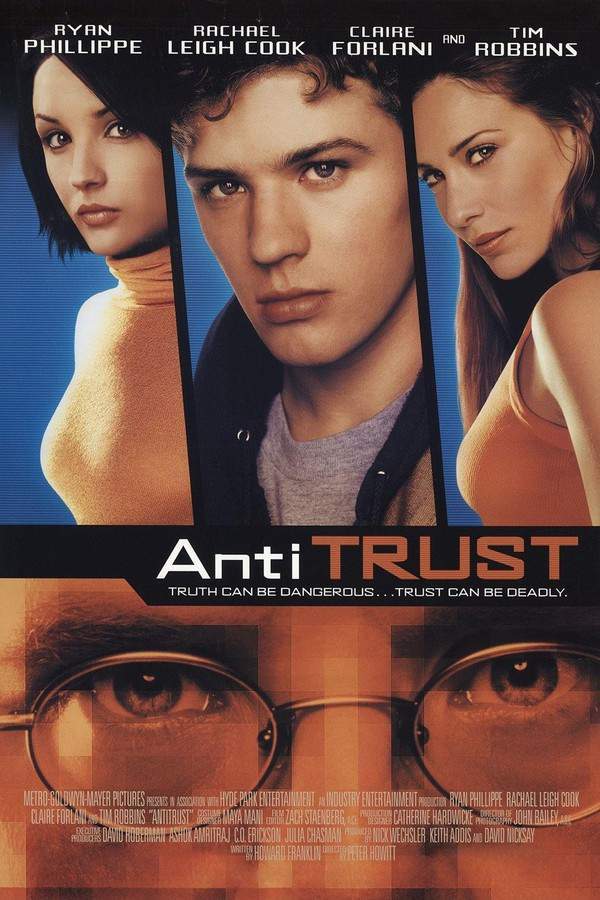
Antitrust 2001

Directed by

Peter Howitt
Made by
MGM Distribution
Where to Watch Antitrust
See current US streaming, rental, and purchase options for Antitrust (2001) via JustWatch.








Antitrust Plot Summary
Read the complete plot summary and ending explained for Antitrust (2001). From turning points to emotional moments, uncover what really happened and why it matters.
Milo Hoffman, a Stanford graduate, works with his three friends at their new software development company, Skullbocks. He is recruited by Gary Winston, the ambitious CEO of the software giant NURV, who offers him a generous salary, near-total creative control, and a permissive working environment. After accepting, Milo and his girlfriend, Alice Poulson, move to NURV’s headquarters in Portland, Oregon.
At the heart of NURV’s ambitions is Synapse, a worldwide media distribution network that appears to be on track. Yet Milo grows uneasy about the pristine source code that Winston personally provides whenever the company needs it, and Winston refuses to reveal where it comes from.
Tragedy strikes when Milo’s best friend and fellow programmer, Teddy Chin, is murdered. He discovers a chilling pattern: NURV is stealing code from programmers around the world—and killing those who stand in their way. The company relies on an expansive surveillance system to monitor and lift ideas, has infiltrated the Justice Department, and even exercises influence over mainstream media. To complicate matters, Milo’s girlfriend is revealed to be a plant, an ex-con hired by NURV to spy on him.
Hidden within a secret NURV database are sensitive dossiers on a friendly coworker, Lisa Calighan. Confronting her about the data, Milo learns she is willing to help expose NURV. He teams with his old start-up friend, Brian Bissel, to hijack Synapse via a local public-access television station and broadcast their charges to the world. But Calighan turns out to be Winston’s accomplice and foils the plan.
As the failed operation unfolds and Winston moves to kill Milo, a backup plan goes into motion. Off-screen, Milo had already persuaded Poulson to turn against NURV; she joins the others—the fourth Skullbocks member—and, with NURV’s incorruptible security contractors, they seize one of the company’s own centers—Building 21—and transmit incriminating evidence using the Synapse code. The plan leads to the arrest of Calighan, Winston, and his entourage by the FBI. In the aftermath, Milo parts ways amicably with the redeemed Poulson and rejoins Skullbocks.
Antitrust Timeline
Follow the complete movie timeline of Antitrust (2001) with every major event in chronological order. Great for understanding complex plots and story progression.
Milo joins Skullbocks and moves to NURV HQ
Milo Hoffman and his three friends run Skullbocks and are recruited by Gary Winston, the CEO of NURV. Milo accepts a lucrative offer that promises a large paycheck, creative control, and a less restricted working environment. He and his girlfriend Alice Poulson relocate to NURV headquarters in Portland, Oregon.
Suspicion about the Synapse code origin
Development of Synapse proceeds on schedule, but Milo grows suspicious of the pristine source code Winston provides. Winston refuses to reveal where the code originated, raising questions about its provenance. Milo senses a deeper conspiracy behind NURV's technical miracle.
Teddy Chin's murder and the theft revelation
Milo's best friend Teddy Chin is murdered, sending shockwaves through the team. Milo discovers that NURV has been stealing code from programmers around the world, including Chin. NURV also employs an extensive surveillance system to observe and extract code, layering deceit on top of the company's image.
Alice Poulson and institutional infiltration
Milo learns that his girlfriend, Alice Poulson, is a plant hired by NURV to spy on and manipulate him. NURV's influence seems to reach the Justice Department and mainstream media, helping cement its grip on information. The crisis reveals how personal relationships are weaponized in the scheme.
Calighan's dossier and alliance with Bissel
Milo uncovers highly sensitive personal information about Lisa Calighan in a secret NURV database. Lisa agrees to help expose NURV's crimes and coordinates with Brian Bissel, Hoffman's old startup friend. They begin plotting a public exposure of NURV's misdeeds.
Plan to hijack Synapse via a local public-access TV station
The group plans to hijack Synapse and use a local public-access television station to broadcast their charges against NURV to the world. Lisa Calighan and Brian Bissel organize the technical and logistical steps to pull it off. The plan hinges on public exposure rather than a covert leak.
Calighan's betrayal foils the plan
Calighan is revealed to be Winston's accomplice, and she sabotages the hijack attempt. The public-exposure plan collapses as Winston's counter-moves tighten the company's control. Milo must pivot to a different strategy to bring NURV to light.
Backup plan set in motion
Off-screen, Milo had previously convinced Poulson to turn against NURV. Poulson joins Skullbocks as the fourth member, and with NURV's incorruptible security contractors they seize Building 21 to mount a new reveal.
Evidence transmitted via Synapse
The group transmits incriminating evidence using the Synapse code, broadcasting NURV's crimes to the world. The operation centers around the compromised Building 21 center and the global reach of Synapse's network.
FBI arrests the conspirators
Calighan, Winston, and their entourage are arrested by the FBI for their crimes. The takedown removes the company's top conspirators and marks a turning point in the battle against NURV's influence.
Poulson's redemption and Hoffman's parting
Alice Poulson is redeemed by turning against NURV, and she remains with Skullbocks. Hoffman and Poulson part ways amicably, with Poulson continuing her work alongside Skullbocks.
Hoffman rejoins Skullbocks
Hoffman recommits to the Skullbocks mission and rejoins the group after the fallout with NURV. The team continues its work to challenge corporate control over technology and information.
Antitrust Characters
Explore all characters from Antitrust (2001). Get detailed profiles with their roles, arcs, and key relationships explained.
Milo Hoffman (Ryan Phillippe)
Stanford graduate recruited by NURV's Gary Winston; he quickly grows suspicious of the source code's origin and gains a moral stake in stopping the theft. As the founder of Skullbocks, he drives the team's efforts to expose NURV while wrestling with personal loyalties.
Gary Winston (Tim Robbins)
CEO of NURV, he exerts absolute control over code, information, and corporate strategy. He uses surveillance, manipulation, and a web of influence to keep competitors and investigators at bay, making him the central antagonist.
Alice Poulson
Milo's girlfriend and a covert plant hired by NURV to spy on him. An ex-con, she manipulates events from behind the scenes but ultimately turns against NURV and joins Skullbocks in the crisis.
Teddy Chin
Milo's best friend and fellow programmer who is murdered as Hoffman's investigation deepens. His death catalyzes Milo's resolve to uncover NURV's crimes.
Lisa Calighan
A friendly coworker with a trove of sensitive personal information about her, whom Milo tries to recruit as an ally. She appears to help expose NURV but is revealed to be Winston's accomplice, foiling Hoffman's plan before the climax.
Brian Bissel
Milo's old startup friend who teams up with Skullbocks to coordinate their counterstrike against NURV. He provides strategic support and helps organize the broadcast scheme.
Antitrust Settings
Learn where and when Antitrust (2001) takes place. Explore the film’s settings, era, and how they shape the narrative.
Location
Portland, Oregon
Portland, Oregon, serves as the corporate backdrop for NURV, a high-profile software company with its headquarters there. The city provides a modern, mid-size urban setting that accommodates sleek campus offices, tech industry ambitions, and a pervasive surveillance culture central to the plot. The film uses Portland's atmosphere of urban progress and secrecy to underscore the tension between innovation and exploitation.
Antitrust Themes
Discover the main themes in Antitrust (2001). Analyze the deeper meanings, emotional layers, and social commentary behind the film.
🔍
Surveillance
Surveillance is a pervasive force in the film, enabling NURV to monitor and extract valuable code from programmers worldwide. The company demonstrates how data collection extends beyond work, intruding into personal lives and legal institutions. Hoffman's discovery of dossiers on Lisa Calighan exposes the extent of corporate spying. The public-broadcast plan leverages surveillance artifacts to expose wrongdoing, highlighting the dangers of unchecked monitoring.
💼
Ethics
Ethics is compromised as NURV consolidates power through stolen code and manipulated talent. Hoffman's trust is betrayed when colleagues are revealed as pawns, revealing a culture that prioritizes profit over people. The film questions who benefits from breakthrough technology when legal systems and media can be bent to corporate interests. Ultimately, the pursuit of ethical tech clashes with ruthless competition.
🛡️
Resistance
Hoffman and his allies mount a covert resistance against NURV's control of information. The plan to hijack Synapse and broadcast charges against the company demonstrates how whistleblowing and alliance-building can challenge corporate tyranny. Alice Poulson's turn against NURV and the Skullbocks’ actions expose the fragile line between ally and adversary. The FBI arrest of key figures marks the turning point toward accountability.

Coming soon on iOS and Android
The Plot Explained Mobile App
From blockbusters to hidden gems — dive into movie stories anytime, anywhere. Save your favorites, discover plots faster, and never miss a twist again.
Sign up to be the first to know when we launch. Your email stays private — always.
Explore the mobile appAntitrust Spoiler-Free Summary
Discover the spoiler-free summary of Antitrust (2001). Get a concise overview without any spoilers.
In the gleaming halls of a Silicon‑valley‑style powerhouse, Milo Hoffman arrives fresh from a modest startup, clutching the optimism of a new graduate and the thrill of a lucrative offer. The company, a titan of software innovation, promises not only a generous salary but also an almost limitless playground for creative ideas. Its campus hums with the low‑frequency buzz of servers and the quiet confidence of a team that believes it can reshape how the world consumes information.
The charismatic founder, Gary Winston, is the sort of visionary who commands respect with a magnetic blend of charisma and ambition. Under his watch, the firm projects an image of futuristic idealism—open offices, flexible schedules, and a culture that seems to celebrate the very spirit of invention. Yet amidst the polished presentations and sleek product demos, there’s an undercurrent of secrecy that makes even the most enthusiastic engineers pause, sensing that the bright veneer may conceal more complex motives.
As Milo settles into this high‑stakes environment, he is pulled between his own drive to create and the subtle pressures of an industry where power and innovation are tightly intertwined. The presence of his girlfriend, Alice Poulson, adds a personal dimension to his quest for belonging, while his old friends from the startup world linger in his thoughts as reminders of a different kind of freedom. The film balances the intoxicating allure of cutting‑edge technology with a growing unease, inviting viewers to wonder how far one will go when the line between ambition and ethical compromise begins to blur.
Featured on this page

What's After the Movie?
Not sure whether to stay after the credits? Find out!
Check out our other apps:

SAT Sphere
Build confidence for the Digital SAT.

Mori Atlas
Discover wild places worth protecting.

Luntero
Search smarter for a home in Amsterdam.

Plot Explained
Unravel movie endings and hidden clues.

Pokechamp
Dive into Pokémon data and battle logic.

Driving Theory
Get ready for your European theory test.

Movie Dust
Plan your next cinema trip with ease.

Musemap
Find art and culture as you travel.

Selkobase
Compare credentials before committing.

Local Manual
Turn an unfamiliar country into practical next steps.

Lernavi
Compare school systems before your next move.

GymRoam
Find a workout stop wherever your plans take you.
Explore Our Movie Platform
New Movie Releases (2026)
Famous Movie Actors
Top Film Production Studios
Movie Plot Summaries & Endings
Major Movie Awards & Winners
Best Concert Films & Music Documentaries
Movie Collections and Curated Lists
© 2026 What's After the Movie. All rights reserved.
Privacy Policy