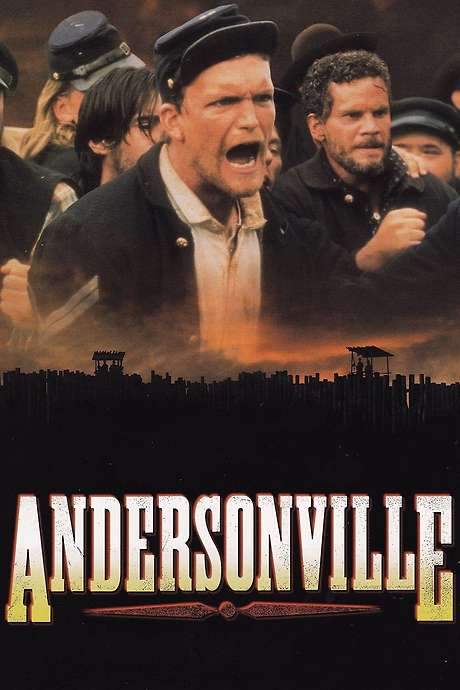
Andersonville 1996

Directed by

John Frankenheimer
Made by

Gideon Productions
Where to Watch Andersonville
See current US streaming, rental, and purchase options for Andersonville (1996) via JustWatch.


Streaming availability powered by 
Andersonville Plot Summary
Read the complete plot summary and ending explained for Andersonville (1996). From turning points to emotional moments, uncover what really happened and why it matters.
In June 1864, a group of soldiers from Company I, 19th Massachusetts Infantry Regiment are captured at the Battle of Cold Harbor in Virginia and transported by train to Georgia, where they march to the harsh military prison known as Camp Sumter. At the gate, Col. Chandler, William H. Macy, commands with a steady, imposing presence, while Captain Henry Wirz Jan Tříska runs the camp with a rigid, calculating calm. Wirz outlines the grim reality: escape is nearly impossible thanks to his scent hounds, and a prisoner exchange is anticipated but far from certain. The newcomers quickly sense the bleak odds and the oppressive mood that will define their stay.
Early on, the prisoners cross paths with Dick Potter Gregory Sporleder, a former comrade captured at Antietam, who becomes a wary mentor of sorts. Potter has seen the worst the camp has to offer and warns them about the Raiders, a ruthless faction of internees who prey on the vulnerable to hoard supplies. He pulls back the veil on the camp’s harsh reality: there is barely enough shelter, water, and food to go around, and the guards include teenagers and older men who take grim delight in coercing prisoners toward the dangerous “dead line” and then shooting them as a warning. The atmosphere is tense, with Wirz’s tight control balancing on a knife edge as a Confederate Colonel audits the operation and chastises Wirz for the squalor, a moment Wirz greets with deflection and a quiet request for a promotion recommendation.
A stubborn group of prisoners from the 19th Massachusetts aligns with other internees who are secretly digging a tunnel beneath the stockade wall. The plan is perilous and nearly clandestine, but the work progresses as the tunnel nears completion. Then the Raiders strike, and Potter is killed in a brutal flare of violence. One prisoner attempting to inform the guards in hopes of a reward is seized, and the taunting stigma of “TT”—tunnel traitor—carved into his forehead marks the price of betrayal and fear. Despite the danger, the tunnel is completed, and the escape unfolds with a mix of courage and catastrophic losses; most who attempt it are killed or captured, and a portion are punished by standing stocks as a brutal reminder of the consequences of resistance.
The escalating tension within the camp erupts into a riot as disparate prisoner groups rally to challenge the Raiders. A makeshift court is proposed to address the raiders’ leadership, and Captain Wirz approves an internal, prisoner-run trial. A jury of fellow internees convicts the six Raider chiefs to death by hanging, while the lower-ranking raiders face a brutal gauntlet as punishment. With the Raiders’ power diminished, life inside Camp Sumter briefly relaxes into a fragile order.
As time passes, new internees arrive with tales of another escapee who reached General Grant, who then rejects any broader prisoner exchange due to the Confederacy’s treatment of Black Union soldiers. The camp’s morale shifts as a Confederate officer arrives with a blunt offer: fight for the Confederacy in exchange for freedom. The men of the 19th Massachusetts, along with others, stand in formation, turn their backs, and refuse the deal—an act of solidarity that signals a deeper resolve to endure.
Yet the toll of hunger, disease, and the rigors of confinement grows heavier. Starvation compounds the dwindling supplies, and thousands never leave the prison walls. Eventually, Captain Wirz announces that an exchange will proceed, and the surviving prisoners begin to depart Camp Sumter, filing past their fallen comrades on the way to the trains that will carry them away. The film closes with a somber coda set against the present-day Andersonville National Cemetery, a stark reminder of the lives lost and the enduring memory of those who endured the camp’s horrors.
Andersonville Timeline
Follow the complete movie timeline of Andersonville (1996) with every major event in chronological order. Great for understanding complex plots and story progression.
Capture at Cold Harbor and transport to Camp Sumter
In June 1864, soldiers from Company I, 19th Massachusetts Infantry are captured at the Battle of Cold Harbor in Virginia. They are transported by train to Georgia and marched toward Camp Sumter, facing an uncertain future in captivity. The event marks the start of a brutal period of imprisonment and hardship.
Wirz’s warning: escape is impossible
Upon arrival, Confederate Captain Henry Wirz explains that escape is unlikely due to his scent hounds and that a prisoner exchange might occur soon. He warns the new arrivals to accept their fate and conform to the camp’s grim rules. The prisoners begin to grasp the severity of their situation.
Meeting Dick Potter and learning the lay of the camp
The men encounter Dick Potter, a former comrade who was captured at Antietam. He warns them about the Raiders, a rogue group that raids, robs, and sometimes kills newcomers to hoard supplies. Potter paints a bleak picture of daily life in the camp.
Harsh conditions and taunting guards
The prisoners face minimal shelter, unsafe drinking water, and scarce food. Guards are often teenagers or old men who taunt detainees and lure them toward the 'dead line' fence, where some are shot for attempting to trade for food. The environment is carefully engineered to break morale.
A secret tunnel takes shape
A group of men from the 19th Massachusetts partners with others to work on a secret tunnel beneath the stockade wall. They hope the tunnel will provide a route to freedom, despite constant danger and the risk of discovery. The project binds prisoners together in a desperate plan.
Raiders attack; Potter is killed; TT is carved
The Raiders launch a brutal attack and Potter is killed, intensifying the prisoners' fear and distrust. A fellow inmate who tries to inform the guards is captured and branded with TT for tunnel traitor. The camp’s internal tensions escalate as security deteriorates.
The tunnel is completed and the escape begins
The tunnel project reaches completion and the escape commences. Most escapees succeed, but many are killed or recaptured and punished, with some prisoners placed in standing stocks as a deterrent. The escape disrupts the Raiders’ control and reshapes camp dynamics.
Prison riot and downfall of the Raiders
Discontent over the Raiders' brutality culminates in a prison riot. The disparate groups rally against the Raiders, ultimately defeating and capturing their leaders. The balance of power within the camp shifts in the aftermath.
Internal court-martial and brutal punishments
Concerns about Raider leadership lead to a request for a legitimate court-martial. Wirz allows a jury of new internees to preside and convict six Raider chieftains of death by hanging, while lower-ranking Raiders are sentenced to run a gauntlet. The sentencing underscores the camp’s harsh sense of justice.
News from Grant and a fragile peace
Life in the camp stabilizes briefly as new internees arrive and one escapee reaches General Grant, who informs that no further prisoner exchanges will occur due to the Confederacy’s treatment of black Union soldiers. The prisoners realize they are trapped in a larger strategic stalemate. The sense of hope flickers but remains fragile.
Deal offered to fight for freedom
A Confederate officer offers the prisoners a deal: fight for the Confederacy to earn their freedom. The proposal is framed as a path to release, tempting some but provoking moral and strategic debate among the men. The offer exposes the shifting calculus of survival inside the camp.
Resistance and unity against surrender
The prisoners, led by the 19th Massachusetts and other groups, turn their backs on the officer, rejecting the idea of fighting for the Confederacy in exchange for freedom. Their act of solidarity reinforces a collective refusal to cooperate with their captors. The stance solidifies a sense of shared purpose among the internees.
Desperation grows; starvation and disease take toll
As time wears on, conditions worsen and starvation and disease spread through the camp. Thousands perish before any meaningful resolution emerges. The toll on the prisoners becomes a central, heartbreaking thread of the story.
Final exchange ordered; survivors depart
Captain Wirz announces that all prisoners are to be exchanged, and the surviving internees begin to march toward the trains. They file past their fallen comrades and their memories as they leave the brutal site behind. The departure marks the nearing end of their ordeal.
Coda at Andersonville National Cemetery
The film closes with a view of the present-day Andersonville National Cemetery, underscoring the human cost of the war’s prison camps. A final coda reflects on the fate of those who endured Camp Sumter and the broader tragedy of Andersonville. The memory of the prisoners anchors the closing note.
Andersonville Characters
Explore all characters from Andersonville (1996). Get detailed profiles with their roles, arcs, and key relationships explained.
Col. Chandler (William H. Macy)
A senior Union officer among the 19th Massachusetts prisoners, Chandler navigates leadership under extreme stress. He balances practical command with concern for his men's welfare as the camp's conditions worsen.
Capt. Henry Wirz (Jan Tříska)
The Confederate camp commandant who justifies brutal conditions with bureaucratic rhetoric while facing pressure from within and from the prisoners. He embodies the cold logic that enables cruelty in war.
Dick Potter (Gregory Sporleder)
A former comrade who adds tension by warning against the Raiders but becomes a symbol of how fear and self-preservation influence prisoner dynamics. His presence shapes decisions and loyalties.
Sgt. McSpadden (Frederic Forrest)
A sergeant within the prisoner group who upholds military order while contending with the camp's chaos. He represents the daily grind of discipline under hopeless conditions.
Hopkins (Carmen Argenziano)
A prisoner who participates in the social structure of the camp, his actions contribute to the negotiation of power and the enforcement of rules among inmates.
Munn (William Sanderson)
An inmate who embodies the stubborn resilience of prisoners who endure starvation, disease, and the daily threat of violence. He represents the ordinary man under extraordinary circumstances.
Andersonville Settings
Learn where and when Andersonville (1996) takes place. Explore the film’s settings, era, and how they shape the narrative.
Time period
June 1864
Set during the early summer of 1864, amid the waning years of the Civil War. Prisoners endure deteriorating conditions as resources dwindle and disease spreads. The narrative frames a critical moment when prisoner exchanges are debated, reflecting the broader war policy and its human cost.
Location
Cold Harbor, Virginia, Camp Sumter (Andersonville), Georgia
The film shifts from the battlefield near Cold Harbor in Virginia to the brutal POW camp at Camp Sumter in Andersonville, Georgia. It shows the stark geography of Civil War captivity: barren grounds, minimal shelter, and scarce clean water. The setting underscores the contrast between battlefield heroism and the grim realities of captivity.
Andersonville Themes
Discover the main themes in Andersonville (1996). Analyze the deeper meanings, emotional layers, and social commentary behind the film.
🕯️
Survival & Morality
In Camp Sumter, prisoners improvise for survival—tunnels, scavenged food, and wary alliances—while facing choices that test their ethics. The film probes how desperation can push individuals toward both solidarity and treachery. It shows the fragile balance between human dignity and the will to endure.
⚖️
Justice & Power
Internal orders, executions of Raiders, and the interaction with Wirz reveal how authority can mask brutality under the veneer of procedure. The story questions what constitutes true justice within a crumbling system of wartime captivity.
🪜
Escape & Rebellion
The secret tunnel and the riot embody a collective instinct to resist oppression. The prisoners' attempts at escape become acts of moral rebellion as groups push back against dehumanizing rules.
🕊️
Memory & Cost
The closing scenes, with the cemetery and the note about prisoner exchanges, connect the prisoners' suffering to historical memory. The film reflects on the lasting human and national costs of the Civil War and the memory of those who did not return.

Coming soon on iOS and Android
The Plot Explained Mobile App
From blockbusters to hidden gems — dive into movie stories anytime, anywhere. Save your favorites, discover plots faster, and never miss a twist again.
Sign up to be the first to know when we launch. Your email stays private — always.
Explore the mobile appAndersonville Spoiler-Free Summary
Discover the spoiler-free summary of Andersonville (1996). Get a concise overview without any spoilers.
In the summer of 1864, a band of Union soldiers from the 19th Massachusetts Infantry are swept from the brutal clash at Cold Harbor and herded northward to a remote outpost in Georgia. Their destination is Camp Sumter—later known as Andersonville—where the stark landscape of pine and mud gives way to a sprawling, barbed‑wire prison that swallows hope as easily as it does men. At the gate, Col. Chandler commands with an unshakable steadiness, while the camp’s overseer, Captain Henry Wirz, watches the influx with a quiet calculation that hints at the grim logistics that will shape every day behind the fences.
Inside the walls, the new arrivals quickly learn that survival is a collective effort as much as a personal battle. Private Josiah Day arrives with a fresh‑off‑the‑line optimism that is tempered by the stark reality of cramped quarters, meager rations, and the ever‑present threat of disease. Beside him, his Sergeant becomes the glue holding their dwindling company together, offering quiet leadership amid the endless murmur of hungry men. Among the inmates, a self‑organized group known simply as the Raiders preys on the vulnerable, turning the camp’s already fragile social contract into a delicate, tense dance. The daily rhythm is punctuated by the clang of metal, the shouts of guards, and the whispered plans of prisoners trying to carve out a sliver of dignity.
The film settles into a hushed, oppressive tone, allowing the oppressive atmosphere of Andersonville to seep into every frame. Light filters through broken roofs, casting long shadows over rows of tin‑clad barracks, while the wind carries the faint echo of distant artillery—reminders that the war rages beyond the barbed wire. As Dick Potter, a weathered veteran of earlier battles, shares the unvarnished truth of camp life, Day and his comrades confront the stark choices that define loyalty, resilience, and the human spirit when confronted with relentless hardship. The story lingers on the uneasy balance between hope and surrender, inviting viewers to feel the weight of history without revealing the outcomes that lie ahead.
Movies with Similar Twists and Themes
Uncover films that echo the narrative beats, emotional arcs, or dramatic twists of the one you're exploring. These recommendations are handpicked based on story depth, thematic resonance, and spoiler-worthy moments — perfect for fans who crave more of the same intrigue.




Featured on this page

What's After the Movie?
Not sure whether to stay after the credits? Find out!
Check out our other apps:

SAT Sphere
Build confidence for the Digital SAT.

Mori Atlas
Discover wild places worth protecting.

Luntero
Search smarter for a home in Amsterdam.

Plot Explained
Unravel movie endings and hidden clues.

Pokechamp
Dive into Pokémon data and battle logic.

Driving Theory
Get ready for your European theory test.

Movie Dust
Plan your next cinema trip with ease.

Musemap
Find art and culture as you travel.

Selkobase
Compare credentials before committing.

Local Manual
Turn an unfamiliar country into practical next steps.

Lernavi
Compare school systems before your next move.

GymRoam
Find a workout stop wherever your plans take you.
Explore Our Movie Platform
New Movie Releases (2026)
Famous Movie Actors
Top Film Production Studios
Movie Plot Summaries & Endings
Major Movie Awards & Winners
Best Concert Films & Music Documentaries
Movie Collections and Curated Lists
© 2026 What's After the Movie. All rights reserved.
Privacy Policy