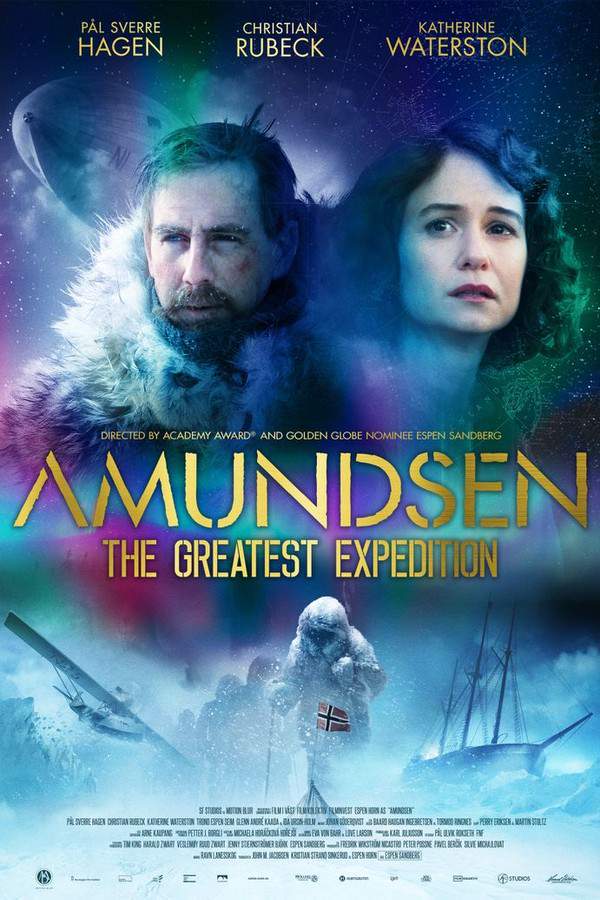
Amundsen: The Greatest Expedition 2021


Directed by

Espen Sandberg
Made by

Samuel Goldwyn Films
Where to Watch Amundsen: The Greatest Expedition
See current US streaming, rental, and purchase options for Amundsen: The Greatest Expedition (2021) via JustWatch.

Amazon Prime Video
HD
Amazon Prime Video with Ads
HD
Hoopla
SD
Kanopy
HD
Plex
HD
Plex Channel
HD
The Roku Channel
HD
Tubi TV
SD
Amazon Video
SD
Apple TV Store
HD
Fandango At Home
SD
Google Play Movies
SD
YouTube
SDStreaming availability powered by 
Amundsen: The Greatest Expedition Plot Summary
Read the complete plot summary and ending explained for Amundsen: The Greatest Expedition (2021). From turning points to emotional moments, uncover what really happened and why it matters.
In a fierce Arctic storm, the elderly Roald Amundsen crashes his plane, stranding him and a small group of companions. As the world assumes he has perished, his brother Leon Amundsen recounts the explorer’s life to Roald’s Alaskan lover, Bess Magids, weaving together memory and myth to keep his legacy alive. The tale moves between past and present, letting Roald hear again the choices that defined a career built on daring and doubt.
From boyhood fascination to fearless exploration, Roald and Leon are drawn to the poles on a globe, their imaginations sparked by the unknown at the world’s edge. As young men they push into the Northwest Passage, charting a course that earns respect even as some peers question the cost. Among the voices of the era, their ambition stands out: a stubborn blend of scientific curiosity and a hunger for achievement. The film quietly situates these early impulses against a backdrop of competing heroics and the political currents of the era, painting a portrait of a man who could be both genius and too quick to take risks.
When the chance arises to join a race to the North Pole, Amundsen and his team secure funding by pledging that science will take precedence over speed. News arrives that Frederick Cook has claimed the Pole, a claim many dismiss as dubious but enough to unsettle his plans. Rather than chase an unproven triumph, Roald contemplates the South Pole, a bold pivot kept close to the chest until the moment of departure. In 1910 he reveals the truth to his crew, and a formal letter to the King signals that a promised scientific expedition to the North may still come to pass. The expedition to Antarctica follows, where Roald’s relentless drive to advance knowledge appears reckless to some and inspirational to others.
In the frozen continent, Roald dismisses some crew members who doubt his methods, while the rest press on and eventually reach the Pole. They plant a Norwegian flag and leave a courteous note for Scott, a gesture that stirs mixed reactions back home. In Europe, the memory of Scott’s obituary-like heroism contrasts with a widely held view of Amundsen as something of an ungentlemanly trickster. Yet Roald finds a warmer welcome in Norway, where his personal life with Kiss Bennett Kiss Bennett brings a fragile normalcy to the storm of his public reputation. That balance is interrupted when he learns he must honor his promise to sail toward the North Pole by drifting on sea ice, a demand that unsettles his colleagues and tests his resolve.
Three years into a five-year mission, Roald abandons his shipmates and heads to Alaska, chasing a new, almost quixotic dream: to fly to the Pole. The pursuit inflames his brother Leon, who struggles with the expense and the risk of such a journey. Eventually Roald’s dream overtakes the old plan and catastrophe follows—a plane crash that eerily mirrors the opening scene and seems to seal the circle of his adventures. Yet Roald and his copilots salvage something of a return, building a makeshift runway and making it home to Norway to a public that both celebrates and questions him. Leon and Bess experience relief, even as Roald staunchly resists reconciliation with his brother while proposing marriage to Bess, who agrees to wed him only after he reaches the North Pole, a goal he achieves in a dramatic moment aboard Umberto Nobile’s airship.
Back on solid ground, Roald publishes an autobiography that many find blunt and abrasive, further alienating some supporters even as it solidifies his place in history. In a final, desperate bid to repair his standing, he sets out to rescue Nobile, whose airship has crashed in a storm. The rescue mission culminates in another plane crash, the very moment the film opened on—yet this time Roald’s fate is sealed. In the quiet aftermath, Leon smashes the glass Earth globe they once admired as children, a small, aching gesture of closure that underscores the bittersweet truth at the heart of Amundsen’s legend: ambition can carry a life to grand heights and dark depths alike.
- Bess Magids plays a pivotal emotional bridge between Roald’s private life and his public feats, offering a steadying counterpoint to his volatile career.
- Leon Amundsen remains a constant chorus in Roald’s life, his memory guiding the narration and shaping the storytelling frame as the audience watches decades unfold.
- Kiss Bennett embodies the personal cost of a life spent chasing impossible horizons, providing intimate moments that ground the larger-than-life journey in human connection.
- Sverre Hassel and Helmer Hanssen appear as colleagues whose fates mirror the film’s themes of loyalty, risk, and resilience in the face of uncertainty.
This cinematic portrait blends archival ambition with intimate relationships, tracing how a charted life becomes a deeply personal saga. It invites viewers to weigh the price of pioneering spirit against the glow of achievement, inviting reflection on what it means to chase the Pole—and what must be left behind when a life’s work demands everything.
Amundsen: The Greatest Expedition Timeline
Follow the complete movie timeline of Amundsen: The Greatest Expedition (2021) with every major event in chronological order. Great for understanding complex plots and story progression.
Childhood dream of the poles
As boys, Roald Amundsen and his brother Leon are spellbound by poles on a globe and imagine distant lands beyond the map. They feed each other's curiosity, dreaming of grand expeditions that will cement Norway's legacy. This early fascination seeds a lifelong quest to reach both the North and South Poles.
Pioneering the Northwest Passage
As young men they push to chart a route through the Northwest Passage, facing skepticism from rivals who doubt such a voyage is possible. The effort blends exploration with national pride and hard-won endurance. They endure hardships and sharpen their resolve to push further north.
Science over speed: North Pole race plan
They secure funding by promising to prioritize scientific study over speed in the race to the North Pole. The unproven claim of Frederick Cook reaching the Pole unsettles Roald and reframes their mission. The plan edges toward a more measured, science-driven expedition.
Pivot to the South Pole revealed to the crew
In 1910, Roald reveals to his crew that the expedition will pivot from the North Pole to the South Pole. The crew accepts the change with support, understanding the scientific aims; they prepare for a grueling journey across Antarctica. The decision marks a significant shift in their overarching agenda.
South Pole expedition and flag planting
The Antarctic expedition reaches its goal when Amundsen's team arrives at the South Pole. They plant the Norwegian flag and leave a courteous note for Scott, signaling a historic achievement. The triumph brings both national pride and complex scrutiny back home.
Reception in Europe and in Norway
Back in Europe, Scott is lionized as a hero while Amundsen is treated with a more skeptical eye by some. In Norway, Amundsen gains warmer public support but struggles with the pressure of his North Pole commitment. The contrasting receptions underscore his complicated legacy.
Three years into a five-year drift toward the North Pole
Three years into the proposed five-year mission, Amundsen abandons his crewmates to pursue the Pole by air from Alaska. He treats the expedition as a personal, expensive undertaking rather than a shared scientific project. The move strains family ties, especially with his brother Leon.
Alaska chase and the crash that follows
Roald and his copilots attempt a daring flight toward the Pole and crash in Alaska. They survive by building a makeshift runway, then manage to return to Norway under a cloud of controversy and risk. The episode deepens his reputation as a fearless yet divisive figure.
North Pole achieved on an ice-and-air expedition
Roald returns to Norway to a cautious yet growing admiration as his Pole dream evolves into a historic achievement aboard Umberto Nobile's airship Italia. He finally reaches the North Pole, fulfilling a lifelong ambition while attracting new debates about leadership and ethics.
Autobiography and the rescue mission
He publishes an undiplomatic autobiography that alienates many supporters and fuels controversy. He then goes on a rescue mission to save Nobile after his airship crashes in a storm, pushing himself to the limit once more.
The final crash and the globe-smashing ending
During the rescue attempt, Amundsen's plane crashes, and the film reveals this crash as the opening scene. Believing Roald is dead, Leon returns home with Bess and smashes the glass Earth globe they once admired as boys, a bittersweet end to their shared dream.
Amundsen: The Greatest Expedition Characters
Explore all characters from Amundsen: The Greatest Expedition (2021). Get detailed profiles with their roles, arcs, and key relationships explained.
Roald Amundsen (Pål Sverre Hagen)
A legendary explorer whose shrewd planning and stubborn will push him from childhood curiosity about the poles to the brink of triumph and tragedy. His strategic mind is matched by a single-minded drive that sometimes strains personal relationships. The film traces his evolution from curious youth to a complex, world-famous figure whose methods spark both awe and controversy.
Leon Amundsen (Christian Rubeck)
Roald’s brother, a steady counterpoint to Roald’s relentless pursuit. He serves as the narrator who frames Roald’s life for the audience and anchors the human cost behind the legend. Loyal but wary of the price of Roald’s ambitions, he embodies family loyalty amid monumental journeys.
Bess Magids (Katherine Waterston)
Roald’s Alaskan lover who grounds the story in a personal, emotional dimension. Her presence highlights the private life that persists alongside global ambitions and public achievement. She represents memory, longing, and the human cost of a life spent chasing the edge of the map.
Kiss Bennett (Ida Ursin-Holm)
Roald’s later partner whose involvement underscores shifting loyalties and the enduring appeal of romance amid peril. Her role adds emotional texture to the later chapters of the explorer’s life.
Hjalmar Johansen (Fridtjov Såheim)
A steadfast crew member whose practical skills and resilience help anchor the expedition through extreme conditions. He embodies the crew’s camaraderie and the moral complexity of long-duration exploration.
Oscar Wisting (Glenn Andre Kaada)
A trusted companion in the perilous journey, contributing to the expedition’s survival and the dynamics of the team. His steadiness under pressure reflects the importance of dependable allies.
Sverre Hassel (Kenneth Åkerland Berg)
An expedition colleague whose presence emphasizes the collective risk of pushing into uncharted polar territory. His role highlights group decision-making and shared peril.
Helmer Hanssen (Mads Sjøgård Pettersen)
A key crew member handling logistics and endurance in the brutal environment. His experience helps navigate the expedition’s most trying moments and keeps the group moving forward.
Fridtjof Nansen (Trond Espen Seim)
A legendary polar figure whose presence anchors the film’s historical scope and ethical debates. He provides a philosophical lens on exploration and the responsibilities of trailblazers.
Aline Amundsen (Ruby Dagnall)
Aline Amundsen appears within Amundsen’s circle, connecting personal life to the explorer’s feats. Her role adds emotional texture to the broader story and the personal stakes of Roald’s adventures.
Amundsen: The Greatest Expedition Settings
Learn where and when Amundsen: The Greatest Expedition (2021) takes place. Explore the film’s settings, era, and how they shape the narrative.
Time period
Early 20th century (1910s–1920s)
The film sits in the era of heroic polar exploration. It follows the 1910 South Pole expedition and the shift toward a science-forward approach, then tracks the ambitious North Pole pursuit and the rise of aviation as a tool of exploration. The period is defined by rivalries, imperial prestige, and shifting public perception of Amundsen’s methods. The narrative spans youth to glory and tragedy, culminating in a perilous rescue mission and its aftermath.
Location
Arctic, Alaska, Antarctica, Norway
The story unfolds across polar landscapes, with key action in Alaska, Antarctica, and Norway. It opens amid an Arctic storm and a dramatic plane crash that strands Amundsen and his companions. The narrative moves from ice-bound expeditions to Norwegian shores, weaving in scenes of Alaska with Roald’s lovers and the harsh camps of Antarctic exploration. The icy environment and remote stations shape the risks, decisions, and personal stakes at the heart of the voyage.
Amundsen: The Greatest Expedition Themes
Discover the main themes in Amundsen: The Greatest Expedition (2021). Analyze the deeper meanings, emotional layers, and social commentary behind the film.
❄️
Science vs Glory
Amundsen’s drive for scientific discovery sits against the lure of national pride and personal fame. The film emphasizes decisions that favor data, method, and safety over flashy speed. This tension plays out on both the ground in Antarctic camps and in the sky during aviation dreams. The struggle between rigorous exploration and heroic spectacle drives much of the emotional and ethical arc.
🧭
Legacy & Reputation
Amundsen is celebrated by some and scrutinized as ungracious by others, highlighting how memory can be contested. Public perception in Europe contrasts with the more forgiving reception in Norway, illustrating how national narratives shape a explorer’s legacy. His autobiographical ambitions and dramatic rescues further complicate how posterity judges his choices. The film shows how reputation can both illuminate and distort a life’s achievements.
🛩️
Obsession & Risk
A relentless impulse to reach the North Pole drives Amundsen toward extraordinary risks, including daring aviation schemes. The narrative paints the fine line between innovation and recklessness, with crew safety ceding ground to ambition. The opening crash and the final rescue attempt reveal how obsession can loop back to confront its own consequences. Throughout, ambition and danger are inextricably linked.

Coming soon on iOS and Android
The Plot Explained Mobile App
From blockbusters to hidden gems — dive into movie stories anytime, anywhere. Save your favorites, discover plots faster, and never miss a twist again.
Sign up to be the first to know when we launch. Your email stays private — always.
Explore the mobile appAmundsen: The Greatest Expedition Spoiler-Free Summary
Discover the spoiler-free summary of Amundsen: The Greatest Expedition (2021). Get a concise overview without any spoilers.
In the frozen chaos of the early twentieth‑century Arctic, a world of uncharted ice and relentless wind becomes the backdrop for a singular obsession. The film follows the relentless pursuit of a legendary explorer, Roald Amundsen, whose yearning to claim the North Pole drives him to the edge of human endurance. The stark, merciless landscape mirrors his inner turmoil, turning every gust of wind and creaking ice shelf into a reminder of the thin line between triumph and disaster.
Amid the icy expanse, Roald is not alone in his quest. His older brother, Leon, serves as both confidant and chronicler, providing a grounded perspective that contrasts sharply with the explorer’s soaring ambitions. Their shared childhood fascination with the poles—once a simple wonder on a globe—now fuels a tense, affectionate rivalry that examines how family ties survive under the weight of monumental goals.
The narrative also weaves in Bess Magids, an Alaskan lover whose presence introduces an intimate counterpoint to the grand scale of exploration. Their relationship adds layers of vulnerability and longing, suggesting that love itself can become both anchor and propulsion in the face of unforgiving nature. The film’s tone oscillates between awe‑inspiring grandeur and quiet introspection, inviting viewers to feel the crushing isolation of the polar frontier while contemplating the psychological cost of chasing a dream that demands total sacrifice.
Through meticulous period detail and a breath‑taking visual palette, the story immerses the audience in a world where scientific curiosity, national pride, and personal ambition collide. It poses a timeless question: how far will one go when the horizon is both a promise of eternal glory and an abyss of unyielding cold? The answer lingers in the frozen air, waiting to be uncovered.
Movies with Similar Twists and Themes
Uncover films that echo the narrative beats, emotional arcs, or dramatic twists of the one you're exploring. These recommendations are handpicked based on story depth, thematic resonance, and spoiler-worthy moments — perfect for fans who crave more of the same intrigue.

Featured on this page

What's After the Movie?
Not sure whether to stay after the credits? Find out!
Check out our other apps:

SAT Sphere
Build confidence for the Digital SAT.

Mori Atlas
Discover wild places worth protecting.

Luntero
Search smarter for a home in Amsterdam.

Plot Explained
Unravel movie endings and hidden clues.

Pokechamp
Dive into Pokémon data and battle logic.

Driving Theory
Get ready for your European theory test.

Movie Dust
Plan your next cinema trip with ease.

Musemap
Find art and culture as you travel.

Selkobase
Compare credentials before committing.

Local Manual
Turn an unfamiliar country into practical next steps.

Lernavi
Compare school systems before your next move.

GymRoam
Find a workout stop wherever your plans take you.
Explore Our Movie Platform
New Movie Releases (2026)
Famous Movie Actors
Top Film Production Studios
Movie Plot Summaries & Endings
Major Movie Awards & Winners
Best Concert Films & Music Documentaries
Movie Collections and Curated Lists
© 2026 What's After the Movie. All rights reserved.
Privacy Policy